
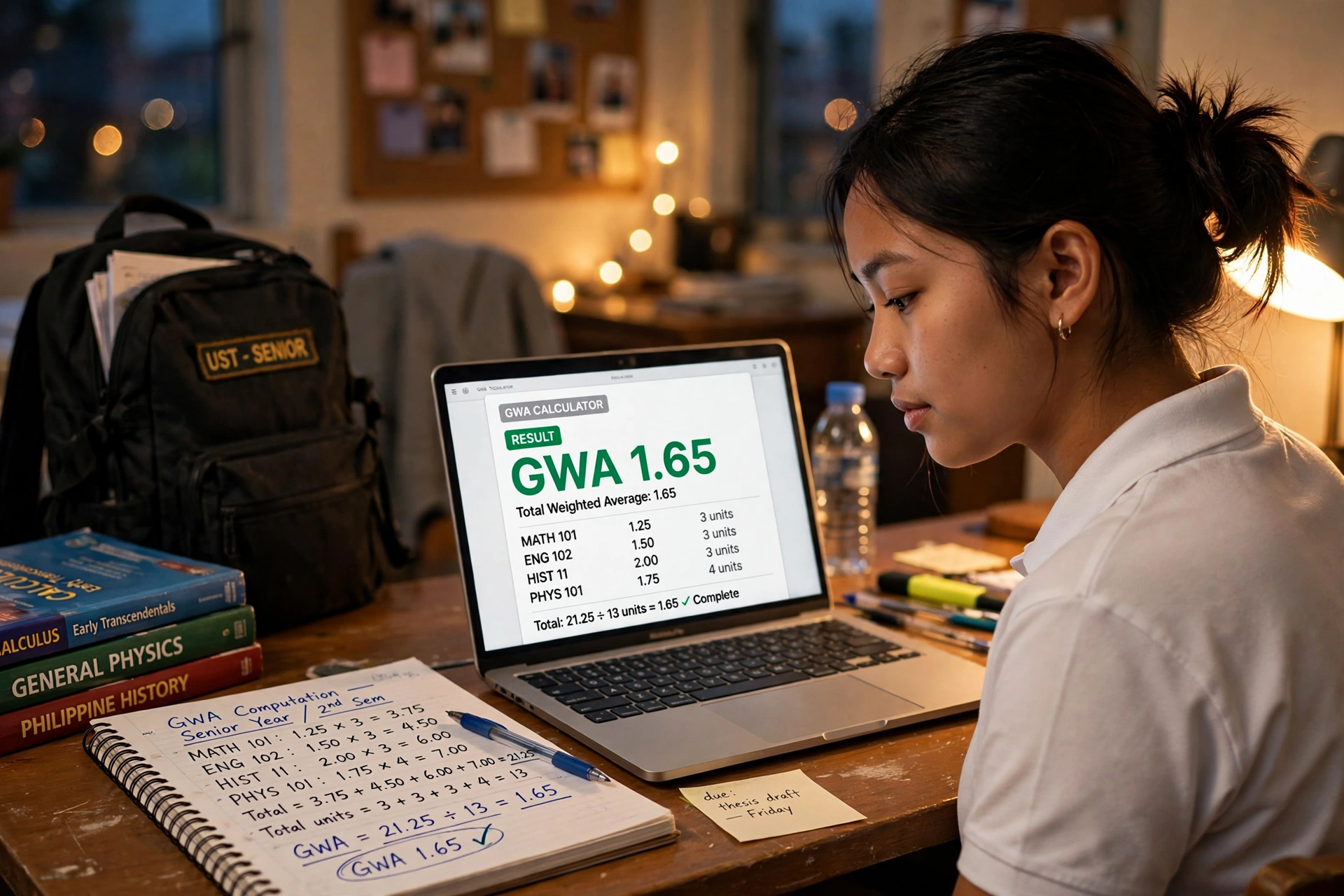
GWA for Senior Students Philippines 2026
If you are in fourth year, the gwa for senior students philippines is no longer a number you check out of curiosity. It is the number your registrar will print on your transcript of records, the number that decides whether you walk across the stage with Latin honours, and the first number an employer or a graduate school will ask for before they ask anything else. The arithmetic has not changed since first year — grade times units, add them up, divide by total units — but everything around it has. Your senior year is the last 40 units of a 169-unit degree, which means it can still move your final GWA, but only inside limits that are now fixed by arithmetic rather than by effort alone. A senior who starts the year at 1.70 cannot reach Magna Cum Laude even with a perfect 1.00 in every remaining subject. The same senior can still reach Cum Laude at UP, can still miss it at PUP by five hundredths, and can still lose it entirely over a single failed thesis — and this guide works out every one of those cases with real numbers, run through this site’s own calculator code before a single figure was written down: 40 test cases, 40 passed, including the exact boundary case for every cutoff in the guide.
GWA for Senior Students Philippines: The Short Answer
Fourth year is the year every gate you have been walking toward finally closes behind you. Here are all the gates in one table.
| Gate | The number | What it decides |
|---|---|---|
| Graduating at all | Pass every subject in the curriculum — no GWA number | Whether you graduate. A 1.65 with an unfinished thesis or OJT does not graduate; a 3.20 with every subject passed does. |
| Latin honours, UP-style schools | Summa 1.20 or better · Magna 1.45 or better · Cum Laude 1.75 or better | Your honours at graduation. Our senior’s 1.65 is Cum Laude here. |
| Latin honours, PUP | Summa 1.0000–1.1500 · Magna 1.1501–1.3500 · Cum Laude 1.3501–1.6000 | Our senior’s 1.65 misses PUP Cum Laude by 0.05. |
| Latin honours, Adamson | Summa below 1.24 · Magna below 1.49 · Cum Laude below 1.74, no grade below 2.5 | Our senior’s 1.65 is Cum Laude here — but exactly 1.74 would not be, because Adamson says “below”, not “or better”. |
| Latin honours, STI | Summa 1.00–1.10 · Magna 1.11–1.30 · Cum Laude 1.31–1.50 | Our senior’s 1.65 misses STI Cum Laude by 0.15. |
| Dean’s List, final semester | 1.75 or better in the semester | Semester honours. Both senior semesters (1.50 and 1.48) clear it. |
| DOST scholarship retention, 4th year | No GWA number — passing grades in all subjects plus a regular load | Whether a DOST scholar keeps the allowance in senior year. |
| OJT / practicum entry | No GWA cutoff — finished prerequisites and units | Whether you start OJT on time. Your GWA is not the gate; your back subjects are. |
| First job, fresh graduate | 2.00 or better clears most screens; 1.75 or better is competitive | Whether your resume passes an employer’s first screen. Guidance, not a rule — no employer publishes a cutoff. |
| Civil service eligibility (PD 907) | Latin honours — any tier | Honor graduates are granted automatic Second Level (Professional) eligibility without taking the exam. |
One more thing before anything else, because getting it backwards ruins a resume or an honours application: on the Philippine scale, a lower GWA is a better grade. A 1.65 beats a 2.50. Say “1.75 or better” on every form, never “1.75 or higher” — several ranking guides write “higher” when they mean “better”, and one of them is quoted and corrected below.

What Fourth Year Changes — and Why the GWA for Senior Students Philippines Matters More Now
Third year forgave, within limits. A weak junior semester could still be diluted by the three good semesters around it, and the honours maths still had room to move. Fourth year does not forgive in the same way, for four reasons, and each one is a number.
First, your cumulative GWA is now built on 129 units of history. Senior year adds 40 units — less than a quarter of the final total. A senior who enters fourth year at 1.70 and then earns a perfect 1.00 in all 40 remaining units still finishes at 1.53, not 1.45. Magna Cum Laude is already gone before the first senior class meets, and no amount of studying in fourth year can bring it back. That is not a motivational statement; it is division, and the test case is in this guide (S25).
Second, the subjects that carry the most units in senior year are also the subjects that can go wrong in the most expensive ways. A thesis is usually 3 units per semester, sometimes 6, and it is graded as a single subject — one panel, one defense, one grade. A failed 3-unit thesis moves a senior semester by more than half a point (worked out below: 1.50 to 2.02), and a failed OJT can delay graduation by a whole semester even if the GWA barely notices.
Third, the honours rules stop being about your average alone. At every school in this guide, Latin honours also require things no calculator can check: no failing grade anywhere in the degree, no unresolved INC at graduation, residency (a minimum share of your units taken at the awarding school), a regular load every semester, no disciplinary case. The Supreme Court case in this guide is about a senior whose GWA was inside the Cum Laude line and who still lost the honour — because two subjects she had passed with 1.0 did not count toward it.
Fourth, senior year is the last time the number is still yours to change. After graduation it is frozen on your transcript of records, and every employer, graduate school and scholarship body that asks for it will read the frozen figure.
The Senior Checkpoint: Every Number That Decides Fourth Year
Our student — the same BS Computer Science student from the freshman, sophomore and junior guides — arrives in fourth year with this record:
| Year | Units | Grade points | Cumulative GWA |
|---|---|---|---|
| First year | 46 | 80.50 | 1.75 |
| Second year | 40 | 67.00 | 1.72 (two-year) |
| Third year | 43 | 71.25 | 1.70 (three-year) |
| Three years total | 129 | 218.75 | 1.70 |
| Fourth year (this guide) | 40 | 59.50 | 1.49 (senior year) |
| Whole degree | 169 | 278.25 | 1.65 |
Read that table the way a registrar reads it. The three-year figure, 218.75 points over 129 units, is already fixed: 218.75 ÷ 129 = 1.6957, which prints as 1.70. Everything senior year can do is add to it. The senior year in this guide adds 59.50 points over 40 units (1.4875, printing as 1.49), and the final figure is 278.25 ÷ 169 = 1.6464, printing as 1.65.
The formula, once, so every number below can be checked: GWA = Σ (grade × units) ÷ Σ (units). Each subject contributes its grade multiplied by its units to the top of the fraction, and its units to the bottom. Never average semester GWAs — a 20-unit semester at 1.50 and a 20-unit semester at 1.48 do not average to 1.49 by luck; they do here only because the semesters are the same size. The full method, with the semester-average trap worked out, is in the how to improve your GWA guide and the cumulative GWA guide.
How to Compute the GWA for Senior Students Philippines
Senior-year GWA is computed exactly the way every other year’s is: list every subject, multiply each grade by its units, add the products, divide by the total units. Three senior-year complications are worth spelling out.
Thesis and capstone units count. They are graded academic units, and at most schools they enter the GWA like any other subject. One competitor page, quoted and corrected below, claims thesis units are excluded from the GWA at most Philippine universities. That is wrong as a general claim, and deleting a 3-unit thesis from the first semester in this guide moves the result by 0.03 — small, but at a 1.60 honours line, 0.03 is the whole margin. The test case is S07b.
OJT units count too, when they carry a numerical grade. A 6-unit practicum graded 1.50 contributes 9.00 points — more than any two 3-unit subjects combined. Some schools grade OJT as Satisfactory/Unsatisfactory instead of a number; a pass/fail subject cannot enter a weighted average, so it counts toward graduation but not toward the GWA. Ask your registrar which kind your OJT is before you compute anything. Both models are worked out below.
PE and NSTP usually do not count toward the honours GWA, but they can count toward other GWAs. UP excludes them from the honours computation; PUP counts only academic courses; Arellano includes PE and NSTP/ROTC in its retention GWA. Most seniors have no PE units left in any case. The rule that matters is the one for the figure you need — retention, scholarship or honours — because the same load reads differently under each rule.
The calculator on this site’s homepage does the arithmetic live: type the subjects, units and grades, and the result updates on every keystroke. It accepts letter grades from A+ (1.00) to F (5.00) and numeric grades from 1.00 to 5.00. It does not accept percentages, INC grades, or a retake-replacement mode — all three limits are tested below, with workarounds.
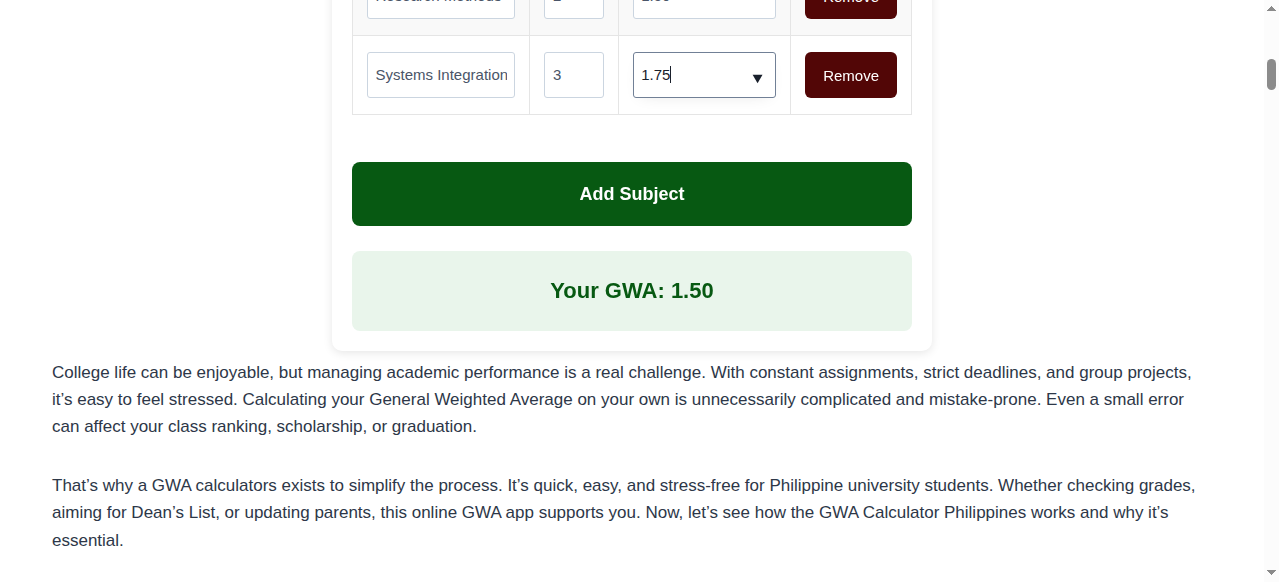
Worked Example 1: A Senior First Semester, GWA 1.50
First semester, fourth year, BS Computer Science. Seven subjects, 20 units. Thesis 1 is the subject everything else is scheduled around: the proposal defense usually falls in weeks 5–8 of the term, the manuscript is due near the end, and at Mapúa Malayan Digital College (MMDC) a student may enrol in Thesis only after completing at least 77% of the programme and passing Business Research — a gate measured in units, not in GWA.
| Subject | Units | Grade | Grade × units |
|---|---|---|---|
| Thesis 1 | 3 | 1.50 | 4.50 |
| Machine Learning | 3 | 1.25 | 3.75 |
| Cloud Computing | 3 | 1.75 | 5.25 |
| IT Ethics | 3 | 1.25 | 3.75 |
| Data Analytics (elective) | 3 | 1.50 | 4.50 |
| Research Methods | 2 | 1.50 | 3.00 |
| Systems Integration | 3 | 1.75 | 5.25 |
| Total | 20 | 30.00 |
30.00 ÷ 20 = 1.50 exactly. On this site’s converter that is 93.75%. It clears the Dean’s List line of 1.75 by a wide margin, and it is the best semester this student has had since first year. Note what the 2-unit Research Methods does here: at 1.50 it contributes 3.00 points, the same as a 3-unit subject at 1.00 would. Small-unit subjects are cheap places to gain points and expensive places to lose them, because the grade is multiplied by so few units either way.
The video below is a real screen recording of the live calculator on this site computing this exact semester — all seven subjects typed in, one by one, ending at “Your GWA: 1.50”. No still image, no staged screenshot: the calculator itself, running its own code.

Worked Example 2: Second Semester, the Senior Year, and the Four-Year Cumulative
Second semester is the semester with the OJT in it. Six subjects, 20 units — but one of those subjects is 6 units all by itself, which makes it the single heaviest line on any transcript in this four-year series.
| Subject | Units | Grade | Grade × units |
|---|---|---|---|
| Thesis 2 | 3 | 1.25 | 3.75 |
| OJT / Practicum | 6 | 1.50 | 9.00 |
| Software Engineering II | 3 | 1.50 | 4.50 |
| Emerging Technologies | 3 | 1.75 | 5.25 |
| IT Project Management | 3 | 1.50 | 4.50 |
| E-Commerce | 2 | 1.25 | 2.50 |
| Total | 20 | 29.50 |
29.50 ÷ 20 = 1.475, which prints as 1.48. On the converter that is 94.0%. Two things are worth noticing. First, the OJT at 1.50 contributes 9.00 points — 30% of the semester’s total from a single subject. If the OJT had been graded 1.00 instead of 1.50, the semester would read 26.50 ÷ 20 = 1.325, printing as 1.32 (Node-verified) — a 0.16 swing from one subject. The OJT grade matters more than any other single grade in senior year, because it carries twice the units of a normal subject. Second, the rounding: 1.475 is a tie at the second decimal, and it prints as 1.48, not 1.47. That is binary floating point, not decimal intuition — the double closest to 1.475 sits a hair above it — and the rounding section below has two more ties that go the other way. Near a 1.50 honours line, a tie like this is the difference between Cum Laude and nothing at STI, so keep four decimal places in your own records.
Now the senior year and the whole degree. The senior year is 30.00 + 29.50 = 59.50 points over 40 units: 59.50 ÷ 40 = 1.4875, printing as 1.49 (93.9% on the converter). The four-year cumulative is 218.75 + 59.50 = 278.25 points over 169 units: 278.25 ÷ 169 = 1.6464, printing as 1.65 (91.9% on the converter). Every one of these figures was reproduced by this site’s own calculator code, run unmodified, in the test run for this guide — WE1 1.50 (S01), WE2 1.48 (S02), senior year 1.49 (S03), four-year cumulative 1.65 (S04).
What 1.65 Is Worth: The Latin Honours Verdict at Five Schools
Here is the sentence this whole guide has been building toward: our senior graduates with a final GWA of 1.65, and whether that earns Latin honours depends entirely on which school’s handbook you open. There is no national table. The pages that claim there is one are corrected below.
| School | Summa | Magna | Cum Laude | Our senior at 1.65 |
|---|---|---|---|---|
| UP (Code Art. 410) | 1.20 or better | 1.45 or better | 1.75 or better | Cum Laude |
| UST | 1.000–1.200 | 1.201–1.450 | 1.451–1.750, no grade below 2.50 | Cum Laude — worst grade in the degree is 2.50, which is not below 2.50 |
| Adamson | Below 1.24 | Below 1.49 | Below 1.74, no grade below 2.5 | Cum Laude — 1.65 is below 1.74 |
| PUP (Student Handbook) | 1.0000–1.1500 | 1.1501–1.3500 | 1.3501–1.6000 | No honours — misses by 0.05 |
| STI (Tertiary Student Handbook) | 1.00–1.10 | 1.11–1.30 | 1.31–1.50 | No honours — misses by 0.15 |
Three honours, two misses, one student, one GWA. The boundary cases were all run through the calculator: exactly 1.60 qualifies at PUP (S13a) and 1.61 misses (S13b); exactly 1.50 qualifies at STI (S14a) and 1.51 misses (S14b); exactly 1.74 at Adamson prints as 1.74 but does not qualify, because Adamson’s rule is “below 1.74”, not “1.74 or better” (S13c), while 1.73 does (S13d). The word “below” is doing real work there: a student who computes 1.74 and celebrates has misread their own handbook. Read yours word for word — “or better”, “below”, “1.6000” with four decimals — because the registrar will.
The non-GWA conditions matter just as much, and our student clears them: no failing grade anywhere in the four years, no INC, no dropped subject, no disciplinary case, a regular load every semester, and the whole degree taken at one school. At PUP the handbook also requires no final grade lower than 2.50 and no 5.00; our student’s worst single grade is a 2.50 from first year, which is not lower than 2.50. At UST the bar is no grade below 2.50 and zero failing marks. None of these conditions appears in a GWA calculator. All of them appear on the graduation evaluation.

The Honours Trajectory: What Senior Year Had to Do — and What It Could Not
Every senior should do this calculation in the first week of fourth year, not the last: given the GWA you already have and the units you have left, what senior-year average does each honours line need? The formula is one line — (target × total units − points already earned) ÷ units remaining — and for our student, entering senior year at 1.70 over 129 units with 40 units left, the answers are sobering.
| Target | Senior-year average needed | Verdict |
|---|---|---|
| PUP Cum Laude (1.60) | 1.29 | Possible, but hard: (1.60 × 169 − 218.75) ÷ 40 = 51.65 ÷ 40 = 1.29125. Verified as a calculator case (S15a): a 1.29 senior year lands the final GWA at exactly 1.60. |
| UP Cum Laude (1.75) | 1.93 or better | Comfortable: (1.75 × 169 − 218.75) ÷ 40 = 77 ÷ 40 = 1.925. A senior year at 1.93 or better holds the line. Test case S15b confirms the landing at exactly 1.75 — with a twist: a 1.925 average is rounded to 1.93 on entry by the calculator, and still lands at 1.75. |
| Adamson Cum Laude (below 1.74) | 1.88 or better | Comfortable: (1.74 × 169 − 218.75) ÷ 40 = 75.31 ÷ 40 = 1.88275. |
| STI Cum Laude (1.50) | 0.87 | Impossible: below 1.00, the best grade that exists. (1.50 × 169 − 218.75) ÷ 40 = 34.75 ÷ 40 = 0.86875. |
| Magna Cum Laude (1.45) | 0.66 | Impossible: (1.45 × 169 − 218.75) ÷ 40 = 26.30 ÷ 40 = 0.6575. Even a perfect 1.00 senior year gives 258.75 ÷ 169 = 1.53 (S25). |
| Simply hold 1.70 | 1.71 | (1.70 × 169 − 218.75) ÷ 40 = 68.55 ÷ 40 = 1.71375. A senior year worse than 1.71 pulls the final figure down. |
Our senior’s actual year, 1.49, sits between the PUP line (1.29) and the UP line (1.93) — which is exactly why the verdict table splits the way it does. The lesson for a real senior is not “work harder”, it is “know which lines are still alive”. If you enter fourth year at 1.70 and your school is PUP, you need a 1.29 year: almost every subject at 1.25 or better, with the thesis and the OJT — 9 of your 40 units — not slipping. If your school is UP, you need 1.93 or better, which leaves room for a 2.00 or two. If your school is STI and you enter at 1.70, Cum Laude is already gone, and the honest plan is to protect the Dean’s List semesters and the job-application GWA instead.
Thesis and Capstone: The Units Count — and a Failed Thesis Is the Most Expensive Grade in Senior Year
Thesis and capstone sit at the centre of senior year in two ways: they carry real units, and they are the subjects most likely to end in an INC rather than a grade. Both facts change the GWA, and both are misunderstood by the pages ranking for this topic.
Thesis and capstone units count. They are graded academic units, and at most schools they enter the GWA like any other subject. One competitor page, quoted and corrected below, claims thesis units are excluded from the GWA at most Philippine universities. That is wrong as a general claim, and the test case proves the point: exclude Thesis 2 (1.25, below the semester average of 1.475) from the second semester and it reads 25.75 ÷ 17 = 1.5147, printing as 1.51 instead of 1.48 (S07b) — a 0.03 swing, and at a 1.60 honours line 0.03 is the whole margin. If your school is one of the exceptions, your handbook will say so in words, and a calculator site is not your handbook.
A failed thesis is the most expensive single grade in the degree. Put a 5.00 on Thesis 1 in the first semester and the semester reads 40.50 ÷ 20 = 2.025, printing as 2.02 (test case S05) — a swing of 0.52 from one subject. The retake is where the arithmetic gets cruel. The calculator on this site has no grade-replacement mode: it counts both attempts. Retake the failed thesis at 1.50 and the semester reads 45.00 ÷ 23 = 1.9565, printing as 1.96 (S06). If your school replaces the grade instead — deleting the 5.00 and counting only the 1.50 — the same semester reads 30.00 ÷ 20 = 1.50, exactly where it started. The difference between the two policies is 0.46 of GWA from one subject, and it is decided by your school’s retake rule, not by your effort. STI and UP Mindanao count a failed-and-retaken course every time it was taken; other schools replace. Find out which one yours is before you enrol in the retake.
An INC thesis does not compute at all. Type INC into this site’s calculator and the whole display reads “invalid grade” (S07a) — the calculator has no INC, DRP or remark grade in its code, and the offending row must be deleted before anything computes. That is the honest behaviour: an incomplete thesis has no grade, so it has no place in a weighted average. What it does have is a deadline. At most schools an INC lapses into 5.00 if it is not resolved within the prescribed period — commonly one year, sometimes one semester — and an unresolved INC at graduation is treated as a failing entry that disqualifies the student from Latin honours.
Getting into the thesis is itself a gate. At MMDC, Capstone 1 requires no more than 3 units of specialization courses, 12 units of professional courses, 9 units of internship and 3 units of Capstone 2 still remaining; Thesis requires at least 77% of the programme completed plus Business Research passed. There is also money attached: an integrative fee of ₱1,600 per student per integrative course per term, and a re-defense fee of ₱2,200, shared by the group, if the panel requires a second defense. The typical MMDC timeline runs the proposal and oral defense in weeks 5–8, the final defense in weeks 10–12, and the manuscript submission in week 12 — a senior who misses the week-8 defense is not behind on one subject, they are behind on graduation.
OJT: The Gate Is Back Subjects and Units, Not Your GWA
Nothing in this guide’s research found a GWA number for OJT eligibility, and that negative finding is itself the point. The OJT gate is prerequisites, units and standing — not a grade average. At MMDC, the internship sits inside the Capstone 1 eligibility count (9 units of internship still remaining is part of the test). In the BSCE OJT rules found in the junior guide’s research, the requirements were third-year standing, regular-student status with no back subjects, a minimum of 240 hours, and enrolment during the summer term. At CKS College the practicum required at least 90 academic units plus 24 professional units. At Xavier University, OJT began when only 50 units were left, at 240 hours for 2 units under the old curriculum and 9 units for 486 hours under the new one. At BSIT programmes the practicum is commonly 6 units and 486 hours, entered by finished prerequisites, not by a GWA cutoff.
What OJT does to the GWA depends on how your school grades it. In this guide’s second semester the practicum carries a numerical grade, 1.50 over 6 units, contributing 9.00 points — and the test cases show both directions of its weight: add a 6-unit OJT at 1.25 to the first semester and it reads 37.50 ÷ 26 = 1.44 instead of 1.50 (S20); add a 6-unit OJT at 1.00 to the second semester and it reads 35.50 ÷ 26 = 1.37 instead of 1.48 (S32). If your OJT is graded Satisfactory/Unsatisfactory instead, it contributes nothing to the numerator or the denominator — it counts toward graduation and not toward the GWA — and a senior who types a made-up number for it into a calculator is inventing a GWA. The full OJT picture is in the internship guide on this site.
One practical warning: OJT hours are the most common reason seniors do not graduate on time, and the reason has nothing to do with grades. A 486-hour practicum is twelve full-time weeks. A student who starts it late, or whose host company signs the hours late, finishes the academic work and still waits for the clearance. Apply for the placement the semester before you need it, keep a copy of every signed hour log, and confirm with your OJT coordinator — in writing — that the hours are complete before the final evaluation.
Graduation: The Checklist That Has Nothing to Do With Your GWA
Graduation is a clearance process, and the GWA is one line on it. Adamson University’s published graduation rules — read in full for this guide — are a good picture of what the process actually contains, and none of it is a grade average:
- Passing grades in all subjects in the curriculum, NSTP requirements completed, and admission requirements finished — including the Form 137-A or transcript of records from the school of last attendance and a PSA birth certificate.
- Apply for an evaluation of your academic records two months before the end of the term before your graduation semester — not in the graduation semester itself. A senior who waits until the last term to ask for the evaluation is already late.
- File the official application for graduation with the Registrar before the midterm examination of your last semester.
- Residency: in general, at least one school year with 36 units of credit at Adamson, and two-thirds of the work in the major field completed there. Particular departments have their own special requirements.
- Clearances: no outstanding financial obligations, and no pending civil, disciplinary or administrative case with the Office for Student Affairs. The graduation fee must be settled as part of the final assessment.
- Attendance at the graduation activities the university prescribes — recollection, community immersion, job fair, exit interview, scheduled orientation — plus a 4×6 graduation picture in academic regalia for the commencement programme and a 2×2 picture for the transcript of records.
Every school’s list differs in the details and matches in the shape: academic completion, residency, money, discipline, paperwork, and a deadline that falls earlier than students expect. Two items on that shape deserve emphasis because they surprise seniors every year. First, residency: a transferee who did most of the degree elsewhere can graduate but cannot take Latin honours, because honours commonly require 50% to 75% of the total units — or the final year — completed in residence at the awarding school. Second, discipline: a pending case, even one that ends in a warning, can hold the clearance.
The Supreme Court Case Every Senior Should Know: Morales v. UP
In December 2004 the Supreme Court decided the case of Nadine Rosario M. Morales against the Board of Regents of the University of the Philippines (G.R. No. 161172) — and it is the single most useful document ever written about senior-year GWA, because it is about a senior whose grades were good enough and who still lost Cum Laude.
Morales transferred from UP Manila, where she had been taking Speech Pathology, to UP Diliman, where she took a BA in European Languages, Plan A, majoring in French — first minoring in German, then changing her minor to Spanish. In German 10 and German 11 she earned 1.0 in both. Her programme required 141 units, 27 of them electives in the minor field. The College of Arts and Letters put her on the list of students with probable honours: by the college’s computation she had a GWA of 1.725, and her final semester average of 1.708 brought her GWA to 1.729 — inside the 1.75 line for Cum Laude under Article 410 of the UP Code, which sets Summa at 1.20, Magna at 1.45 and Cum Laude at 1.75.
On final assessment she was denied the honour. Excluding German 10 and 11, her GWA was 1.760 — outside the line. UP’s reason was that Plan A has no free electives: German 10 and 11 were basic language courses from an abandoned German minor, and they did not qualify as electives in a French-major, Spanish-minor curriculum. Her transcript totalled 147 units — 69 in general education, 45 in French, 27 in Spanish, 6 in German — against 141 required, and the 6 German units were excess. The University Council voted 207–4 and then 99–12 against her; the Board of Regents denied her appeal 9–2. She won in the Regional Trial Court, lost in the Court of Appeals, and lost in the Supreme Court, which held that honours are part of academic freedom and that courts may not substitute their judgment for the university’s absent grave abuse of discretion.
Three lessons for a senior, and none of them is “get better grades”. First, which subjects count can decide honours even when the GWA looks safe. Morales’s two 1.0 grades — the best grades on her transcript — were the reason she lost, because they were excluded and the average rose past the line. A senior who shifted programmes, changed a minor, or took extra electives should ask the registrar, before the final semester, exactly which subjects will be included in the honours computation. Article 410 itself says all grades in all subjects prescribed in the curriculum, plus subjects that qualify as electives, are included — and then gives a procedure for choosing among excess electives, chronological order for students who did not shift, priority order for students who did. Second, the Court’s own arithmetic is a warning about trusting a printed figure. The decision’s body text says her final-semester average of 1.708 brought her GWA from 1.725 to 1.729 — but a final semester better than the running average can only pull the average down, never up past it, so the figures as printed cannot be a weighted average; the decision’s own footnote 7 corrects the computation, giving her actual GWA including German as 1.7325. Either way she was inside 1.75 with German and outside it (1.760) without — the margin was 0.01, and the subject-inclusion rule decided it. Third, the Court’s language is the phrasing trap this guide warns about: it calls 1.729 “definitely higher than the 1.75 average grade required” and 1.760 “lower than the minimum weighted average grade required”, using higher and lower to mean better and worse. On the 1.00–5.00 scale, 1.729 is numerically lower than 1.75 and better than it. Always write “1.75 or better” — never “higher” or “lower” without saying which direction you mean.
The full decision is public — the Supreme Court decision in Morales v. UP Board of Regents — and it is worth reading in full if you shifted programmes or took subjects outside your curriculum.
DOST and CHED in Senior Year: The Scholarship You Keep, Not the One You Apply For
By fourth year, the scholarship story is about retention, not application. The DOST Junior Level Science Scholarship — the 83% GWA award that dominated the sophomore and junior guides — is open to second-year students only, and its AY 2026–2027 cycle ran from April 17 to May 15, 2026, with the qualifying exam on June 28, 2026. That cycle is closed, and a senior cannot apply for it. What a senior DOST scholar has instead is the retention rule, and the rule is good news: for third, fourth and fifth year scholars, the DOST-SEI Scholar’s Handbook requires passing grades in all academic subjects, a regular load, and completion of the course within its prescribed period. No GWA number is stated for seniors.
The benefits a senior scholar is retaining are worth naming: ₱8,000 a month in living allowance for ten months a year — ₱80,000 a year, not the ₱96,000 one competitor page prints by multiplying by twelve months — plus tuition support of up to ₱40,000 a year, ₱10,000 for learning materials, and a ₱10,000 thesis grant for the subject this guide has just shown to be the most expensive one on the transcript.
CHED’s merit scholarships work the same way in reverse: the bars are percentages, and on this site’s converter 85% is a GWA of 2.20 and 80% is a GWA of 2.60. A senior holding a CHED merit scholarship should check the percentage, not the GWA, because the two scales do not map onto each other neatly — the DOST handbook’s own “2.5 or 85%” pairing is a standing example of the mismatch (2.50 is 81.25% on the linear scale; 85% is 2.20). The senior-year point is short: you are defending a scholarship now, and the defence is passing everything on a regular load.
After Graduation: Jobs, Board Exams and Graduate School
The final GWA leaves the campus with you, and its value changes the moment it does. There is no national GWA cutoff for getting a job in the Philippines — no law sets one, and the companies that do filter on grades almost never print the number in the job ad. What actually happens, as the job-application guide on this site establishes, is quieter: large companies running management-trainee and graduate programmes, banks and a few multinationals use GWA as a first screen, and the bands they are usually working with are 2.00 or better for a general shortlist and 1.75 or better for the most selective programmes. Our senior’s 1.65 clears both. Small companies, startups and BPO employers mostly screen on skills tests, portfolios and interviews. For experienced hires, GWA is close to irrelevant — which is why the first job matters more than the first decimal.
For board-exam programmes, the GWA is not a licensure eligibility requirement: the Professional Regulation Commission requires graduation from an accredited programme, not a grade average. The board-exam guide has the full picture. For graduate school, the usual bars are 2.00 to 2.50 or better depending on the programme; the graduate-school guide covers the per-programme numbers. And for the civil service, the rule is the cleanest of all: under Presidential Decree No. 907, graduates with Latin honours are granted automatic Second Level (Professional) eligibility — our senior’s UP, UST or Adamson Cum Laude carries that with it, and the PUP or STI version of the same student does not.
A Failed Subject in Senior Year — and What a Retake Actually Does
A failed subject in fourth year is a different problem from a failed subject in first year, because there is no next year to absorb it. The arithmetic is in the thesis section above — a failed 3-unit thesis moves the semester from 1.50 to 2.02 — but the practical consequences are worse than the arithmetic. A failed subject in the final semester delays graduation by at least one term, because the subject must be retaken and passed before the clearance is signed. A failed subject in the first semester of senior year can usually be retaken in the second semester, but only if the subject is offered then and only if the retake does not clash with the thesis defense or the OJT. The full failed-subject picture is in the failed-subject guide on this site.
The retake rule is the thing to get in writing. Three models exist in Philippine universities, and your school uses exactly one of them: both counted (the failed grade and the retake grade both stay in the average — the model this site’s calculator uses, and the model at STI and UP Mindanao); replacement (the failed grade is deleted and only the retake counts — worth 0.46 of GWA on our thesis example); and average of both attempts. A senior who assumes replacement and gets both-counted has lost nearly half a point on a misunderstanding. The registrar’s office answers this question in one sentence. Ask it before you enrol in the retake, not after the grade comes out.
One more senior-year trap: the “conditional” grade. A 4.00 on this site’s calculator is accepted as an ordinary numeric grade and counted at face value (S16) — the calculator does not know it is conditional. In real life a 4.00 means unfinished requirements, and at most schools it converts to 5.00 if it is not removed within the prescribed period. A senior with a 4.00 in the final semester should treat it as an INC with a deadline, not as a grade.
Rounding: When 1.475 Prints as 1.48 and 2.025 Prints as 2.02
The calculator shows two decimals, and the underlying arithmetic is binary floating point, not decimal intuition. A GWA that looks like an exact tie at the second decimal can print either way, and this guide’s test run caught ties going in both directions:
| Exact value | Prints as | Why |
|---|---|---|
| 1.475 (WE2, 29.50 ÷ 20) | 1.48 | The double closest to 1.475 sits a hair above it, so it rounds up |
| 1.725 (13.80 ÷ 8) | 1.73 | Double a hair above 1.725, rounds up (S10b) |
| 1.375 (57.75 ÷ 42) | 1.38 | 1.375 is exact in binary; a half rounds up |
| 1.625 (29.25 ÷ 18) | 1.63 | 1.625 is exact in binary; a half rounds up |
| 2.025 (failed thesis, 40.50 ÷ 20) | 2.02 | The double closest to 2.025 sits a hair below it, so it rounds down (S05) — new this run |
| 1.575 (retake model, 31.50 ÷ 20) | 1.57 | Double a hair below 1.575, rounds down |
| 1.325 (OJT at 1.00, 26.50 ÷ 20) | 1.32 | Double a hair below 1.325, rounds down (Node-verified) |
The practical rule is the one the junior guide gave: near any cutoff — 1.75, 1.60, 1.50, 1.74 — check the unrounded figure with your registrar, because the printed two decimals are not the whole story. A student whose true cumulative is 1.7549 prints as 1.75 and qualifies at UP; a student whose true cumulative is 1.7551 prints as 1.76 and does not. And a student whose school computes honours to four decimal places, as PUP does (1.6000), is playing a different game from a student whose school rounds to two.
What the Calculator Cannot Do (and the Workarounds That Work)
This site’s calculator is honest about its limits, and the test run for this guide confirmed all three of them again. First, it rejects percentages: type 92 and the whole display reads “invalid grade” (S08a). Convert percentages to the 1.00–5.00 grade first, using your school’s transmutation table, and type the grade. Second, it rejects INC: type INC and the display reads “invalid grade” (S07a). Delete the INC row and compute the rest, then add the subject back once the grade exists. Third, it has no grade-replacement mode for retakes: it always counts both attempts (S06). If your school replaces, delete the failed row and type only the retake grade — or compute that semester by hand, which takes two minutes with the formula at the top of this guide.
Three more behaviours are worth knowing. Decimal grades are rounded to two places on entry, so typing 1.925 enters 1.93 — and the test run shows the consequence: a senior year at a 1.925 average still lands the final GWA at exactly 1.75 (S15b). Letter grades work in any case (S09, S09b) from A+ at 1.00 to F at 5.00. And rows with zero units are ignored — all rows at zero units shows 0.00 (S17).
Competitor Errors Corrected in This Guide
Ten pages were read in full for this guide — the top results for the exact keyword plus wider searches on Latin honours, graduation and senior-year GWA — and the pattern this year is the same as last year’s: the pages that rank highest are the least reliable on the numbers that matter. Every error below is quoted verbatim, with the correction. The full research, page by page, is in the package notes for this article.
1. A law firm’s page puts Cum Laude at 1.76–2.00. The lawyer-philippines.com guide to CHED Latin honours states: “Cum Laude (With Honors): GWA of 1.76 to 2.00 (or equivalent in percentage systems, e.g., 88-92%). Magna Cum Laude (With High Honors): GWA of 1.46 to 1.75 (e.g., 93-96%). Summa Cum Laude (With Highest Honors): GWA of 1.00 to 1.45 (e.g., 97-100%).” It attributes these bands to “CMO No. 19, series of 2018” — but it quotes no text from that order at all: no section number, no quoted sentence, no link. The bands shift every tier one step looser than the UP bands in Article 410: its “Summa” of 1.00–1.45 is UP’s Magna range, and its “Cum Laude” of 1.76–2.00 would not qualify for any honours at UP, PUP or STI. The percentage equivalents are wrong against the bands themselves: on this site’s converter 1.76 is 90.5% and 2.00 is 87.5%, so 88–92% does not describe the 1.76–2.00 band at all. The same page says “Candidates must have no grade below 3.0 (passing) in any subject” — read literally, that bans all good grades, since grades below 3.00 are the good ones; it should say “no grade of 5.00” or “no grade worse than 3.00”. It also contradicts itself on residency (“at least 75% of their total units (or two years for four-year programs)” — 75% of a four-year programme is three years, not two) and claims “CHED requires that GWAs include all academic subjects, including physical education and national service training”, which contradicts the UP and PUP rules. The operative CHED rule, as the respicio.ph companion article states, is Section 112 of the Manual of Regulations for Private Higher Education (CMO No. 40, s. 2008): every institution must adopt its own policy and criteria. There is no national table. Do not use this page’s bands.
2. A gradebook vendor invents a national CHED standard — twice. OpenEduCat’s Latin honours page presents a single “standard” table — Summa 1.0–1.20 with no grade below 2.0, Magna 1.21–1.45 with no grade below 2.5, Cum Laude 1.46–1.75 with no grade below 3.0 — attributed to “CHED CMO guidelines”, but it never cites a specific CMO number anywhere on the page. The same vendor’s gradebook overview calls the Philippine scale “an inverted 4-point scale where 1.0 is Excellent and 5.0 is Failure”. The scale is 1.00–5.00: five points, not four, and the page’s own 5.00 failure grade proves it. The overview’s grade-band table has gaps a student can fall through: 1.5 is 91–93% and 2.0 is 85–87%, leaving 88–90% unmapped; 2.0 is 85–87% and 3.0 is 75–79%, leaving 80–84% unmapped; and the intermediate grades 1.75, 2.25, 2.50 and 2.75 — used by most Philippine universities — are missing entirely. Its classification table says “Pass | GWA ≤ 3.0 — eligible for graduation”, which is wrong in both directions: a student can graduate with a cumulative GWA worse than 3.0 if every subject is passed, and a student at 2.5 with an unfinished thesis or OJT cannot graduate at all. It also claims “a student scoring 98 in a 3-unit Engineering subject earns 1.0” — percentage-to-grade mapping is institution-specific, and no Philippine-wide rule maps 98% to 1.0. Both pages are software marketing, not student guidance. The concrete harm: a 1.18 GWA is Summa on their table but only Magna at PUP, where Summa ends at 1.1500.
3. A Latin honours calculator gives PUP the wrong bands. The academic-suite.online Latin honours guide gives PUP as Summa 1.000–1.250, Magna 1.251–1.500, Cum Laude 1.501–1.750. The PUP Student Handbook itself gives Summa 1.0000–1.1500, Magna 1.1501–1.3500, Cum Laude 1.3501–1.6000. Under the calculator’s bands a 1.40 GWA is Magna at PUP; under the handbook it is only Cum Laude. One of the two is wrong, and the handbook wins. The same page’s FAQ mashes the UP and PUP numbers into one “standard” that matches neither school exactly. To its credit, this page has the only usable senior worked example in the whole research batch — an incoming senior with 110 units at a cumulative 1.4250 and 36 units left, who can average up to 2.74 across the final 36 units and still graduate Cum Laude (110 × 1.4250 = 156.75; 146 × 1.75 = 255.50; 98.75 ÷ 36 = 2.743) — and its UP/UST bands are correct. Use it for the worked example, not for the PUP table.
4. A law firm’s “most HEIs” bands disagree with UP. Respicio.ph states that “most HEIs adopt a tiered system on the 1.00–5.00 scale: Summa Cum Laude: 1.00–1.20 … Magna Cum Laude: 1.21–1.50 … Cum Laude: 1.51–1.75”. Its Magna ceiling of 1.50 conflicts with UP’s Article 410, where Magna ends at 1.45 and Cum Laude starts at 1.451: a 1.46–1.50 GWA is Magna on this page and only Cum Laude at UP. The same page says DepEd’s highest distinctions are “conferred on the top 1%, 2%, and 5% of the graduating class, respectively” — that is the pre-2016 system. Under DepEd Order No. 36, s. 2016 the awards were absolute general-average cutoffs (98–100, 95–97, 90–94), and DepEd Order No. 015, s. 2026 has since repealed DO 36: from SY 2026–2027 there is a single Academic Excellence Award, general average 90 or higher, no final grade below 80. The page names no DepEd Order at all. Its core thesis is right — CHED imposes no uniform national cutoff — but its tables should not be quoted.
5. A calculator site says scholarships need “1.75 or higher”. The gwacalculatorph.ph guide states: “CHED (Commission on Higher Education) and DOST (Department of Science and Technology) scholarships often need a GWA of 1.75 or higher.” On the 1.00–5.00 scale, “higher” numerically means worse — a 2.50 is higher than 1.75. The page uses the correct phrasing elsewhere (“1.75 or better” in its own scholarship table), so this sentence is an internal inconsistency, and it is the exact phrasing trap the Morales decision falls into. The same page claims a single annual GWA of 1.44 “qualifies for Magna Cum Laude in many universities” — a single year’s GWA does not confer Latin honours; honours use the cumulative GWA over the whole degree plus the no-fail, residency, load and disciplinary conditions. Its grading table overlaps its own fail bands (“4.00 | Conditional Failure | Below 75%” against “5.00 | Failed | Below 70%” — a grade of 72% falls in both), and its DOST-SEI line reads “90% (≈ 1.75 GWA)” although its own table puts 1.75 at 88–90%, making 90% the top edge of the band rather than its equivalent. Its worked examples, to be fair, are arithmetically correct: 13.75 ÷ 8 = 1.72, 49 ÷ 34 = 1.44, and the SHS example 448 ÷ 5 = 89.6 — but the 49 ÷ 34 example includes PE and NSTP grades in the GWA, which is fine for a semestral figure and misleading if read as a Latin-honours GWA.
6. The best calculator page contradicts itself on DOST. The phgwacalculator.com homepage is the most trustworthy page in this batch: it is the only one that reflects DepEd Order No. 015, s. 2026, it is correct on the UP/PUP distinction, and it labels its GWA-to-GPA conversion as an unofficial estimate. But its body states the DOST JLSS “requires an 83% minimum GWA (second-year students)”, while its FAQ answers the same question with “The DOST-SEI JLSS requires 83% minimum GWA with no failing or conditional grades. STEM students apply regardless of GWA; non-STEM must be top 5% of their class.” “STEM students apply regardless of GWA” directly contradicts the 83% minimum just stated. The 83%-for-all reading is the correct one. The page also states that a 4.00 “is included in computation” as a general rule, although whether a conditional grade enters the GWA varies by university. Its one worked example, “27.25 ÷ 17 = 1.60 GWA”, checks out arithmetically (27.25 ÷ 17 = 1.6029), although the subject inputs are not shown on the page.
7. Two SHS pages give two different honours floors — and both are repealed. The academic-suite.online SHS honours calculator presents DepEd Order No. 36, s. 2016 as current, with the three tiers and an 85-grade floor. The gwacalculatorph.com SHS calculator presents the same three tiers but states the disqualification floor as 75%: “to qualify for any of these honors, a student must not have obtained a final grade below 75% in any learning area”. The 75% figure matches neither the old rule (85) nor the current one (80): under DepEd Order No. 015, s. 2026, from SY 2026–2027, DO 36 is repealed and the single Academic Excellence Award requires a general average of 90 or higher with no final grade below 80. A student with an 82 in one subject and a 93 average would be told by the second page that they qualify for With Honors; under the old rule they did not, and under the current rule they do — the page’s 75% figure is wrong under both. Both pages are SHS-only and say nothing about college GWA at all, which is why they rank for a college keyword they cannot answer: Google reads “senior” as senior high school, and the first page of results for this keyword is mostly Grade 11 and 12 material.
Frequently Asked Questions
What is a good GWA for a senior student in the Philippines?
It depends on the gate. For Latin honours at UP-style schools, 1.75 or better is Cum Laude; at PUP the line is 1.60, at STI it is 1.50, at Adamson it is below 1.74. For a first job, 2.00 or better clears most employer screens and 1.75 or better is competitive. For Dean’s List in a semester, 1.75 or better.
How do I compute my senior GWA?
Multiply each subject’s grade by its units, add all the products, and divide by the total units. That is the whole method behind the gwa for senior students philippines figures in this guide — for example, the first semester here is 30.00 ÷ 20 = 1.50. Or type the subjects into the calculator on this site’s homepage: it updates live, accepts letter grades from A+ to F, and shows the result to two decimals. Do not average your semester GWAs; combine the points and the units instead.
Can I still get Cum Laude in senior year?
It depends on where you start. From a three-year cumulative of 1.70 with 40 units left, UP Cum Laude (1.75) needs a senior average of 1.93 or better, PUP Cum Laude (1.60) needs 1.29, and STI Cum Laude (1.50) is already impossible — the average needed is 0.87, below the best grade that exists.
Do thesis units count in the GWA?
Yes, at most schools: thesis and capstone are graded academic units that enter the weighted average like any other subject. Deleting Thesis 2 from this guide’s second semester moves it from 1.48 to 1.51. One competitor page claims thesis units are excluded at most Philippine universities; that is wrong as a general claim. Check your own handbook — if your school is an exception, it will say so in words.
Does OJT count in the GWA?
It depends on how your school grades it. A numerical OJT grade counts, and heavily: a 6-unit practicum at 1.50 contributes 9.00 points, 30% of a 20-unit semester. A Satisfactory/Unsatisfactory OJT contributes nothing to the GWA, although it still counts toward graduation. There is no published GWA cutoff for entering OJT anywhere — the gate is finished prerequisites, units and standing.
What happens if I fail my thesis?
A failed 3-unit thesis moves a 20-unit semester from 1.50 to 2.02, and the retake rule decides what happens next. If your school counts both attempts, the retaken thesis at 1.50 leaves the semester at 1.96; if it replaces the grade, the semester returns to 1.50. A failed subject in the final semester delays graduation by at least one term. Get the retake rule in writing before you enrol in the retake.
Does an INC grade affect my GWA?
An INC has no grade, so it has no place in a weighted average — this site’s calculator rejects it outright and shows “invalid grade” until the row is deleted. What an INC does affect is graduation: at most schools it lapses into 5.00 if not resolved within the prescribed period, and an unresolved INC at graduation disqualifies the student from Latin honours.
Is 1.65 good enough for a job?
For most first screens, yes. Large employers and management-trainee programmes usually work with 2.00 or better for a general shortlist and 1.75 or better for the most selective ones, and 1.65 clears both. No employer publishes a GWA cutoff, and after your first year of work experience the number stops mattering.
The Senior Checklist: What to Do This Week
Fourth year rewards the student who does the paperwork early and the arithmetic once, properly. In order:
- Run the trajectory formula for every honours line at your school — (target × total units − points earned) ÷ units remaining — and write down which lines are still alive. Stop chasing the ones the arithmetic has closed.
- Ask the registrar, in writing, which subjects count toward your honours GWA — especially if you shifted programmes, changed a minor, or took extra electives. The Morales case turned on exactly this question, and the margin was 0.01.
- Ask for the retake rule in one sentence — both counted, replacement, or averaged — and ask how many decimals the honours computation uses. PUP uses four; most schools use two.
- Apply for the graduation evaluation two months before the end of the term before your graduation semester, and file the graduation application before the midterm of your last semester. Both deadlines fall earlier than students expect.
- Resolve every INC and 4.00 before the final semester, and confirm your OJT hours are signed off before the final evaluation. A missing signature holds a diploma; a GWA does not fix it.
- Compute your senior GWA with the calculator on this site — type the subjects in as the grades come out, and keep the unrounded figures. The worked examples in this guide are the template: 1.50, 1.48, senior year 1.49, four-year cumulative 1.65.
Senior year is the last 40 units of a degree that took 169. They cannot rewrite the first 129, and they do not need to: a 1.49 senior year on a 1.70 base is a real improvement, and a 1.65 final GWA is Cum Laude at UP, UST and Adamson, a Dean’s List finish, a civil service eligibility under PD 907, and a clear pass at every employer screen this guide could find. It misses PUP by 0.05 and STI by 0.15 — and knowing exactly that, to the hundredth, is worth more than a vague hope. Compute it, check which subjects count, file the paperwork early, and finish the thesis.
