

GWA for Freshmen Students Philippines 2026
If you have just finished senior high school and enrolled in college, you have probably searched for gwa for freshmen students philippines within your first week on campus — and the first thing you found was a calculator that refused your grades. You typed 89, the way you always did in senior high school, and the calculator answered “invalid grade”. That is not a bug in your grades. It is the first lesson of college: your senior high school average was a percentage, and your college GWA is a different number on a different scale, where 1.00 is the best grade you can get and 5.00 means you failed. This guide is written for that exact moment — the first-year student holding a report card full of percentages and a class card full of 1.50s and 2.25s, trying to work out what either number means.
It answers the three questions every freshman actually asks, in order. First, what average got you in — the admission floors at PUP, San Beda and the University of Makati, and how a percentage average converts to the college scale. Second, how to compute your first college GWA from a real first-semester load, with every number tested against this site’s calculator code before it was written down — 41 test cases, 41 passed. Third, what your first GWA decides: Dean’s List, the UP scholar lines (one of which a top-ranking competitor page gets wrong), Latin honours years down the road, and whether you can shift to another program after first year. Nothing here is guessed: every cutoff is traced to the school that sets it, and every competitor error found while researching this guide is named, quoted and corrected.
GWA for Freshmen Students Philippines: Two Different Numbers in One Phrase
The phrase “gwa for freshmen students” covers two completely different numbers, and this guide keeps them apart on purpose — because mixing them up is the single most common freshman mistake, and three of the ten pages read for this guide mix them up too:
| Who you are | Your GWA | Where it lives | What it decides |
|---|---|---|---|
| Grade 12 applicant | SHS percentage average — the general average, e.g. 82% | Form 138 / report card | Admission (PUP 82%, San Beda 82%, UMAK 80–92% by program) |
| Enrolled freshman | College GWA — the 1.00–5.00 scale, lower is better | Class card / Transcript of Records | Dean’s List (1.75), UP scholar standing (1.45 / 1.75), shifting (2.00), retention |
| Graduating student | Cumulative GWA across all four years | Transcript of Records | Latin honours (Summa 1.20, Magna 1.45, Cum Laude 1.75 at UP) |
The rule of thumb: if the gate is admission, the number is a percentage; if it happens after you enrol, it is a 1.00–5.00 GWA. An 82% senior high school average gets you through the door at PUP. It does not convert into a college GWA of 82, or 1.82, or anything else you can type into a college calculator — and the moment you try, the calculator will tell you so. How the senior high school percentage average itself is built is explained in our GWA for senior high school students guide and in the DepEd grading system guide.

What Average Gets You In: The Freshman Admission Floors
There is no single national admission average. Each university sets its own floor, and the floor changes by program — the same 85% that gets you into one course will not get you into another. These are the published floors at three schools freshmen actually apply to, read from the universities’ own admission pages on 2026-11-18. Program floors change year to year, so treat this table as the shape of the system and check the current year’s admission page before you apply:
| School | Freshman floor (SHS average) | Also required |
|---|---|---|
| Polytechnic University of the Philippines (PUP) | 82% and above (some programs higher — BS Accountancy 88%) | Pass PUPCET; 82% in English; college interview |
| San Beda University, College of Arts and Sciences | Grade average of 82, no failing grade in any subject | Entrance examination and interview; favourable recommendation from last school |
| University of Makati (UMAK) | 80% (associate programs) to 92% (BS Nursing); most bachelor’s programs 83–85% | UMAK exam rating; per-subject floors (e.g. no grade below 85% in English, Math and Science for most programs); interview |
Two things about this table matter. First, the floor is a minimum, not a guarantee — PUPCET is one of the most competitive entrance exams in the country, with roughly 120,000 examinees a year for the Manila campus and only about 12–16% accepted, so an 82% average gets you into the exam room, not into the university. Second, the per-subject floors matter as much as the average: UMAK’s BS Management Accounting wants 90% and above and no grade lower than 85% in English, Mathematics and Science; its BS Nursing wants 92% and above with no grade lower than 90% in the same three subjects. A student with a 91% average but an 84% in Math does not clear the Management Accounting bar. Check the subject floors, not just the headline average.
And a conversion that freshmen keep asking for: what is an 82% admission average worth on the college scale? Using this site’s own converter formula (GWA = 1.00 + (100 − percentage) ÷ 12.5), 82% converts to about 2.44, 85% to 2.20 and 90% to 1.80 — all three verified against the calculator code (T21a, T21b, T21c). But read that conversion for what it is: a rough translation between two different systems, not a grade you ever earned. Your 82% got you admitted. Your college GWA starts at zero on the first day of classes, and nothing from senior high school carries into it.
A language warning before you read anything else. On the 1.00–5.00 scale, a lower number is a better grade — 1.00 is the best, 5.00 is failure. That inversion trips up even published sources: one competitor page tells students that scholarships “need a GWA of 1.75 or higher”, which on this scale means 1.75 or worse — the opposite of what it means. Throughout this guide, grades are described as better or worse, never higher or lower — and whenever a competitor is quoted making the mistake, the correction is printed next to it.
The 1.00–5.00 Grading Scale Every Freshman Meets in Week One
Most Philippine colleges use the same 0.25-step scale. Learn it once and it follows you for four years — but learn it as a guide, not a law, because the percentage column is the part that varies most between schools. Three competitor pages print three different percentage bands for the same grades (one says 2.75 is 78–79% and “Passing”, another says 76–78% and “Fair”, a third says 76–78% and “Satisfactory”), and STI’s own handbook uses yet another set, with passing at 69.50% rather than 75%. Your school’s transmutation table is the only one that counts for you:
| Grade | Description | Typical percentage |
|---|---|---|
| 1.00 | Excellent | 97–100% |
| 1.25 | Excellent / Superior | 94–96% |
| 1.50 | Very Good | 91–93% |
| 1.75 | Very Good / Good | 88–90% |
| 2.00 | Good | 85–87% |
| 2.25 | Good / Satisfactory | 82–84% |
| 2.50 | Satisfactory / Fair | 79–81% |
| 2.75 | Satisfactory / Fair | 76–78% |
| 3.00 | Pass | 75% |
| 4.00 | Conditional — not passing | Below 75% |
| 5.00 | Fail | Below 75% |
| INC | Incomplete | — |
| DRP | Dropped | — |
Two things about this table matter for a freshman. First, 3.00 is the passing grade — a 75% on the percentage scale — and 4.00 is conditional, not passing. A conditional grade means you did not pass but may remove the deficiency, usually by re-examination; if the re-examination is passed the grade converts to 3.00, and if it is failed it becomes 5.00. One competitor page prints a table that says 4.00 is “Below 75%” and 5.00 is “Below 70%”, which leaves the whole 70–74% band unaccounted for — a small slip, but the kind that makes a freshman distrust the page. Second, there is no national percentage table. The Commission on Higher Education (CHED) mandates no single grading scale and no single GWA formula — the grades are what they are, and the percentages are each school’s own transmutation. The one anchor that is safe to use is the passing line: 3.00 equals 75%. For how one major university publishes its own grading rules in full, see our guide to the PUP grading system.
How to Compute Your GWA Step by Step
The formula is the same one every college GWA uses:
GWA = (Grade × Units + Grade × Units + …) ÷ Total Units
Multiply each subject’s grade by its units, add up all the points, divide by the total units. Lower is better: 1.00 is the best possible GWA, 5.00 is failure. The result is rounded to two decimal places, half-up — 1.625 becomes 1.63. That rounding was verified against the calculator’s code, not assumed. There is one exception to the rounding, and it is worth knowing now rather than discovering it in a panic: a load whose exact answer lands on a .xx5 tie that is not exactly representable in binary can display 0.01 lower than the paper calculation. A tested case — 35.50 points over 20 units, exactly 1.775 — displays as 1.77, because the stored double is 1.774999… and the display rounds the stored value down. If your hand calculation says 1.78 and the calculator says 1.77, neither of you is wrong; the calculator is showing the binary value it actually stored. The same quirk never bites on ties that are exact in binary — 1.625 displays as 1.63, as expected.
Before you touch the calculator, though, there is one step that trips up almost every freshman who searches for gwa for freshmen students philippines: convert your percentage grades to the 1.00–5.00 scale first. We tested this site’s calculator directly — type 89 into the grade box and the result reads invalid grade, because 89 is outside the 1.00–5.00 range it accepts. In senior high school every grade was a percentage, so this is the first thing a new college student hits. Convert each percentage with this site’s own converter formula:
GWA = 1.00 + (100 − percentage) ÷ 12.5
So 95% becomes 1.40, 92% becomes 1.64, 90% becomes 1.80, 88% becomes 1.96, and 85% becomes 2.20 — while 75%, the passing mark, becomes exactly 3.00. Enter a failed subject (below 75%) as 5.00. The reverse trip is percentage = 100 − (GWA − 1.00) × 12.5. If you would rather not do the arithmetic by hand, use the site’s GWA to percentage converter. Two caveats. First, this linear mapping is this site’s convention, and a school using its own transmutation table may map a percentage slightly differently — if a conversion decides a scholarship or a retention case, confirm it with your registrar. Second, beware the wrong formula circulating on competitor pages: one top-ranking page tells students that percentage = ((5.00 − GWA) ÷ 4.00) × 100, which turns a 2.50 GWA into 62.5% and a passing 3.00 into 50%. A 2.50 is roughly 80%, and a 3.00 is 75% — the formula’s endpoints are wrong, because it assumes the college scale spans 100% down to 0%, when in Philippine practice it spans roughly 100% down to 50%. Do not use it.
The calculator also accepts letter grades, typed in any case: A+ = 1.00, A = 1.25, A− = 1.50, B+ = 1.75, B = 2.00, B− = 2.25, C+ = 2.50, C = 2.75, C− = 3.00, D = 3.50, F = 5.00. Two warnings. First, the letter map is this site’s map, not necessarily your school’s: the calculator counts A− as 1.50 and D as 3.50, while some schools map A− to 1.75. If your school’s table differs, type the number, not the letter — numbers are unambiguous. Second, the calculator recalculates live on every keystroke; there is no separate Calculate button. And a quirk: a row with zero units but a mistyped grade still breaks the whole result with invalid grade, because the grade is checked before the units are. If a stray row is poisoning your result, delete the row — setting its units to zero is not enough.
One more distinction a freshman needs in the first week: a plain average is not a GWA. One competitor page presents a “Basic Average Method” — add all your grades, divide by the number of subjects — as a way to calculate GWA. It is not. The “W” stands for weighted, and a plain average hides exactly the thing that matters: a 5-unit major at 2.50 and a 1-unit PE at 1.00 average to 1.75 by the plain method, but the real weighted GWA is 2.25. The plain average is the senior high school method. In college, always multiply by units first.
Worked Example 1: A Freshman First Semester — GWA 1.67
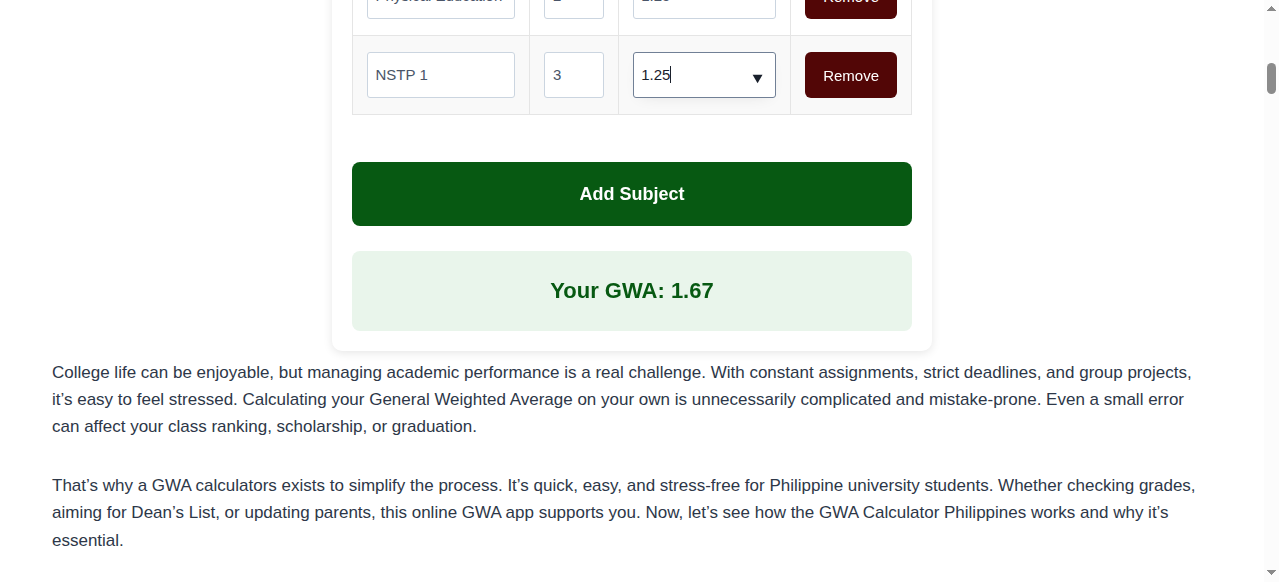
Meet a first-year student — call her Ana. Her first semester is almost entirely general education subjects, the same load most freshmen carry whatever their program: six GE subjects, plus PE and NSTP. Her eight first-semester subjects came back with these grades:
| Subject | Grade | Units | Points |
|---|---|---|---|
| Understanding the Self | 1.50 | 3 | 4.50 |
| Mathematics in the Modern World | 2.00 | 3 | 6.00 |
| Purposive Communication | 1.75 | 3 | 5.25 |
| Readings in Philippine History | 1.50 | 3 | 4.50 |
| The Contemporary World | 2.25 | 3 | 6.75 |
| Science, Technology and Society | 1.75 | 3 | 5.25 |
| Physical Education 1 | 1.25 | 2 | 2.50 |
| NSTP 1 | 1.25 | 3 | 3.75 |
| Total | 23 | 38.50 |
GWA = 38.50 ÷ 23 = 1.67
That 1.67 is a strong first semester — comfortably inside the common 1.75 Dean’s List line, and a long way from the 2.00 shifting floor. The Contemporary World at 2.25 is the heaviest drag on the average (6.75 points on 3 units), while PE and NSTP at 1.25 pull it the other way. That is the whole logic of a weighted average: a 3-unit subject moves the result half as much again as a 2-unit subject, so the subjects you struggle with matter most when they carry the most units. Watch the video below: the same eight subjects typed into the live calculator, arriving at 1.67.

The photo above shows the same kind of check in a library: grades going into the calculator one row at a time, notebook open beside the laptop. Do it this way — one row per subject, grade and units together — and the calculator updates live as you type, so a mistyped grade shows up immediately as a number that does not look like yours.
Worked Example 2: A Freshman Second Semester — GWA 1.83
Now Ana’s second semester, where the GE load continues — Art Appreciation, Ethics, Rizal, Filipino, Environmental Science — plus a first taste of a major subject:
| Subject | Grade | Units | Points |
|---|---|---|---|
| Art Appreciation | 1.75 | 3 | 5.25 |
| Ethics | 2.00 | 3 | 6.00 |
| Life and Works of Rizal | 1.50 | 3 | 4.50 |
| Filipino (Komunikasyon) | 2.50 | 3 | 7.50 |
| Introduction to Computing | 2.25 | 3 | 6.75 |
| Environmental Science | 1.75 | 3 | 5.25 |
| Physical Education 2 | 1.50 | 2 | 3.00 |
| NSTP 2 | 1.25 | 3 | 3.75 |
| Total | 23 | 42.00 |
GWA = 42.00 ÷ 23 = 1.83
Ana’s 1.83 is still solid — but just outside the common 1.75 Dean’s List line, and the reason is one subject: Filipino at 2.50 contributes 7.50 points, more than any other subject in the load. Bring that grade from 2.50 to 2.00 and the points fall to 40.50, which over 23 units is 1.76 — still just outside the line; bring it to 1.75 and the points fall to 39.75, which is 1.73 — back inside. That is how a single 3-unit subject decides a semester, and it is why the advice in every “how to improve your GWA” list boils down to one thing: put your study hours into the high-unit subjects first, because they move the average the most.
Your First Year Is One Number, Not Two
Most freshmen watch each semester separately and never compute the cumulative figure — and the cumulative figure is the one that actually decides things. Latin honours, shifting, retention and most scholarship renewals all run on the cumulative GWA, not on either semester alone. Ana’s two semesters combine like this:
| Semester | GWA | Units | Points |
|---|---|---|---|
| 1st semester | 1.67 | 23 | 38.50 |
| 2nd semester | 1.83 | 23 | 42.00 |
| First year (cumulative) | 1.75 | 46 | 80.50 |
Cumulative GWA = 80.50 ÷ 46 = 1.75
Ana’s first year cumulates to exactly 1.75 — the Cum Laude line at UP and the common Dean’s List line. Notice what the arithmetic does here: the plain average of 1.67 and 1.83 is also 1.75, because both semesters carry the same 23 units. That coincidence hides the rule that matters: never average semester GWAs directly. If the semesters carry different unit loads, the plain average is wrong. The correct method — the one every competitor page that does cumulative GWA properly uses — is to multiply each semester’s GWA by its units, add the products, and divide by the total units. One competitor page demonstrates the difference well: three semesters at 1.80 (24 units), 1.95 (21 units) and 1.75 (18 units) give a cumulative of 1.84, while the plain average of the three GWAs gives 1.83 — wrong, because it ignores the units. Keep a running record each semester, in points and units, and the cumulative figure is one division away at any point in your degree.
That 1.75 also shows why the first year matters more than it feels like it does in week one. A cumulative GWA is a weighted average over everything you have taken, so the first year’s 46 units are nearly a third of a typical 130-unit degree — and they are the hardest units to repair later, because every later semester has to drag the same 46 units with it. A freshman who finishes first year at 2.50 needs three later semesters at 1.50 just to pull the cumulative back to 1.90. The first year is not a warm-up. It is the foundation the rest of the average is built on.
What a Good Freshman GWA Is: Dean’s List, UP Scholars, and the Shifting Floor
“Good” depends on what you want the number to do. A 1.67 first semester is good in every sense — but the lines it crosses are specific, and two of them are widely misquoted. If you searched for gwa for freshmen students philippines because you want to know where you stand after your first semester, this is the table to read. Here are the lines that matter in first year, with the source for each:
| What it decides | The line | Also required | Who sets it |
|---|---|---|---|
| Dean’s List (most colleges) | 1.75 or better, per semester | No failing grade; full load | Each college — 1.75 is the common line, not a national rule |
| UP University Scholar | 1.45 or better, per semester | At least 15 units of academic credit; no grade below 3.00 in any subject | Revised UP Code, Art. 381 |
| UP College Scholar | 1.75 or better, per semester | At least 15 units of academic credit; no grade below 3.00 in any subject | Revised UP Code, Art. 382–383 |
| Latin honours at graduation (UP) | Summa 1.00–1.20; Magna 1.21–1.45; Cum Laude 1.46–1.75 (cumulative) | Residency (75% of units at UP, 2 years); 15 units per semester; no 4.00/5.00 | Revised UP Code, Art. 410 |
| Shifting to another program (UP) | Typically 2.00 or better (some programs 1.75, some 2.25–2.50) | 30–33 units earned; no failing grade | UP Diliman PRIMER AY 2026–2027, by college |
| Shifting / transferring (UMAK) | College GWA 1.50–2.50 depending on program | No failing grade, no unofficially dropped, no incomplete; letter of approval | UMAK admission requirements |
The UP scholar lines deserve a paragraph of their own, because a page ranking at the top of Google gets both of them wrong. That page — gwacalculatorph.com’s UP calculator — states that “a student who earns a semester GWA of 1.75 or better … is recognized as a University Scholar” and that “a semester GWA of 2.00 or better” makes a student a College Scholar. Both lines are wrong. The University of the Philippines’ own published rules, in the Revised UP Code as printed by the UP Diliman Office of the University Registrar, say the opposite: University Scholar is 1.45 or better; College Scholar is 1.75 or better — each with at least 15 units of academic credit in the previous semester and no grade below 3.00 in any academic or non-academic subject. A freshman at 1.50 reading that competitor page would wrongly believe they are a University Scholar; a freshman at 1.60 would wrongly believe they missed University Scholar by a little, when in fact they are a College Scholar and 0.15 away from the University line. Note also that UP does not use the term “Dean’s Lister” — the UP System awards these two scholar standings instead, evaluated fresh every semester. A student who qualifies one semester does not automatically keep the standing; they must meet the bar again the next term.

How knife-edge are those lines? The same 15-unit load was tested at each boundary. At exactly 1.45 — three subjects at 1.50 and one at 1.25, 21.75 points over 15 units — the student sits on the University Scholar line (T12d). At 1.50, one 1.50 slipping to 1.75, the student misses University Scholar but is still a College Scholar (T12e). At exactly 1.75 the student sits on the College Scholar line (T12a); one 3-unit subject slipping from 1.75 to 2.00 pushes the load to 1.80 and out of both standings (T12b). One subject, one grade step, two honours lost. Dean’s List is the same story: a load at 1.74 sits inside the 1.75 line, and one 3-unit subject slipping from 2.50 to 3.00 pushes it to 1.80 and out (T11a vs T11b).
Two cautions about the honours table. First, a semester GWA never earns Latin honours — that is the error a second competitor page makes when it tells freshmen that a first-year annual GWA of 1.44 “qualifies for Magna Cum Laude”. Latin honours are cumulative, at graduation, over the whole degree, with residency and load conditions attached. A first-year average of 1.44 puts you on pace for Magna; it qualifies you for nothing yet. Second, the UP numbers are UP’s numbers. Other universities set their own scholar and honours rules — STI, for example, awards Cum Laude at 1.31–1.50 cumulative, Magna at 1.11–1.30 and Summa at 1.00–1.10, with no grade lower than 2.25 in any credited course. Do not carry one school’s cutoffs into another school’s handbook.
Shifting deserves its own note because it is the decision most freshmen actually make at the end of first year. At UP, shifting within a college or within Diliman typically needs a GWA of 2.00 or better on 30–33 earned units — some programs ask for 1.75, some for 2.25 or 2.50, and the requirements are published program by program in the UP Diliman PRIMER for the coming academic year. At UMAK, shifters need a college GWA of 1.50 (91–93%) for the most competitive programs, 2.00 (85–87%) for most bachelor’s programs and 2.25–2.50 for others, with no failing grade, no unofficially dropped subject and no incomplete in any semester. The tested boundary cases say the same thing in numbers: a load at exactly 2.00 sits on the common shifting floor (T12c); at 2.25 it misses it (T22). If you are a freshman thinking of shifting, 2.00 is the number to protect — and it is a much easier number to protect in first year, when the load is mostly general education, than in second year, when the major subjects arrive.
When a Subject Goes Wrong: Failed, Dropped, Incomplete, Retaken
First year is when most students meet their first 5.00, their first INC, or their first dropped subject — and first year is when those marks cost the most, because there are so few units to dilute them. Here is what each one actually does to the number, tested against the calculator code:
A failed subject is expensive. Take Ana’s first semester (GWA 1.67) and change one subject — Mathematics in the Modern World — from 2.00 to 5.00. The points rise from 38.50 to 47.50, and 47.50 ÷ 23 = 2.07 (T04). One failed 3-unit subject moves the semester by 0.40. Now drop that same subject before the deadline instead of failing it: the points fall to 32.50 over 20 units, and 32.50 ÷ 20 = 1.63 (T05) — actually better than the original 1.67, because the failed subject is gone entirely. The swing between failing and dropping the same subject is 0.44 of GWA. That is the single most valuable decision a freshman makes in a bad semester, and it has a deadline: once the dropping period closes, the choice is gone. Know your school’s dropping deadline in week one, not in week fourteen.
An incomplete grade breaks the calculator — and it should not be in it. Type INC into the grade box and the whole display reads invalid grade (T07a), because the calculator has no INC in its grade map and no remark grades at all. The fix is to delete the INC row and compute without it (T07b), then recompute once the INC is completed and replaced with a final grade. The same rule applies to any grade the calculator does not recognise: an empty grade field (T17), a 0.75 (T25a — below the 1.00 floor) and a 5.25 (T25b — above the 5.00 ceiling) all produce invalid grade. And the quirk from the testing: a row with zero units but a bad grade still poisons the whole result (T18), because the grade is checked before the units are. If a stray dropped-subject row is breaking your calculation, delete the row — setting its units to zero is not enough.
Retakes depend on your school, not on the calculator. The calculator counts every row you give it. If your school counts both attempts, a failed first attempt stays in the GWA alongside the retake; if your school replaces the grade, only the retake counts. The same retake can sit 0.81 apart depending on the rule — in the tested cases, a load with both attempts counted came to 2.56, while the same load with only the retake counted came to 1.75. STI counts a failed course every time it was taken, so the 5.00 stays; UP Mindanao counts a removal grade of 5 together with the passing grade after re-enrolling. Other schools replace. Ask your registrar which rule your school uses before you trust the number — and before you decide whether retaking a subject is worth the units. For how retention rules work in one specific program — including a university whose own documents disagree about the retention bar — see our guide to GWA for agriculture students.
UP’s scholastic standing is not a GWA floor. One competitor page invents a UP rule that “a GWA of 2.0 or better is usually required to stay in good standing”. There is no such rule. UP’s standing is driven by the proportion of failed units: failing 25–49% of registered units triggers a warning, 50–75% puts you on probation, and above 75% leads to dismissal. A student with a 2.30 GWA and no failed units is in good standing; a student with a 1.90 GWA who failed half their units is on probation. The GWA and the standing measure different things, and a freshman who watches only the GWA can be blindsided by the other one.
Do PE and NSTP Count? The Same Grades, Three Different GWAs
Ask ten freshmen whether PE and NSTP count in the GWA and you will get ten confident answers, most of them wrong for somebody’s school. One competitor page answers “at most schools, no” — a generalisation with no source, and the other pages in this set contradict it: STI leaves NSTP out, while Arellano University counts PE and NSTP/ROTC in the cumulative GWA it uses for retention. At UP, PE and NSTP are typically excluded from the GWA, though it can vary by college or campus. The honest answer is that it depends on the school, and the article that helps a freshman is the one that shows the size of the difference instead of picking a side. Here it is, on Ana’s first-semester load:
| What is counted | Points ÷ Units | GWA |
|---|---|---|
| Everything, including PE and NSTP | 38.50 ÷ 23 | 1.67 (T01) |
| NSTP excluded | 34.75 ÷ 20 | 1.74 (T06) |
| PE and NSTP excluded (UP-style) | 32.25 ÷ 18 | 1.79 (T06b) |
The same eight grades give 1.67, 1.74 or 1.79 depending on a rule the student never sees printed on their class card — and the difference crosses the 1.75 Dean’s List line. A student who counts NSTP when their school does not will think they made Dean’s List when they did not; a student who excludes PE when their school counts it will think they missed it when they made it. The fix takes thirty seconds: ask the registrar, or check the student handbook, which subjects count — and then compute the GWA both ways once, so you know how much the rule matters for your own grades. A GE-only load (the six GE subjects, no PE or NSTP at all) gives the same 1.79, which is a useful cross-check: if your GE-only figure and your all-subjects figure disagree by more than a few hundredths, one of the two is using the wrong rule.
The Mistakes the Top Pages Make (So You Don’t Repeat Them)
Ten pages were read in full for this guide. Most of their arithmetic is correct — the formula is simple and hard to get wrong. The errors are in the claims around it, and they are the kind that cost a freshman a scholarship application or a wrong expectation. Here are the ones that matter, quoted and corrected:
1. “University Scholar is 1.75 or better.” Wrong — see the table above. The official UP Code says University Scholar is 1.45 or better and College Scholar is 1.75 or better. The competitor page that states it (gwacalculatorph.com) also invents a 2.00 College Scholar line. If you are at UP, trust the UP Code, not a calculator page.
2. “Percentage = ((5.00 − GWA) ÷ 4.00) × 100.” Wrong formula, from a top-ranking calculator page (onlinegwacalculator.com). It turns a 2.50 GWA into 62.5% and a passing 3.00 into 50%. Use percentage = 100 − (GWA − 1.00) × 12.5 instead, which gives 2.50 ≈ 81% and 3.00 = 75% — or better, use the site’s GWA to percentage converter and remember that any linear formula is a convention, not your school’s transmutation table.
3. “A high-school average of (85 + 90 + 88 + 82) ÷ 4 = 1.82.” Wrong, from the same page. The sum is 345 and 345 ÷ 4 = 86.25 — which the page itself says two lines later (“Your GWA is 86.25”), contradicting its own result. The 1.82 was copied from the college example above it. If a page contradicts itself inside one example, check its other examples too.
4. “CHED says GWA must be computed to three decimal places and compared without rounding.” Unverified. No CHED text stating this was found; what university codes actually say is that the average is carried to three or four places and then rounded to two. Rounding is set by each school. Do not quote a CHED rule you cannot find in a CHED document.
5. “A first-year GWA of 1.44 qualifies for Magna Cum Laude.” Wrong in kind, not in number. Magna Cum Laude is a cumulative graduation honour. A first-year average of 1.44 is on pace for it; it qualifies you for nothing yet. The same page repeats the error for a single-semester 1.25 (“qualifies you for Magna Cum Laude”) and a 1.00 (“qualifies you for Summa Cum Laude”). Semester numbers earn term recognition; cumulative numbers earn graduation honours.
6. “A plain average is a method of computing GWA.” Wrong. A plain average is the senior high school method. In college, every subject is multiplied by its units first — that is what the “W” means. A freshman who averages their grades plainly will get a number that matches no registrar’s figure.
7. “2.50 to 3.00 is below average” and “a 1.0 is rare outside the top 1–2% of students.” The first is a value judgement dressed as a fact; the second is an invented statistic, admitted by the page’s own reference note to be illustrative. A 2.50 is a normal passing average, inside the shifting floors at most schools. Do not let a calculator page grade-shame a passing average.
8. “At most schools, NSTP does not affect your GWA.” Unestablished, and contradicted by other pages in the same set. Some schools exclude NSTP, some include it, and the difference on a real freshman load is 0.12 of GWA — enough to cross the Dean’s List line. Ask your registrar; do not trust a generalisation.
One page deserves praise rather than correction: gwacalculators.ph’s cumulative GWA guide is the strongest competitor in the set — its arithmetic checks out on every example, it sources STI’s handbook rules properly, and it is honest about school-by-school differences, including a table that admits its own gaps. The standard it sets — recompute everything, source every rule, admit what varies — is the standard this guide was written to.
Your First-Year Routine: Five Habits That Protect the Number
1. Compute after every grading period, not at the end of the semester. Type each subject in as its grade comes out. The calculator updates live, so a mistyped grade shows up immediately — and a mid-semester GWA tells you which subject needs the study hours while there is still time to move it.
2. Keep a running record in points and units. A notebook line per semester — total points, total units — is all it takes. The cumulative GWA is then one division away at any moment, and any discrepancy with the registrar’s figure is easy to spot while it can still be corrected. One competitor page gives the same advice, and it is the best advice in the set.
3. Know your dropping deadline in week one. The difference between failing a subject (1.67 → 2.07) and dropping it (1.67 → 1.63) is 0.44 of GWA on a real freshman load. That decision is only available before the deadline closes.
4. Ask the registrar three questions in your first month. Which subjects count in the GWA — PE? NSTP? What is the Dean’s List line here? And what happens to a failed grade when the subject is retaken — does it stay, or is it replaced? The answers are different at every school, and every number in this guide that depends on them is labelled with the school that sets it.
5. Protect the 2.00. If there is any chance you will want to shift programs after first year, treat 2.00 as your floor, not 3.00. A 2.00 cumulative after first year keeps every shifting door open; a 2.25 closes the competitive ones. And if you are at UP, remember the other floor that matters: 15 units a semester, no grade below 3.00, or the scholar standings are out of reach no matter what the average says.
Frequently Asked Questions
What is a good GWA for a freshman in the Philippines?
A 1.75 or better is strong at most colleges — it is the common Dean’s List line and the Cum Laude line at UP. A 1.67 first semester, like the worked example above, is comfortably inside it. A 2.00 or better keeps every shifting option open. Below 2.50 you are passing but outside honours and most scholarship lines; at 3.00 you are passing and nothing more. What counts as “good” depends on your goal, so pick the line that matches it — Dean’s List, scholar standing, shifting, or simply staying enrolled — and aim at that number, not at a vague idea of good.
How do I compute my GWA as a freshman?
List every subject with its grade and its units, multiply each grade by its units, add all the products, and divide by the total units. Convert percentage grades to the 1.00–5.00 scale first (GWA = 1.00 + (100 − percentage) ÷ 12.5) — typing a percentage into a college calculator gives “invalid grade”. A worked first semester: eight subjects, 38.50 points over 23 units, GWA 1.67.
What GWA do I need to get into PUP as a freshman?
A senior high school general average of 82% and above, plus a passing PUPCET score, 82% in English, and a passed college interview. Some programs demand more — BS Accountancy asks for an 88% high school average and 85% in English and Math. The 82% is a percentage average on your Form 138, not a college GWA.
Does NSTP affect my GWA?
It depends on your school. At UP, PE and NSTP are typically excluded; at some schools they are included — Arellano University counts them in the cumulative GWA used for retention, while STI leaves NSTP out. On the worked first semester in this guide, the same grades give 1.67 with NSTP counted, 1.74 without it, and 1.79 without PE and NSTP. Ask your registrar which rule your school uses.
What GWA makes you a University Scholar at UP?
A semester GWA of 1.45 or better, with at least 15 units of academic credit and no grade below 3.00 in any subject (Revised UP Code, Art. 381). College Scholar is 1.75 or better under the same conditions. One top-ranking calculator page states the lines as 1.75 and 2.00 — both are wrong.
Can I shift to another program after first year?
Usually yes, if your first-year GWA clears the receiving program’s floor — typically 2.00 or better at UP (some programs 1.75, some 2.25–2.50) on 30–33 earned units, and a college GWA of 1.50–2.50 at UMAK depending on the program, with no failing grade, no unofficially dropped subject and no incomplete. Check the current year’s primer or admission page for the program you want.
What happens to my GWA if I fail a subject in first year?
A single failed 3-unit subject moved the worked first semester from 1.67 to 2.07. The failed grade stays in the GWA at schools like STI that count every attempt; at schools that replace the grade, only the retake counts. Dropping the subject before the deadline instead of failing it gives 1.63 on the same load. Know your dropping deadline and your school’s retake rule.
Is a 1.75 GWA good enough for Cum Laude?
A cumulative GWA of 1.75 sits exactly on the Cum Laude line at UP (1.46–1.75) — but only as a cumulative figure at graduation, with residency, load and no-failing-grade conditions attached. A single semester at 1.75 does not earn Cum Laude; it puts you on pace for it. Keep the cumulative figure, not the semester figure, in view from first year onward.
Your first year in college is the only year when the whole system is new at once — a new scale, a new average, new rules about what counts and what does not. The students who struggle with it are rarely the ones who cannot do the arithmetic. They are the ones who typed a percentage into a college calculator and trusted the error, or who believed a page that said 1.75 makes you a University Scholar, or who found out in second year that their first-year average was already a third of their degree. If you came here searching for gwa for freshmen students philippines, you now have the whole picture: the admission average that got you in, the first-semester load worked out loud, the scholar lines as the universities themselves print them, and the three numbers your first year actually produces. Compute it yourself, from your own class card, with the rules your own school sets — and check it against the registrar’s figure the first time, while a discrepancy is still easy to fix. The calculator on this site will do the arithmetic in seconds, for free, with no signup. The judgement about what the number means is yours, and now you have the numbers to make it with.
