
GWA for Senior High School Students Philippines 2026
If you are in Grade 11 or Grade 12 in the Philippines, you have probably typed gwa for senior high school students philippines into Google at least once — usually the night the report card comes out, usually with one very specific number in mind. Am I still With Honors? Do I qualify for the CHED scholarship? Is my average high enough for my dream course at UP, UST, or Ateneo? And the first thing most students discover is that the answer is messier than the search results make it look: half the GWA pages on Google are written for college students, the other half mix up the DepEd percentage system with the college 1.00–5.00 scale, and at least two of the top ten pages ship worked examples with wrong arithmetic in them.
This guide is written for senior high school students specifically — Grade 11 and Grade 12, all strands — and every number in it was checked twice. The worked examples use real SHS subjects with real grades, the quarterly-grade example follows DepEd’s actual component weights, and every computation that runs through this site’s calculator was tested against the calculator’s own code: 26 test cases, 26 passed. Along the way, this guide also corrects the mistakes sitting at the top of Google right now. One popular page tells students DepEd uses letter grades A+ to F — it does not. Another claims a CHED scholarship needs a “1.75 GWA” — CHED judges incoming freshmen on their percentage average, 93% or 96%, not a college GWA they have never had. And one page’s own worked example says (85 + 90 + 88 + 82) ÷ 4 = 1.82. It is 86.25.
GWA for Senior High School Students Philippines: The Short Answer
Your SHS GWA — the general average on your report card — is the simple average of your final subject grades, all in percentages. Add up the final grades, divide by the number of subjects. No credit units, no weighting, no 1.00–5.00 scale. A 90.00 average is With Honors. A 74 in a single subject can cost you honors and force remedial classes even if your average is 90. And the number that matters depends on which gate you are standing at:
| Gate | The number | What it decides |
|---|---|---|
| Passing a subject | 75% in every subject | Anything below 75 is Did Not Meet Expectations — failed, whatever your average is. |
| With Honors (DepEd) | General average 90–94%, no grade below 80 | Academic Excellence Award. A 76 in one subject disqualifies you even with a 95 average. |
| With High Honors | 95–97%, no grade below 80 | Second-highest DepEd award band. |
| With Highest Honors | 98–100%, no grade below 80 | Top DepEd award band — and the Bagong Pilipinas scholarship door (95%+). |
| CHED Merit Scholarship | 93% (Half Merit) / 96% (Full Merit) | For incoming freshmen; parents’ combined income must not exceed ₱500,000 a year. |
| Bagong Pilipinas Merit Scholarship | 95%+ and top 5 of your graduating class | Up to ₱208,000 a year at a private university in Metro Manila. |
| DOST-SEI Scholarship | No GWA threshold — exam-based | Selection runs through DOST-SEI’s own qualifying exam plus priority S&T courses. Any page quoting a “90% DOST cutoff” is inventing it. |
| Promotion to the next grade | Count of subjects below 75, not the average | 1–2 failed subjects: conditionally promoted, take remedial classes. 3 or more: retained. |
Everything below explains how each of those numbers is actually computed — and where Google’s top pages get them wrong.
What GWA Means for an SHS Student (and What It Does Not)
In senior high school, your GWA is your general average: the average of the final grades on your report card (Form 138 / SF9). DepEd grades are percentages from 60 to 100, and every percentage carries a descriptor:
| Percentage | DepEd descriptor | What it means |
|---|---|---|
| 90–100 | Outstanding | With Honors territory (90–94) and above. |
| 85–89 | Very Satisfactory | Strong, but one band below honors. |
| 80–84 | Satisfactory | Comfortably passing. |
| 75–79 | Fairly Satisfactory | Passed, but only just. |
| Below 75 | Did Not Meet Expectations | Failed. Remedial classes or retention follow. |
Three things about this system trip students up every year — and they are the reason the search for gwa for senior high school students philippines returns so much wrong information. First, there are no letter grades in DepEd SHS — no A+, no B, no C+ Fair. A page ranking near the top of Google right now prints a “10-point grading scale” mapping 70–74 to “C+ Fair” and below 60 to F. That table is a generic US-style scale pasted into a Philippine article. On a DepEd report card, 70–74 is not a C+. It is a failure. Second, there are no credit units in SHS. Subjects are measured in hours per week, not college units, so the college formula (grade × units ÷ total units) does not apply to your report card. Your GWA is a simple average: every subject counts the same. Third, the 1.00–5.00 scale is a college scale. It shows up in SHS life only when you convert — for example, to use a college-style calculator like the one on this site — and the conversion is a separate step with its own formula, explained below.
One caveat, because it matters: a few private schools apply their own weighting to SHS grades. If your school does, your registrar’s number is the official one, not the simple average. The DepEd method in this guide is the standard for public schools and the benchmark most private schools follow — but when in doubt, ask the registrar before you argue with your report card.
How One Quarterly Grade Is Built (WW / PT / QA)
Before your GWA exists, each subject’s grade has to be built — and this is the step no competitor page explains end to end. A quarterly grade (now called a term grade under the new system) is not one test score. It is three components, weighted differently depending on the subject:
| Subject group (DepEd Order No. 8, s. 2015, Table 5) | Written Works | Performance Tasks | Quarterly Assessment |
|---|---|---|---|
| Core subjects (all tracks) | 25% | 50% | 25% |
| Academic track — all other subjects | 25% | 45% | 30% |
| Academic track — Work Immersion / Research / Exhibit / Performance | 35% | 40% | 25% |
| TVL / Sports / Arts and Design — all other subjects | 20% | 60% | 20% |
| TVL / Sports / Arts — Work Immersion / Research / Exhibit / Performance | 20% | 60% | 20% |
Notice what the weights reward: in a core subject like Oral Communication, half your quarterly grade is performance tasks — the speeches, the presentations, the recitations — not the written quizzes. In TVL subjects it is 60%. The quarterly exam is never more than 30%. Students who pour everything into exam week and coast on performance tasks are optimising for the smallest slice of their grade.
Here is the build, step by step, for Oral Communication in the first quarter. The subject is a core subject, so the weights are 25% / 50% / 25%:
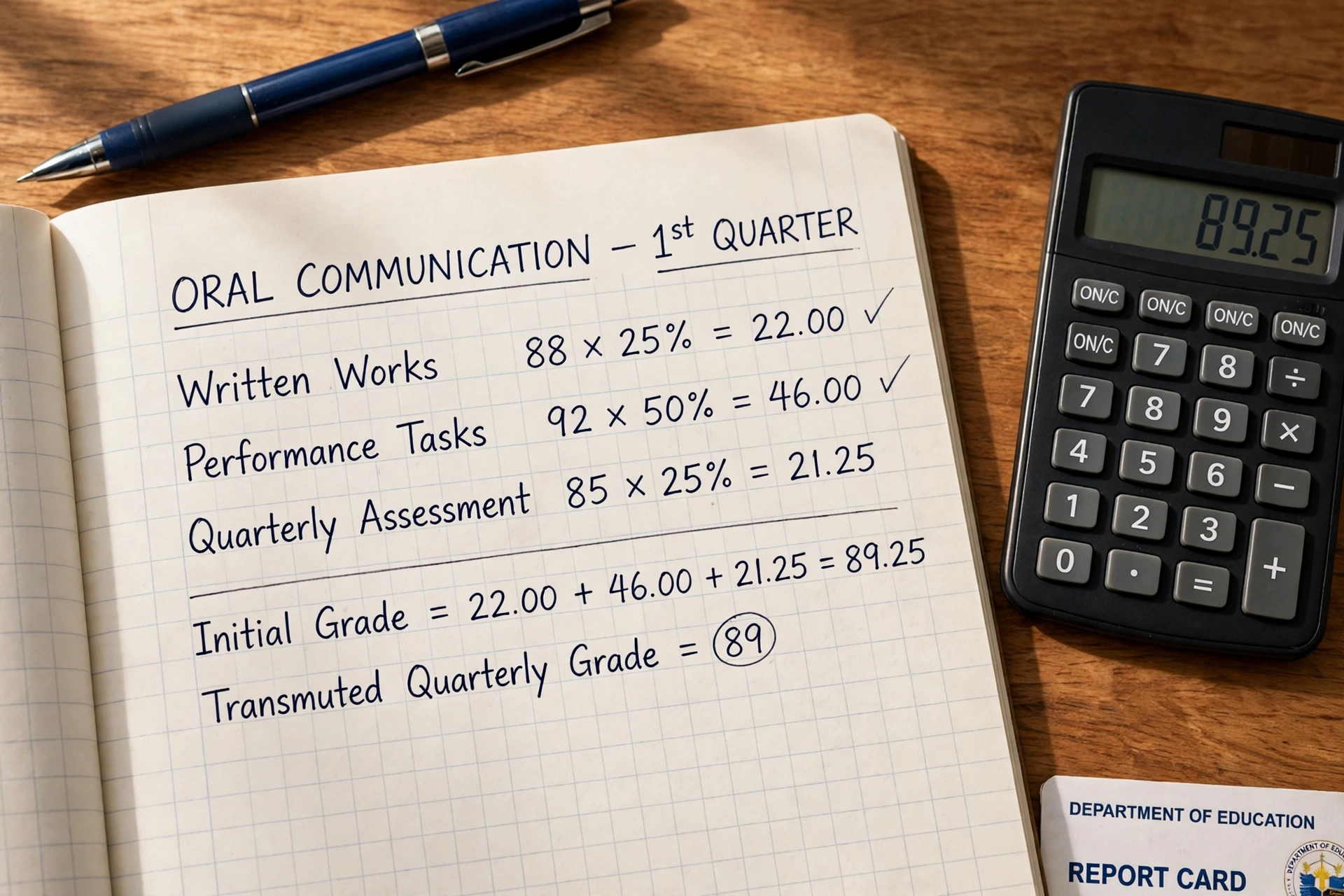
Written Works 88 × 25% = 22.00. Performance Tasks 92 × 50% = 46.00. Quarterly Assessment 85 × 25% = 21.25. Add them: 22.00 + 46.00 + 21.25 = 89.25. That 89.25 is the initial grade — the raw weighted score. It then goes through DepEd’s transmutation table to become the grade on the report card: 89.
What changed in SY 2026–2027 — read this before you trust an old guide. DepEd Order No. 015, s. 2026 (issued June 4, 2026) supersedes DepEd Order No. 8, s. 2015 and the awards policy under DepEd Order No. 36, s. 2016, and takes effect from school year 2026–2027. Three things change: the four-quarter calendar becomes a three-term calendar (Term 1, Term 2, Term 3), so a subject’s final grade is the average of three term grades instead of four quarterly grades; the transmutation table is adjusted so that an initial grade of 70 (not 60) transmutes to the passing 75 for this transition year; and from SY 2027–2028, transmutation is phased out entirely — the computed grade is reported directly, with 75 as the passing mark. One important exception written into the order itself: Grade 12 still uses the DepEd Order No. 8, s. 2015 component weights for SY 2026–2027, because Grade 12 has not yet moved to the Strengthened SHS Curriculum — the adjusted transmutation table applies to it, the old weights do not change. If you are in Grade 11, ask your teacher which weights your school is applying this year; if you are in Grade 12, the table above is still your table.
That transmutation step is where a lot of confusion lives. Under the old table, a raw 60% became a passing 75 on the report card — which is why older guides say “60 is the passing raw score.” Under the SY 2026–2027 adjusted table, the raw score that transmutes to 75 is 70. From SY 2027–2028 there is no table at all: a computed 75 is a 75. The one constant through all three systems is the report-card floor: 75 passes, 74 fails.
Worked Example 1: A Grade 11 Report Card, Start to Finish
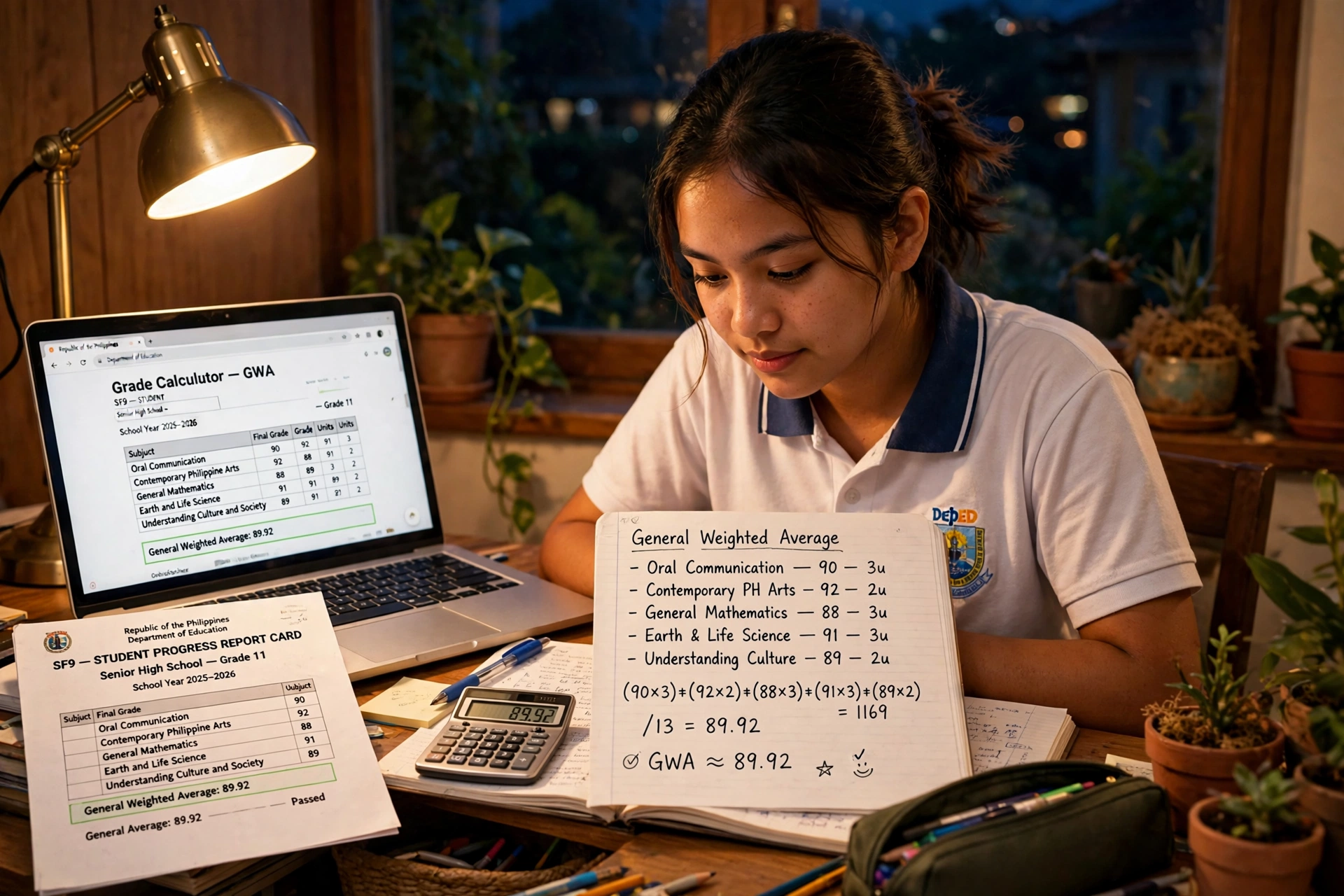
Meet a Grade 11 student — call her Ana, STEM strand, first semester. Her five core subjects came back with these final grades: Oral Communication 90, Contemporary Philippine Arts from the Regions 92, General Mathematics 88, Earth and Life Science 91, Understanding Culture, Society and Politics 89.
Her DepEd GWA is the simple average:
(90 + 92 + 88 + 91 + 89) ÷ 5 = 450 ÷ 5 = 90.00
That is a 90.00 — Outstanding, and exactly on the With Honors line (90–94%). One point lower in any subject and she drops to 89.80, Very Satisfactory, no honors. That is how thin the line is: a single point across five subjects decides the award.
Now, the notebook in the photo at the top of this article shows the same five subjects computed a different way — weighted by the unit numbers printed beside them (3, 2, 3, 3, 2): (90×3 + 92×2 + 88×3 + 91×3 + 89×2) ÷ 13 = 1169 ÷ 13 = 89.92. That 89.92 is not Ana’s DepEd GWA. It is the college-style weighted figure, and it is 0.08 lower than the official 90.00 purely because the heavier subjects happened to carry the lower grades. This is the single most common error in SHS GWA guides: importing college unit-weighting into a system that does not use it. For your report card, the simple average is the number that counts. The weighted figure is only useful when you are converting to the college scale — which is exactly what the next section does.
Using This Site’s Calculator: Convert First, Then Compute
Here is the trap that catches almost every student who searches for gwa for senior high school students philippines and opens an online calculator to check their average: this site’s calculator runs on the college 1.00–5.00 scale, not the DepEd percentage scale. We tested it — type 89 into the grade box and the result reads invalid grade, because 89 is outside the 1.00–5.00 range the calculator accepts. You have to convert each percentage to the 1.00–5.00 scale first, using this site’s own converter formula:
GWA = 1.00 + (100 − percentage) ÷ 12.5
So 90% becomes 1.80, 92% becomes 1.64, 88% becomes 1.96, 85% becomes 2.20, and 75% — the passing mark — becomes 3.00. A failed subject (below 75%) is entered as 5.00. The reverse trip, percentage from GWA, is percentage = 100 − (GWA − 1.00) × 12.5. Two honest caveats: this linear mapping is this site’s convention, and schools using DepEd’s transmutation tables may map a percentage slightly differently — if a conversion decides a scholarship, confirm the mapping with your registrar. And one quirk we found in the calculator’s code: a row with zero units but a mistyped grade still breaks the whole result with invalid grade, because the grade is checked before the units are. Delete the stray row and the calculation comes back.
Worked Example 2: A Grade 11 STEM Semester on the Calculator (GWA 1.76)
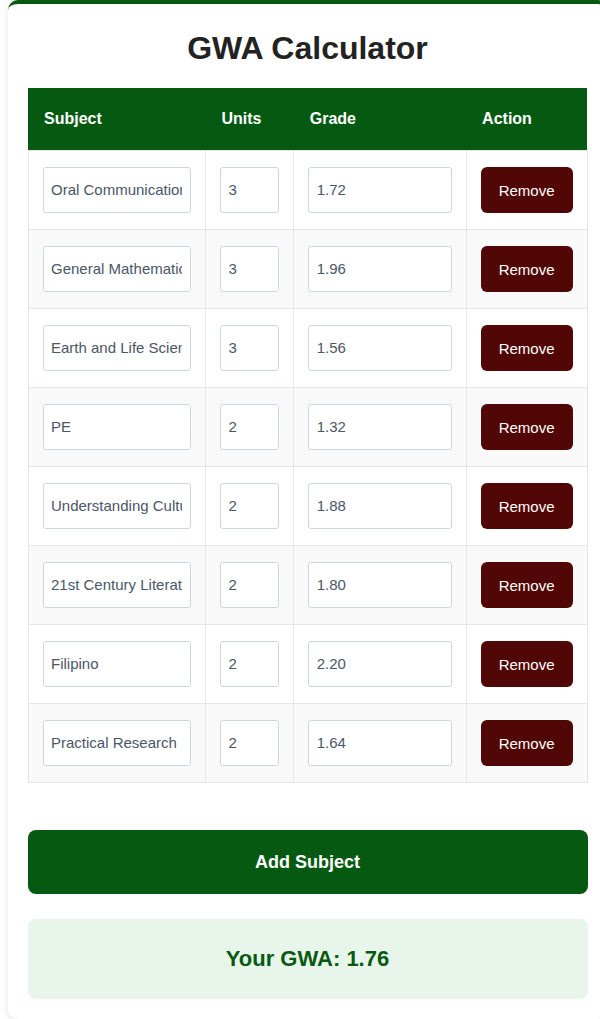
Now the same idea at full size. Ana’s classmate, a STEM student, finished his first semester with eight subjects: Oral Communication 91%, General Mathematics 88%, Earth and Life Science 93%, PE 96%, Understanding Culture, Society and Politics 89%, 21st Century Literature 90%, Filipino 85%, Practical Research 92%. Converted to the calculator’s scale and entered with the unit numbers from his enrolment form, that is:
| Subject | DepEd grade | Converted | Units | Points |
|---|---|---|---|---|
| Oral Communication | 91% | 1.72 | 3 | 5.16 |
| General Mathematics | 88% | 1.96 | 3 | 5.88 |
| Earth and Life Science | 93% | 1.56 | 3 | 4.68 |
| Physical Education and Health | 96% | 1.32 | 2 | 2.64 |
| Understanding Culture, Society and Politics | 89% | 1.88 | 2 | 3.76 |
| 21st Century Literature | 90% | 1.80 | 2 | 3.60 |
| Filipino | 85% | 2.20 | 2 | 4.40 |
| Practical Research 1 | 92% | 1.64 | 2 | 3.28 |
| Total | 19 | 33.40 |
GWA = 33.40 ÷ 19 = 1.76
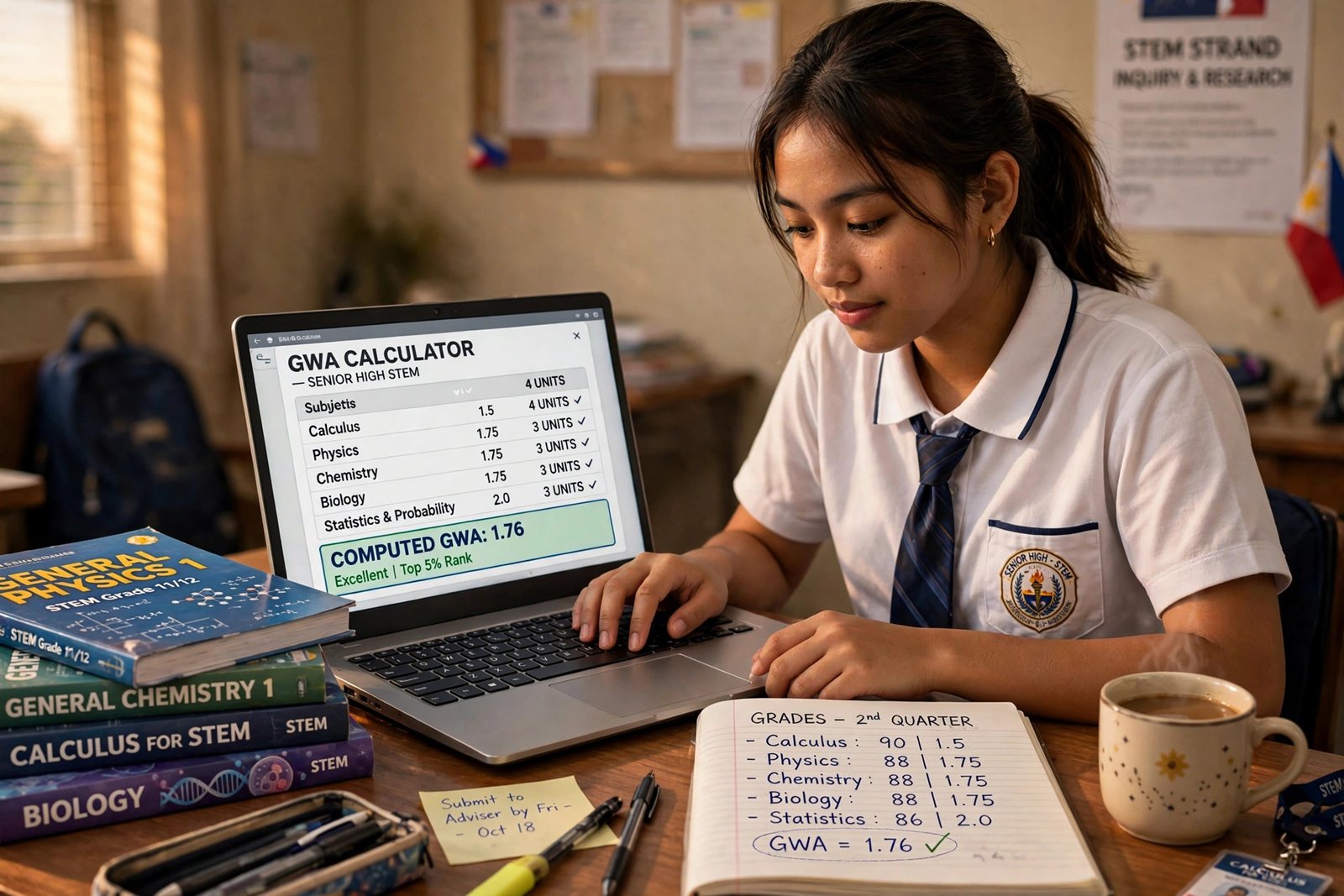
That 1.76 converts back to 90.5% (100 − 0.76 × 12.5) — and the DepEd simple average of the eight percentages is exactly the same: (91 + 88 + 93 + 96 + 89 + 90 + 85 + 92) ÷ 8 = 724 ÷ 8 = 90.5. The two routes agree here because the conversion is linear; when they disagree by a tenth or two, it is the unit-weighting and the two-decimal rounding doing it, not an error in either method. A 1.76 sits just inside the With Honors band — on this site’s scale, With Honors (90–94%) runs from about GWA 1.80 down to 1.48. Watch the video below: the same eight subjects typed into the live calculator on this site, arriving at the same 1.76.
A note for students who type letter grades: the calculator accepts letters (A+ = 1.00 through F = 5.00), but the letter D counts as 3.50 in the calculator’s code, not 3.00 as the old dropdown on the page suggested — and C counts as 2.75, not 2.50. If your school’s own table says D = 3.00, type the number 3.00 instead of the letter. And the result always shows exactly two decimals, rounded half-up: 1.625 becomes 1.63, 2.125 becomes 2.13. That rounding is verified, not assumed — it was tested against the calculator’s code.
If you only need the percentage equivalent of a college GWA (for example, a university asking for your GWA as a percentage), use the site’s GWA to percentage converter — never the linear “1.00 = 100%, 5.00 = 0%” shortcut some guides print, which claims a 2.50 GWA is about 62.5%. The real transmutation is non-linear: a 2.50 GWA is roughly 79–81%, and the converter on this site uses the formula above, which matches that range.
What One Failed Subject Really Costs
Take the same seven good subjects from a second test case — no failure, GWA 1.78 — and add one failed 2-unit subject (74%, entered as 5.00). The GWA jumps to 2.12. One subject, a 0.34 swing, and the student drops from the edge of With Honors to the middle of the Satisfactory band. That is the arithmetic of the 5.00: it is not just a low grade, it is the maximum possible grade on the scale, and it drags the average the way no other single grade can.
But the GWA is not even the worst of it. Promotion in SHS is decided by the count of failed subjects, not by the average — the only competitor page that states this clearly is gradecalculator.io, and it is right. The rule, from DepEd’s School Form 5:
- Promoted — every subject passed. Move up as normal.
- Conditionally promoted — one or two subjects below 75. You move up, but you take remedial classes for the failed subjects, and you must pass them.
- Retained — three or more subjects below 75. You repeat the grade level.
Read that again: a student with a 90 average and one 74 is conditionally promoted and loses honors. A student with an 88 average and three 74s repeats the year. The average alone never tells you whether a student moves up. If your report card has a subject below 75, the first question is not “what is my GWA” — it is “how many subjects, and when do remedial classes start.”
Honors: The 90 Line and the 80 Floor
DepEd’s Academic Excellence Awards run on two numbers at once: the general average, and the lowest single grade. The bands, from DepEd Order No. 36, s. 2016 and confirmed in DepEd Order No. 015, s. 2026:
- With Honors: general average 90–94%
- With High Honors: 95–97%
- With Highest Honors: 98–100%
- In every band: no grade below 80 in any subject.
That last line is the one competitors get wrong. The SHS calculator page ranking at the top of Google states the rule as “no grade below 75%” — that is the passing mark, not the honors floor. A student with a 76 in one subject and a 95 average is not eligible for honors at all. If your average is 95 but one subject sits at 79, the award you are chasing does not exist for you this year — and no amount of extra credit in other subjects fixes it, because the floor is per-subject. On this site’s converted scale, the With Honors band is roughly GWA 1.48–1.80, High Honors 1.24–1.40, Highest Honors 1.00–1.16. The all-high test case we ran — grades of 95–98% across six subjects — came out at GWA 1.24, right at the edge of With Highest Honors.
Scholarships: Three Programmes, Three Different Numbers
Scholarship guides blur these programmes together more than any other topic in this niche. They are separate programmes with separate rules, and quoting one programme’s number for another’s application is how students miss deadlines they were actually qualified for.
| Programme | GWA needed | Other conditions |
|---|---|---|
| CHED Merit Scholarship — Full Merit | 96% SHS general average | Filipino citizen, incoming freshman, priority course, parents’ combined income ≤ ₱500,000/year. |
| CHED Merit Scholarship — Half Merit | 93% SHS general average | Same conditions as Full Merit. Note: the average CHED looks at is typically Grade 11 plus the first semester of Grade 12 for graduating applicants. |
| Bagong Pilipinas Merit Scholarship Program | 95%+ and top 5 of the graduating class | High Honors or Highest Honors graduate, low-to-middle-income household, CHED-recognised HEI in a priority programme, return-service agreement. Details in the Philippine Information Agency’s report on the programme. |
| DOST-SEI Undergraduate Scholarship | No GWA threshold — qualifying exam | Priority science and technology courses, income rules, and DOST-SEI’s own examination. Your GWA gets you to the exam; the exam decides the scholarship. |
Two corrections to what Google currently says. First, the income ceiling for CHED Merit is ₱500,000 a year, per CHED’s official regional calls — one widely read guide still prints ₱400,000, which would wrongly turn away families earning between the two figures. Second, CHED’s cutoffs are percentages, not college GWAs: a page stating “CHED Merit — 1.75 or better” is meaningless for a Grade 12 applicant, because a Grade 12 student has never had a college GWA. The 93% / 96% figures are the real ones, and they are judged on your SHS percentage average — the same number this whole guide teaches you to compute. Keep the programmes apart when you plan: a 94% average qualifies you for CHED Half Merit but not for Bagong Pilipinas (95% plus top 5), and a 96% average qualifies you for CHED Full Merit whether or not you crack your class top 5. Full details and the current cycle’s requirements are on ched.gov.ph — confirm there before you apply, because cutoffs and income ceilings are set per cycle.
One more distinction worth money: the average that qualifies you for a scholarship is not the average that keeps it. CHED and DOST both set a maintaining grade every semester, and failing a subject can terminate the grant outright. Students who win a scholarship on a 96% average and then relax into a 2.50 college GWA routinely lose it in the first year. The scholarship game is won twice — once in Grade 12, once every semester after.
Strands: Same Rules, Different Workloads
Every strand — STEM, ABM, HUMSS, TVL, GAS, and the sports and arts tracks — plays by the same DepEd grading rules: same descriptors, same 75 passing mark, same honors bands, same simple-average GWA. What changes is where the weight falls and which grades matter most for the course you want next.

- STEM: the specialised subjects are mathematics- and science-heavy (Pre-Calculus, Basic Calculus, General Physics, General Chemistry), and the Academic-track weights apply — 25% written works, 45% performance tasks, 30% quarterly assessment for most specialised subjects. A STEM GWA is usually decided by the science and math grades, and those are the grades engineering and health-science programmes look at first.
- ABM: specialised subjects run on business mathematics, accounting, and business simulation — and the Business Enterprise Simulation subject is assessed on the immersion-style weights (35% written works, 40% performance tasks, 25% quarterly assessment). Accountancy and business programmes weigh the ABM specialised grades heavily.
- HUMSS: reading-, writing-, and discussion-heavy specialised subjects, with performance tasks carrying the largest share of the grade. Strong HUMSS grades signal the communication and critical-thinking skills that law, education, and social-science programmes screen for.
- TVL: the most hands-on strand — 60% of most subject grades is performance tasks, and the National Certificate (NC) assessments sit outside the GWA entirely. A TVL student’s GWA understates their employability by design: the NC is the credential employers ask for.
- GAS (General Academic Strand): the flexible strand — a mix of subjects from the other tracks, useful if you are undecided, but it means your GWA is built from a broader spread of subjects with no single strength to lean on.
The practical point: two students with the same 90.00 GWA are not the same applicant. A 90 built on STEM physics and calculus reads differently to an engineering admissions office than a 90 built on TVL workshop subjects. Pick your strand for the course you want, not for the GWA you think it will give you — the grading rules are identical, but the subjects are not interchangeable.
How Colleges Actually Use Your SHS GWA
Your SHS GWA is an admissions input, not a verdict — but it is a heavily weighted one, and the gwa for senior high school students philippines that universities actually read is usually the Grade 11 general average plus the first semester of Grade 12 (because applications go in before Grade 12 finishes). State universities and the big private universities all use Grade 11 and Grade 12 grades as part of admission, and for the most competitive programmes (BS Accountancy, BS Nursing, engineering, pre-med tracks) the SHS average is often the first screen: below the programme’s cutoff, the application does not reach the interview or exam stage. The exact cutoffs are set per university and per programme and change every year, so no guide can print them as fact — but the structure is consistent, which is why your Grade 11 average matters more than most students realise. A weak Grade 11 cannot be fully repaired by a strong Grade 12 second semester, because that semester does not exist yet when the application is judged.
If your GWA is below the target for the course you want, the honest options are: raise it in the terms that still count (the remaining term grades feed directly into the final grade), pick a related programme with a lower cutoff and shift later (shifting rules at most universities require a GWA of 2.00 or better with no failing subjects — see our guide to the PUP grading system for how one major university sets those bars), or take the programme at a campus or school where your average clears the bar and transfer on a strong first-year college GWA. What does not work is re-weighting your own average: admissions offices compute from your Form 138, not from your calculator screenshot.
One related conversion students ask about constantly: the college 1.00–5.00 scale and the percentage scale are not interchangeable by a single rule, because every university transmutes differently. The GWA to percentage converter on this site uses the linear formula in this guide, which is a reasonable approximation — but if a university’s own transmutation table says otherwise, the university’s table wins. The same applies to the DepEd grading system guide on this site, which covers the K to 12 descriptors and promotion rules in more detail.
What Google’s Top 10 Get Wrong — Corrected in One Place
Ten pages were read in full for this guide. The strongest, gradecalculator.io, is the only one with fully correct worked examples and the only one explaining that promotion depends on the number of failed subjects, not the average. The rest contain errors that cost real students real opportunities. The full list, with sources, is in the research notes — here are the ones that matter most:
- “DepEd uses letter grades A+ to F.” False. DepEd SHS uses percentages plus descriptors only. Below 75 is failed, not “C+ Fair.”
- “SHS GWA is weighted by credit units.” False — and one page contradicts itself on this within a single article. The DepEd method is the simple average. Units are a college concept.
- “(85 + 90 + 88 + 82) ÷ 4 = 1.82.” Wrong arithmetic. It is 86.25 — the page itself states the right answer in the next line.
- “2.50 GWA ≈ 62.5%.” Wrong conversion. The transmutation is non-linear: 2.50 is roughly 79–81%. The linear formula understates the percentage by nearly twenty points.
- “CHED Merit needs a 1.75 GWA.” Wrong scale. CHED judges incoming freshmen on the SHS percentage average: 93% Half Merit, 96% Full Merit.
- “DOST-SEI needs a 90% GWA.” No such threshold exists. DOST-SEI selection runs through its own qualifying exam.
- “Honors needs no grade below 75%.” Wrong floor. Honors needs no grade below 80.
- “CHED income ceiling is ₱400,000.” Outdated. The official regional calls set ₱500,000.
- “NSTP counts in the GWA with 3 units.” Wrong at most universities — NSTP is non-credit and excluded from the GWA.
- “DepEd Order No. 8, s. 2015 is repealed, full stop.” Needs the nuance: DepEd Order No. 015, s. 2026 does supersede it from SY 2026–2027 — but Grade 12 keeps the old component weights for this school year, and the adjusted transmutation (initial 70 = 75) applies in the transition year before zero-based grading arrives in SY 2027–2028.
Frequently Asked Questions
What is a good GWA for senior high school students in the Philippines?
90% and above is With Honors — that is the line that opens scholarship doors. 85–89% (Very Satisfactory) is strong but below honors. For scholarships specifically: 93% for CHED Half Merit, 96% for CHED Full Merit, 95% plus top 5 of your class for Bagong Pilipinas. A “good” GWA is always relative to the gate you are aiming at.
How is GWA computed in senior high school?
Simple average of your final subject grades: add the final grades, divide by the number of subjects. That is the whole computation behind gwa for senior high school students philippines — each subject’s final grade is the average of its term grades (three terms under the new SY 2026–2027 calendar, four quarters under the old one), and each term grade is built from Written Works, Performance Tasks, and the term exam at the weights in the table above.
Is 89 a good GWA in SHS?
89 is Very Satisfactory — a good grade, but one point below the With Honors line at 90. It qualifies you for nothing that requires honors or a 93%+ scholarship average, which is why students at 89 fight hardest for the next point: a single point in one subject can move a five-subject average by 0.2, and the honors line is exactly one point away.
Does the SHS GWA use units?
No. DepEd SHS subjects do not carry college credit units, so the GWA is a simple average — every subject counts equally. If a calculator asks you for units, it is running the college formula; you can still use it by converting your percentages to the 1.00–5.00 scale first, but the number it gives is the weighted figure, not your official DepEd average. The two differed by 0.08 in our worked example (89.92 weighted vs 90.00 official).
Can I compute my SHS GWA on gwcalculator.com?
Yes — convert each percentage first (GWA = 1.00 + (100 − percentage) ÷ 12.5), then enter the converted values with the unit numbers from your enrolment form. Do not type the percentage directly: typing 89 shows “invalid grade” because the calculator only accepts the 1.00–5.00 scale. A failed subject is entered as 5.00.
What happens if I fail one subject in SHS?
You lose honors eligibility for the year, and you are conditionally promoted — you move up, but you must pass remedial classes for the failed subject. Fail three or more subjects and you are retained (you repeat the grade level). Your GWA also takes a heavy hit: in our tested case, one failed 2-unit subject moved a 1.78 GWA to 2.12.
What GWA do I need for a CHED or DOST scholarship?
CHED Merit: 93% (Half) or 96% (Full) on your SHS general average, with parents’ combined income at or below ₱500,000 a year. DOST-SEI has no GWA threshold — it selects through its own qualifying exam in priority science and technology courses. Bagong Pilipinas: 95% or higher and a top-5 finish in your graduating class.
How to Check Your GWA Against the Official Record
Your GWA lives in three places: your report card (Form 138 / SF9), the School Form 5 that your school files, and the registrar’s certification if you request one. If the average you compute differs from the school’s, check in this order: did you average the final grades, not the quarterly ones; did you include every subject, including PE and immersion; did the school round each term grade to a whole number before averaging (DepEd rounds term grades, so a 89.25 initial grade becomes 89, not 89.25 — that rounding alone moves averages by tenths); and did you weight anything — if you did, you computed the college figure, not the DepEd one. If it still does not match, the registrar’s computation is the official record, and the discrepancy is usually a transmutation-table difference or a subject your school excludes.
The bottom line is simple enough to fit on a notebook margin: in SHS, your GWA is the simple average of your final percentage grades, 75 passes, 90 is honors with no subject below 80, and the scholarships start at 93. Everything else — the conversions, the calculator, the strand weights — is a tool for getting to those four numbers, not a replacement for them. Compute yours with the worked examples above, check it against your report card, and if the number is a point short of the gate you want, you now know exactly which subject has to move.