
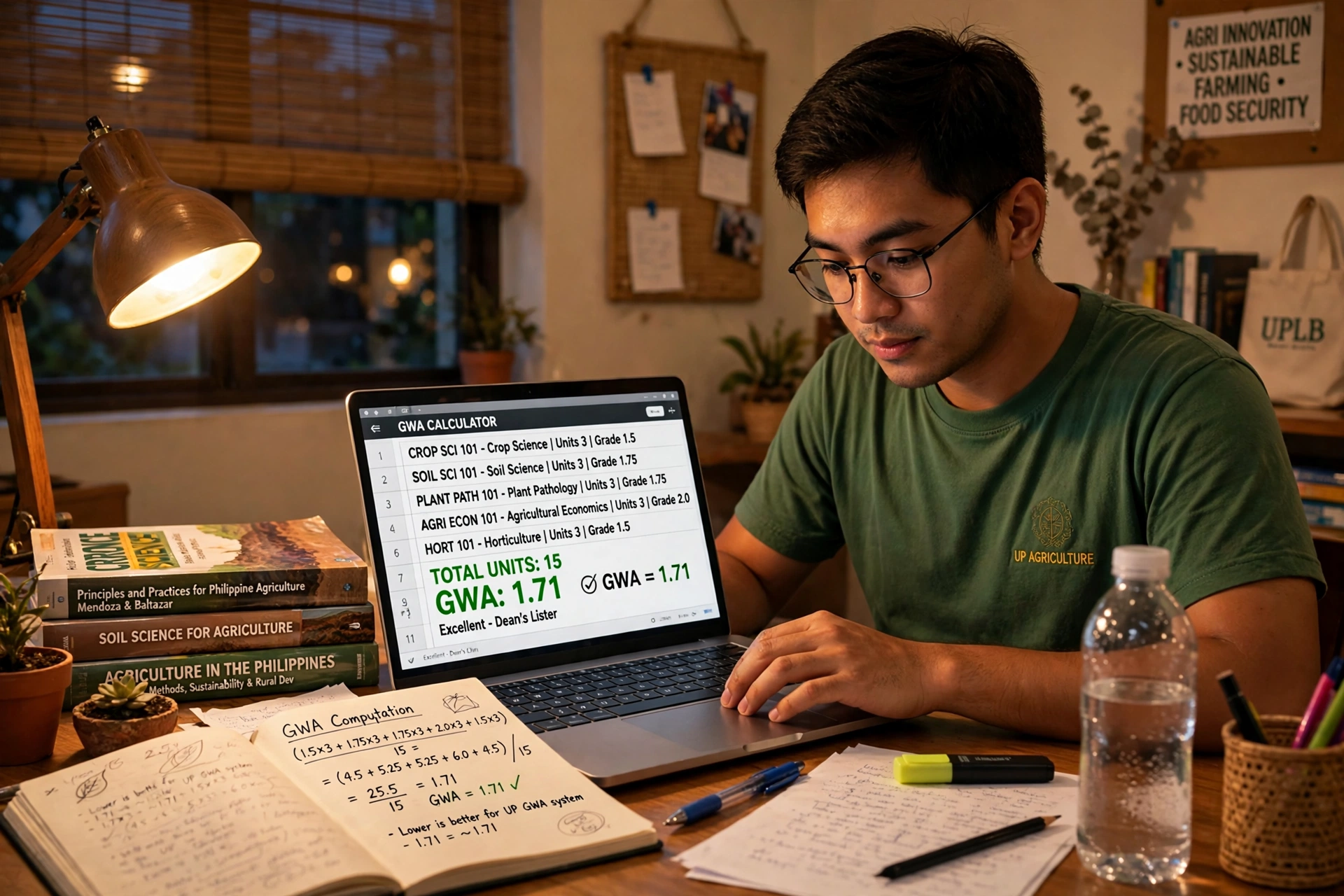
GWA for Agriculture Students Philippines 2026
If you are a Filipino student in BS Agriculture — or a Grade 12 student thinking about it — you have probably searched for gwa for agriculture students philippines at least once: as a senior high school student checking whether your report-card average clears the 80% scholarship floor, or as an enrolled BSA student working out your college GWA from a transcript full of Crop Science, Soil Science and the occasional 5.00. No page at the top of Google says it plainly: that one search phrase is three different questions, and the answer to one is useless for the other. The 80% that gets you a CHED Coconut Scholarship is a percentage average on your senior high school report card. The 2.70 that keeps you enrolled at PSAU is a weighted average on the 1.00–5.00 college scale. And the 1.97 that separated the students who passed the agriculture board exam from the ones who did not is a cumulative GWA built over four years. Mix them up and you will panic over a number that was never a problem — or walk into an exam believing you qualify when you do not.
This guide answers all three, with numbers that were actually tested. Grade 12 applicants get the exact scholarship cutoffs — CoScho, BFAR and the rest — percentage averages, not college GWAs. Enrolled BSA students get the real grading scale their schools use, two fully worked semesters (BSA first semester 1.71, second semester 1.80), the PSAU retention rules in full, and the traps that cost real students real money: a single failed subject, an INC typed into a calculator, an NSTP subject counted when it should not be. Every computation was run against this site’s calculator code before it was written down — 33 test cases, 33 passed — and every competitor error is named, quoted and fixed.
GWA for Agriculture Students Philippines: Three Different Numbers in One Phrase
Start by deciding which student you are. The phrase “gwa for agriculture students” covers three completely different numbers, and this guide keeps them apart on purpose:
| Who you are | Your GWA | Where it lives | What it decides |
|---|---|---|---|
| Grade 12 applicant | SHS percentage GWA — the general average, e.g. 80% | Form 138 / report card | Scholarship eligibility (CoScho 80%, BFAR 80%), admission |
| Enrolled BSA student | College GWA — the 1.00–5.00 scale, lower is better | Transcript of Records | Retention (PSAU 2.70), Dean’s List (1.75), honours, graduation |
| Graduating / graduate | Cumulative GWA across all four years | Transcript of Records | Predicts Licensure Exam for Agriculturists results (passers averaged 1.97, non-passers 2.33) |
The confusion is not academic — it is the biggest source of wrong answers in searches for gwa for agriculture students philippines. A Grade 12 student with an 80% average who types 80 into a college GWA calculator gets an error, because the calculator only accepts the 1.00–5.00 scale. On this site’s conversion formula (GWA = 1.00 + (100 − percentage) ÷ 12.5), 80% converts to about GWA 2.60 and 96% to 1.32. The rule of thumb: if the gate is admission or a scholarship for incoming freshmen, the number is a percentage; if it happens after you enrol, it is a 1.00–5.00 GWA. How the SHS percentage average itself is built is explained in our GWA for senior high school students guide and in the DepEd grading system guide.
One more thing to say plainly, because no competitor does: there is no national BSA GWA cutoff. Unlike the maritime academies, which share a uniform 83% cadetship floor, agriculture retention is set school by school. PSAU’s 2.70 is the only published BSA-specific retention figure this research found. Other agriculture schools — UPLB, CLSU, VSU and the rest — set their own floors, and this guide does not invent numbers for them.
A language warning before you read anything else. On the 1.00–5.00 scale, a lower number is a better grade — 1.00 is the best, 5.00 is failure. That inversion trips up even published sources: three of the ten pages read for this guide say “higher GWA” when they mean better grades, and a peer-reviewed study’s abstract says students with a “CGWA of 1.97 and above” tended to pass the board exam, when 1.97 and above numerically includes 2.00, 2.33 and every worse grade. Throughout this guide, grades are described as better or worse, never higher or lower — and whenever a competitor is quoted making the mistake, the correction is printed next to it.
The Agriculture Grading Scale — UPLB and the 75% Pass Mark
The agriculture school most students picture when they think of the degree is the University of the Philippines Los Baños — founded in 1909 as a college of agriculture, inside the Makiling Forest Reserve, and still the country’s reference point for agricultural education. Its grading table is the one most BSA students will recognise, and it is worth printing in full, because two competitor sites print it with errors:
| Grade | Description |
|---|---|
| 1.00 | Excellent |
| 1.25 | Excellent |
| 1.50 | Very Good |
| 1.75 | Very Good |
| 2.00 | Good |
| 2.25 | Good |
| 2.50 | Satisfactory |
| 2.75 | Satisfactory |
| 3.00 | Pass |
| 4.00 | Conditional |
| 5.00 | Fail |
| INC | Incomplete |
| DRP | Dropped |
Two things about this table matter. First, 3.00 is the passing grade — a 75% on the percentage scale — and 4.00 is conditional, not passing. A conditional grade means the student did not pass but may remove the deficiency, usually by re-examination; if the re-examination is passed the grade converts to 3.00, and if it is failed it becomes 5.00. One competitor page, gwacalculator.com, states flatly that “a grade of 4.00 indicates a passing grade” — and then contradicts itself in its own FAQ, which correctly calls 4.00 a conditional failure. The FAQ is right; the introduction is wrong. Second, no percentage bands are published for this table by either competitor site that prints it. The grades are what they are; any page that attaches exact percentages to UPLB’s 1.25 or 2.75 is guessing. The one anchor that is safe to use is the passing line: 3.00 equals 75%.
Most agriculture schools use the same 0.25-step scale — 1.00, 1.25, 1.50, 1.75, 2.00, 2.25, 2.50, 2.75, 3.00, 4.00, 5.00 — but the passing mark and the meaning of a 4.00 can differ by school, so the table above is a guide, not a substitute for your own school’s handbook. For how one major university publishes its own grading rules in full, see our guide to the PUP grading system.
How to Compute Your GWA Step by Step
The formula is the same one every college GWA uses:
GWA = (Grade × Units + Grade × Units + …) ÷ Total Units
Multiply each subject’s grade by its units, add up all the points, divide by the total units. Lower is better: 1.00 is the best possible GWA, 5.00 is failure. The result is rounded to two decimal places, half-up — 1.625 becomes 1.63. That rounding was verified against the calculator’s code, not assumed. There is one exception to the rounding, and it is new: a load whose exact answer lands on a .xx5 tie that is not exactly representable in binary can display 0.01 lower than the paper calculation. A tested case — 35.50 points over 20 units, exactly 1.775 — displays as 1.77, because the stored double is 1.774999… and the display rounds the stored value down. If your hand calculation says 1.78 and the calculator says 1.77, neither of you is wrong; the calculator is showing the binary value it actually stored. The same quirk never bites on ties that are exact in binary — 1.625 displays as 1.63, as expected.
Before you touch the calculator, though, there is one step that trips up almost everyone who searches for gwa for agriculture students philippines: convert your percentage grades to the 1.00–5.00 scale first. We tested this site’s calculator directly — type 89 into the grade box and the result reads invalid grade, because 89 is outside the 1.00–5.00 range it accepts. Some agriculture schools issue percentage grades, so this is the first thing a new BSA student hits. Convert each percentage with this site’s own converter formula:
GWA = 1.00 + (100 − percentage) ÷ 12.5
So 95% becomes 1.40, 92% becomes 1.64, 90% becomes 1.80, 88% becomes 1.96, and 85% becomes 2.20 — while 75%, the passing mark, becomes exactly 3.00. Enter a failed subject (below 75%) as 5.00. The reverse trip is percentage = 100 − (GWA − 1.00) × 12.5. If you would rather not do the arithmetic by hand, use the site’s GWA to percentage converter. Two caveats: this linear mapping is this site’s convention, and a school using its own transmutation table may map a percentage slightly differently — if a conversion decides a scholarship or a retention case, confirm it with your registrar. And remember: the converter expresses a finished GWA as a percentage; it does not assign grades.
The calculator also accepts letter grades, typed in any case: A+ = 1.00, A = 1.25, A− = 1.50, B+ = 1.75, B = 2.00, B− = 2.25, C+ = 2.50, C = 2.75, C− = 3.00, D = 3.50, F = 5.00. Two warnings. First, the letter map is this site’s map, not necessarily your school’s: the calculator counts A− as 1.50 and D as 3.50, while some agriculture schools map A− to 1.75. If your school’s table differs, type the number, not the letter — numbers are unambiguous. Second, the calculator recalculates live on every keystroke; there is no separate Calculate button. And a quirk: a row with zero units but a mistyped grade still breaks the whole result with invalid grade, because the grade is checked before the units are. If a stray row is poisoning your result, delete the row — setting its units to zero is not enough.
Worked Example 1: A BSA First Semester — GWA 1.71
Meet a first-year BSA student — call her Ana. Her eight first-semester subjects came back with these grades:
| Subject | Grade | Units | Points |
|---|---|---|---|
| Introduction to Agriculture | 1.75 | 3 | 5.25 |
| General Botany | 2.00 | 3 | 6.00 |
| General Chemistry | 1.50 | 3 | 4.50 |
| Mathematics | 2.25 | 3 | 6.75 |
| English | 1.50 | 3 | 4.50 |
| Filipino | 2.00 | 3 | 6.00 |
| Physical Education | 1.25 | 2 | 2.50 |
| NSTP | 1.25 | 3 | 3.75 |
| Total | 23 | 39.25 |
GWA = 39.25 ÷ 23 = 1.71
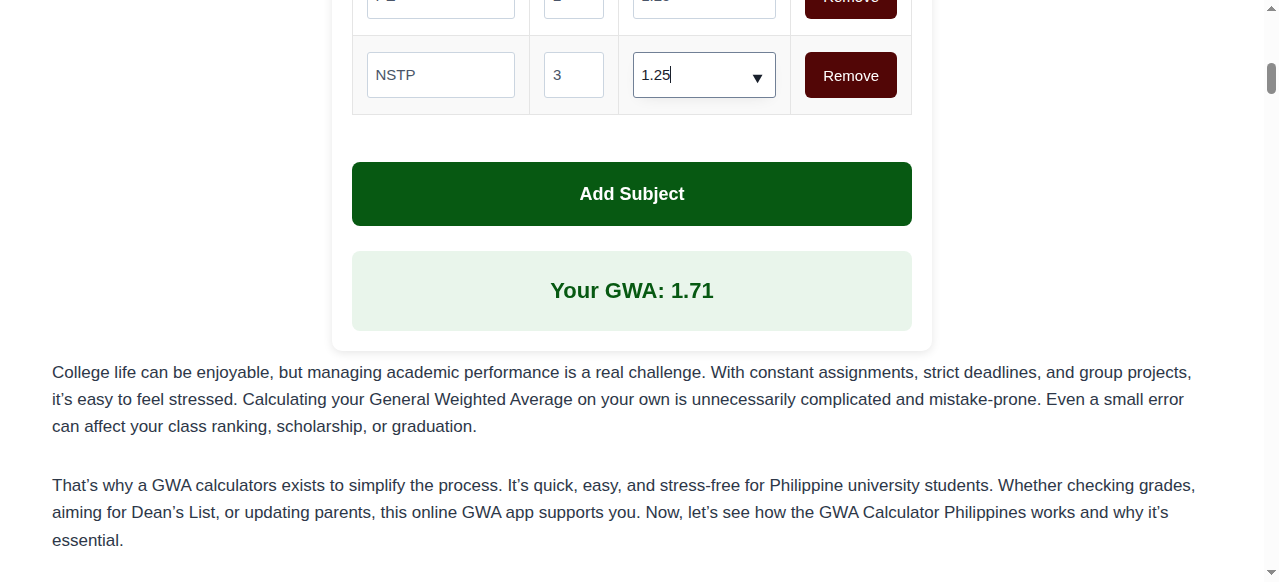
That 1.71 is a strong first semester — comfortably inside the common 1.75 Dean’s List line, and a long way from the 2.70 retention floor. Mathematics at 2.25 is the heaviest drag on the average (6.75 points on 3 units), while PE and NSTP at 1.25 pull it the other way. That is the whole logic of a weighted average: a 3-unit subject moves the result half as much again as a 2-unit subject, so the subjects you struggle with matter most when they carry the most units. Watch the video below: the same eight subjects typed into the live calculator, arriving at 1.71.
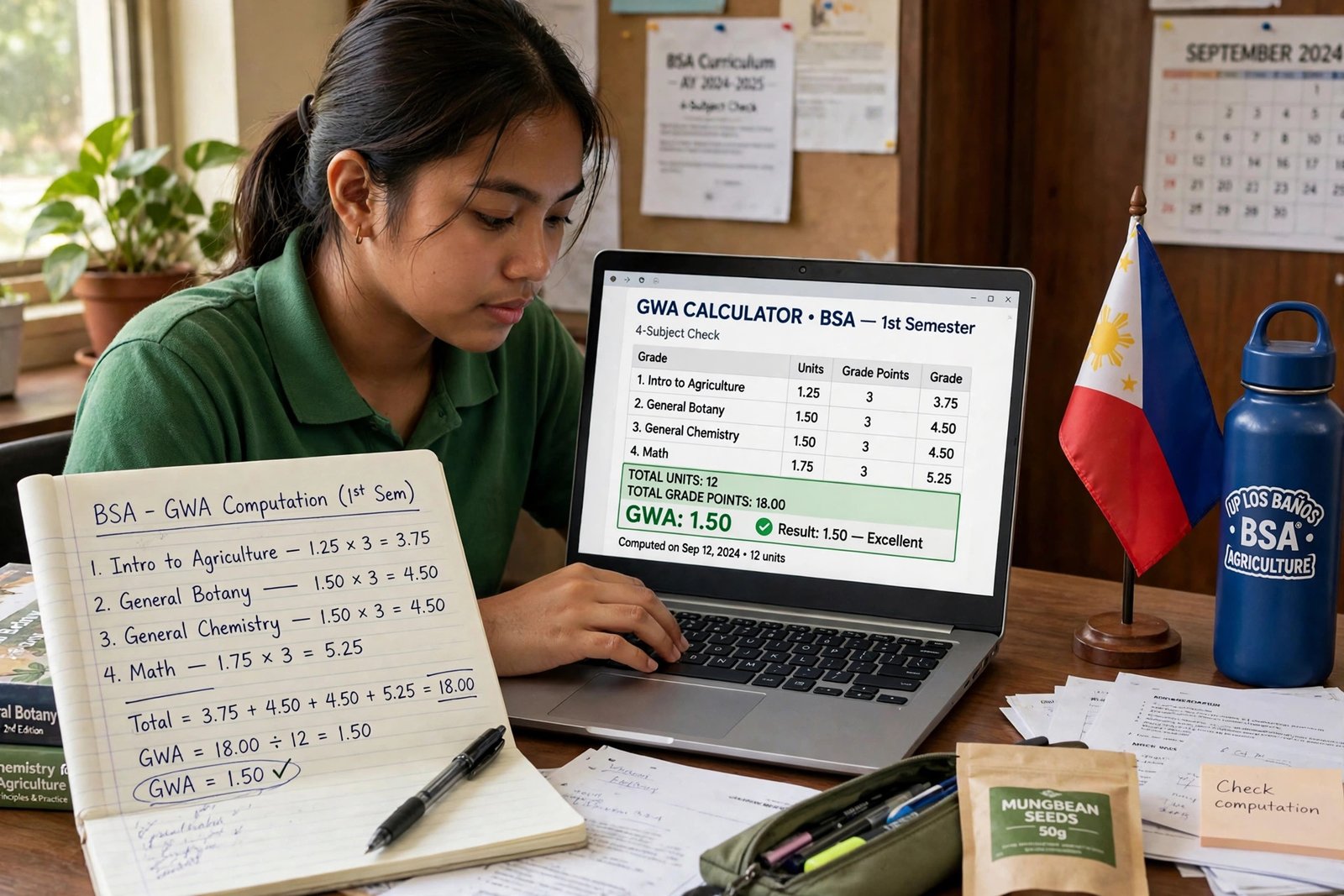
The photo above shows a quicker four-subject check, the kind you do mid-semester when only a few grades are in: Intro to Agriculture 1.25, General Botany 1.50, General Chemistry 1.50 and Math 1.75, all 3 units. The arithmetic is 3.75 + 4.50 + 4.50 + 5.25 = 18.00 points over 12 units, and 18.00 ÷ 12 = 1.50 exactly. All four subjects carry 3 units, so the GWA is just the simple average of the four grades — a useful shortcut whenever every subject carries the same units.
Worked Example 2: A BSA Second Semester — GWA 1.80
Now Ana’s second semester, where the agriculture subjects proper begin — Crop Science, Soil Science and Agricultural Economics join the load:
| Subject | Grade | Units | Points |
|---|---|---|---|
| General Zoology | 1.50 | 3 | 4.50 |
| Organic Chemistry | 2.00 | 3 | 6.00 |
| Crop Science | 1.75 | 3 | 5.25 |
| Soil Science | 2.50 | 3 | 7.50 |
| Agricultural Economics | 2.00 | 3 | 6.00 |
| Rizal | 1.75 | 3 | 5.25 |
| Physical Education | 1.25 | 2 | 2.50 |
| NSTP | 1.50 | 3 | 4.50 |
| Total | 23 | 41.50 |
GWA = 41.50 ÷ 23 = 1.80
Ana’s 1.80 is still solid — but just outside the common 1.75 Dean’s List line, and the reason is one subject: Soil Science at 2.50 contributes 7.50 points, more than any other subject in the load. Bring that grade from 2.50 to 2.00 and the points fall to 40.00, which over 23 units is 1.74 — right back inside the line. That is how a single 3-unit professional subject decides a semester.
Now put the two semesters together, because the number that follows you to graduation is the cumulative GWA — and it is not the average of the two semester GWAs. Add the points together, add the units together, and divide once: 39.25 + 41.50 = 80.75 points over 23 + 23 = 46 units, and 80.75 ÷ 46 = 1.76. Averaging the two semester GWAs (1.71 + 1.80) ÷ 2 happens to give 1.76 here only because both semesters carry the same 23 units; with unequal loads the shortcut is wrong. Keep a running total of points and units from your first semester and you will never make that mistake.
The same running-total method answers the question every BSA student asks after a bad semester: what do I need next semester to get back to the line I want? Ana’s cumulative after year one is 80.75 points over 46 units — 1.76, just outside the 1.75 Dean’s List line. For a third semester of 23 units to pull the cumulative to 1.75 or better, her third-semester points must be no more than 40.00 — because (80.75 + 40.00) ÷ 69 = 1.75 exactly. That means a third-semester GWA of 1.74 or better. It is a demanding target, but it is a concrete one: she knows, before the semester starts, that a 1.80 repeat will not do it, and that the subject to fix is the one that cost her the most points — Soil Science.
What One Failed Subject Does to Your GWA
Take Ana’s first semester — 39.25 points over 23 units, GWA 1.71 — and change one grade: General Botany goes from 2.00 to 5.00, failed. The points jump from 39.25 to 48.25, and the GWA jumps with them:
| Scenario | Points | Units | GWA |
|---|---|---|---|
| All eight subjects passed | 39.25 | 23 | 1.71 |
| General Botany failed (5.00) | 48.25 | 23 | 2.10 |
| General Botany dropped before the deadline | 33.25 | 20 | 1.66 |
One subject, a 0.39 swing — from 1.71 to 2.10 — and the student drops from inside the Dean’s List to well outside it, and from a comfortable margin above the retention floor to a semester that would still pass PSAU’s 2.70 but with far less room. That is the arithmetic of the 5.00: the worst possible grade on the scale, it drags the average the way no other single grade can. But look at the third row: dropping the same subject before the deadline instead of failing it gives 1.66 — actually better than the original 1.71, because the 2.00 you removed was worse than your average. The gap between failing and dropping is 0.44 of GWA. If a subject is going badly and the dropping deadline has not passed, the honest calculation is not “can I pass” but “what does each outcome do to my GWA”.
The GWA is not even the worst of it. A failed subject has to be re-enrolled, and at PSAU it counts toward the limits that decide whether you stay in the programme at all — fewer than three failed subjects to enter third year, fewer than six in total across the four years. A single 5.00 in first year is survivable; a pattern of them is not.
PSAU Retention: The 2.70 Line That Keeps You in BSA
Retention is where the college GWA stops being a report-card number and starts being a gate. The only published BSA-specific retention rule this research found comes from Pampanga State Agricultural University, in the College of Agriculture Systems and Technology instruction manual published by its Quality Assurance Office in June 2022. It is worth printing in full, because no competitor page does:
- Maintain a GWA not lower than 2.70 every semester, including summer. Fall below it and you are placed on probationary status.
- Maximum of two probations. Probation lasts one semester for regular students and one year for freshmen.
- A probationary student who incurs a 5.00 is terminated from the programme.
- Failing to reach 2.70 after one probationary semester may mean dismissal. Probation is lifted by passing all subjects with a GWA better than 2.70.
- To enter third year (the bachelor’s degree proper), a sophomore needs a 2.70 GWA every semester, fewer than three failed subjects, and a passing mark in the Qualifying Exam for incoming third-year students.
- Degree students must keep 2.70 and stay under six failed subjects in total from first to fourth year, or face dismissal.
- A related PSAU policy note records that the maintaining GWA was changed from 3.00 (75.00) to 2.70 (81.00) — the bar was raised, not lowered.
How thin is that line? Take a tested four-subject load — Soil Science 2.50, Crop Science 3.00, PE 2.50 and NSTP 2.75, totalling 27.00 points over 10 units — exactly 2.70, sitting on the bar. Now let one subject slip: Soil Science goes from 2.50 to 3.00. The points rise to 28.50, and 28.50 ÷ 10 = 2.85 — probationary status. One 3-unit subject, one grade step, and the semester flips from retained to probation. A comfortable semester, by contrast, is 2.50 — two subjects at 2.50 over 6 units, 15.00 ÷ 6, with 0.20 of margin above the bar.
Read this before you quote the 2.70. PSAU’s own documents disagree about the BSA retention bar. The BSAGRO instruction manual (2022) says 2.70, but the PSAU Code lists a different figure for the same college’s BSA programme: “maintain a GWA of 2.25, with grades in Math and English not lower than 2.25” — and adds “no grades of 3.0, 4.0, 5.0 and incomplete in any subject under the curriculum.” The two documents may cover different programme versions, or admission versus retention contexts, but no reader can tell from the texts alone. The manual is also four years old. Treat 2.70 as the figure in PSAU’s published manual, confirm the current bar with the PSAU registrar before you plan a semester around it, and never assume 2.70 applies at any other agriculture school. UPLB, CLSU, VSU and every other SUC set their own retention floors, and none of them was published in the pages read for this guide.
Two more PSAU rules matter if you are moving into BSA rather than starting in it. Shifters into BSA (and BS Development Communication) need a GWA of 2.50 or better with no 5.00, plus oral and written examinations. Returnees need a GWA of 2.50 or better — and their grades of 4, INC and On-Process are automatically converted to 5.00, so an old incomplete can come back as a failure. Shifters into the forestry programmes (BSF/BSAF) need a GWA not below 2.6044 across general-education courses — a figure quoted to four decimal places with no derivation given, so take it as printed, not as something you can reproduce. For students eyeing a move to UP Diliman’s agriculture-adjacent programmes, the official AY 2026–2027 primer sets BS Food Technology at a CWA of 2.50 or better plus Math 21 and Chem 16/16.1 — but the same block marks the programme “NOT ACCEPTING FOR AY 2026-2027”, and the PDF’s scrambled columns make it unclear whether the freeze applies to every applicant category, so confirm with the College of Home Economics before applying. Note that UP Diliman has no BS Agriculture — that is UPLB’s programme — so these are the nearest equivalents, not BSA cutoffs.
Dean’s List and Honours for Agriculture Students
There is no universal Dean’s List cutoff in the Philippines — any page that prints one as a fact is guessing. The commonly used figure is 1.75, and PSAU’s own manual confirms 1.75 for its Dean’s List, with academic-scholar bands of 1.00–1.49 for a full scholarship and 1.50–1.75 for a partial one, judged on the second semester of the previous school year plus the first semester of the current one. The same 1.75 line appears at UP (College Scholar), UST, PUP and Mapúa, with PUP’s President’s List at 1.50. The usual conditions are a full load and no 5.00, 4.00 or INC that semester. Latin honours have no universal GWA bands either — two pages at the top of Google disagree, and neither cites a source. For your own school, the registrar’s handbook is the only source that counts.
The numbers below show how thin the line is at the common 1.75 cutoff, using a full BSA semester load:
| Subject | Grade | Units | Points |
|---|---|---|---|
| Introduction to Agriculture | 1.50 | 3 | 4.50 |
| General Botany | 1.75 | 3 | 5.25 |
| General Chemistry | 1.50 | 3 | 4.50 |
| Mathematics | 2.50 | 3 | 7.50 |
| Crop Science | 2.00 | 3 | 6.00 |
| Soil Science | 1.75 | 3 | 5.25 |
| English | 1.75 | 2 | 3.50 |
| Physical Education | 1.25 | 2 | 2.50 |
| NSTP | 1.50 | 3 | 4.50 |
| Total | 25 | 43.50 |
GWA = 43.50 ÷ 25 = 1.74 — just inside the 1.75 line
Now let one subject slip: Mathematics goes from 2.50 to 3.00. The points rise by 1.50, from 43.50 to 45.00 — 45.00 ÷ 25 = 1.80, outside the line. One 3-unit subject, one grade step, and the Dean’s List is gone for the semester. The reverse is just as instructive: bring Mathematics from 2.50 down to 2.00 and the points fall to 42.00, which over 25 units is 1.68 — comfortably inside, with room to spare. A smaller test case shows the boundary itself: four subjects totalling 17.50 points over 10 units land at exactly 1.75, and whether that counts as inside depends on your school’s wording — “1.75 or better” includes it, “below 1.75” does not. Read the handbook’s exact words before you celebrate or despair.
Agriculture Coursework and Fieldwork — Where the Grades Come From
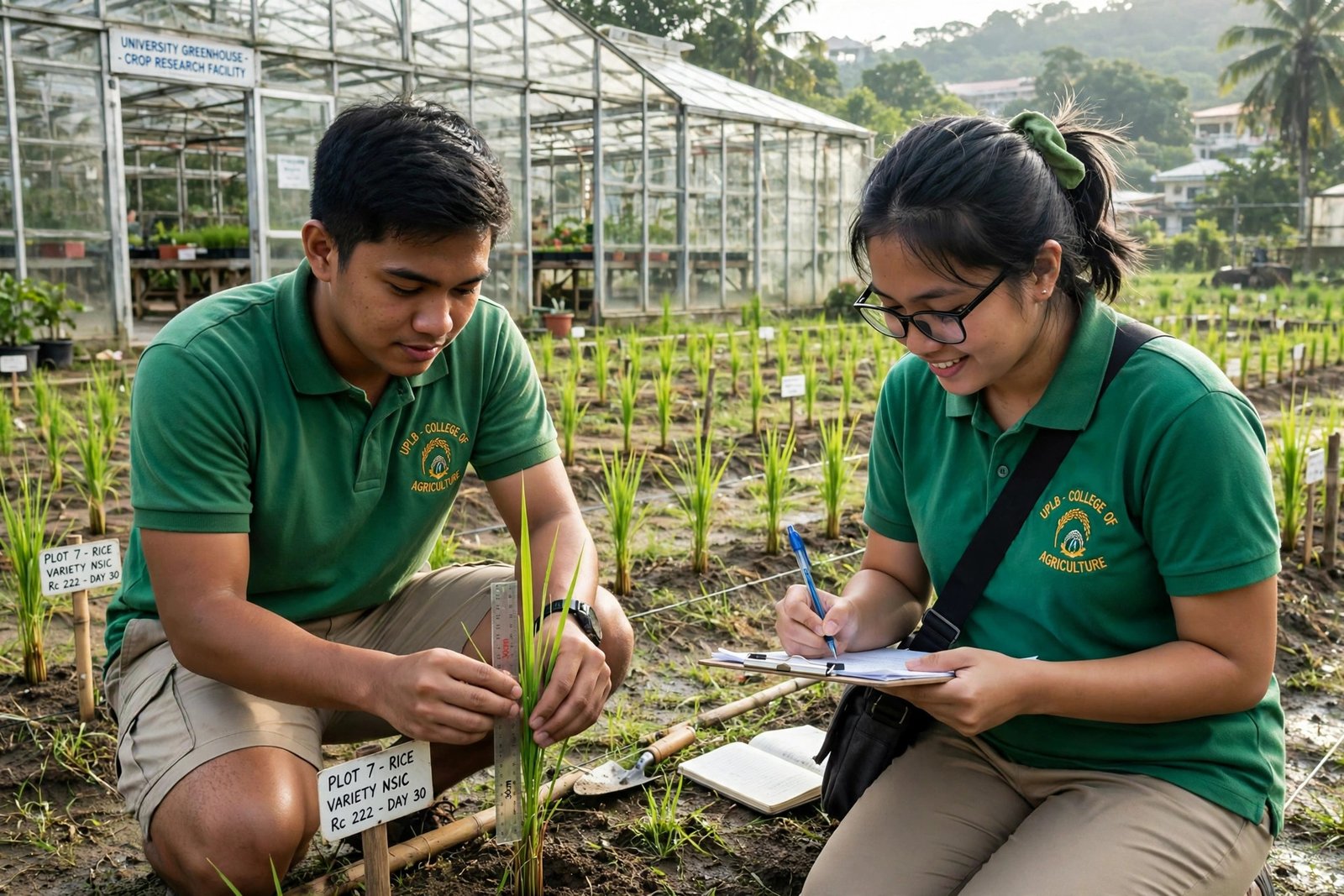
A BSA transcript looks different from most degrees, and that difference is the point of the programme. Alongside the lecture subjects — General Botany, General Chemistry, Agricultural Economics — sit the laboratory and field subjects that carry the professional weight: Crop Science, Soil Science, Animal Science, Crop Protection, Agricultural Extension. Much of the grade in those subjects is earned outside the classroom, in experimental plots and greenhouses, measuring plant height, recording growth data, running soil tests. A student who treats BSA like a lecture degree and skips the fieldwork is not just missing classes; they are missing the assessments themselves.
That structure is also why the unit weights matter so much. The professional subjects are usually 3 units, sometimes with a laboratory component that adds a half unit or a full unit of its own. A poor laboratory grade drags the average nearly as hard as a poor lecture grade, because the units are where the GWA is decided — and the field subjects are where the units are.
Scholarships for Agriculture Students — the 80% Floor

If you searched for gwa for agriculture students philippines as a Grade 12 student, the number that matters most is the one on Form 138 — and for the agriculture scholarships it is almost always the same number: 80%. Here is every cutoff that could be verified, with the ones that could not be verified flagged rather than stated as fact:
| Scholarship | GWA needed | Other rules |
|---|---|---|
| CHED Coconut Scholarship (CoScho) | 80% or equivalent | Coconut farmer or dependent, registered in the NCFRS; combined parental income not over ₱300,000 a year; not already on another government-funded aid programme; one family member only; return service of 1 year per year of scholarship, within 2 years after graduation |
| BFAR Scholarship | Not lower than 80% | Fisheries-related programmes; fisherfolk or indigenous cultural community families |
| CHED Merit Scholarship | Full Merit 96%, Half Merit 93% (secondary sources — confirm at ched.gov.ph) | Incoming freshmen, SHS percentage average; income cap reported at ₱400,000 — confirm before applying |
| LANDBANK-CAG Scholarship | Reported: GWA not lower than 2.50 per semester, no grade below 3.00 (unverified — confirm with CLSU) | Agriculture SUC scholarship; SHS average 90% / top 10% for entry, family income not over ₱300,000 — confirm before applying |
| ACEF-GIAHEP | No GWA figure found in the sources read | For agriculture, forestry, fisheries and veterinary students; check the programme’s current call for its grade rule |
The CoScho figure deserves emphasis, because a ranked competitor page gets it wrong in a way that costs real students real money. The official CHED rule, published on CHED’s own CoScho page under RA No. 11524 (the Coconut Farmers and Industry Trust Fund Act) and CHED-PCA Joint Memorandum Circular No. 1, s. 2023, is a GWA of 80% or its equivalent — for a graduating high school student, or for a college student with relevant units at 80% the previous semester. The 2026 application guide on phscholarships.com instead states 85%. No official source read for this guide contains an 85% figure, and every applicant between 80% and 84% would be wrongly excluded by it. The correct cutoff is 80%.
Three more cautions about the same page. Its benefit breakdown lists a ₱35,000 stipend per semester and then a “total of ₱80,000 as Regular Allowance” — but ₱35,000 × 2 semesters is ₱70,000, not ₱80,000, so its own total does not add up. (Its other allowances do check out: thesis ₱75,000 + book ₱10,000 + laptop ₱30,000 = ₱115,000.) Its deadline says 30 September 2026, while another guide says 31 August 2026 and CHED’s own page still shows the AY 2025–2026 deadline of 31 July 2025 — three sources, three deadlines, and the official page is four months out of date in November 2026. Confirm the current cycle’s deadline with your CHED regional office; do not trust any of the three dates printed online. And note the trap that applies to every scholarship in the table: the average that qualifies you is not the average that keeps it. A student who wins CoScho on an 80% average and then settles into a college GWA worse than the programme’s maintaining grade loses the grant — and the maintaining grade is a 1.00–5.00 GWA, not a percentage.
One more distinction the scholarship lists never make: CHED’s SIKAP grant, which appears in a popular “no GWA requirement” list, is for higher-education personnel pursuing graduate studies, not for BSA undergraduates. A BSA student reading the list could waste an application. The same list includes the KCC Foundation at 85% under a heading promising “no GWA requirement or low GWA cutoff” — 85% is neither.
The Licensure Exam for Agriculturists — No GWA Needed to Sit, But Your GWA Predicts Passing
Here is the single most useful correction in this whole guide: there is no GWA requirement to sit the Licensure Examination for Agriculturists. The Professional Regulation Commission’s official list of requirements (prc.gov.ph) asks for a BSA degree — or a related baccalaureate from a government-recognised school — with the minimum nine basic subjects in agriculture: two crop science, two crop protection, two animal science, one soil science, one agricultural economics and marketing, and one agricultural extension and communication. It asks for a transcript marked “For Board Examination Purposes”, two certificates of good moral character, and a fee of ₱900 for a complete application or ₱450 for a conditioned removal. It does not ask for a GWA at all. The same is true under the new law: RA No. 12215, the Philippine Agriculturists Act, signed 29 May 2025, requires the degree, the six foundation subjects and good moral character — no GWA (§15).
What the exam does require is a score. Under RA 12215 §16, a candidate passes with a 75% average and no subject below 50%. A candidate who averages 75% or better but scores below 50% in a subject retakes only the failed subject. After three failures, a refresher course is required — the PRC puts it at six months. The six foundation subjects under the new law are Crop Science, Animal Science, Soil Science, Crop Protection, Agricultural Economics / Agribusiness / Agri-entrepreneurship, and Agricultural Extension and Communication, and the exam is held at least once a year. The law also creates a new Professional Regulatory Board of Agriculture (a chairperson and five members), allows registration without examination within five years for pre-1997/2003 veterans and doctorate holders, sets a Salary Grade 13 minimum base pay for government agriculturists, requires SUC agriculture faculty to be registered agriculturists, and requires private agri-corporations to employ registered agriculturists. No competitor article mentions any of this — it is the “why your GWA matters after graduation” section they do not have.
And your GWA does matter, even though it is not an eligibility rule. A peer-reviewed study of 152 first-time examinees from six Bicol state universities (Dimayuga, 2015, Journal of Public Affairs and Development) found that LEA passers averaged a cumulative GWA of 1.97, while non-passers averaged 2.33 — and that the cumulative GWA was the strongest predictor of the exam rating (correlation −0.554; the regression coefficient β = 0.430, ahead of the high-school average at 0.203 and exam preparation at 0.178). Examinees who took a formal review class plus self-review averaged 68.34 against 63.03 for self-review alone, and only 44 of the 152 passed. Two warnings about those figures: they describe 2008–2009 examinees, published in 2015, and the LEA framework has since been rewritten by RA 12215 — do not present the 7% and 17% first-time pass rates from those years as today’s numbers. And the study’s own abstract gets the direction wrong, saying students with a “CGWA of 1.97 and above” tended to pass; the body of the paper says the correct thing, that a CGWA of 2.0 or better tended to pass. The abstract’s phrasing would tell a 2.50 student they are in the passing group. They are not.
What a Good BSA GWA Looks Like — The Mindanao Numbers
“What is a good GWA?” is the question every BSA student eventually asks, and most pages answer it with an opinion. There is actual data. A peer-reviewed study published in 2025 (Acuña & Intong, in the Aloysian journal) surveyed 416 senior agriculture students at three Mindanao state universities recognised by CHED as Centers of Excellence in Agriculture Education, and reported their GWAs as they were:
| GWA band | Share of senior BSA students |
|---|---|
| 1.00 – 1.50 | 15% |
| 1.51 – 2.00 | 60% |
| Above 2.00 (not broken down in the paper) | 25% |
The mean GWA was 1.92. Eighty percent of the students were regular students and 20% irregular; 84% were non-delinquent, 9% on warning and 7% on probationary status. The study also records who these students are: 44% of their fathers are farmers, and 41% of their families earn ₱1,000–10,000 a month.
Put the three anchors together and a BSA student has a map, not a slogan. A GWA of 2.70 keeps you enrolled at PSAU. A GWA around 2.00 puts you in the group that tends to pass the board exam — the LEA passers averaged 1.97. A GWA of 1.75 makes the Dean’s List at most schools. And the typical senior agriculture student in the Mindanao study sits at 1.92 — inside the LEA-passing range, outside the Dean’s List. Ana’s first year, 1.71 then 1.80 for a cumulative 1.76, sits just outside the Dean’s List line and comfortably inside the board-passing range: a good first year, with one subject — Soil Science — standing between her and the honours list. One caution about the study itself: its abstract says data were gathered in the second semester of SY 2022–2023 while its methodology says SY 2023–2024, so cite it as “2025, senior students at three Mindanao SUCs” without pinning the semester; and it quotes an academic-performance score of 10.58 with no scale explained anywhere in the paper, so that number is uninterpretable and is not quoted here.
Retakes, INC, NSTP/PE and Other Traps
Most GWA errors are not arithmetic errors. They are policy errors — a subject counted that should not be, a grade entered that the calculator cannot read, a retake handled the wrong school’s way.
Convert percentages first — a full semester, worked. Suppose a school issues percentage grades: 92%, 88%, 95%, 85% and 90% across five 3-unit subjects. Typing those numbers into the calculator gives invalid grade five times over. Converted with the site’s formula, they become 1.64, 1.96, 1.40, 2.20 and 1.80 — and 3 × 1.64 + 3 × 1.96 + 3 × 1.40 + 3 × 2.20 + 3 × 1.80 = 27.00 points over 15 units, GWA 1.80. The same trap in reverse: a student who sees 3.00 on a transcript and reads a competitor table that says 5.00 means “below 60%” will think a 70% student passed. On the UP tables, 3.00 is 75–77.7% — so 5.00 is below 75%, and a 70% student has failed. The “below 60%” figure appears on gwacalculator.com’s UP Diliman table and is wrong by fifteen points.
An INC breaks the calculator. The calculator has no INC, DRP or remark grades in its code. Type INC into a grade box and the whole result reads invalid grade — even if every other subject is fine. Delete the INC row and compute without it, then recompute once the INC is completed. At PSAU the stakes are higher than a broken calculation: a returnee’s INC is automatically converted to 5.00.
A zero-unit row with a bad grade poisons the result. A row with 0 units contributes nothing — but the grade is checked before the units are, so a leftover dropped or INC row with a bad grade shows invalid grade even though it adds zero points. We tested it twice: a 0-unit row holding 89% and one holding INC both broke an otherwise correct 1.50 calculation. The fix is the same as for INC: delete the row. Setting units to zero is not enough if the grade cell is bad. An empty grade field does the same thing — an empty cell is not a zero, it is an error. And if every row has zero units, the calculator shows 0.00 — “no valid data”, not “perfect GWA”. A 0.00 on the screen is a prompt to check your rows.
Letter grades are a translation, and translations differ. This site maps A− to 1.50 and D to 3.50; some agriculture schools map A− to 1.75. Enter letters and you trust the site’s table; enter numbers and there is nothing to mistranslate. A tested mixed-case letter load (B+, A, b, C−, A+) computed to 1.86 exactly as the map says — the calculator is consistent, but consistency with the wrong table is still wrong. If your school’s letter table differs, type numbers.
NSTP changes the answer. The same BSA grades give GWA 1.71 with NSTP counted and 1.77 without it (35.50 points over 20 units instead of 39.25 over 23). Many schools exclude NSTP from the GWA, and some exclude PE as well. If your computed GWA does not match the registrar’s, the first question is whether NSTP and PE are in or out. Ask the registrar which subjects count — and note that the NSTP-excluded case is also the one that exposes the rounding quirk: 35.50 ÷ 20 is exactly 1.775 on paper, but the calculator displays 1.77, because the stored binary value is 1.774999… and rounds down. A student sitting on a .xx5 tie can see 0.01 less than the paper calculation, and on a knife-edge cutoff — 1.75 for the Dean’s List, 2.70 for retention — 0.01 is the whole difference.
A retake counts twice unless your school says otherwise. Repeat a failed 3-unit subject and pass it at 1.75: if the school counts both attempts, the failed 5.00 stays in and the tested load comes out at 2.56; if the school replaces the grade, only the retake counts and the same load comes out at 1.75. Same student, same retake, 0.81 of GWA apart — the difference is entirely a registrar policy. Ask, in writing, before you plan a semester around the retake.
Half-unit labs work fine. Laboratory subjects with fractional units — 1.5 or 2.5 units — compute exactly as the formula says: a tested load of 1.5 units at 1.50, 1.5 at 2.00 and 2.5 at 1.75 came out at 9.625 over 5.5 units, GWA 1.75 exactly.
Competitor Mistakes to Avoid — Corrected in One Place
Ten pages were read in full for this guide. The strongest, the PSAU instruction manual, is the only source for the BSA retention rules — and even it conflicts with PSAU’s own Code. The rest contain errors that cost real students real opportunities. Here are the ones that matter most:
- phscholarships.com: CoScho needs “a GWA of 85% the previous semester”. Wrong. The official CHED rule is 80% or its equivalent (legacy.ched.gov.ph, under RA 11524 and CHED-PCA JMC No. 1, s. 2023), corroborated by philscholar.com’s own CoScho guide. The 85% figure appears in no official source read, and would wrongly exclude every applicant between 80% and 84%.
- gwacalculator.com: “A grade of 4.00 indicates a passing grade.” Wrong. 4.00 is conditional; 3.00 is the passing grade — and the page’s own FAQ says exactly that. The introduction contradicts its own FAQ.
- gwacalculator.com: “5.0 = Less than 60 Fail.” Wrong. UP’s passing grade is 3.00 = 75–77.7% on the page’s own table, so 5.00 is below 75%. A student at 70% reading this table would think they passed. They have failed.
- gwacalculator.com: UPOU table “01 Excellent … 02 Good … 03 Pass”. Mangled “1.0 / 2.0 / 3.0” — and the 0.25-step grades (1.25, 1.75, 2.25, 2.75) are missing entirely. Its USC table is worse: rows are scrambled so that “Fail | 80–82 | 2.50” sits next to “Dropped | 75–76 | 3.00” — a 2.50 cannot be a fail while a 3.00 at a lower percentage is a pass.
- phgwacalculator.com: “US GPA = 5.00 minus Philippine GWA” (a 1.75 GWA is “roughly 3.25” on the US 4.0 scale). Wrong. The conversion is non-linear: a 1.75 GWA is roughly 86–88%, about 3.3–3.7 on a US 4.0 scale, not a fixed 3.25 — and the linear formula fails badly at the low end, where a 2.50 GWA (≈79–81%) is nothing like a 2.5 GPA.
- phgwacalculator.com: “Official policies behind the deans list requirements trace back to guidelines from CHED.” Wrong. CHED sets no Dean’s List rules — each higher-education institution sets its own, as the page itself says two paragraphs earlier. The sentence contradicts its own table.
- Mindanao study (2025): “Obtaining higher GWA suggests that the students were doing very well.” Backwards. On the 1.00–5.00 scale a higher GWA number is a worse result; the study’s own data (mean 1.92 described as “very good”) proves the intended meaning is a lower, better GWA. The same wrong-direction slip appears in the JPAD study’s abstract (“CGWA of 1.97 and above tended to pass”) and in philscholar.com’s Mercury Drug entry (“GWA 2.5 or 80% or higher” — the intended meaning is 2.5 or better).
- phscholarships.com: CoScho benefits “Total of ₱80,000 as Regular Allowance” against a ₱35,000-per-semester stipend. The arithmetic does not add up: ₱35,000 × 2 = ₱70,000, not ₱80,000. And its 30 September 2026 deadline conflicts with another guide’s 31 August 2026 and CHED’s own stale 31 July 2025 date — confirm the deadline with your CHED regional office.
Frequently Asked Questions
What is the GWA for agriculture students in the Philippines?
It depends on which student you are. For a Grade 12 applicant it is the SHS percentage average on Form 138 — 80% is the floor for the CHED Coconut and BFAR scholarships. For an enrolled BSA student it is the college GWA on the 1.00–5.00 scale: multiply each subject’s grade by its units, add the points, divide by the total units. A realistic BSA first semester — Intro to Agriculture 1.75, General Botany 2.00, General Chemistry 1.50, Math 2.25, English 1.50, Filipino 2.00, PE 1.25, NSTP 1.25 — is 39.25 points over 23 units, GWA 1.71. A realistic second semester is 41.50 over 23 units, GWA 1.80.
What GWA do I need to stay in BS Agriculture?
There is no national figure — each school sets its own retention floor. The only published BSA-specific rule found is PSAU’s: maintain a GWA not lower than 2.70 every semester including summer, with a maximum of two probations, termination for a 5.00 while on probation, and dismissal if 2.70 is not regained after one probationary semester. PSAU’s own Code lists a different figure (2.25) for the same college’s BSA programme, so confirm the current bar with the PSAU registrar — and never assume 2.70 applies at another school.
Can I type percentage grades into the GWA calculator?
No. The calculator only accepts the 1.00–5.00 scale (or letter grades), so typing 89 shows “invalid grade”. Convert first with GWA = 1.00 + (100 − percentage) ÷ 12.5 — 92% becomes 1.64, 88% becomes 1.96, 95% becomes 1.40, 85% becomes 2.20 and 90% becomes 1.80 — or use the site’s GWA to percentage converter.
What happens if I fail one subject?
Your GWA takes a heavy hit and the subject must be re-enrolled. In our tested BSA semester, one failed 3-unit General Botany subject moved the GWA from 1.71 to 2.10. Dropping the same subject before the deadline instead would have given 1.66 — a 0.44 swing between failing and dropping. At PSAU a failed subject also counts toward the limits on staying in the programme: fewer than three to enter third year, fewer than six in total.
What GWA do I need for the Dean’s List?
There is no universal figure — the commonly used cutoff is 1.75, confirmed in PSAU’s own manual, but schools set their own. The line is knife-edge: a full BSA semester at 1.74 sits just inside 1.75, and one 3-unit subject slipping from 2.50 to 3.00 pushes it to 1.80. Confirm your school’s exact cutoff and wording.
Does an INC affect my GWA?
It cannot be entered at all — typing INC shows “invalid grade”, so delete the row and compute without it, then recompute once the INC is completed. At PSAU a returnee’s INC is automatically converted to 5.00.
Do I need a GWA to take the agriculture board exam?
No. The PRC requires a BSA degree (or related baccalaureate) with the nine basic agriculture subjects — there is no GWA requirement to sit the Licensure Examination for Agriculturists, and RA 12215 confirms the same. But your cumulative GWA strongly predicts whether you pass: in a 2015 study of 152 first-time examinees, passers averaged 1.97 and non-passers 2.33. The pass mark is a 75% average with no subject below 50%.
What is the CoScho scholarship GWA requirement?
80% or its equivalent — the official CHED rule under RA 11524. A ranked guide wrongly states 85%; applicants between 80% and 84% are eligible and should not be put off. You must also be a coconut farmer or dependent registered in the NCFRS, with combined parental income not over ₱300,000 a year, and the scholarship carries a return service of one year per year of scholarship.
Does NSTP count in my GWA?
It depends on your school. Many schools exclude NSTP (and sometimes PE) from the GWA. The same BSA grades give 1.71 with NSTP counted and 1.77 without it, so if your computed GWA does not match the registrar’s, the first question is whether NSTP and PE are in or out.
The Bottom Line
Three numbers, three jobs. If you are in Grade 12, your number is a percentage on Form 138, and the gate is 80% for the agriculture scholarships — CoScho and BFAR — not 85%, whatever a ranked guide says. If you are enrolled in BS Agriculture, your number is a 1.00–5.00 GWA on your transcript, built in 0.25 steps under a 75% passing rule, with 3.00 as the pass and 4.00 as conditional, not passing. Compute it the way this guide does — convert percentages first, multiply grade by units, divide by total units — and check the traps first: delete INC rows, delete poisoned zero-unit rows, confirm whether NSTP counts, ask the registrar how retakes are handled, and confirm the retention bar with your own school, because the only published BSA figure, PSAU’s 2.70, comes with a conflicting document from the same university. A realistic first semester lands at 1.71 for BSA and a second at 1.80, a single failed subject can move either one by nearly half a point, and the cumulative GWA you carry to graduation is the number that best predicts whether you will pass the board exam. That is the whole story of gwa for agriculture students philippines: the arithmetic is simple, the scale is inverted, and the number only means something when you know which of the three GWAs you are looking at.
Run your own numbers now on the calculator at the top of this page — convert each percentage first, enter the grades your school actually issued, and compare with the worked examples above. If it does not match your registrar’s figure, the difference is almost always NSTP, a retake policy, or a letter-grade translation, and the registrar’s number is the official one. And if the number is a point short of the gate you want — the 80% for a scholarship, the 2.70 to stay enrolled, the 1.75 for the Dean’s List, the 2.00 that puts you in the board-passing group — you now know exactly which subject has to move.