
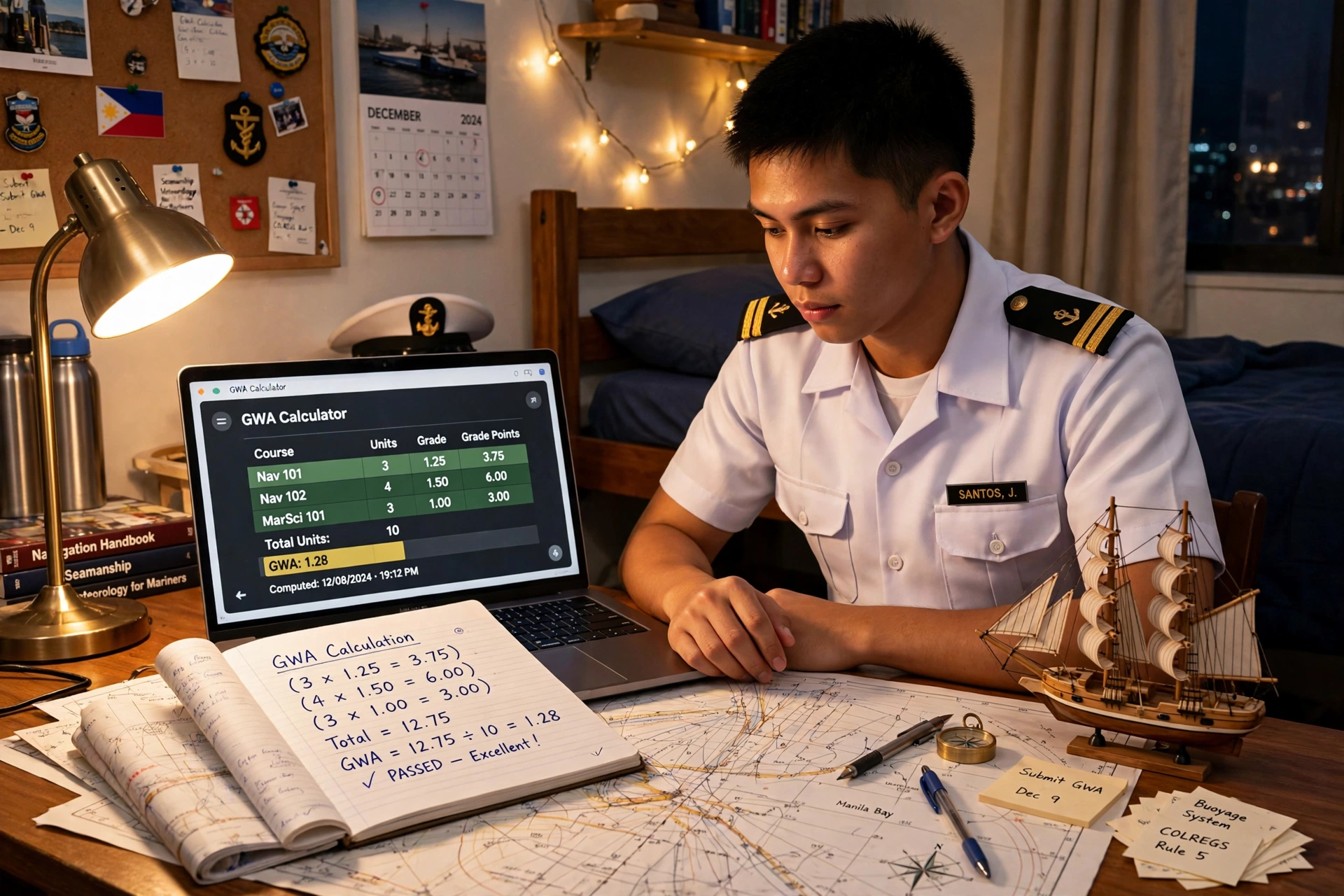
GWA for Maritime Students Philippines 2026
If you are a Filipino student aiming for a life at sea, you have probably searched for gwa for maritime students philippines at least once — as a Grade 12 student checking whether your report-card average clears the 83% cadetship floor, or as an enrolled BSMT or BSMarE student working out your college GWA from a transcript full of 1.00s, 2.50s and the occasional 5.00. No page at the top of Google says it plainly: that one search phrase is two different questions, and the answer to one is useless for the other. The 83% that gets you into a maritime academy is a percentage average on your senior high school report card. The 1.71 that keeps you on the Dean’s List is a weighted average on the 1.00–5.00 college scale. Mix them up and you will panic over a number that was never a problem — or walk into an exam believing you qualify when you do not.
This guide answers both, with numbers that were actually tested. Grade 12 applicants get the exact cadetship cutoffs — MAAP, IMEC, MMMA and the rest — percentage averages on Form 138, not college GWAs. Enrolled maritime students get the real grading scale their schools use, two fully worked semesters (BSMT 1.71, BSMarE 1.81), and the traps that cost real students real money: a single failed subject, an INC typed into a calculator, an NSTP subject counted when it should not be. Every computation was run against this site’s calculator code before it was written down — 28 test cases, 28 passed — and every competitor error is named, quoted and fixed.
GWA for Maritime Students Philippines: The Two GWAs in One Phrase
Start by deciding which student you are. The phrase “GWA for maritime students” covers two completely different numbers, and this guide keeps them apart on purpose:
| Who you are | Your GWA | Where it lives | What it decides |
|---|---|---|---|
| Grade 12 applicant | SHS percentage GWA — the general average, e.g. 83% | Form 138 / report card | Cadetship admission (83% at MAAP, IMEC, MMMA), CHED Merit entry (93% / 96%) |
| Enrolled BSMT / BSMarE student | College GWA — the 1.00–5.00 scale, lower is better | Transcript of Records | Retention, Dean’s List, honours, graduation, MARINA CAV and Special Order |
The confusion is not academic — it is the biggest source of wrong answers in searches for gwa for maritime students philippines. A Grade 12 student with an 83% average who types 83 into a college GWA calculator gets an error, because the calculator only accepts the 1.00–5.00 scale — and a BSMT student with a 2.36 college GWA who reads that “83% is the cadetship cutoff” can wrongly conclude they are below it, when the two numbers are roughly the same standing on two different scales. On this site’s conversion formula (GWA = 1.00 + (100 − percentage) ÷ 12.5), 83% converts to about GWA 2.36 and 96% to 1.32. The rule of thumb: if the gate is admission or a scholarship for incoming freshmen, the number is a percentage; if it happens after you enrol, it is a 1.00–5.00 GWA. How the SHS percentage average itself is built is explained in our GWA for senior high school students guide and in the DepEd grading system guide.
The Maritime Grading Scale — Why 75% Is the Pass Mark
Maritime students are graded under a different rulebook. The Bachelor of Science in Marine Transportation (BSMT) and Bachelor of Science in Marine Engineering (BSMarE) programmes run under the Policies, Standards and Guidelines (PSG) issued jointly by CHED and MARINA, built on the STCW Convention — the international treaty that sets the standards for seafarer training. That rulebook sets the passing standard far above the one on generic GWA pages, and bans three things generic pages treat as normal.
| Percentage | Letter | Description | GWA grade |
|---|---|---|---|
| 90–100% | A | Excellent | 1.0 |
| 86–89% | B | Very Good | 1.5 |
| 85% | C | Good | 2.0 |
| 76–84% | D | Satisfactory | 2.5 |
| 75% | E | Pass | 3.0 |
| 0–74% | F | Fail | 5.0 |
Read this before you quote the table. This grade table comes from the CHED–MARINA PSG for BSMT/BSMarE as published in the March 2019 public-hearing draft. We checked it against the current governing circular, Joint CHED–MARINA Memorandum Circular No. 01, s. 2023: the current circular confirms every rule around the table — no transmutation, no provisional or conditional final grades, the final grade based solely on scholastic performance, an INC mark limited to one academic year — but it does not reprint the percentage-to-grade table itself. It leaves the passing standard to each school, with one floor: not lower than the 50th percentile grade. In Philippine maritime practice that floor is 75%, and current school handbooks still print 75% as the passing mark — but confirm the exact table in your own school’s student handbook.
Three features of this scale matter more than the numbers themselves — all three contradict what generic GWA pages teach. First, there is no transmutation: the PSG states plainly that the transmutation of grades shall not be allowed, and the current circular (JCMMC No. 01, s. 2023, Section 35) repeats it. A raw score is not curved or scaled — the percentage you earned is the percentage that maps to the table. Second, there are no conditional grades: no provisional, conditional or temporary final grade may be given in BSMT or BSMarE — a failed subject is a 5.00 and must be re-enrolled; there is no 4.00 to remove by re-examination. Third, the final grade is based solely on scholastic performance: no adjustment for co-curricular activities, attendance or misconduct. One related rule: a student absent for more than 20% of the required school days in a course is automatically dropped.
Notice also how coarse the scale is. It runs in 0.5 steps only — 1.0, 1.5, 2.0, 2.5, 3.0, 5.0. There is no 1.25, 1.75 or 2.75 on a maritime transcript. This site’s calculator accepts any number from 1.00 to 5.00, so it will happily compute with a 1.75 you typed in — but your school never issued a 1.75. Enter the grades your school actually gave you, in 0.5 steps, and the result will match the registrar’s.
One more distinction: the site’s percentage-to-GWA converter and the PSG table are two different tools. The converter turns a finished college GWA into a percentage (a 1.75 GWA is about 90.6%, a 2.50 about 81.25%, a 3.00 exactly 75%). The PSG table turns a percentage score into a grade (85% is a 2.00). They do not always agree — the converter maps 85% to 2.20, the PSG table assigns 2.00 — because one is a linear approximation and the other is the school’s official assignment. Use the converter to express a GWA you already have as a percentage; use the PSG table to find out what grade a percentage score earns.
How to Compute Your GWA Step by Step
The formula is the same one every college GWA uses:
GWA = (Grade × Units + Grade × Units + …) ÷ Total Units
Multiply each subject’s grade by its units, add up all the points, divide by the total units. Lower is better: 1.00 is the best possible GWA, 5.00 is failure. The result is rounded to two decimal places, half-up — 1.625 becomes 1.63. That rounding was verified against the calculator’s code, not assumed.
Before you touch the calculator, though, there is one step that trips up almost everyone who searches for gwa for maritime students philippines: convert your percentage grades to the 1.00–5.00 scale first. We tested this site’s calculator directly — type 89 into the grade box and the result reads invalid grade, because 89 is outside the 1.00–5.00 range it accepts. Some maritime academies issue percentage grades, so this is the first thing a new cadet hits. Convert each percentage with this site’s own converter formula:
GWA = 1.00 + (100 − percentage) ÷ 12.5
So 96% becomes 1.32, 93% becomes 1.56, 85% becomes 2.20, 83% becomes 2.36, and 75% — the passing mark — becomes exactly 3.00. Enter a failed subject (below 75%) as 5.00. The reverse trip is percentage = 100 − (GWA − 1.00) × 12.5. If you would rather not do the arithmetic by hand, use the site’s GWA to percentage converter. Two caveats: this linear mapping is this site’s convention, and a school using its own transmutation table may map a percentage slightly differently — if a conversion decides a scholarship or a cadetship slot, confirm it with your registrar. And remember: the converter expresses a finished GWA as a percentage; it does not assign grades.
The calculator also accepts letter grades, typed in any case: A+ = 1.00, A = 1.25, A− = 1.50, B+ = 1.75, B = 2.00, B− = 2.25, C+ = 2.50, C = 2.75, C− = 3.00, D = 3.50, F = 5.00. Two warnings. First, the letter map is this site’s map, not necessarily your school’s: the calculator counts A− as 1.50 and D as 3.50, while some maritime schools map A− to 1.75. If your school’s table differs, type the number, not the letter — numbers are unambiguous. Second, the calculator recalculates live on every keystroke; there is no separate Calculate button. And a quirk: a row with zero units but a mistyped grade still breaks the whole result with invalid grade, because the grade is checked before the units are. If a stray row is poisoning your result, delete the row — setting its units to zero is not enough.
Worked Example 1: A BSMT First Semester — GWA 1.71
Meet a first-year BSMT cadet — call him Marco. His nine subjects came back with these grades:
| Subject | Grade | Units | Points |
|---|---|---|---|
| Marine Navigation 1 | 1.75 | 3 | 5.25 |
| Seamanship 1 | 2.00 | 3 | 6.00 |
| Maritime English | 1.50 | 3 | 4.50 |
| Trigonometry | 2.25 | 3 | 6.75 |
| Physics 1 | 2.00 | 3 | 6.00 |
| Chemistry 1 | 1.75 | 3 | 5.25 |
| Computer Applications | 1.50 | 3 | 4.50 |
| Physical Education | 1.25 | 2 | 2.50 |
| NSTP | 1.25 | 3 | 3.75 |
| Total | 26 | 44.50 |
GWA = 44.50 ÷ 26 = 1.71
That 1.71 is a strong first semester — comfortably inside the common 1.75 Dean’s List line, far from the 3.00 passing boundary. Trigonometry at 2.25 is the heaviest drag on the average (6.75 points on 3 units), while PE and NSTP at 1.25 pull it the other way. That is the whole logic of a weighted average: a 3-unit subject moves the result half as much again as a 2-unit subject, so the subjects you struggle with matter most when they carry the most units. Watch the video below: the same nine subjects typed into the live calculator, arriving at 1.71.
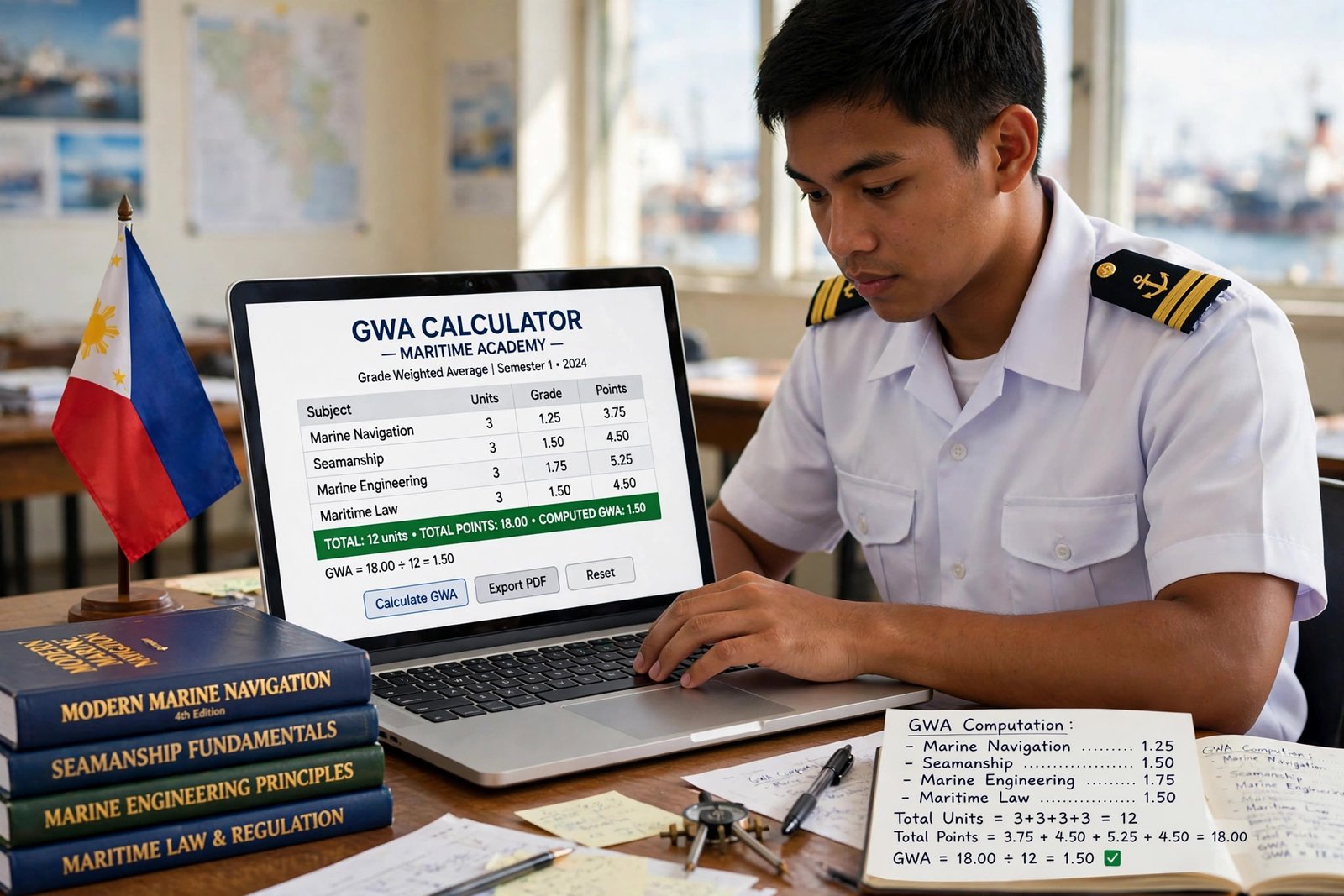
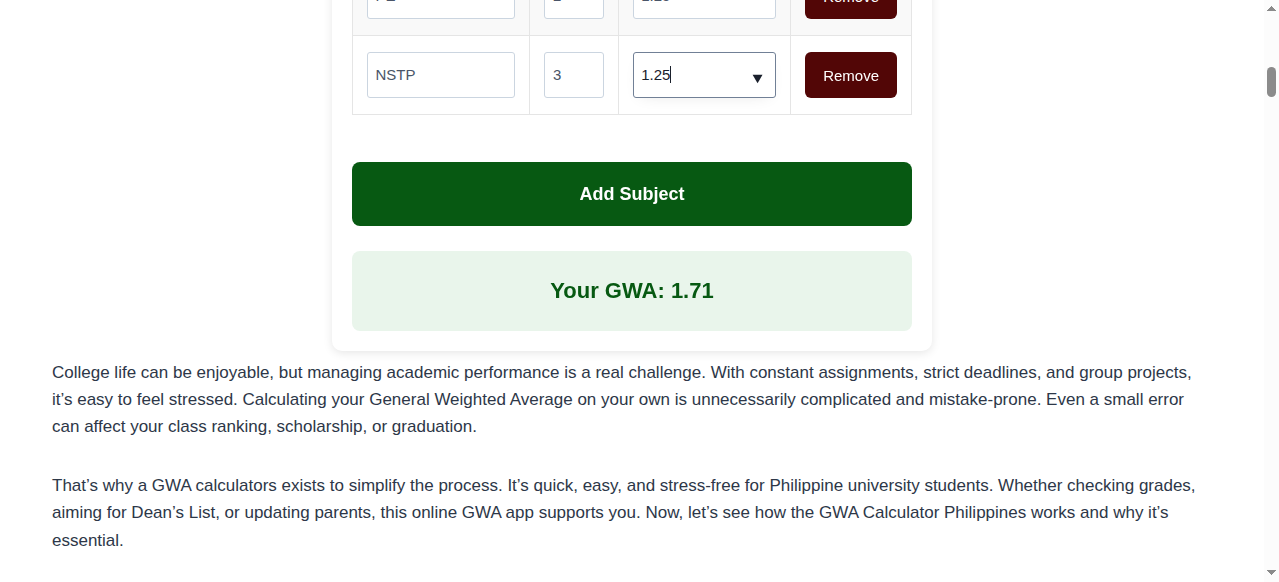
The screenshot above is the calculator’s own result for the nine subjects in the table — Your GWA: 1.71 — captured from the live page. The photo above it shows a quicker four-subject check, the kind you do mid-semester when only a few grades are in: Marine Navigation 1.25, Seamanship 1.50, Marine Engineering 1.75 and Maritime Law 1.50, all 3 units. The arithmetic is 3.75 + 4.50 + 5.25 + 4.50 = 18.00 points over 12 units, and 18.00 ÷ 12 = 1.50 exactly. All four subjects carry 3 units, so the GWA is just the simple average of the four grades — a useful shortcut whenever every subject carries the same units.
Worked Example 2: A BSMarE First Semester — GWA 1.81
Now the engine side: a first-year BSMarE cadet — call her Angela — finished with these nine subjects:
| Subject | Grade | Units | Points |
|---|---|---|---|
| Marine Engineering 1 | 1.75 | 3 | 5.25 |
| Thermodynamics | 2.50 | 3 | 7.50 |
| Engineering Mathematics | 2.00 | 3 | 6.00 |
| Engineering Drawing | 1.50 | 2 | 3.00 |
| Physics 1 | 2.25 | 3 | 6.75 |
| Chemistry 1 | 1.75 | 3 | 5.25 |
| Maritime English | 1.50 | 3 | 4.50 |
| Physical Education | 1.25 | 2 | 2.50 |
| NSTP | 1.50 | 3 | 4.50 |
| Total | 25 | 45.25 |
GWA = 45.25 ÷ 25 = 1.81
Angela’s 1.81 is solid — but just outside the common 1.75 Dean’s List line, and the reason is one subject: Thermodynamics at 2.50 contributes 7.50 points, more than any other subject in the load. Bring that grade from 2.50 to 2.00 and the points fall to 43.75, which over 25 units is exactly 1.75 — right on the line. That is how a single 3-unit professional subject decides a semester. For tracking across semesters, keep a running total rather than averaging semester GWAs: add each semester’s points together, add each semester’s units together, and divide once. Averaging the two GWAs (1.71 + 1.81) ÷ 2 would give 1.76 — only right if both semesters carried the same number of units, and they usually do not.
What One Failed Subject Does to Your GWA
Take Marco’s BSMT semester — 44.50 points over 26 units, GWA 1.71 — and change one grade: Seamanship 1 goes from 2.00 to 5.00, failed. The points jump from 44.50 to 53.50, and the GWA jumps with them:
| Scenario | Points | Units | GWA |
|---|---|---|---|
| All nine subjects passed | 44.50 | 26 | 1.71 |
| Seamanship 1 failed (5.00) | 53.50 | 26 | 2.06 |
| Seamanship 1 dropped before the deadline | 38.50 | 23 | 1.67 |
One subject, a 0.35 swing — from 1.71 to 2.06 — and the student drops from inside the Dean’s List to well outside it. That is the arithmetic of the 5.00: the maximum possible grade on the scale, it drags the average the way no other single grade can. But look at the third row: dropping the same subject before the deadline instead of failing it gives 1.67 — actually better than the original 1.71, because the 2.00 you removed was above your average. The gap between failing and dropping is 0.39 of GWA. If a subject is going badly and the dropping deadline has not passed, the honest calculation is not “can I pass” but “what does each outcome do to my GWA”.
The GWA is not even the worst of it. A failed maritime subject has to be re-enrolled: there is no conditional 4.00 to clear with a re-examination, because the PSG forbids conditional final grades outright. Promotion requires passing every course, and retention policy is set by each school — so a single 5.00 can mean a delayed semester, a lost cadetship slot, or a sponsor’s review. For a sponsored cadet the stakes are higher still: the company paying for the scholarship is watching the transcript, and academic delinquency is the fastest way to lose a berth.
Dean’s List and Honours for Maritime Students
There is no universal Dean’s List cutoff in the Philippines — any page that prints one as a fact is guessing. The commonly used figure is 1.75, some schools use 2.00 or 1.50, and the maritime academies set their own honours rules. The numbers below show how thin the line is at the common 1.75 cutoff, using a full BSMT semester load:
| Subject | Grade | Units | Points |
|---|---|---|---|
| Marine Navigation 1 | 1.50 | 3 | 4.50 |
| Seamanship 1 | 1.75 | 3 | 5.25 |
| Maritime English | 1.50 | 3 | 4.50 |
| Mathematics (Trigonometry) | 2.50 | 3 | 7.50 |
| Physics 1 | 2.00 | 3 | 6.00 |
| Chemistry 1 | 1.75 | 3 | 5.25 |
| Computer Applications | 1.75 | 2 | 3.50 |
| Physical Education | 1.25 | 2 | 2.50 |
| NSTP | 1.50 | 3 | 4.50 |
| Total | 25 | 43.50 |
GWA = 43.50 ÷ 25 = 1.74 — just inside the 1.75 line
Now let one subject slip: Mathematics goes from 2.50 to 3.00. The points rise by 1.50, from 43.50 to 45.00 — 45.00 ÷ 25 = 1.80, outside the line. One 3-unit subject, one grade step, and the Dean’s List is gone for the semester. A smaller test case shows the boundary: four subjects totalling 17.50 points over 10 units land at exactly 1.75, and whether that counts as inside depends on your school’s wording — “1.75 or better” includes it, “below 1.75” does not. Read the handbook’s exact words before you celebrate or despair. The same warning applies to Latin honours: cum laude, magna cum laude and summa cum laude have no universal GWA bands for maritime schools. Two pages at the top of Google disagree — one says Latin honours begin around 1.75, the other says 1.50 or better is required — and neither cites a source. For how one major university publishes its own bars, see our guide to the PUP grading system — for your own school, the registrar’s handbook is the only source that counts.
Cadetship and Scholarship Cutoffs — Which GWA Each One Uses
If you searched for gwa for maritime students philippines as a Grade 12 student, the number that matters most is the one on Form 138 — and for the free and sponsored routes it is almost always the same number: 83%. Here is every cutoff we could verify:
| Academy / programme | GWA needed | Notes |
|---|---|---|
| MAAP (Maritime Academy of Asia and the Pacific) | 83% SHS average | Below 83% you can still take the exam, but acceptance is the sponsoring company’s decision. Exam fee now PHP 400. |
| IMEC Cadet Training Programme | 83% SHS average | 4.5-year course at MAAP; full scholarship; sponsor provides the fourth-year sea berth. Details on the IMEC cadet training page. |
| MMMA (Magsaysay MOL Marine Academy) | 83% + no final grade below 80% | Subject floor for SHS applicants; college-level applicants need no grade below 83%. Exam fee PHP 400. |
| UC-METC (University of Cebu — METC) | 85% + no grade below 80 | From a 2019 source — re-verify before applying. |
| NSA Cadet Program | 83% (reported) | From a 2019 source — current pages give no NSA number, so re-verify. |
| PMMA (Philippine Merchant Marine Academy) | No published number | Requirement is “good academic performance” only. Other gates: 17–23 years old, height and BMI limits, single, natural-born Filipino. |
| NTMA (Norwegian Training Center — Manila) | No published GWA cutoff | Its gates are age, medical standards (including no colour blindness) and its own exam. |
Two things about this table deserve emphasis. First, the 83% figures are academy and sponsor rules, not CHED rules. The PSG’s admission article sets no GWA cutoff at all: admission requires being an SHS graduate, passing IQ, personality and Math/Science/English tests, and meeting STCW medical fitness. The academies add the 83% because they — and the sponsoring shipping companies — choose among far more applicants than they have berths for. Second, grades are only one gate among many. Every academy also runs an entrance exam, a medical examination (including eyesight and colour-blindness screening), height and age checks, and an interview — and for MAAP and IMEC, the final word belongs to the sponsoring company.
On the scholarship side, the CHED Merit Scholarship Programme for academic year 2026–27 judges incoming freshmen on the same SHS percentage average: Full Merit needs 96% or higher, Half Merit 93–95%, and scholars must then maintain a college GWA of 2.50 to keep the grant. On this site’s conversion scale those entry bars work out to about GWA 1.32 (96%) and 1.56 (93%) — but those GWA figures are site-scale conversions of CHED’s percentage thresholds, not CHED’s own conversions. CHED speaks in percentages, and the percentage is what your application will be judged on. Full details are on ched.gov.ph — confirm there before you apply. And note the trap: the average that qualifies you for a scholarship is not the average that keeps it. A student who wins on a 96% average and then settles into a 2.60 college GWA loses the grant in the first year.
What changed in 2026 — three facts that affect where your GWA is certified. From 1 January 2026, MARINA — not CHED — issues the Certification, Authentication and Verification (CAV) of documents and the Special Order for graduation of maritime students and graduates, under RA 12021 (the Magna Carta of Filipino Seafarers). The moratorium on opening new BSMT/BSMarE programmes, in effect since 2022, still stands. And MARINA has deferred the national maritime aptitude test (NaMMAT) for academic year 2026–2027, so schools are using their own entrance exams this cycle. Check the academy’s own site for the current intake year before you trust any guide — including this one — on dates and fees.
Retakes, INC, NSTP/PE and Other Traps
Most GWA errors are not arithmetic errors. They are policy errors — a subject counted that should not be, a grade entered that the calculator cannot read, a retake handled the wrong school’s way.
An INC breaks the calculator. The calculator has no INC, DRP or remark grades in its code. Type INC into a grade box and the whole result reads invalid grade — even if every other subject is fine. Delete the INC row and compute without it, then recompute once the INC is completed. Under the PSG an INC may not remain for more than one academic year, so an incomplete subject is a temporary hole in your GWA.
A zero-unit row with a bad grade poisons the result. A row with 0 units contributes nothing — but the grade is checked before the units are, so a leftover dropped or INC row with a bad grade shows invalid grade even though it adds zero points. We tested it twice: a 0-unit row holding 89% and one holding INC both broke an otherwise correct 1.50 calculation. The fix is the same as for INC: delete the row. Setting units to zero is not enough if the grade cell is bad. An empty grade field does the same thing — an empty cell is not a zero, it is an error.
Letter grades are a translation, and translations differ. This site maps A− to 1.50 and D to 3.50; some maritime schools map A− to 1.75. Enter letters and you trust the site’s table; enter numbers and there is nothing to mistranslate. A tested mixed-case letter load (B+, A, b, C−, A+) computed to 1.86 exactly as the map says — the calculator is consistent, but consistency with the wrong table is still wrong. If your school’s letter table differs, type numbers.
NSTP changes the answer. The same BSMT grades give GWA 1.71 with NSTP counted and 1.77 without it (40.75 over 23 units instead of 44.50 over 26). Many schools exclude NSTP from the GWA, and some exclude PE as well. If your computed GWA does not match the registrar’s, the first question is whether NSTP and PE are in or out. Ask the registrar which subjects count.
A retake counts twice unless your school says otherwise. Repeat a failed 3-unit subject and pass it at 1.75: if the school counts both attempts, the failed 5.00 stays in and the tested load comes out at 2.56; if the school replaces the grade, only the retake counts and the same load comes out at 1.75. Same student, same retake, 0.81 of GWA apart — the difference is entirely a registrar policy. Ask, in writing, before you plan a semester around the retake.
Half-unit labs work fine. Laboratory subjects with fractional units — 1.5 or 2.5 units — compute exactly as the formula says: a tested load of 1.5 units at 1.50, 1.5 at 2.00 and 2.5 at 1.75 came out at 9.625 over 5.5 units, GWA 1.75 exactly. If every row has zero units, the calculator shows 0.00 — “no valid data”, not “perfect GWA”. A 0.00 on the screen is a prompt to check your rows.
Onboard Training and STCW — How OBT Grading Differs

After the classroom years comes the part of the degree no GWA calculator can measure: twelve months of onboard training (OBT), the sea year that turns a maritime student into a seafarer. OBT is assessed on competence, not on grades. Aboard ship, a cadet’s work is recorded in the Training Record Book (TRB) and signed off task by task — plot a course, take a bearing, run the watch — under the competence tables of the STCW Code. There is no 1.00–5.00 grade for a watch kept well, and no percentage for a mooring done right. The question is binary: demonstrated, or not yet demonstrated. That is why OBT does not enter your GWA the way a semester does: a student can hold a 1.50 GWA and still fail to complete OBT, and a student can complete OBT with a GWA that would never make a Dean’s List.
The degree requires both, plus more. Under the current circular, graduation requires completing classroom instruction, completing onboard training with its validation and assessments, passing a comprehensive examination, and complying with the school’s policies. Onboard training of less than one year does not count toward the one-year residency requirement. And there is a clock on the programme: if the degree is not completed within six years of finishing classroom instruction, a refresher course is required. For a cadet whose sea year is delayed — a common story when berths are scarce — that six-year rule turns a delay into a repeat.
After graduation comes one more gate — neither a GWA nor a TRB signature: the marine officer licensure assessment. The long-standing rule, from the PRC Board of Marine Deck Officers (Board Resolution No. 21, s. 1999, as amended in 2000), is a written examination with a weighted general average of at least 70% and no subject below 60%, a practical assessment of at least 70%, and an overall result computed 70% written and 30% practical. Treat that as the historical framework rather than today’s procedure — licensure assessment has since moved under MARINA and STCW processes, so verify the current practice with MARINA. The structure has not changed: the GWA gets you through the degree, the TRB gets you through the sea year, and the assessment gets you the licence.
Competitor Mistakes to Avoid — Corrected in One Place
Ten pages were read in full for this guide. The strongest, maritimematch.ph, is the only one current for the 2027 intake and the only source for several cutoff details. The rest contain errors that cost real students real opportunities. Here are the ones that matter most:
- gwacalculatorph.com: “65–68% = 3.00 Passing” and “Below 65% = 5.00 Failed.” For a maritime student this is dangerously wrong: the PSG passing standard is 75%, and 0–74% is a 5.00 fail. A student with 70% has failed — this table says they passed with a 3.00.
- gwacalculatorph.com: “Some schools use 60% or 70% as their passing mark.” False for every maritime school: the PSG sets 75% as the floor and allows institutions only to raise it, never to lower it.
- gwacalculatorph.com: “85% = 1.75” and “76–84% = 2.00–2.25.” The PSG table maps 85% to 2.00 and 76–84% to 2.5 — and the PSG says transmutation is not allowed at all, so presenting any transmutation table as the maritime standard contradicts the regulation itself.
- qalc.ai: “5.0 = failing (below 60%).” On common university tables 5.00 is below 65%, and for maritime students below 75% — “below 60%” understates the failing range by up to fifteen points.
- qalc.ai: “1.0–1.75 GWA qualifies for Dean’s List recognition” and “1.50 or better required for Latin honors.” Both stated as universal rules; neither is. Dean’s List cutoffs are set per school (commonly 1.75 or 2.00), and cum laude commonly extends to 1.75 — the two claims even contradict each other across the competitor set.
- zencalcy.com: “US 4.0 equivalent ≈ 5.00 − GWA” (a 1.50 GWA maps to about 3.5). The conversion is non-linear: a 1.50 GWA is roughly 89–92%, about 3.7 on a US 4.0 scale, not 3.5 — and the linear formula breaks badly at the low end.
- zencalcy.com: grades run “usually in 0.25 steps.” The maritime PSG scale has no 0.25 steps — 1.0, 1.5, 2.0, 2.5, 3.0, 5.0 only. Entering 1.25 or 1.75 means using grades your school does not issue.
- mathulate.com: “4.00 is a conditional grade” removable by re-examination. Under the PSG, no provisional, conditional or temporary final grade may be given in BSMT or BSMarE — the 4.00 conditional grade does not exist; a failed subject is a 5.00 and must be re-enrolled.
- Stale 2019 pages still ranking: one lists the NSA age range as “7–23 years old” — a typo for 17–23. The same page says NTMA admits men only; NTMA now admits women. Its MAAP and MMMA exam fees are P300; both are now PHP 400. And it lists PMMA’s benefit as “100% employability” — unverifiable marketing, not a fact. Check the academy’s own site and the intake year.
Frequently Asked Questions
What GWA do I need for a maritime cadetship in the Philippines?
83% — your SHS percentage average on Form 138, not a college GWA. MAAP, IMEC and MMMA all publish an 83% floor; MMMA adds no final grade below 80% for SHS applicants. UC-METC publishes 85% with no grade below 80 (2019 source — re-verify). PMMA publishes no number, only “good grades”, and NTMA publishes no GWA cutoff. Below 83% at MAAP you can still sit the exam, but acceptance is the sponsoring company’s decision.
What is the passing grade for maritime students?
75% — a 3.00 on the maritime grade table. Anything from 0–74% is a 5.00, failed. Schools may raise the passing standard above 75% but never lower it, and grades may not be transmuted — so a 70% in a maritime subject is a failure even though generic tables would call it a pass.
How do I compute gwa for maritime students philippines?
Multiply each subject’s grade by its units, add the points, divide by the total units. A realistic BSMT first semester — Navigation 1.75, Seamanship 2.00, Maritime English 1.50, Trigonometry 2.25, Physics 2.00, Chemistry 1.75, Computer 1.50, PE 1.25, NSTP 1.25 — is 44.50 points over 26 units, GWA 1.71. A realistic BSMarE first semester is 45.25 over 25 units, GWA 1.81.
Can I type percentage grades into the GWA calculator?
No. The calculator only accepts the 1.00–5.00 scale (or letter grades), so typing 89 shows “invalid grade”. Convert first with GWA = 1.00 + (100 − percentage) ÷ 12.5 — 89% becomes 1.88 — or use the site’s GWA to percentage converter.
What happens if I fail one subject?
Your GWA takes a heavy hit and the subject must be re-enrolled. In our tested BSMT semester, one failed 3-unit Seamanship subject moved the GWA from 1.71 to 2.06. There is no 4.00 conditional grade in maritime schools — a fail is a 5.00. Dropping the same subject before the deadline instead would have given 1.67.
What GWA do I need for the Dean’s List?
There is no universal figure — the commonly used cutoff is 1.75, but schools set their own (some use 2.00 or 1.50). The line is knife-edge: a full BSMT semester at 1.74 sits just inside 1.75, and one 3-unit subject slipping from 2.50 to 3.00 pushes it to 1.80. Confirm your school’s exact cutoff and wording.
Does an INC affect my GWA?
It cannot be entered at all — typing INC shows “invalid grade”, so delete the row and compute without it, then recompute once the INC is completed. Under the PSG an INC may not remain for more than one academic year.
Does onboard training count in my GWA?
No. The twelve months of onboard training are assessed on competence through the Training Record Book, not on grades — demonstrated or not yet demonstrated, with no 1.00–5.00 figure attached. Your classroom GWA and your onboard competence are two separate gates, and you need both, plus a comprehensive examination, to graduate.
The Bottom Line
Two numbers, two jobs. If you are in Grade 12, your number is a percentage on Form 138, and the gate is 83% for the sponsored academies or 93% and 96% for CHED Merit. If you are enrolled in BSMT or BSMarE, your number is a 1.00–5.00 GWA on your transcript, built in 0.5 steps under a 75% passing rule no generic conversion table may soften. Compute it the way this guide does — convert percentages first, multiply grade by units, divide by total units — and check the traps first: delete INC rows, delete poisoned zero-unit rows, confirm whether NSTP counts, ask the registrar how retakes are handled. A realistic first semester lands around 1.71 for BSMT and 1.81 for BSMarE, and a single failed subject can move either one by more than a third of a point. That is the whole story of gwa for maritime students philippines: the arithmetic is simple, the scale is strict, and the number only means something when you know which of the two GWAs you are looking at.
Run your own numbers now on the calculator at the top of this page — convert each percentage first, enter the grades your school actually issued, and compare with the worked examples above. If it does not match your registrar’s figure, the difference is almost always NSTP, a retake policy, or a letter-grade translation, and the registrar’s number is the official one. And if the number is a point short of the gate you want — the 83% for a cadetship, the 1.75 for the Dean’s List, the 93% for a scholarship — you now know exactly which subject has to move.