

Failed a Subject in College? Here’s Exactly What It Does to Your GWA
You open your student portal, scroll to the new grades — and there it is: 5.00. One failed subject. Your stomach drops, and the first question hits: how bad is this for my GWA, really?
This guide answers that with real numbers, not guesses. We measured real failed subject GWA Philippines scenarios on the free GWA calculator — the same tool this site runs — measuring exactly how one 5.00 moves a 1.47 transcript, what retaking it does under the two retake policies Philippine schools use, and what to type when your transcript has dropped or incomplete subjects. If you’re new to the formula itself, our what is GWA explainer covers the basics first.
How a failed subject changes your GWA: the exact math
The GWA formula is unit-weighted, and that one detail decides everything:
GWA = sum of (grade × units) ÷ total units
A failed subject isn’t skipped or forgiven in the math — its 5.00 gets multiplied by its units and averaged in with everything else. Here’s a real 24-unit transcript we measured:
| Subject | Units | Grade | Grade × Units |
|---|---|---|---|
| Subject 1 | 3 | 1.25 | 3.75 |
| Subject 2 | 3 | 1.50 | 4.50 |
| Subject 3 | 4 | 1.25 | 5.00 |
| Subject 4 | 3 | 1.50 | 4.50 |
| Subject 5 | 2 | 1.25 | 2.50 |
| Subject 6 | 3 | 1.75 | 5.25 |
| Subject 7 | 3 | 1.50 | 4.50 |
| Subject 8 | 3 | 1.75 | 5.25 |
| Total | 24 | 35.25 |
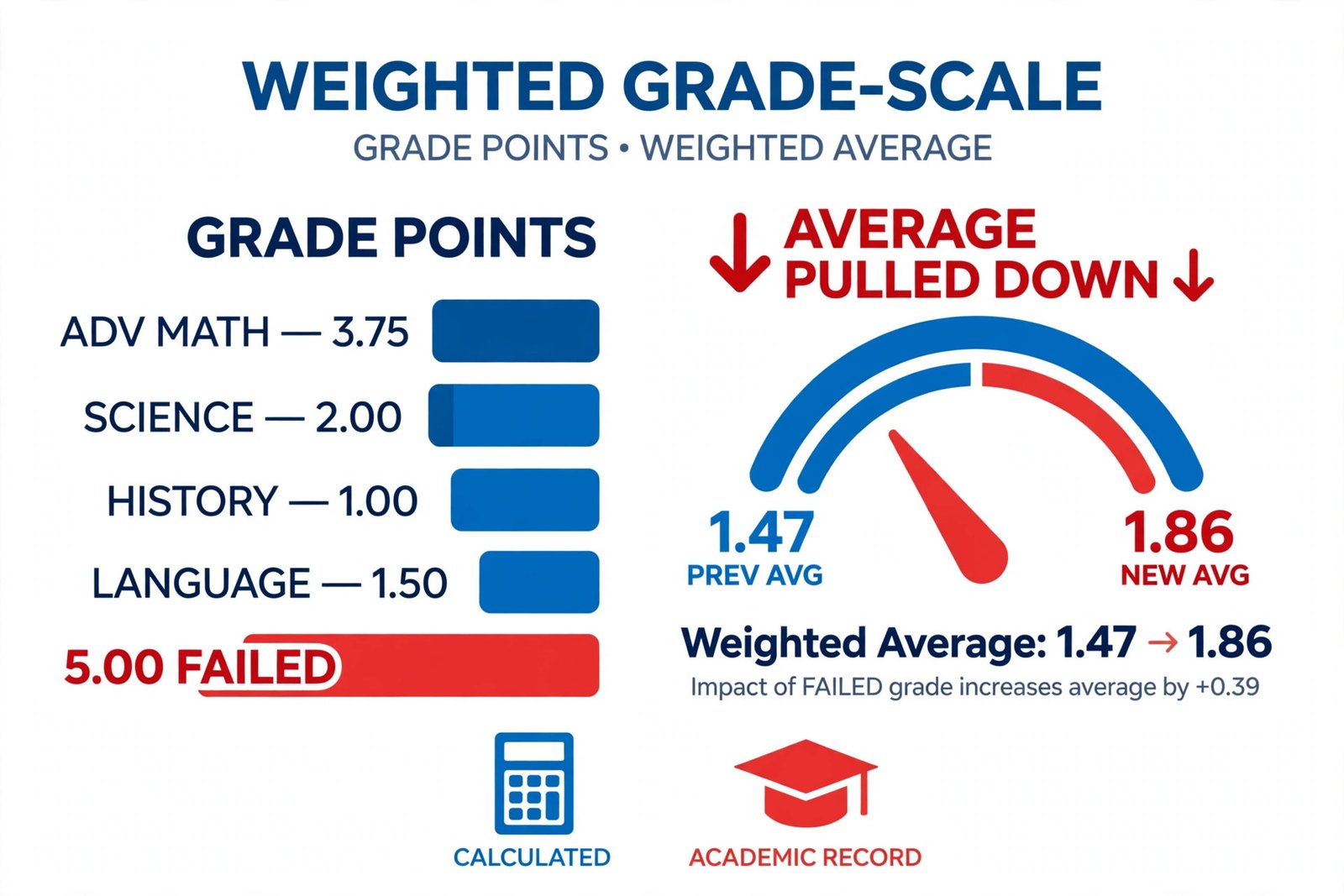
35.25 ÷ 24 = 1.47 — a solid transcript. Now add one failed 3-unit subject:
35.25 + (5.00 × 3) = 50.25 points over 27 units → 1.86.
One failure moved this transcript by +0.39. That’s the number most guides won’t give you — because the honest answer to “how much does a failed subject hurt my GWA” is it depends on your units, and we’ll prove that next. That unit-dependence is the entire failed subject GWA Philippines story in miniature: the damage is always weighted, never flat. Watch the calculation happen live in the video below: a clean 1.47 transcript, then the 5.00 row added, then the retake fix.
Why the unit weight decides how much it hurts
Not all failures are equal. We measured the same 1.47 transcript with failures of different sizes:
- 1-unit failure (a small PE-type subject): 1.47 → 1.61
- 3-unit failure (a regular subject): 1.47 → 1.86
- Two 3-unit failures: 1.47 → 2.17
And the reverse: a student with a deep transcript is harder to sink. An honors student holding 1.25 across 60 units who fails one 3-unit subject only drops to 1.43 — still magna-cum-laude territory. Sixty units of good history dilute one bad row almost completely.
This is the failed subject GWA Philippines reality in one line: your units decide the damage, not the failure itself. Always run your units. (If you’ve been mixing up term and cumulative averages, our cumulative GWA guide shows why only the unit-weighted total counts.)
Failed subject GWA Philippines retake rules: replace vs. average
Here’s the part most students get wrong: passing the retake does not automatically fix your GWA. Philippine schools handle retakes two different ways, and the difference is enormous. Same failed 3-unit subject, retaken with a 1.50, measured both ways:
- Replace policy: the 5.00 is swapped out for the 1.50 → back to 1.47. The failure is fully erased from the average.
- Average-both policy: the 5.00 row and the 1.50 retake row both count → 1.82. The failure still haunts the transcript — barely better than keeping the 5.00 alone (1.86).
Which policy is yours? As a rule of thumb from a legal survey of Philippine university practice, private universities frequently record only the latest passing grade on the transcript (the fail stays in the internal ledger), while state universities and colleges (SUCs) often compute the cumulative average using all attempts. So if you’re at a state university, assume both attempts count unless your registrar tells you otherwise in writing.
Two corrections to things you’ll read elsewhere: one popular guide claims most public universities (UP, PUP, PLM) replace the failed grade on retake — that inverts the pattern above, so don’t rely on it. And a competing calculator site advises students to “never count both attempts” — also wrong for many schools. The only safe move: ask your registrar which policy applies to you, then enter exactly what your school counts. School-specific rules vary a lot — PUP’s grading system, for instance, has its own conventions worth checking directly.

What to type into the calculator (and what breaks it)
Real transcripts aren’t tidy. Here’s how each problem row behaves on the gwcalculator.com tool, measured:
- Dropped subject: enter it with 0 units. Zero-unit rows are skipped entirely — 1.47 stays 1.47. This is the correct way to exclude a dropped subject.
- INC (incomplete): typing
INCgives “invalid grade” — and one invalid row poisons the whole result. INC is a status, not a number, so it can’t be averaged. Settle the INC with your professor first; note that at many schools an unresolved INC converts to 5.00 after about a semester. - DRP / dropped-as-text: typing
DRPalso gives “invalid grade.” Never type a status as a grade. - Blank rows: an empty grade row also poisons the result to “invalid grade” — delete rows you aren’t using instead of leaving them blank.
- Entering F: the letter
Fmaps to 5.00 exactly (same 1.86 as typing 5.00). Bare5works too.
Two quirks worth knowing. First, the calculator accepts 4.00 as a number (it’s a conditional mark at some schools, e.g., UP) — just make sure 4.00 means what you think it means at your school. Second, numeric grades are rounded to 2 decimals on entry — typing 1.755 lands as 1.76. (And a formula-wording note, since one competitor page instructs readers to “sum your grades and credit units, then divide by total units” and shows a broken example where 345 ÷ 4 somehow equals 1.82: the correct computation is the sum of grade × units products divided by total units — 345 ÷ 4 = 86.25, a percentage average, not a GWA at all.)
One more inclusion rule people get wrong: some guides claim PE and NSTP “usually carry no units.” Arellano University’s official retention policy bases its GWA on all subjects in the approved load including PE and NSTP/ROTC. Treat PE/NSTP inclusion as school-dependent — check your handbook. Curious what your number looks like as a percentage? Run it through the GWA to percentage converter after you compute it.
The recovery math: how much clean work undoes one failure?
Starting from the damaged transcript (1.86 over 27 units), we measured how much perfect 1.00 work it takes to climb back:
- +30 units of 1.00 (a full strong year): 1.86 → 1.41
- +60 units of 1.00 (two full strong years): 1.86 → 1.27 — still not back to 1.47
Dilution is a long, grinding game. The honest takeaway: replacing the failure through a retake (back to 1.47 instantly under a replace policy) beats years of dilution. That math is why any serious failed subject GWA Philippines recovery plan starts at the registrar’s office, not with extra units. Retake the subject as soon as your school allows it.
The scholarship version of this is scarier. DOST scholarships generally require keeping the GWA at or below 2.50. We measured a scholar holding 2.38 over 60 units: one failed 3-unit subject takes her to exactly 2.50 — sitting precisely on the retention line, with zero room left for another bad row. If your scholarship has a GWA floor, one failure can end it; talk to your scholarship coordinator the same week, not the next semester.
Beyond the number, a failed subject costs time. If the failed course is a prerequisite, you can’t take its sequel until you pass the retake — a failed 3-unit prereq in second year can push a subject chain (say, Math 1 → Math 2 → Math 3) a full semester late, which can delay graduation even when your GWA recovers. Plan the retake for the earliest term the subject is offered.
Your recovery checklist, in order: 1) confirm the grade is really a 5.00 and not an INC or encoding error — ask the professor; 2) see your academic adviser about the retake schedule; 3) get your registrar’s retake policy in writing (replace or average); 4) check scholarship and academic-standing implications now; 5) replan the next two semesters around the retake. For the motivation side of the climb, our honest GWA recovery guide walks through raising a damaged average step by step.
The damage beyond the number
A failed subject shows up in places the GWA doesn’t capture:
- Academic standing. At UP, the reported scholastic-standing ladder runs: warning below 3.00, probation below 2.75, dismissal below 2.00 or after two consecutive probations. One failure rarely triggers these alone — but it spends your margin. (Bands vary by school; your student handbook is the authority.)
- Honors. Many schools bar any 5.00 on the record from Latin honors and Dean’s List consideration — a recovered 1.47 still isn’t enough if the rule counts failures. Our Latin honors cutoffs guide and Dean’s List guide cover the exact bands; the no-failure rule is the part people miss.
- Cross-enrollment. A prior failure can block a cross-enrollment permit at some schools — another reason to clear the retake early rather than shopping it elsewhere.
- Repeated failures. A second failure in the same subject typically needs good standing to re-enroll; a third or fourth can mean forced shifting or disqualification. Don’t let one back subject become a pattern.
Note this article covers the college GWA system; basic-education grading works differently — see our DepEd grading system explainer for the K-12 side.
Frequently asked questions
These are the questions students actually ask about the failed subject GWA Philippines problem — short answers, same measured numbers as above.
Does a failed subject stay on my transcript even after I retake it?
Usually yes. Both attempts typically appear on your Transcript of Records; the question is only which one your school counts in the GWA. Private schools often compute with the latest grade, while many state universities average all attempts — confirm with your registrar.
How much does one failed subject affect my GWA?
It depends on the subject’s units and your total units. Measured: a 3-unit 5.00 moved a 24-unit 1.47 transcript to 1.86 (+0.39). A 1-unit failure moved it only to 1.61, while a student with 60 units at 1.25 dropped only to 1.43.
If I retake a failed subject and pass, does my GWA go back to normal?
Only under a replace policy — our measured transcript returned exactly to 1.47. Under an average-both policy it only recovered to 1.82. Ask your registrar which policy applies before you celebrate.
What do I enter on the calculator for a dropped subject or an INC?
For a dropped subject, enter the row with 0 units — it’s excluded from the math. For an INC, enter nothing: typing INC gives “invalid grade” and poisons the whole result. Settle the INC with your professor first.
Can one failed subject get me dismissed?
Almost never by itself. Dismissal bands (e.g., below 2.00 at UP) are far below what a single failure produces on a normal transcript — but repeated failures and consecutive probations can get there, so don’t ignore the pattern.
Does a failed subject disqualify me from Latin honors or Dean’s List?
At many schools, yes — a 5.00 anywhere on the record bars honors eligibility even if your GWA later recovers into the cutoff range. Check your school’s honors rules, not just the GWA bands.
The bottom line
A failed subject is a unit-weighted 5.00 in your average — painful, precisely measurable, and very often fixable. The three moves that matter: run your real numbers so you know the actual damage (free, no signup), get your school’s retake policy in writing, and retake the subject at the earliest possible term. Dilution takes years; replacement takes one semester. And if this is one part of a bigger transcript puzzle — transferring schools, or stacking semesters — our transferee GWA guide covers how grades carry over when you move.