

Transferee GWA in the Philippines: How Your Grades Actually Carry Over
Here’s the comforting lie every transferee hears at the registrar’s window: “Don’t worry, your GWA follows you.” It doesn’t. Not cleanly, not automatically, and not in the way most students picture it. The real question behind transferee GWA Philippines searches is trickier than a single number, because a transferee is actually juggling three different GWAs computed over three different sets of units — and on top of that, Philippine schools follow two completely opposite policies about what credited subjects do to your average. Same transcript, same grades, two different answers. I ran a real transcript through the actual calculator engine on gwcalculator.com — the same code running on the live site — to show you exactly where each number comes from, down to the centavo-level rounding. No invented figures anywhere below; every GWA in this article is a measured tool output.
The three GWAs every transferee is juggling
Before touching a single number, get this taxonomy straight, because every confused transferee I’ve seen was confused about exactly this — and it’s the first thing to understand about any transferee GWA Philippines computation. There are three different averages in play, and competitors blur them together constantly:
1. The admission GWA. This is computed over the units you took outside the new school, and it exists for one purpose: getting you in. UP Diliman’s official transfer admission page is the clearest example in the country — it requires at least 33 academic units completed outside UP and a GWA of 2.00 or better (lower number = better, remember) over all collegiate units taken outside UP, with individual programs setting stricter cutoffs like 1.75 or 1.50. Mapua does its own version: a weighted average of at least 2.00 over your old subjects, and here’s the detail everyone misses — excluding Religion, PE, and NSTP from that computation. So the number that got you admitted was already computed with exclusions you probably didn’t know about.
2. The resident graduation GWA. Once you’re in, most schools compute your running GWA over units taken at the new school. Your credited transfer subjects may or may not be in this number — that’s the entire Policy A vs Policy B question we’ll work through below, and it’s the single biggest variable in your whole transferee life.
3. The honors GWA. Latin honors run on the school’s own rulebook, and transferees get the strictest version. UP requires 75% of units completed in residence plus two years of residence immediately before graduation. Mapua requires at least 60% of degree units completed at Mapua. And if a private school never wrote its own honors rule, CHED’s fallback (MORPHE Section 112) demands 75% of required subjects completed at the degree-granting school. Miss the residency line and you can graduate without honors no matter how pretty your grades are.
If you take one thing from this section: when someone says “what’s your GWA?”, a transferee’s correct answer is “which one?” If you want the general machinery first, our what is GWA guide covers the formula; what follows is the transferee-specific part nobody else shows with real numbers.
How credit evaluation really works (and the 80% myth)
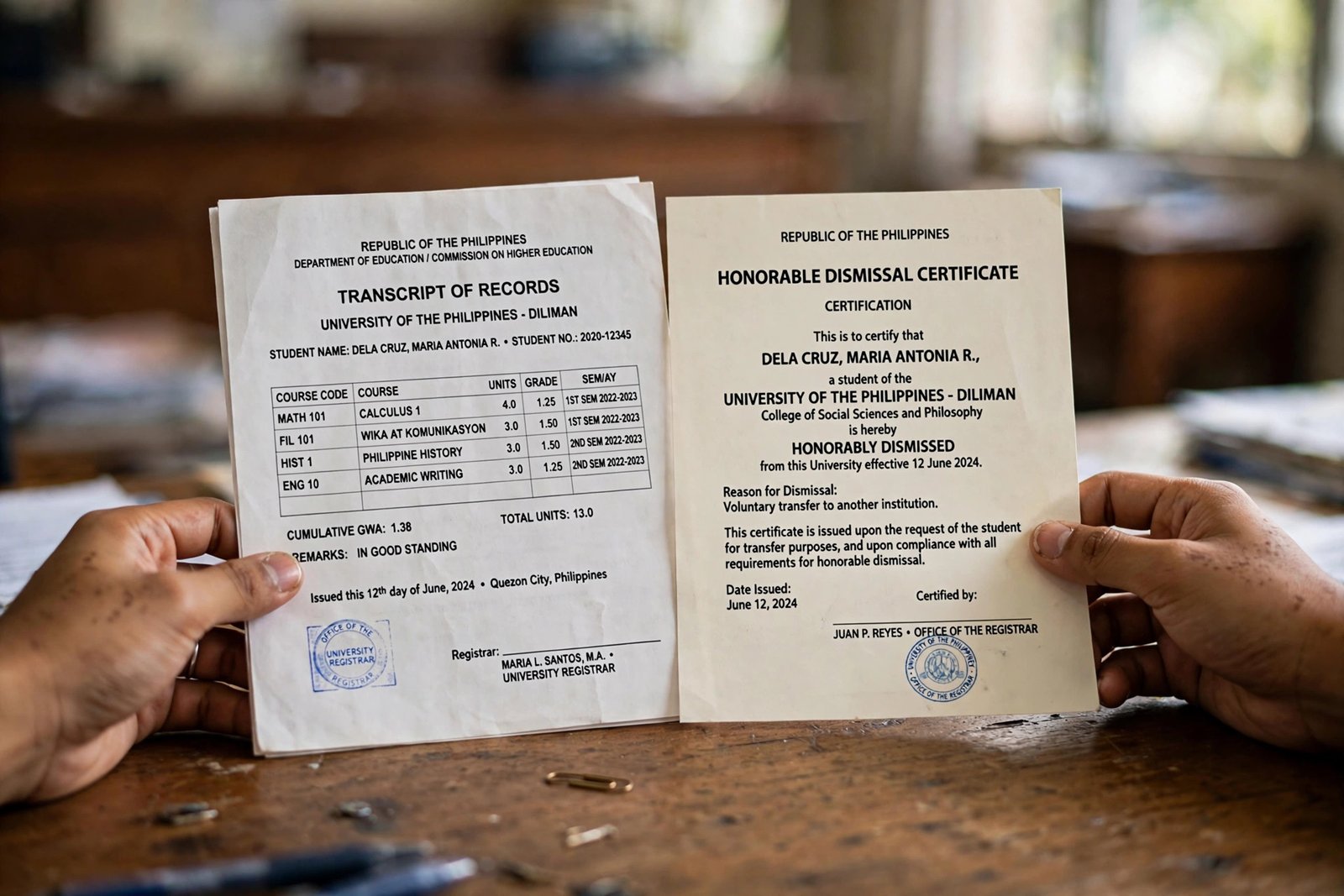
The process starts with paper, not math. You request your Transcript of Records and your Honorable Dismissal — also called transfer credentials — from your old school. The new school’s registrar then evaluates your subjects one by one against their own curriculum: course descriptions, contact hours, lab hours, prerequisites. This is discretionary. Every serious source says so, and the official pages prove it.
Now, a correction worth making, because one popular transfer guide states it as fact: “Courses with at least 80% similarity in content and hours are usually credited.” That precise-sounding 80% has no CHED memorandum behind it, no cited source, and the same page’s own FAQ quietly downgrades it to “70–80%”. Real policies don’t work in similarity percentages. Look at Mapua’s actual published transferee rule: Social Sciences, Filipino, PE, and NSTP are credited without a validation exam; English, Math, Chemistry, Drawing, Physics, and Computer require validation examinations given one month before enrollment, for a fee — otherwise you repeat the course. That’s categorical, exam-gated, and subject-specific. There is no 80% anywhere. When a blog gives you a clean percentage for a messy registrar decision, that’s the blog inventing certainty. Always work from the school’s published rule, and get the credit evaluation in writing before you finalize anything.
The two registrar policies that decide your number
This is the heart of the matter, and it’s where I need to correct a second piece of bad guidance floating around. One legal commentary page claims transferees’ previous grades are “officially validated and included in the GWA computation where required” — phrased as a near-universal rule. Its own sister article, on the same site, quotes the actual common policy clause: “Subjects credited from other institutions do not bear grades and are excluded from the computation of the GWA.” Those two statements can’t both be the universal rule. The truth is there are two live policies, and your school follows one of them:
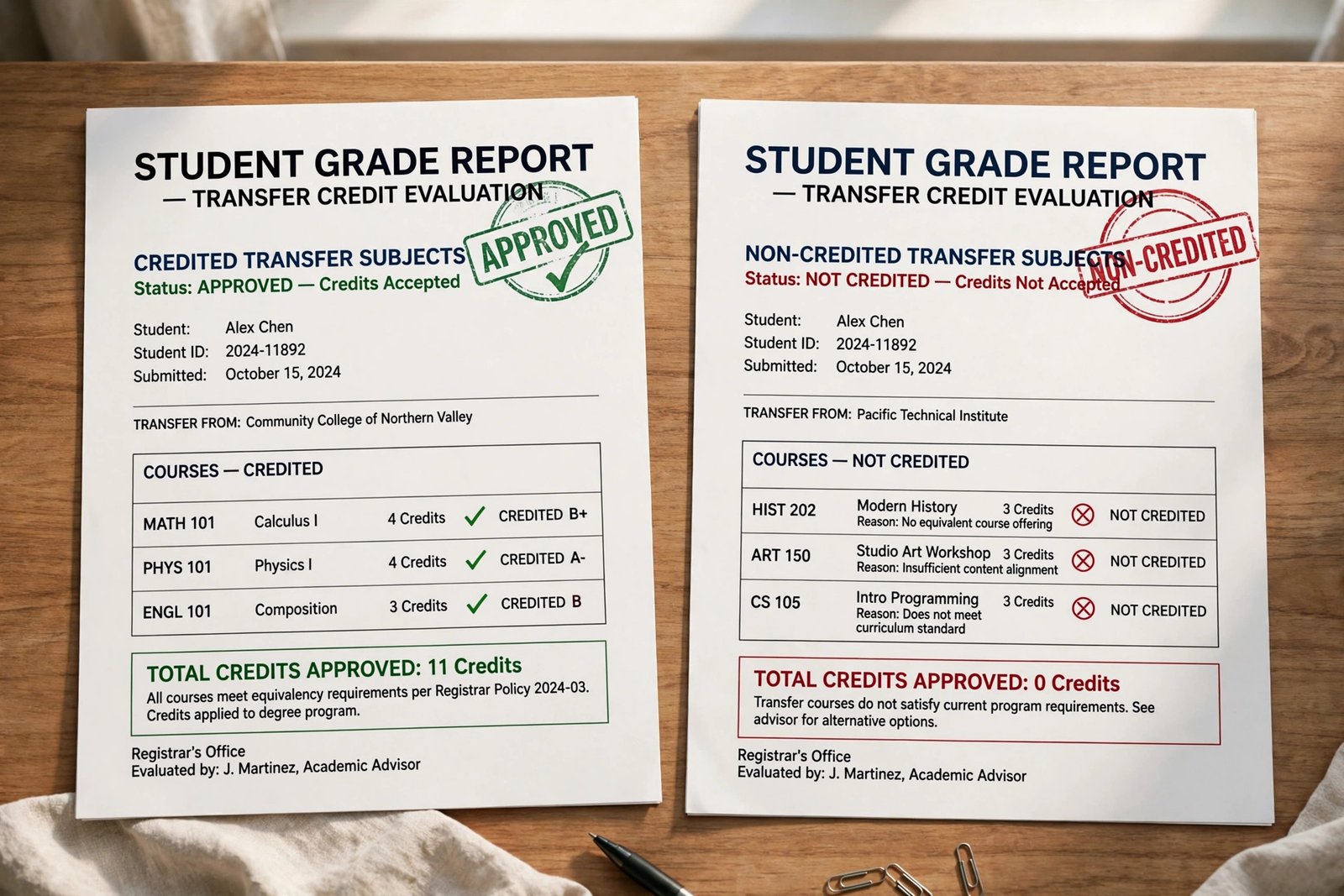
Policy A — credits carry no grades (the common one). Your credited subjects appear on the new TOR in a separate transfer section, usually with a “Credited” remark and no numeric grade. Because there’s no grade, they contribute nothing to the GWA formula — they’re invisible to the average. Your new-school GWA starts effectively from zero and is built only from subjects you take at the new school.
Policy B — credits carry grades (the rarer one). The old grades ride along into the new school’s computation — via validation exam results, sister-school arrangements, or institutional policy. Your transferee GWA is then a genuine weighted average across both transcripts.
Which one applies to you is a registrar question, not a math question. Ask it in writing before you estimate anything, because as you’ll see in the worked examples, the same transcript produces wildly different numbers under the two policies — and this two-policy split is the core of every transferee GWA Philippines question you’ll ever need answered.
Worked example 1: the full transcript, honestly computed
Meet the transcript I’ll use for every example — one realistic term from an old school, six subjects:
- Math 101 — 3 units — 1.75 → 5.25 grade points
- English 101 — 3 units — 2.00 → 6.00
- Filipino 101 — 3 units — 1.50 → 4.50
- General Chemistry — 5 units — 2.25 → 11.25
- PE 1 — 2 units — 1.00 → 2.00
- NSTP 1 — 3 units — 1.25 → 3.75
Total: 32.75 grade points ÷ 19 units = 1.72 (exact 1.723684, measured on the live calculator engine). That’s the old school’s number — the GWA on the TOR you’re carrying out the door.
Under Policy B (credits carry grades), if the new school credits all six subjects, the transfer computation is identical: 1.72. Same rows, same weights, same answer. The tool doesn’t know which school a grade came from, and under this policy it doesn’t need to.
Worked example 2: the picky registrar
Now the realistic case. The new school credits only Math, English, and Filipino — Chemistry needs a validation exam you haven’t taken, and PE/NSTP don’t map to anything in the new curriculum. Under Policy B with grades carried, your credited-subject GWA is:
(5.25 + 6.00 + 4.50) ÷ 9 units = 1.75 (measured).
Notice what happened: dropping three subjects moved the GWA up by 0.03. Counterintuitive until you remember the scale is inverted — your two best grades in the whole term were PE (1.00) and NSTP (1.25), and they’re exactly the subjects that didn’t get credited. The “easy A” subjects were subsidizing your average, and the transfer stripped the subsidy away.
And here’s the sharper version of the same trap, measured: if the new school’s policy excludes PE and NSTP from the computation entirely (the Mapua-style exclusion), the estimate on the remaining four academic subjects is 1.93 — a full 0.21 worse than the 1.72 on your old TOR, from the same transcript, with zero new grades earned. Transferees who casually include their PE/NSTP rows in a self-estimate are fooling themselves by two-tenths of a point. I measured both; believe the 1.93.
Under Policy A (credits carry no grades), the credited Math/English/Filipino rows contribute nothing — the tool reads an empty table as 0.00, which is the honest representation: you have no new-school GWA yet. Your first term at the new school builds it from scratch. For reference, a sample first term (1.50×3u, 2.00×4u, 1.25×3u, 2.25×3u) measured 1.77.
Worked example 3: the failed subject that won’t die
Same transcript, but English 101 was a 5.00 — failed. The old school’s TOR now reads 2.20 (measured, exact 2.197368). One failed 3-unit subject cost 0.48 of GWA.
Here’s the transferee twist: failed subjects are generally not creditable — CHED’s credit transfer framework only lets passed courses transfer. So the new school credits the other five subjects and your transfer-side computation reads 1.67 (measured, exact 1.671875). It looks like a fresh start: 0.53 better than the TOR you’re carrying.
Don’t get drunk on that number. The 5.00 still sits on your old TOR, and admissions offices read the TOR, not your optimistic spreadsheet. Mapua’s published transferee requirement is literally “No failing grade” — full stop. Meanwhile a certain blog claims “failures in non-major subjects may be overlooked if the overall GPA meets the threshold.” One of these is an official admissions page and the other is an unsourced blog sentence; bet your transfer on the official page. If you’re recovering from a rough term, read our honest GWA recovery guide before you apply anywhere.
Worked example 4: two terms, two schools, one honest average
Let’s finish the arithmetic with the case that breaks most DIY spreadsheets: cumulative GWA across terms and schools. Add a second old-school term — 1.25×3u, 1.75×4u, 2.00×4u, 1.00×2u, 1.50×3u — which measured 1.58 over 16 units. The cumulative old-school GWA over both terms: 58.00 grade points ÷ 35 units = 1.66 (measured, exact 1.657143).
Now watch the classic mistake: (1.72 + 1.58) ÷ 2 = 1.65. Wrong. The correct 1.66 differs because the terms carry different unit weights (19 vs 16). Never average two GWAs. Combine the underlying grade points and units, always. Our cumulative GWA guide walks through this trap in detail, and it’s the single most common arithmetic error in transferee self-estimates.
One more useful combined figure, measured: if a Policy-B school blends 15 old-school units at 2.00 with 15 new-school units at 1.50, the combined estimate is 1.75 — the honest weighted middle, not a guess.
Five ways transferees break their own estimates
These are all measured behaviors of the calculator, and every one of them bites transferees specifically:
1. Leaving an unresolved INC on the list. One INC row makes the entire result read “invalid grade” — the tool refuses to compute, and honestly so should you. Settle every INC at the old school before you transfer; an INC that converts to 5.00 after the deadline is a nightmare that follows you across registrars.
2. Typing percentage grades in raw. Old schools on a percentage system hand you numbers like 89. Type “89” into the grade box and you get “invalid grade” — the tool only accepts the 1.00–5.00 scale or letter grades. Convert first with our GWA to percentage converter (and note: it’s the converter page, which is the tool — don’t confuse it with guide articles).
3. Three-decimal grades. Transfer documents sometimes list grades like 1.755. The calculator rounds to two decimals on entry — 1.755 becomes 1.76 before weighting even starts, and the rounding in this case works against you (measured: 1.76). Small, but on a Latin-honors borderline, small is everything — see our Dean’s List cutoffs guide.
4. Forgetting letters map cleanly. Old schools that issue letter grades transfer fine: B+ → 1.75, B- → 2.25, C+ → 2.50, and a B+/B-/C+ trio over 3/3/2 units measured 2.13 exactly as the arithmetic says. Mixed scales are a non-problem; just enter the letters.
5. Counting credited-but-gradeless rows. Under Policy A, a credited subject with no numeric grade contributes nothing — entering it as a 0-unit row is skipped by the tool (measured: identical 1.75 with or without the 0-unit row), which is mathematically the same as leaving it out. Don’t pad your estimate with rows the registrar won’t count.

Compute your own transferee GWA in 60 seconds
Here’s the procedure, in order — the honest way to build your transferee GWA Philippines estimate. Skip step one and the rest is fiction.
Step 1 — Get the written credit evaluation. Not a verbal assurance from the counter. The memo should list every subject as credited or not, and state whether credited subjects carry grades into the GWA. This single document determines which of the two policies — and therefore which set of rows — applies to you.
Step 2 — List only the units the policy counts. Policy A: only subjects taken at the new school. Policy B: credited subjects with their carried grades plus new-school subjects. Exclude PE/NSTP/Religion if the school’s rule excludes them (Mapua publishes this; many schools do it quietly).
Step 3 — Enter them on the calculator. Open the GWA calculator, add one row per subject, units and grade each. The video below shows the exact walkthrough on the live tool: I entered the six-subject old transcript (1.72), then removed the three non-credited subjects to show the credited-only figure (1.75) — the two numbers from the worked examples above, computed live.
Step 4 — Sanity-check against the TOR. Your old TOR’s printed GWA should match your full-transcript computation (1.72 in our example). If it doesn’t, the difference is a policy exclusion you haven’t accounted for — different counted units, registrar rounding, or a repeat-replacement rule. Find it before you trust the transfer estimate.
One related note for PUP-bound transferees: PUP runs its own grading mechanics, so run your numbers through the PUP grading system guide too. And if your old school used a DepEd-style percentage system, the DepEd grading system explainer will help you convert grades correctly before entering them.
Transferee GWA Philippines — FAQ
Does my GWA reset to zero when I transfer schools?
Under the common policy (credited subjects carry no grades), your new-school GWA effectively starts fresh — credited subjects appear on your TOR as “Credited” with no numeric grade and don’t enter the average. Your old TOR keeps its own GWA forever; nothing is erased, it’s just a different document measuring a different set of units.
Do credited subjects show grades on my new Transcript of Records?
Usually not. Transferred subjects typically appear in a separate section with a special notation or a “Credited” remark, without the numeric grade format used for courses taken at the issuing school. Whether those credits enter the local GWA is a separate policy question — ask your registrar in writing.
Can I still graduate with Latin honors as a transferee?
Yes, if you satisfy the residency rule and the GWA cutoff. UP Diliman requires 75% of units in residence plus two years immediately before graduation; Mapua requires 60% of degree units at Mapua; CHED’s fallback for schools without their own rule is 75%. Note that some schools compute honors only on in-residence grades, excluding transfer credits entirely.
What GWA do I need to transfer to UP?
UP Diliman’s published rule: at least 33 academic units completed outside UP, and a GWA of 2.00 or better over all collegiate units taken outside UP — with individual programs setting stricter cutoffs (1.75 or 1.50). “Better” means a lower number on the 1.0–5.0 scale. Check the specific program’s page; the 2.00 is a university-wide floor, not a guarantee.
Will my failed subjects transfer to the new school?
No — only passed courses are creditable, so a 5.00 won’t ride along as earned units. But the failure stays on your old TOR, and many schools’ admissions rules count it: Mapua publishes “No failing grade” for transferees, and some schools disqualify Latin honors for any failing mark at any time, anywhere. The failed subject follows you on paper even when it doesn’t follow you in units.
Should PE and NSTP go into my transferee GWA estimate?
Only if the receiving school’s policy counts them. Mapua explicitly excludes Religion, PE, and NSTP from the transferee weighted average; UP’s grading rules have their own treatment (see our UP grading system guide). When in doubt, compute both versions — with and without — and you’ll usually find a swing of around 0.2, as our measured 1.72 vs 1.93 example showed.
The one-paragraph version
Getting your transferee GWA Philippines estimate right comes down to this: it’s not one number — it’s an admission GWA over outside units, a resident GWA over new-school units, and an honors GWA filtered through residency rules. Get the registrar’s credit evaluation in writing, find out whether credited subjects carry grades (Policy B) or arrive gradeless (Policy A, the common case), enter only the units the policy counts into the GWA calculator, and never average two GWAs — combine grade points and units. Every figure in this article was measured on the live calculator engine, and the worked examples above are yours to replay with your own transcript. Do that before enrollment week, not during it.