

If you are a University of the Philippines student, you already know the strange feeling of celebrating a 1.25 while your cousin at another school cries over the same number. The up grading system gwa is an inverted world: the smaller your number, the bigger your achievement. But the inversion is only the beginning of what makes UP’s system genuinely different from most other Philippine schools — and if you misunderstand the rules, you can misread your own academic standing by a wide margin.
I spent this week testing how UP grades actually behave when you run them through gwcalculator.com’s calculator engine, and the results surprised even me. One failed subject in a solid term costs nearly half a point. Typing a grade one digit too long can cost you before the math even starts. And the most common worked example on the internet quietly includes a subject UP itself would exclude — inflating the result by more than a tenth of a point. Every number in this guide comes from executing the live calculator’s logic in a test harness; nothing here is estimated or copied from a forum.
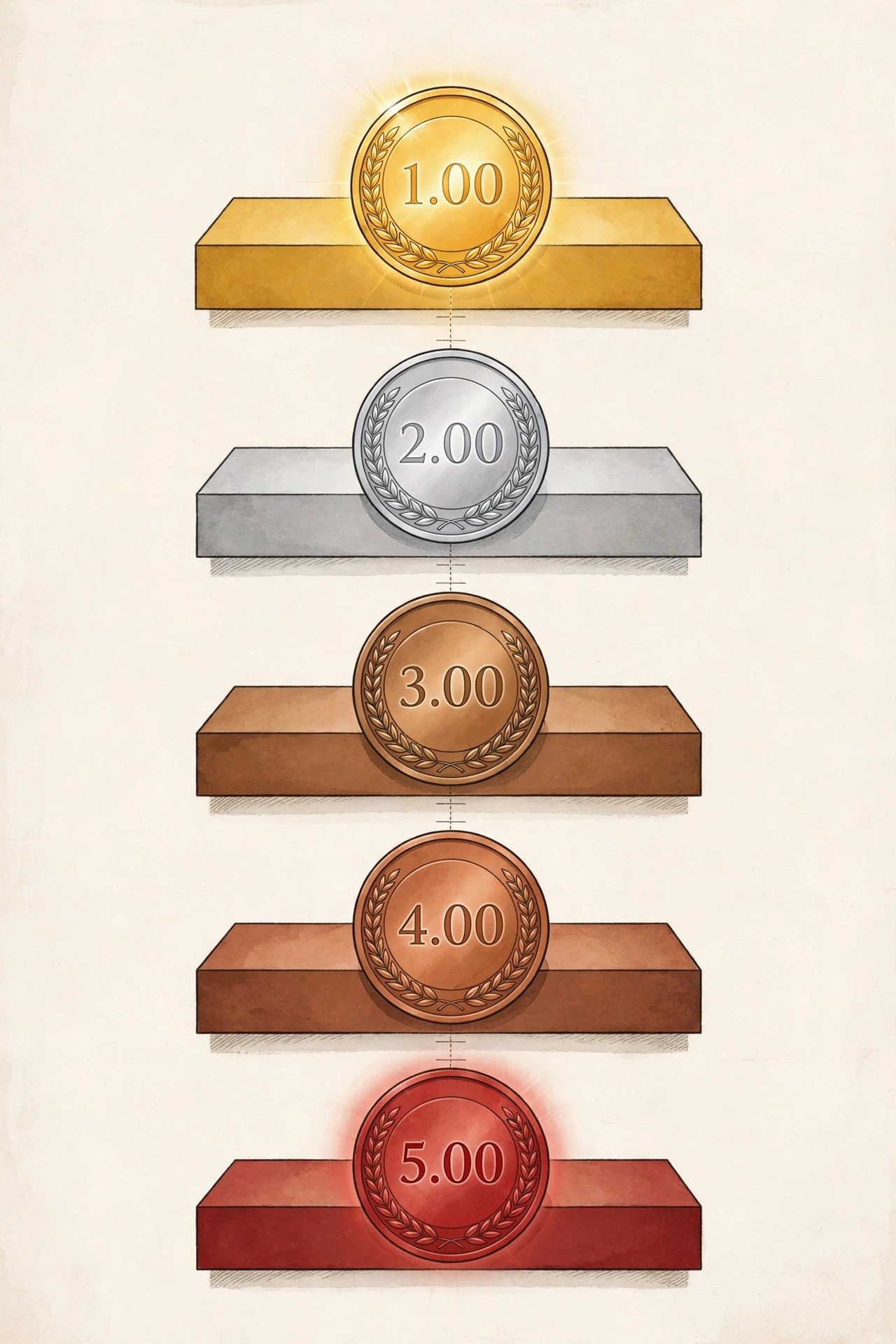
The UP grade scale: what each number means
UP grades its courses on a 1.00-to-5.00 scale, almost always in quarter steps: 1.00, 1.25, 1.50, 1.75, 2.00, 2.25, 2.50, 2.75, 3.00, then the special marks. That quarter-step granularity is a UP signature — many other Philippine schools work in half steps, but UP profs hand out 1.75s and 2.25s routinely, and those quarter points move your average in ways that matter.
| Grade | Meaning | What it does to you |
|---|---|---|
| 1.00 | Excellent | The ceiling. Straight 1.00s across a degree means Summa Cum Laude territory. |
| 1.25–1.50 | Very Good | Strong grades that keep Latin honors alive. |
| 1.75–2.50 | Good to Satisfactory | Comfortable passing; 1.75 is the Cum Laude cutoff line. |
| 2.75 | Satisfactory | Passing, but it drags a term average down. |
| 3.00 | Passing (“Tres”) | The UP passing grade. A 3.00 is not a failure — students sometimes call it a “tres,” and a full-tres term still produces a passing 3.00 GWA (measured). |
| 4.00 | Conditional | You get exactly one removal exam. Pass it and the grade becomes 3.00; fail it and it becomes 5.00. |
| 5.00 | Failed | Counted in the GWA at full unit weight. A 5.00 is not invisible — see the measured damage below. |
| INC | Incomplete | Given to students with passing class standing who missed the final exam; it must be resolved or it poisons every computation. |
| DRP | Dropped | Not a grade — dropped subjects carry no units into the average. |
How the UP grading system GWA formula works
The formula itself is the same weighted average used everywhere: multiply each grade by its credit units, add those products up, and divide by the total units. What makes the up grading system gwa different is not the arithmetic — it is which grades the arithmetic is allowed to see.
Here is a real freshman-style term, measured through the calculator engine: five subjects graded 1.25×3u, 1.75×3u, 2.00×3u, 1.50×5u, and 2.25×3u. The weighted sum is 3.75 + 5.25 + 6.00 + 7.50 + 6.75 = 29.25, divided by 17 units: GWA = 1.72 (exact 1.720588, displayed as 1.72). That is a healthy term — comfortably inside Cum Laude range — and every input is a quarter-step grade you would actually see on a UP report card.
Now watch what the scale’s direction does to intuition. In most of the world, a bigger number is better; at UP, 1.72 beats 1.91. New students sometimes read a 2.50 as “halfway decent” because it sits halfway between 1.00 and 5.00 — it is not. A 2.50 is barely Satisfactory and sits a full 0.75 away from the Cum Laude line.
Quarter steps: UP’s hidden tax (and hidden gift)
Because UP grades in quarter steps, the difference between two neighboring grades is often 0.25 rather than 0.50 — but the calculator rounds every grade you type to two decimals on entry, and that rounding happens before any weighting. I measured a typed 1.755 becoming 1.76 on entry. Half a hundredth sounds trivial until you multiply it by 17 units and then wonder why your number never quite matches the registrar’s.
The quarter steps cut both ways. A B- at UP is 2.25, not 2.50 — meaning a “barely below average” mark drags your term down less than students from half-step schools assume. Letters map cleanly into the system too: I measured A, A-, B+, B, B- (3 units each) landing at exactly 1.75, the Cum Laude line itself.
PE and NSTP are excluded — and the internet’s favorite example gets this wrong
This is the rule that costs UP students the most confusion, because it contradicts what you learned in high school. PE and NSTP grades are not counted in your GWA for UP purposes. The academic subjects are what move the number. That is the core of the up grading system gwa treatment of non-academic subjects: they never enter the average, no matter how many units they carry on your enrollment form.
The same term above — 1.72 on its own — becomes 1.59 the moment you add a PE grade of 1.00×2u and an NSTP grade of 1.25×3u (measured: exact 1.590909, displayed 1.59). That is a 0.13 swing from two rows that should not be in the computation at all. When I ran the same check with a 0-unit placeholder row — the calculator’s way of skipping a subject — the result came back 1.72, identical to the clean term. The practical rule: never enter PE or NSTP rows when estimating your UP GWA; leaving them out is mathematically the same as the tool ignoring them.
This matters because one of the most-linked worked examples on the internet makes exactly this mistake. A popular GWA guide (gwacalc.online) walks through a Chemistry-heavy first semester totaling 19.75 grade points over 13 units = 1.5192 — and includes PE 1 (2 units) in the total. Their arithmetic is correct, but the example contradicts their own text, which admits PE/NSTP are excluded at many universities. Removing just the PE row: (19.75 − 2.00) ÷ 11 = 1.6136. Same student, same semester, a tenth of a point worse — purely from following their own stated rule. For a UP student, 1.61 vs 1.52 is the difference between feeling safe and checking the honors bands twice.

Watch: entering a full UP-style loadout on gwcalculator.com gives 1.64 with PE included; removing the PE row gives the correct 1.72.
The 4.00 conditional: your one-shot rescue
A 4.00 at UP is not a failure — it is a conditional pass with exactly one removal exam. Pass the exam and the subject becomes a 3.00; fail it (or don’t show up) and it becomes a 5.00. There is no second exam, and there is no negotiating the mark.
I measured both branches against the same base term (1.72). With the conditional sitting in the term as a 4.00×3u, the calculator shows 2.06. Pass the removal exam (4.00 → 3.00) and the term recovers to 1.91 — a 0.15 swing from a single exam. Fail it (→ 5.00) and the term drops to 2.21 territory. If you are staring at a 4.00, the removal exam is the highest-leverage few hours of your semester: 0.15 of GWA rarely comes cheaper. Note the calculator accepts 4.00 as a plain numeric grade, so you can model your own conditional right in the tool before the exam.
A terminology warning, because a popular GWA guide gets this wrong: onlycalculators.com lists UP’s grades as “1.00 … 3.00 (Passing), 4.00 (Incomplete), and 5.00 (Fail)” and advises that an “Incomplete (grade 4.00)” can be excluded from the GWA until resolved. That is incorrect. 4.00 is the CONDITIONAL grade; the incomplete mark is INC — a separate, non-numerical mark. Entering 4.00 in a calculator when your record actually says INC models the wrong thing entirely (the tool will happily compute 2.06 for a conditional, while a real INC row makes the whole result read “invalid grade”). One more caveat from the research: guides disagree on the removal window — one UP-focused guide gives you “one academic year” in its body but “the next semester” in its own FAQ. UP practice varies by constituent university, so confirm the actual deadline with your college; missing it turns the 4.00 into a 5.00.
Failed subjects count — and shifted-program courses count too
Two more rules that surprise transferees. First: a failed 5.00 is counted in the GWA at full unit weight. Adding one failed 3-unit subject to my base term moved it from 1.72 to 2.21 (measured, exact 2.212500). That is a 0.49 swing from a single subject — roughly what an entire bad semester costs.
Second: UP counts every course taken at the level in the GWA, including courses from a program you shifted out of. Your freshman-year subjects from the program you left still weigh on your number. I modeled this: 2.00×15u from an old program plus 1.50×15u from the new one averages to exactly 1.75 — the calculator cannot know (or care) which program a grade came from, and per the UP rule it doesn’t need to. Shifting resets your curriculum, not your average.
Semester awards: University Scholar vs College Scholar (not the same as Latin honors)
Students confuse these constantly, so let’s separate the layers. UP grants semester academic awards in addition to the graduation honors below: a University Scholar finishes a semester with a GWA of 1.45 or better, and a College Scholar finishes with 1.75 or better — both with no grade below 3.00 and no incomplete or failing marks. These are semester-by-semester awards; Latin honors (Summa, Magna, Cum Laude) are determined at graduation over the whole degree, with their own residency and load rules. You can be a College Scholar for four semesters and still miss Cum Laude, or graduate Cum Laude without ever collecting a semester award.
Latin honors at UP: the bands and the fine print
UP awards Latin honors by weighted average bands: Summa Cum Laude at 1.20 or better, Magna Cum Laude at 1.45 or better, and Cum Laude at 1.75 or better. These bands are brutally exact, and the calculator’s two-decimal display can mislead you at the edges. I measured a borderline loadout — 1.00, 1.25, 1.25, 1.25 (3 units each) — landing at exact 1.187500, displayed as 1.19: Summa-safe, but only just. A flat 1.75 across 15 units displays 1.75 and still qualifies for Cum Laude (the band is “or better,” so 1.75 itself counts). But flat 1.79 across 15 units displays 1.79 — four hundredths above the line, no honor at all.
And the number is not the whole story. UP also applies residency and unit-load rules, and the University Registrar has the final word on every honors determination. (UP’s own academic advising page lays out the Latin honors rules from the UP System Code, Articles 409–413.) If you are within 0.05 of a band, do not plan your graduation speech — plan a visit to the registrar first.

How to estimate your UP GWA with the calculator (the honest way)
- List academic subjects only. Enter each subject’s final grade and credit units. Leave PE and NSTP out entirely — the tool’s 0-unit skip behaves identically, but cleanest is to not enter them.
- Type grades exactly as awarded. Quarter steps (1.75, 2.25) are fine; letters (B-, C+) map automatically. Remember the tool rounds each typed grade to 2 decimals on entry — if your estimate differs from the registrar’s by 0.01, this is usually why.
- Resolve INC before trusting the number. One INC row makes the entire result read “invalid grade” (measured) — the tool cannot compute around it, and neither can your estimate.
- Model your conditionals. Enter a 4.00 as-is to see the damage, then change it to 3.00 to see what passing the removal exam buys you.
- Confirm honors math with your college secretary. The bands are public, but residency, load, and shifting rules vary by campus — the calculator gives you the number, the registrar gives you the verdict.
One last thing the tool cannot do for you: GWA is backward-looking. Every term you complete locks in more units, and as we showed in our recovery guide, the same perfect term buys less GWA movement in your senior year than in your freshman year. The cheapest time to fix your number is always the term you are in right now.
FAQ
How is GWA computed at UP?
Multiply each subject’s final grade by its credit units, sum those products, and divide by total units — using academic subjects only (PE and NSTP excluded). UP counts every course taken at the level, including courses from a program you shifted out of. Measured example: 1.25×3u + 1.75×3u + 2.00×3u + 1.50×5u + 2.25×3u → 1.72. These two features — the exclusion of non-academic subjects and the inclusion of everything else — are what make the up grading system gwa distinct from most other Philippine schools’ versions of the same formula.
What is the passing grade at UP?
3.00 is the passing grade. A 3.00 is not a failure — a full-tres term still yields a passing 3.00 GWA (measured), though it sits far below any honors or scholarship line.
What does a 4.00 grade mean at UP?
Conditional. You get one removal exam: pass and the grade becomes 3.00; fail or miss it and it becomes 5.00. Measured swing on a typical term: 2.06 (conditional) → 1.91 (passed). Confirm the removal-exam deadline with your college — guides disagree on whether it is one academic year or the next semester, and practice varies by constituent university.
Is 4.00 the same as INC at UP?
No. 4.00 is the conditional grade (removal exam); INC is a separate, non-numerical incomplete mark. Some guides merge the two — that is wrong. In the calculator, a 4.00 row computes normally while an INC row makes the entire result read “invalid grade,” so never substitute one for the other when modeling your grades.
Are PE and NSTP included in the UP GWA?
No. They should not be entered in the computation at all. Measured: a 1.72 term becomes 1.59 when a PE 1.00×2u and NSTP 1.25×3u are wrongly included — a 0.13 error.
What GWA do you need for Latin honors at UP?
Summa Cum Laude: 1.20 or better; Magna Cum Laude: 1.45 or better; Cum Laude: 1.75 or better. Residency and unit-load rules also apply — the registrar has the final word.
Do failed subjects affect your UP GWA?
Yes, at full unit weight. One failed 3-unit subject moved a measured 1.72 term to 2.21 — a 0.49 swing.
Does the UP GWA use quarter steps?
Yes — 1.25, 1.75, 2.25, 2.75 are routine UP grades. Type them exactly; the calculator rounds each entry to two decimals before weighting.
What happens if you shift programs at UP?
Your grades from the previous program still count in the GWA — UP includes every course taken at the level. Measured: 2.00×15u (old) + 1.50×15u (new) → 1.75.
Read next: What Is GWA? The Complete Philippine Guide · GWA to GPA Conversion · Dean’s List GWA Requirements in the Philippines · PUP Grading System Explained · Cumulative GWA Across Semesters