
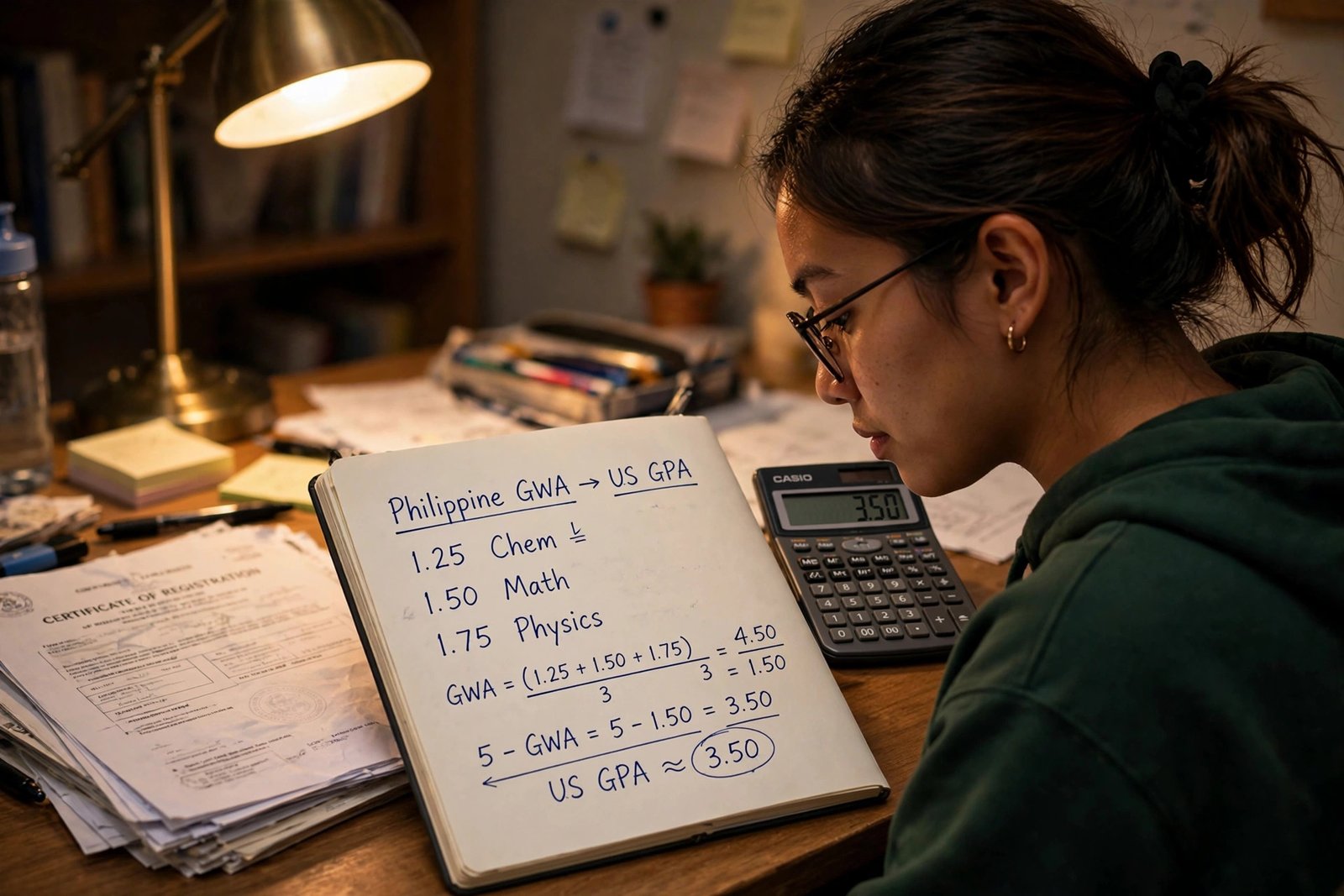
Here is a mistake that quietly sinks Filipino study-abroad applications every year: writing “GPA: 1.75” on a US university form. On the Philippine scale, 1.75 is a genuinely good grade — Very Good, dean’s-list-adjacent at many schools. On the American 4.0 scale, a 1.75 GPA reads as barely passing, borderline failure. Same digits, opposite meaning. I have watched students with strong transcripts get filtered out by automated cutoffs because nobody told them the number flips.
So I took real grade sets and ran them through every gwa to gpa conversion method that actually gets used — the linear formula, the band tables, the Scholaro letter-grade mapping, and the official WES route — comparing the numbers side by side.
The quick answer
In a hurry? The most widely cited gwa to gpa conversion is GPA = 5 − GWA. A GWA of 1.75 becomes a 3.25 GPA. A GWA of 2.00 becomes 3.00. A GWA of 3.00 — the lowest passing grade in the Philippines — becomes 2.00. This formula is an approximation, perfectly fine for forms that accept self-reported numbers, but it is not the same thing as an official credential evaluation. The rest of this guide covers when each method applies, because using the wrong method in the wrong place is exactly where people get burned.
The two scales, plainly explained
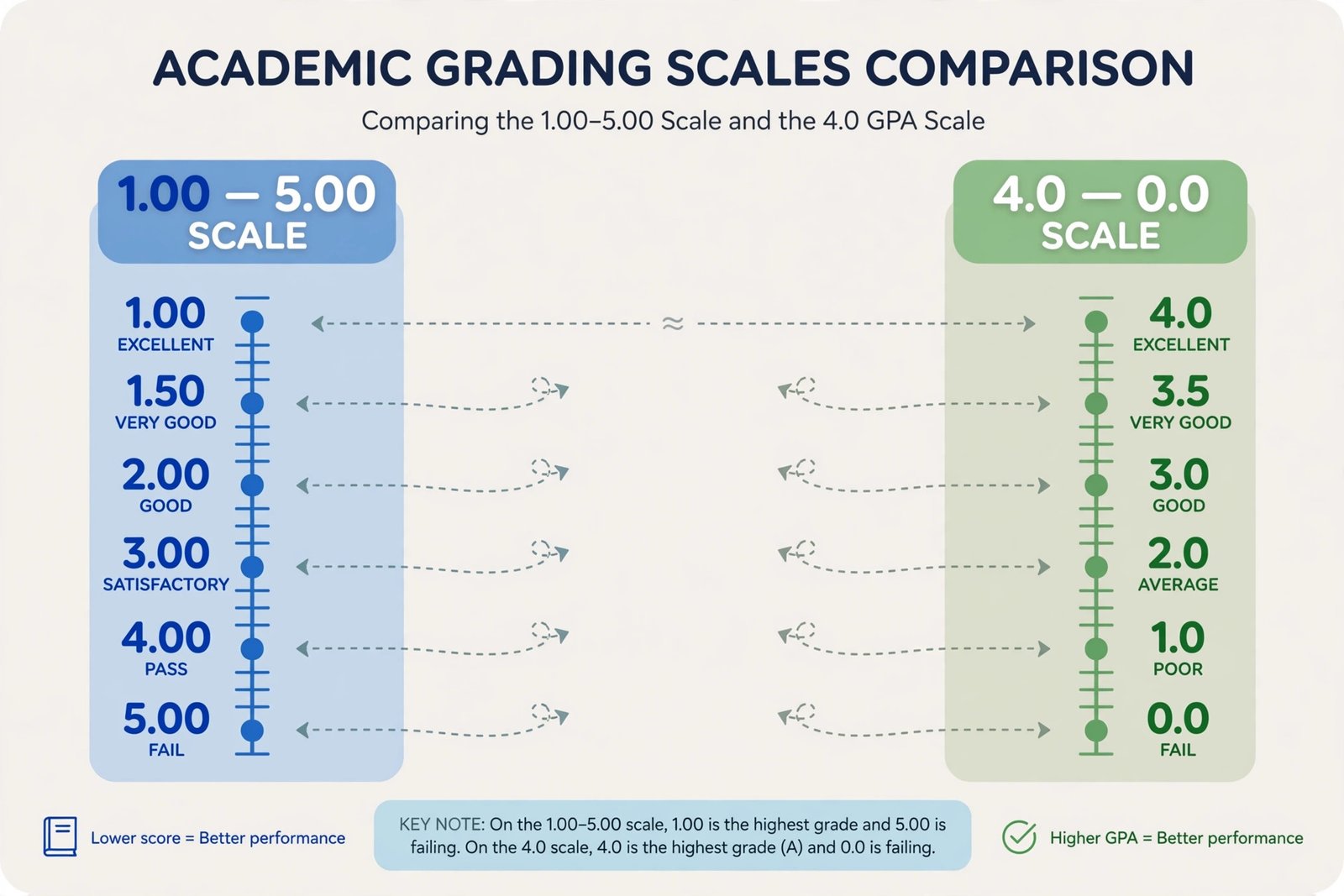
Philippine universities grade from 1.00 (best) down to 5.00 (fail). American universities grade from 4.00 (best) down to 0.00 (fail). The scales run in opposite directions, and that inversion is the entire source of confusion. A lower GWA is better; a higher GPA is better. Every conversion method is just a different way of mapping one inverted scale onto the other.
Two anchors make the relationship click. A perfect 1.00 GWA maps to a perfect 4.00 GPA. A barely-passing 3.00 GWA maps to a 2.00 GPA — a flat C average in the US. Everything else falls somewhere between those two points, and the methods differ in how they fill the middle.
Method 1: The linear formula (GPA = 5 − GWA)
This is the formula you will find on nearly every converter site, and there is a good reason for its popularity: it is dead simple and it nails both anchors. Subtract your GWA from 5. Done. The logic is that the two scales are inversely related with an offset of 5 — when GWA goes down by 0.25, GPA goes up by 0.25.
Let me run a real example. Maria, a second-year accountancy student, finished the semester with these grades: 1.25 (3 units), 1.50 (3 units), 1.75 (4 units), and 2.00 (3 units). First the GWA, the honest way:
(1.25 × 3) + (1.50 × 3) + (1.75 × 4) + (2.00 × 3) = 3.75 + 4.50 + 7.00 + 6.00 = 21.25 total grade points. Divide by 13 total units: GWA = 1.63.
Now convert: GPA = 5 − 1.63 = 3.37. That is a solid B+ average on the US scale — which feels right for a student whose worst grade was a 2.00.
My take: for gwa to gpa estimates, this is the method to use — quick calculations and any form that accepts a self-reported GPA. It is transparent, reproducible, and any admissions officer can verify your math in ten seconds. Its weakness is that it is smooth and continuous, while real grading is lumpy — which brings us to method 2.
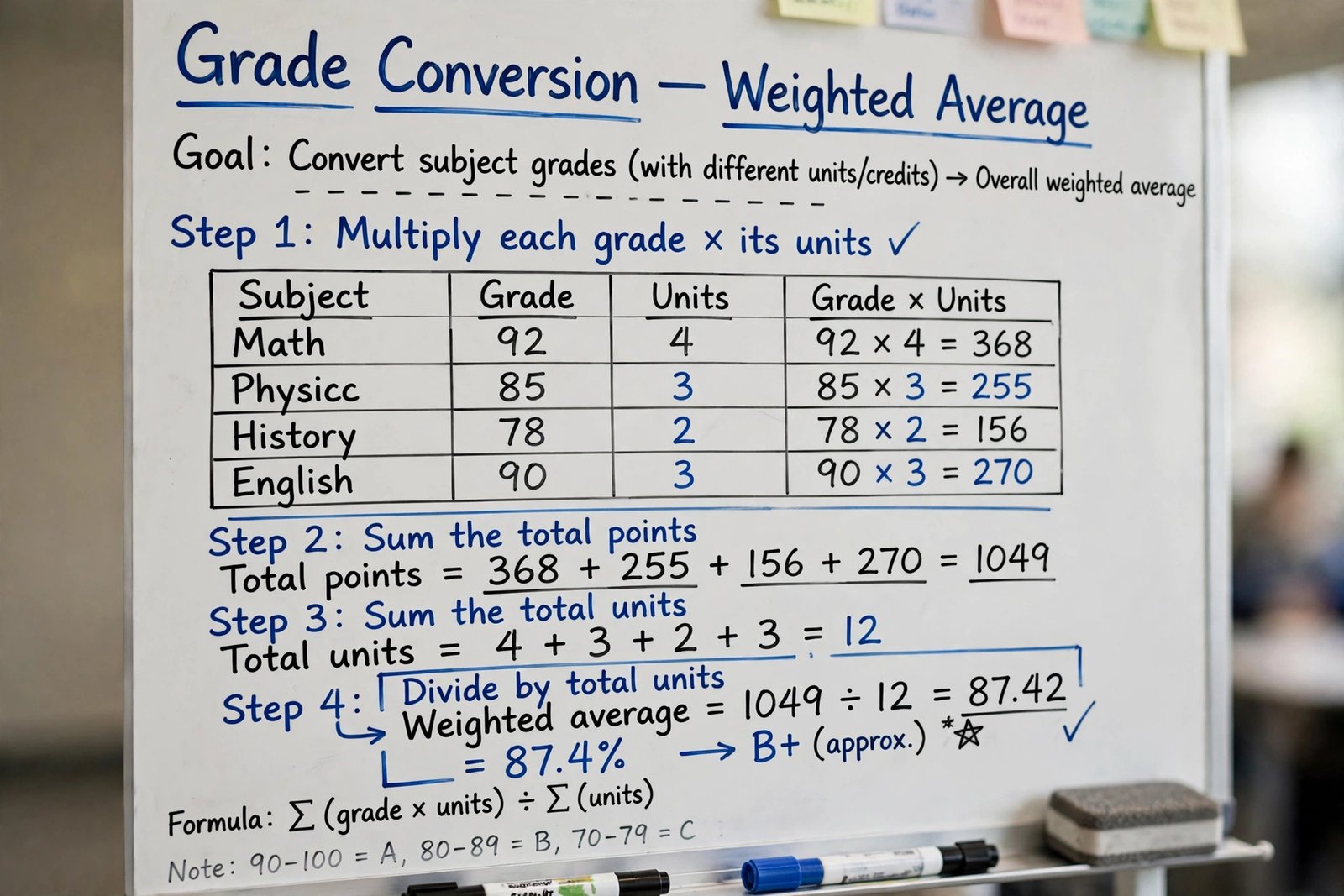
Method 2: The band table (GWA ranges to fixed GPA)
Several Philippine converter sites publish band tables instead of a formula: your GWA falls into a range, and each range maps to one fixed GPA. The most common version looks like this — 1.00–1.24 → 4.0, 1.25–1.49 → 3.75, 1.50–1.74 → 3.50, 1.75–1.99 → 3.00, 2.00–2.49 → 2.50, 2.50–2.99 → 2.00, 3.00–3.49 → 1.50, and anything above → 1.00 or 0.00.
Take Jose: grades of 1.75 (3 units), 2.25 (4 units), 1.50 (3 units), 2.50 (3 units). His GWA works out to (5.25 + 9.00 + 4.50 + 7.50) ÷ 13 = 2.02. The linear formula gives him 5 − 2.02 = 2.98. The band table drops him into the 2.00–2.49 range → 2.50.
That is a gap of nearly half a grade point for the same transcript — and it is the most important honest finding in this guide. Band tables are stepwise, so a GWA of 2.01 and a GWA of 2.49 get the identical GPA, while the linear formula treats every hundredth of a point fairly. My opinion: band tables systematically undervalue students near the top of each band. Use them only when a specific school or scholarship explicitly publishes its own table — never as a default.
Method 3: The Scholaro letter-grade mapping
Scholaro, a widely referenced credential resource, maps Philippine grades through US letter grades: 1.00–1.25 counts as A/A+ (4.0), 1.50 as A− (3.7–3.9), 1.75 as B+ (3.3–3.6), 2.00 as B (3.0–3.2), 2.25 as B−, 2.50 as C+, 2.75 as C, and 3.00 as C−. You convert each subject to its US grade points, then take the unit-weighted average — the same weighted-average math as a GWA, just on the flipped scale.
Ana’s grades: 2.00 (3 units), 2.25 (3 units), 2.50 (4 units), 3.00 (3 units). Converting each — B (3.1), B− (2.8), C+ (2.45), C− (1.8) — and weighting by units: (3.1 × 3 + 2.8 × 3 + 2.45 × 4 + 1.8 × 3) ÷ 13 = 2.53. Her GWA is 2.44; the linear formula would give 2.56. Close here, but notice the pattern: Scholaro tends to land between the linear formula and the band table.
When does this method win? For study-abroad applications, because it mirrors how an American registrar thinks — in letter grades per course. If your target university’s international admissions page mentions grade equivalencies, this gwa to gpa mapping is usually what they mean.
Method 4: Official evaluation (WES / ECE)
For actual admission — not estimates, not forms — many US and Canadian universities require an official credential evaluation from World Education Services (WES) or Educational Credential Evaluators (ECE). You send your transcript, they do a course-by-course analysis, and they issue an authoritative US-equivalent GPA.
No formula on this page replaces that. WES has its own internal conversion tables, and their number is the one that counts wherever an evaluation is required. My practical advice: compute your own estimate with the linear formula first (so you know roughly where you stand before paying the evaluation fee), then let WES produce the official figure. Never submit a self-converted GPA to a school that asked for WES — that is an easy way to get your application flagged.
A trick worth knowing: per-subject conversion
Some guides tell you to convert each subject’s grade with (5 − grade) and then take the weighted average, presenting it as a separate “more accurate” method. I tested it on all four of my sample students. Maria: 3.37 either way. Jose: 2.98 either way. It is mathematically identical to converting the final GWA — the 5s factor out of the weighted average. Not a scam, just the same method wearing a different coat. If a converter site lists both as separate methods, now you know.
All four methods, one transcript
Here is the same GWA — 1.75, a grade thousands of Filipino students actually have — run through every method, plus when to use each:
| Method | Formula | 1.75 GWA becomes | Use it when |
|---|---|---|---|
| Linear formula | GPA = 5 − GWA | 3.25 | Self-reported forms, quick estimates |
| Band table | GWA range → fixed GPA | 3.00 | A school publishes its own table |
| Scholaro mapping | Grade → US letter → points | 3.3 (B+) | Study-abroad applications |
| WES / ECE | Official course-by-course | Varies | University requires evaluation |
Full worked example: Miguel, the dean’s lister
Miguel is the strongest student in my test set: 1.00 (3 units), 1.25 (4 units), 1.50 (3 units), 1.75 (3 units). His GWA: (3.00 + 5.00 + 4.50 + 5.25) ÷ 13 = 17.75 ÷ 13 = 1.37. That is comfortably on the dean’s list at most Philippine universities — our PUP Latin honors guide shows what that kind of GWA unlocks locally.
Converted three ways: linear gives 5 − 1.37 = 3.63; the band table puts 1.37 in the 1.25–1.49 range → 3.75; Scholaro’s per-subject mapping gives 3.79. All three agree he is an A-minus student in US terms — the methods converge at the top of the scale and diverge in the middle, which is exactly what you would expect.
If Miguel is applying abroad, by the way, he should also know his percentage equivalent — our GWA to percentage guide covers that conversion — since some scholarship forms ask for percentages rather than GPA.
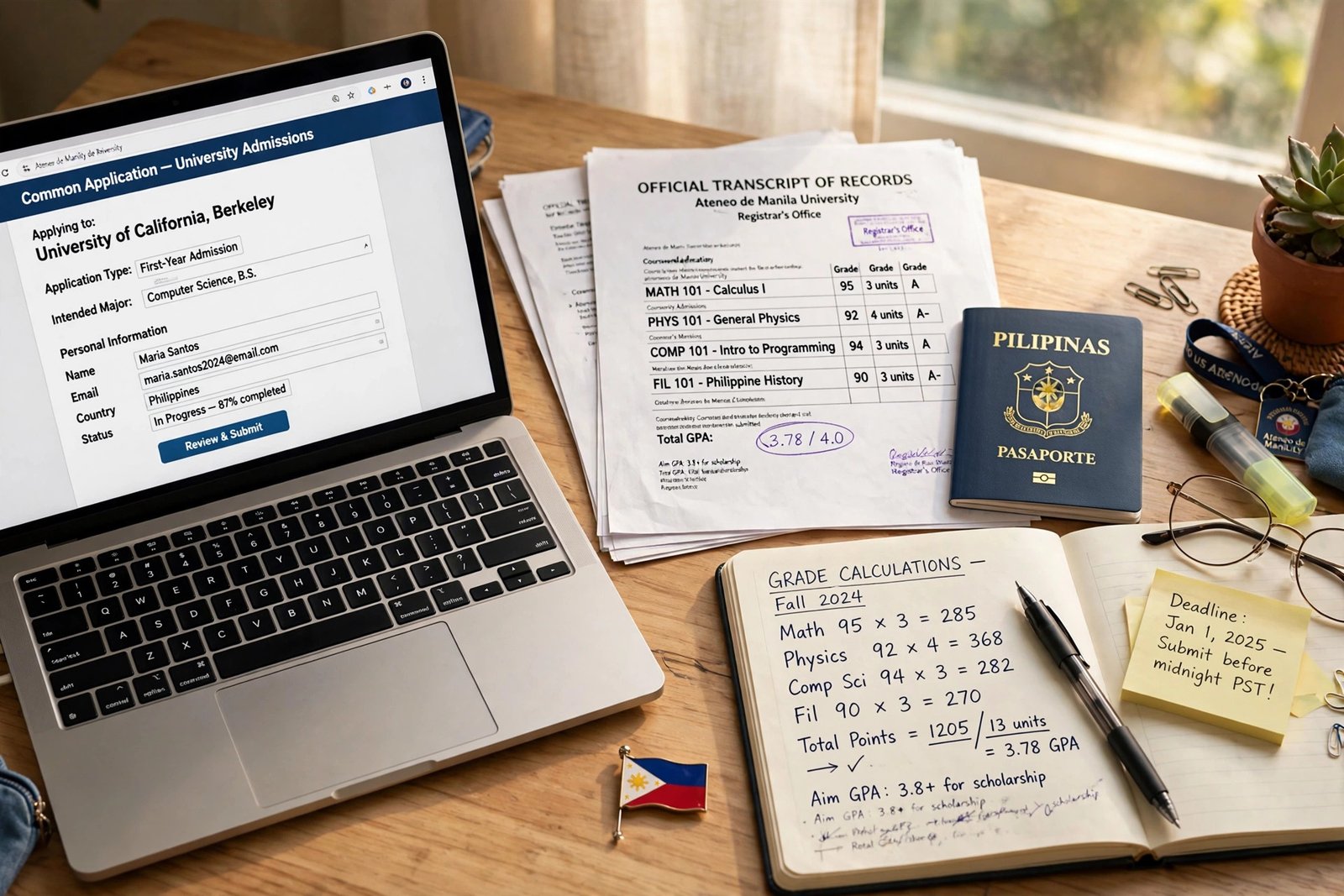
Watch: the conversion in 30 seconds
FAQ
What is the formula for gwa to gpa conversion?
The most widely used formula is GPA = 5 − GWA. Subtract your Philippine GWA from 5 to get the approximate US 4.0 GPA. A 1.75 GWA becomes 3.25, a 2.00 becomes 3.00. It is an approximation — official applications may require a WES evaluation instead.
Is the linear formula official?
No. It is a well-established approximation, not an official standard. No Philippine government body publishes an official GWA-to-GPA formula. For anything binding — admission, scholarships with GPA cutoffs — use a credential evaluator like WES or the conversion table your target school publishes.
What GPA is a 1.75 GWA?
It depends on the method: 3.25 with the linear formula, 3.00 on the common band table, and about 3.3 (B+) with the Scholaro letter-grade mapping. If a form just says “GPA” with no method specified, 3.25 via the linear formula is the defensible answer — and note the method next to the number.
Do I need a WES evaluation to study in the US?
Many universities require one, especially for graduate programs — check your target school’s international admissions page before you apply. WES costs money and takes weeks, so compute your own estimate first with the linear formula to see where you stand, then start the official evaluation early.
Can I just write my GWA on a US application form?
Please don’t. A 1.75 in a “GPA” field reads as near-failing to anyone used to the 4.0 scale, and automated screens will filter you out before a human sees the transcript. Convert it, label the method, and note that 1.00 is the highest Philippine grade. Still computing the GWA? Our complete GWA computation guide walks through it step by step.
Verdict
So which gwa to gpa method should you actually use? My practical rule after running the numbers: the linear formula (5 − GWA) for anything self-reported or informal — it is transparent and fair to every hundredth of a point. The Scholaro-style mapping when a university’s admissions page talks in letter grades. The school’s own band table only when they publish one. And WES whenever the application requires it — no shortcut survives that requirement.
One last thing: the methods agree at the top and diverge in the middle. At 1.50 or better, every method calls you an A student. Between 1.75 and 2.50, your choice of method can move the reported GPA by three-tenths — exactly where scholarships are won and lost. Choose deliberately, label your method, and never submit a raw GWA where a GPA was asked for.