

How to Compute GWA: The 30-Second Answer
If you’re here to learn how to compute GWA fast, here it is: multiply each subject’s grade by its number of units, add all those products together, then divide by your total units. That’s the entire method. The worked example below takes four lines of arithmetic and about two minutes.
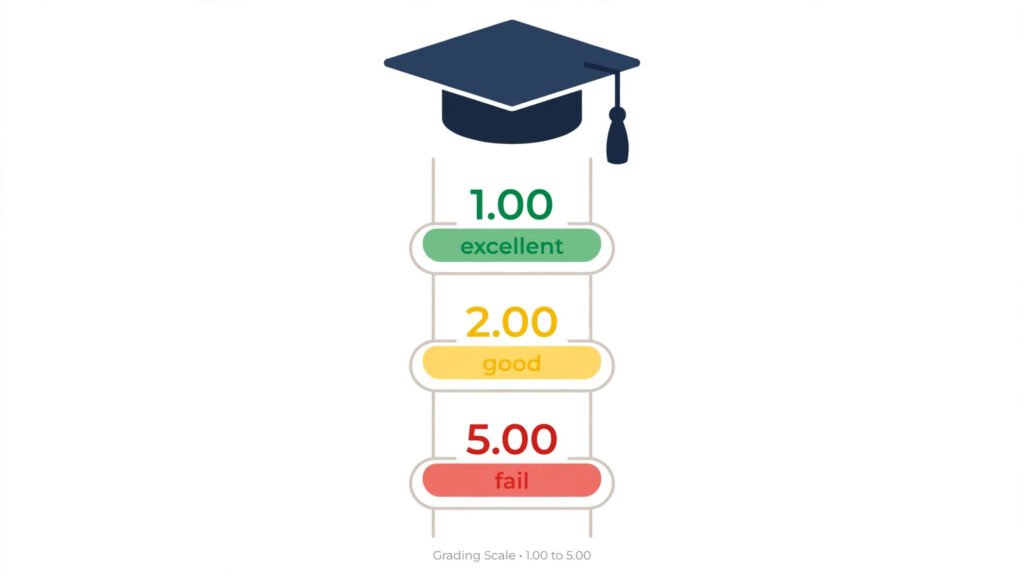
GWA stands for General Weighted Average. It’s the Philippine grading system’s version of a GPA — a single number that summarizes your whole semester. The scale runs backwards from what Americans expect: 1.00 is perfect and 5.00 means you failed the subject. Employers, grad schools, and scholarship committees in the Philippines will all ask for it, and Latin honors — cum laude, magna, summa — are decided by it. So it’s worth knowing exactly where your number comes from instead of trusting a classmate’s spreadsheet.
The GWA Formula, Explained Like a Normal Person
The formula looks intimidating for roughly ten seconds:
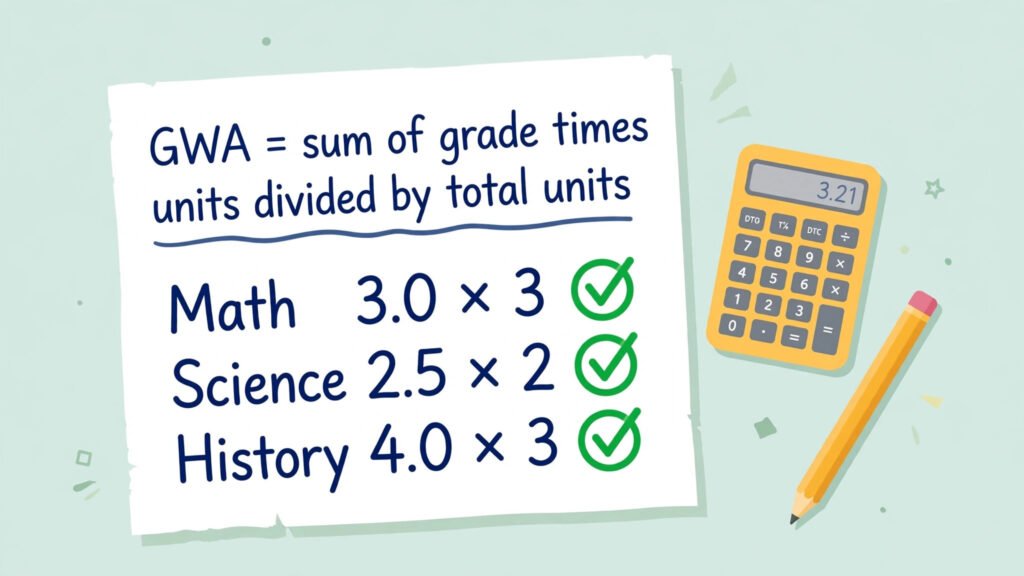
GWA = Total (Grade × Units) ÷ Total Units
In plain language: every subject contributes its grade multiplied by how heavy the subject is. A 4-unit major subject drags your GWA four times harder than a 1-unit PE class. That’s the “weighted” part, and it’s the part most students get wrong — they just average their grades and call it a day. We’ll get to why that’s broken in a minute.
Worked Example: One Semester, Five Subjects
Let’s use a real report card. Say these are your final grades for the semester:
- Mathematics — 1.50 × 3 units = 4.50
- English — 2.00 × 3 units = 6.00
- Science — 1.25 × 4 units = 5.00
- History — 1.75 × 3 units = 5.25
- PE — 1.00 × 2 units = 2.00
Add the products: 4.50 + 6.00 + 5.00 + 5.25 + 2.00 = 23.25. Add the units: 3 + 3 + 4 + 3 + 2 = 15. Divide: 23.25 ÷ 15 = 1.55. That’s the GWA — comfortably in cum laude territory at most schools.
How to Compute GWA Manually: 5 Steps
If you want to learn how to compute GWA by hand — no calculator app, no spreadsheet — follow these five steps exactly:
- List every subject with its final grade and unit count. Get these from your report card or class record. Don’t guess units; a wrong unit number is the most common reason GWAs come out wrong.
- Multiply each grade by its units. A 1.50 in a 3-unit subject contributes 4.50. Do this for every subject.
- Add all the products together. This is your total weighted grade points.
- Add all the units together. This is your total units for the semester.
- Divide total weighted points by total units. Round to two decimal places — that’s your GWA.
The Philippine GWA Scale: What Your Number Means
Schools vary slightly, but this is the scale most Philippine colleges use:
- 1.00 – 1.45: Excellent (summa cum laude range at many schools)
- 1.46 – 1.75: Very good (magna cum laude range)
- 1.76 – 2.00: Good (cum laude range)
- 2.01 – 2.75: Satisfactory to fair
- 2.76 – 3.00: Passing, barely
- 5.00: Failed
Check your own school’s handbook — PUP, UP, and private colleges each publish their own Latin-honor cutoffs, and they don’t all agree.
5 Mistakes That Silently Wreck Your GWA Math
- Averaging grades instead of weighting them. (1.50 + 2.00) ÷ 2 = 1.75 looks right but ignores units. If the 1.50 was a 4-unit subject and the 2.00 was 1 unit, the real GWA is 1.60. Always weight.
- Using the wrong unit count. Lab subjects often carry different units than you think. Verify against your registration form.
- Forgetting a subject entirely. That 1-unit NSTP class still counts. Every enrolled subject goes in.
- Mixing up the scale direction. On the Philippine scale, a lower number is better. Treating 1.00 like an American “1 out of 100” will ruin every calculation.
- Rounding too early. Keep full decimals through every step and round only the final answer to two places.

GWA vs GPA: What’s the Difference?
GWA and GPA measure the same thing — academic performance — on mirrored scales. GPA (American) runs 0.00 to 4.00 where higher is better; GWA (Philippine) runs 1.00 to 5.00 where lower is better. The rough linear conversion is GWA = 5.00 − GPA, so a 3.50 GPA is about a 1.50 GWA. If you’re applying abroad or converting records, use our GPA to GWA converter instead of guessing.
Frequently Asked Questions
What is a good GWA in the Philippines?
Anything 2.00 or better opens doors — 1.75 and below puts you in Latin-honor contention at most schools, and 1.50 or better makes you competitive for the best scholarships.
Is 2.5 GWA good?
It’s decent — solidly passing and above average in many programs — but it won’t qualify for Latin honors or most merit scholarships, which usually require 1.75 or better.
How do I compute GWA if I failed a subject?
Include it. A failed subject counts as 5.00 × its units, which drags the average hard — that’s exactly why one failed major subject can sink a whole semester’s GWA. Retaking the subject replaces the grade per your school’s policy.
What’s the difference between GWA and GPA?
Scale direction. GPA runs 0.00–4.00 (higher = better); GWA runs 1.00–5.00 (lower = better). Both are weighted by units/credits. Convert between them with GWA = 5.00 − GPA as a rough estimate.
Compute Yours in 30 Seconds
Now you know how to compute GWA by hand — the formula, a real worked example, the scale, and the traps to avoid. But honestly, for every semester after this one, just use the tool: try our free GWA calculator, punch in your grades and units, and get your exact GWA instantly — including both letter grades (A+, B) and numeric grades (1.00–5.00).