

Every semester, thousands of Filipino students ask the same question in a dozen different ways: what grade average do I actually need before a company will take me as an intern? This guide to gwa for internship philippines gives you the honest answer first, because most guides will not: there is no national GWA cutoff for internships in the Philippines. No CHED order sets one, no government internship program uses one, and the big companies that do filter on grades almost never publish the number. What exists instead is three separate gates — your school’s practicum eligibility, the host company’s unpublished shortlist, and program-specific rules like the Government Internship Program — and each one works differently. Below you will see all three, worked through with real numbers run through the live GWA calculator on this site, so you can check exactly where you stand before you apply.
GWA for Internship Philippines: The Short Answer
If you only have thirty seconds, here it is. For a school-required internship (OJT or practicum), your school decides whether you may go, and it usually decides on year standing, back subjects, and good standing — not on a single GWA number. For a competitive company internship, grades matter as a shortlisting filter, and the planning bands students actually encounter are “2.00 or better” for most competitive hosts and “1.75 or better” for the most selective ones. For government programs like the DSWD Government Internship Program, the gates are age and family income, not grades at all. None of those three bands is a law. Treat them as planning targets, confirm the real rule with your practicum coordinator, and use the math below to see how far you are from each one.

The Three Gates That Actually Decide GWA for Internship Philippines
Students fail internship applications for three different reasons, and confusing them is expensive: you can spend a semester raising a number that was never the gate, while the real gate — an unsigned memorandum of agreement, say — quietly stays shut. Here are the three gates, side by side.
| Gate | Who sets it | What it actually checks |
|---|---|---|
| 1. School practicum eligibility | Your college or university, under CHED Memorandum Order No. 104, s. 2017 (the Student Internship Program in the Philippines) | Year standing, back subjects, good standing, completed prerequisites. Some schools publish a GWA floor for practicum; many do not — they check standing instead. |
| 2. Host company shortlist | The company, unpublished | Course match, year level, skills, portfolio, interview — and, at competitive hosts, a GWA filter used to trim a long applicant list. The number is rarely posted. |
| 3. Program-specific rules | The program (e.g., DSWD/DOLE Government Internship Program) | Age 18–25, preferably incoming third or fourth year, family income at or below the poverty threshold. No GWA requirement is stated. |
Gate 1: What Your School Checks Before It Signs Your Endorsement
Under CHED Memorandum Order No. 104, s. 2017, a school internship must run through an accredited host training establishment with a signed memorandum of agreement (MOA) in place before deployment, a training plan tied to your program, a designated supervisor, and insurance cover. One school’s published process (Mapúa Malayan Colleges’ MMDC) tells students to start a full term — three months — before their practicum term, because accreditation and MOA signing take that long. That timeline is the part students most often miss: they fixate on their average while the MOA clock runs out.
On grades, school handbooks vary, and that variation is the point. One state college’s published student manual sets promotion bars of 2.00 for board programs, 2.25 for non-board programs, and 2.50 for vocational programs, with probation below the bar — a retention rule, not an internship rule, but it shows how a “cutoff” looks when a school actually publishes one: a number, a consequence, and a handbook to check it in. Other schools simply require “good standing” and no back subjects. A common practicum-manual rule is fourth-year standing with no back subject. If your handbook says that, then a single failed major subject blocks your endorsement even if your overall average looks fine — which is exactly why the failed-subject math below matters.
Before you apply anywhere, get three answers from your practicum coordinator in writing: (1) Is there a published GWA floor for practicum in my program, and if so, is it semester GWA or cumulative GWA? (2) Which subjects count — are PE, NSTP, and the OJT subject itself included? (3) How are retakes and INC grades treated? Those three answers change your number more than any study tip will.
Gate 2: What Companies Actually Check (and Why the Number Is Almost Never Posted)
Look at live postings and the pattern is consistent. A General Motors Philippines facilities intern posting asks for graduating or third-year engineering students whose internship is an official undergraduate requirement, onsite availability, and office software skills — no GWA number. A PwC Philippines human resources intern posting requires only that the internship be a university requirement, plus the course and soft skills. Neither post hides a cutoff in the fine print; there simply is not one in the posting.
That does not mean grades never matter. It means they operate one step earlier, as an unpublished shortlist filter when a popular host receives far more applications than slots. Recruiters will not tell you the filter, and anyone who quotes you a precise company cutoff without naming the company and the year is guessing. The honest planning bands, drawn from how Philippine schools and scholarship programs talk about averages, are these: 2.00 or better keeps you in the running at most competitive hosts, and 1.75 or better is the band selective programs and honors-linked opportunities tend to use. Use them as targets, not as promises — a 1.90 student with a strong portfolio and a clean interview routinely beats a 1.60 student with neither, because the interview is where hosts test the things a transcript cannot show.
There is research behind that, with its limits stated. A University of Mindanao study of 98 Computer Engineering graduates (2018–2022) found their GWA averaging 82.10% — a “fair” rating — while their OJT grades averaged 92.33%, “very good”. One program at one school cannot settle the question nationally, but it matches what supervisors say everywhere: classroom averages under-predict workplace performance, which is why hosts weigh interviews, portfolios, and supervisor feedback alongside grades. If your average is below the band you are aiming at, that is a reason to apply more widely and to strengthen the rest of your application — not a reason to sit out the application season.
The Worked Example: One Pre-OJT Semester, Run Through the Live Calculator
Every number in this section was produced by running the live calculator on this site — its own code, executed unmodified — on a realistic pre-OJT semester for a third-year BSIT student. The full test log, with 19 cases, is documented alongside this article; the cases that matter for internship planning are these:
| Situation | Subjects and grades | GWA |
|---|---|---|
| Pre-OJT semester | Programming 3u @ 1.50, Database 3u @ 1.75, Networking 3u @ 2.25, General Education 3u @ 1.25, PE 2u @ 2.00 | 1.73 |
| Same semester as letter grades | A-, B+, B-, A, B | 1.73 |
| Plus one failed 3-unit major @ 5.00 | The five subjects above, plus a failed major | 2.31 |
| Fail counted AND retaken @ 1.75 | Both the fail and the retake stay on the record | 2.23 |
| Retake replaces the fail | Fail row removed, retake @ 1.75 only | 1.74 |
| INC grade still open | The five subjects plus an INC subject | invalid grade |
| INC completed @ 2.00 | The five subjects plus the completed subject | 1.78 |
Read that table as a story. At 1.73, our student sits inside the selective 1.75 band. One failed major subject drags the semester to 2.31 — outside even the 2.00 planning band. Retaking it helps, but how your school counts the retake decides how much: if both grades stay on the record, the semester only recovers to 2.23; if the retake replaces the fail, it recovers to 1.74, back inside the selective band. That 0.49 gap between the two retake rules is the single most expensive misunderstanding in internship planning, and it is decided by your handbook, not by any calculator. Ask before you enrol in the retake, because the answer changes whether the retake alone is enough or whether you also need a strong next semester.
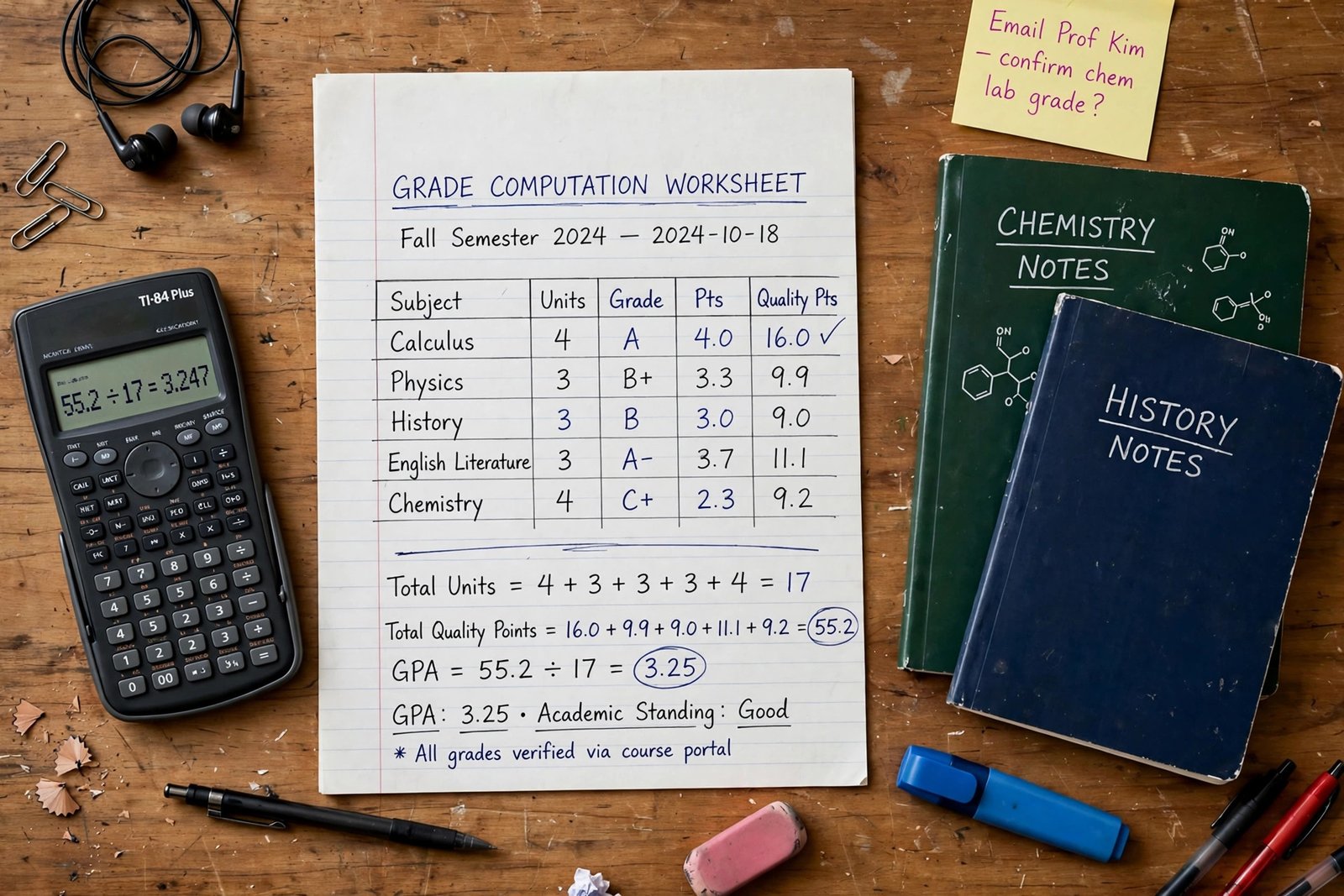
And the INC row deserves its own warning. On this site’s calculator, a single unparseable grade — INC is the classic one — makes the whole result read “invalid grade”, because the calculator cannot average a subject that has no numeric grade yet. In real life the effect is similar but slower: an open INC can hold up your endorsement, your clearance, and your deployment while the paperwork catches up. Completing that INC at 2.00 brings the semester to 1.78 — still inside the selective band, and more importantly, it unblocks the endorsement. If you have an INC hanging over your practicum semester, finishing it is usually worth more than any other single grade improvement available to you.
How to Compute GWA for Internship Philippines: The Formula, Done Properly
The formula never changes: multiply each subject’s grade by its units, add those products, and divide by the total units. GWA = (sum of grade × units) ÷ total units. The trap is averaging the grades instead of weighting them. Take a 3-unit major at 2.50 and a 1-unit PE subject at 1.00: the simple average is 1.75, but the weighted GWA is 2.13, because the major carries three times the weight. The live calculator confirms 2.13. Students who “average their grades” in a spreadsheet routinely report a number half a point better than their transcript shows, and then wonder why a host’s shortlist disagrees.
The second trap is averaging semester averages. A 14-unit semester at 2.00 plus a 6-unit term at 1.00 does not average to 1.50; the unit-weighted result is 1.70, as the calculator confirms. If you want your cumulative figure, you must weight every semester by its units — which is why the cumulative GWA guide on this site exists, and why the step-by-step GWA computation guide walks through the same formula with a different worked set. For a quick check of your own numbers, use the free calculator on the gwcalculator.com homepage: type your subjects, units, and grades exactly as they appear on your grades, and it returns the same weighted figure the tests above produced.

Watch: The Calculator Run, Step by Step
The video below is a real screen recording of this site’s own calculator running the worked example: the pre-OJT semester as numbers (1.73), the same grades as letters (1.73), then the failed major added (2.31), then the retake added with both grades counted (2.23). If your own result differs from the video, check your units first — a mistyped unit moves the answer more than a mistyped grade usually does.
Cumulative Math: Hitting a Target Band Before Applications Open
Internship shortlists, when they use grades at all, usually look at your cumulative average, not one semester. So the question that matters is: given where you are now, what average do you need next semester to land inside the band you want? The formula is simple rearranged arithmetic: needed average = (target × total units after next semester − current weighted points) ÷ next semester’s units.
Worked through the calculator: a student with 60 units at 2.10 who adds our 14-unit pre-OJT semester at 1.73 lands at 2.03 — just outside the 2.00 band. A student with 60 units at 2.25 who adds the same semester lands at 2.15, clearly outside it. A student with 60 units at 1.90 lands at 1.87, comfortably inside it. And if you are sitting at 60 units at 2.20 and want to hit exactly 2.00 after a 14-unit semester, you need a 1.14 average across that semester — the calculator confirms 2.00. That last number is deliberately uncomfortable: it tells you, before you enrol, whether the target is reachable in one semester or whether you need two, or a retake, or a different plan. Do this calculation the semester before applications open, not the week they close.
One more cumulative effect students forget: the OJT subject itself is usually graded, and its grade enters your average afterwards. Adding a 6-unit OJT subject at 1.00 to our 1.73 semester pulls it to 1.51; the same OJT at 2.50 pushes it to 1.96. An OJT grade is not a footnote to your average — at six units, it is one of the heaviest single grades on your record. Treat the internship itself as a graded subject, because that is what it is.
If Your GWA for Internship Philippines Is Below the Bar
First, find out which bar you actually missed. If the gate was your school’s practicum eligibility, the fix is administrative as much as academic: clear the back subject, complete the INC, or finish the prerequisite — and confirm with your coordinator that the clearance has actually been recorded, not just promised. If the gate was a host’s shortlist, the fix is a wider application strategy plus a stronger remainder of the application: portfolio pieces in your field, a skills certificate, and a cover letter that names the host’s actual work, not a generic paragraph.
Second, run the retake math before you commit to a retake. As the worked example shows, a retake that replaces a fail is worth far more than one that merely sits alongside it (1.74 versus 2.23 in our example). If your school counts both, a retake alone may not move you into the band, and you will need a strong next semester on top of it — which the needed-average formula above will tell you in advance.
Third, do not let a weak average keep you from the programs that do not use one. The Government Internship Program screens on age and income, not grades; many LGU and NGO placements screen on course match and availability; and school-arranged OJT placements exist precisely so that every student in the program gets a host, not only the top of the class. A below-band average narrows your options at the most competitive companies. It does not cancel your internship.
OJT Hours, Paperwork, and the Checklist Before You Deploy
Hours vary by program, and blogs that quote a single number are oversimplifying. The commonly cited ranges are 200-400 hours for business, IT, and media programs and 400-600 hours for engineering and hospitality, with education running a full semester of practicum — but your program handbook and your MOA override any blog, including this one. Some practicum manuals specify 240, 320, or 420 hours by program. Confirm your number from your coordinator, then plan your semester load around it; students who discover their hour requirement late are the ones who end up extending into the next term.
The pre-deployment checklist, drawn from the CHED SIPP framework and school practicum manuals, is: endorsement letter from your program chair or coordinator; acceptance letter from the host; signed MOA (school, host, and you) plus training agreement; proof of insurance cover; medical certificate or fit-to-work clearance where required; and enrolment in the practicum subject itself. Start at least one term early if your host is not already accredited — accreditation and MOA signing are the slowest steps, and no GWA, however strong, speeds them up. Keep copies of everything; the certificate of completion you receive at the end is the document your school needs to release your grade, and hosts issue it only after attendance and evaluation records are complete.
Mistakes Other Guides Make (and What to Check Instead)
Three errors in rival pages are worth naming, because students copy them into applications. First, one popular “how to compute GWA” page midway redefines GWA as “Gross Weekly Average” and walks through averaging weekly production units (350 units over 7 days = 50 units per day). That is a different metric with the same initials; in Philippine education, GWA is General Weighted Average only, and any page that tells you otherwise has pasted in unrelated content.
Second, rival percentage-conversion tables contradict each other: one maps 1.50 to 90–95%, another to 91–93%, a third to 85–89%. All three cannot be “the” national table, because there is no national table — each school publishes its own percentage equivalents, and some schools do not use percentages at all. If you need a percentage figure for an application, convert with your own school’s table (the GWA to percentage converter on this site explains the school-by-school caveat) or ask your registrar; do not copy a rival blog’s table into a formal application.
Third, several guides quote single-number scholarship cutoffs (“CHED and DOST require 1.75–2.0”) as if one number governed every grant. Scholarship cutoffs are set per grant and per school, and the same applies to internship filters: a number without a named setter and a named year is a rumour, not a requirement. When a guide gives you a cutoff, ask who set it. If the guide cannot answer, neither can you — and you should not plan around it.
For the grading systems behind all of this — how the 1.00–5.00 scale works at different schools, and how it differs from the DepEd percentage system — see the PUP grading system explainer and the DepEd grading system explainer on this site. And for background on how Philippine grading works more broadly, see the Official Gazette’s DOLE internship program guidelines and the MMDC practicum accreditation process under CHED CMO 104, which documents the accreditation and MOA rules described above.
Frequently Asked Questions
Is there a minimum GWA for internship in the Philippines?
No national minimum exists. Your school’s practicum eligibility rules and each host’s own (usually unpublished) shortlist decide. The planning bands used in this article — 2.00 or better for most competitive hosts, 1.75 or better for selective ones — are targets drawn from common school and scholarship practice, not legal requirements.
What GWA do I need for OJT?
For school-required OJT, you usually need good standing and no back subjects rather than a specific average, though some programs publish a floor — check your handbook. For a competitive company placement, aim for 2.00 or better, and 1.75 or better if you are targeting the most selective hosts.
Does a failed subject block my internship?
It can, in two ways: it drags your average (one failed 3-unit major moved our worked semester from 1.73 to 2.31), and some schools bar practicum enrolment while a back subject is outstanding. Retaking helps, but whether the retake replaces or sits alongside the fail changes the result by nearly half a point in our example — confirm your school’s rule first.
Does an INC grade affect my internship application?
Yes. An open INC can hold up your endorsement and clearance, and on this site’s calculator an INC grade makes the whole result read “invalid grade” because there is no number to average yet. Completing the INC is usually the highest-value single fix available before applications open.
How many OJT hours do I need?
It depends on your program: commonly cited ranges are 200-400 hours for business, IT, and media and 400-600 for engineering and hospitality, but your program handbook and MOA set the real number. Confirm it with your practicum coordinator a term early.
Can I get an internship with a low GWA?
Yes. School-arranged OJT exists for every student in the program, government programs like GIP screen on age and income rather than grades, and many hosts weigh course match, skills, portfolio, and interview performance over a single average. Apply widely, and fix the fixable items — back subjects and INCs — first.
So: check your handbook, run your real numbers through the calculator, and apply a semester early. The students who land the best internships are rarely the ones with the highest average; they are the ones who knew which gate they were facing, and walked through it before it closed. For a final check of where you stand, revisit the graduating students GWA guide if you are in your last year — the cumulative math there is the same math your internship shortlist will see.