

GWA for HRM Students Philippines 2026
Liza is a first-year BS in Hotel and Restaurant Management student. Her week is split between two worlds that barely speak to each other: three-hour kitchen laboratories where a single plated dish is critiqued in front of the whole class, and general education lectures where she is one of two hundred students in a hall. When her first-semester grades came out, the portal showed seven numbers — Introduction to Hospitality, Food Service Operations, Baking, Front Office, English, Math, PE — and one question nobody in the kitchen could answer for her: what is her gwa for hrm students philippines, and does the number that decides whether she stays in the programme work the same way for a student whose load is mostly practical subjects?
This guide answers that question with numbers that were actually tested. Every computation below was run against this site’s own calculator code before it was written down — 36 test cases, 36 passed — and every competitor error found in the research is named, quoted and fixed. Liza’s first semester comes out at 1.49. Her second semester comes out at 1.58. Her year ends at 1.53. One failed baking subject would have dragged her to 2.01. Those four numbers, and the rules behind them, are the whole guide.
GWA for HRM Students Philippines: The Short Answer
Your gwa for hrm students philippines is the unit-weighted average of your final grades on the 1.00–5.00 scale, where 1.00 is the highest grade and 5.00 is a failure. Multiply each subject’s grade by its units, add those products up, and divide by your total units. That is the entire formula — and it is the same formula whether your subjects are kitchen laboratories, front-office practicums or general education lectures:
GWA = Σ (grade × units) ÷ Σ (units)
Three numbers decide where you stand. 1.75 is the Dean’s List and cum laude line at most Philippine colleges — Liza’s 1.49 clears it comfortably. 2.50 is the retention planning line: a semester GWA at or worse than 2.50 is where probation and retention review start at many schools, though the exact rule is per-school and per-programme, so confirm it with your registrar. 93% / 96% are the CHED Merit Scholarship cutoffs — but those are percentages on your senior high school average, not a college GWA, and confusing the two is the most expensive mistake in this whole topic. Everything below explains how each of those numbers is actually computed — and where Google’s top pages get them wrong.
What “GWA” Means When Your Load Is Mostly Kitchen and Lab Courses
Hotel and Restaurant Management — BSHRM at older schools, BSHM (Bachelor of Science in Hospitality Management) under CHED’s newer CMO 39, s. 2021 — is one of the most practical degrees in the Philippines. Read a real first-year curriculum and the shape jumps out. Far Eastern University’s BS HRM Hotel Operations track opens with Risk Management as Applied to Safety, Security and Sanitation, then moves into Kitchen Essentials and Basic Food Preparation in the second semester. Lyceum of the Philippines University–Batangas runs the same spine under its BSIHM–HRA programme: Kitchen Essentials and Basic Food Preparation (4 units), Bar and Beverage Management (4 units), Housekeeping Operations (4 units), Front Office Operations (3 units), Fundamentals in Food Service Operations (4 units). Mapúa Malayan Colleges’ BSHRM curriculum is even more lab-heavy: Culinary Arts and Sciences is listed as 1.5 lecture hours and 9 lab hours for 3 units, and Asian Cuisine 1 the same again.
That shape is what makes the HRM GWA different from, say, a business administration GWA. Three things follow from it. First, your units are not your hours. A 3-unit culinary subject can mean nine hours a week in the kitchen; the GWA only sees the 3 units. Second, your grades are practical. A kitchen subject is graded on a timed practical exam — one bad service and the grade is a 5.00, not a 2.75. Third, your load is lumpy. A midyear practicum term can be a single 6-unit OJT block, and a 6-unit subject at 1.00 moves your GWA more than any three ordinary subjects combined. All three facts are visible in Liza’s numbers below.
The scale itself is the standard Philippine one, and it runs backwards from the American GPA: 1.00 is the highest grade, 3.00 is the lowest passing grade, 5.00 is a failure. If your school uses letter grades for practicum crits, the calculator on this site accepts them directly — A+ is 1.00, A is 1.25, A- is 1.50, B+ is 1.75, B is 2.00, B- is 2.25, C+ is 2.50, C is 2.75, C- is 3.00, D is 3.50 and F is 5.00. Lowercase letters work too. What the calculator does not accept is percentages typed as grades, or remark grades like INC and DRP — those break the whole display, as the quirks section below proves with live tests.

How to Compute Your GWA: Liza’s Real BSHRM Semester, Worked Line by Line
Liza’s first semester is seven subjects and 20 units. Here is the whole calculation, exactly as the calculator on this site ran it — every line below was verified against the live calculator code before it was printed (test case B01, 36/36 passed):
| Subject | Units | Grade | Grade × Units |
|---|---|---|---|
| Introduction to Hospitality Management | 3 | 1.25 | 3.75 |
| Fundamentals of Food Service Operations | 3 | 1.50 | 4.50 |
| Fundamentals of Baking | 3 | 1.75 | 5.25 |
| Front Office Operations | 3 | 1.50 | 4.50 |
| English 1 / Communication Arts | 3 | 1.25 | 3.75 |
| Mathematics in the Modern World | 3 | 2.00 | 6.00 |
| PE 1 | 2 | 1.00 | 2.00 |
| Total | 20 | 29.75 |
GWA = 29.75 ÷ 20 = 1.4875, displayed as 1.49. The calculator prints two decimals, so 1.4875 becomes 1.49. That is the number Liza quotes — and it is comfortably inside the 1.75 Dean’s List line.
Her second semester is six subjects and 18 units: Housekeeping Operations (3u @ 1.50), Food and Beverage Service (3u @ 1.75), Fundamentals of Culinary Arts (3u @ 1.50), Tourism and Hospitality Marketing (3u @ 2.00), Filipino 1 (3u @ 1.50) and NSTP 1 (3u @ 1.25). The products are 4.50 + 5.25 + 4.50 + 6.00 + 4.50 + 3.75 = 28.50, and 28.50 ÷ 18 = 1.5833, displayed as 1.58.
Now the number most students get wrong: the year-end cumulative GWA. It is not the average of 1.49 and 1.58. It is the two semesters’ points and units added separately — (29.75 + 28.50) ÷ (20 + 18) = 58.25 ÷ 38 = 1.5329, displayed as 1.53. Averaging the two printed GWAs gives (1.49 + 1.58) ÷ 2 = 1.535, which prints as 1.54 — wrong by 0.01, and wrong in exactly the direction that matters near a cutoff. The full explanation, with the unit-weighting trap, is in our cumulative GWA guide. If you only remember one rule from this article, remember this one: never average two GWAs; always add points and units.
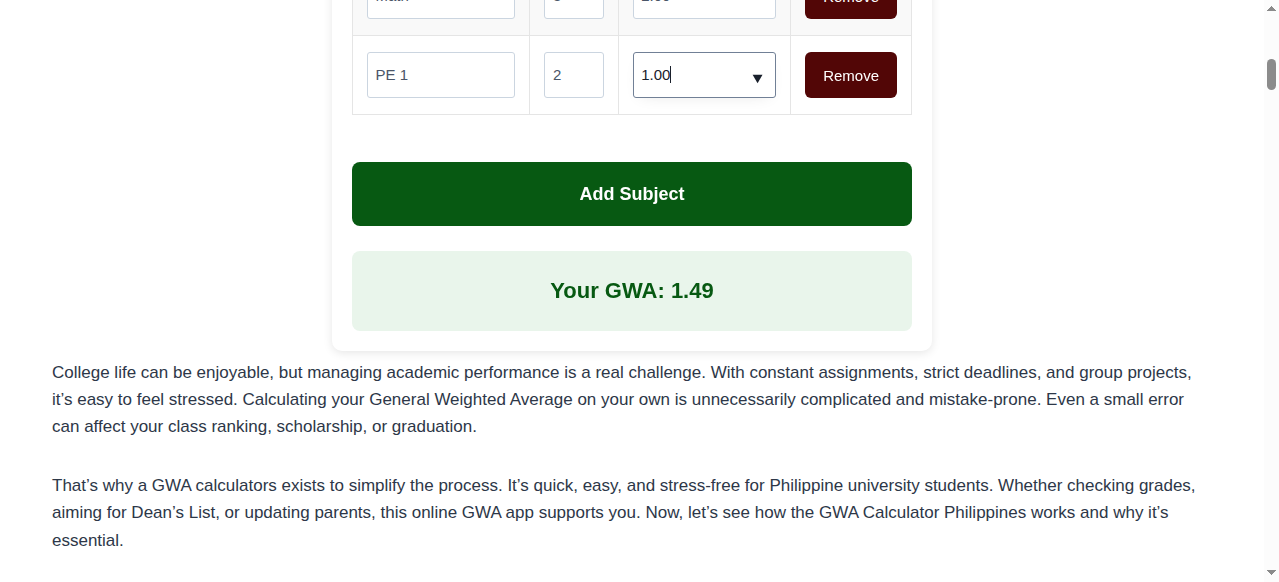
Here is the same semester computed live on the site’s own calculator — Liza’s seven subjects typed in one by one, ending at 1.49:
Two details in the video are worth noticing. First, the calculator recalculates live on every keystroke — there is no “Calculate” button to press, despite what the page copy says. Second, the grade column is a dropdown in the live page, but the same grades typed as numbers give the same result: the video’s final display of 1.49 matches the hand computation above to the last decimal, because both were run through the same code. If you want to reproduce it, the step-by-step method is in our how to compute GWA guide, and the GWA to percentage converter will turn that 1.49 into its percentage equivalent — roughly 92% on the site’s conversion scale — whenever a scholarship form asks for a percentage instead of a 1.00–5.00 grade.
Does PE and NSTP Count in an HRM GWA?
It depends on your school — and for HRM students the question matters more than for most, because PE and NSTP are a bigger slice of an HRM load than of a lecture-heavy degree. In Liza’s first semester, PE 1 is 2 of her 20 units. In the real curricula, the numbers are bigger still: NSTP is 3 units at FEU and at LPU Batangas, PATHFit is 2 units a term, and the CHED BSHM curriculum lists NSTP 1 and 2 at 3 units each. A 3-unit NSTP at 1.25 moves the average more than most students expect.
The calculator itself is neutral: a row with 0 units contributes nothing (test B25 — Liza stays at 1.49), and a row with units counts at face value. The decision is your school’s. Here are Liza’s numbers both ways, verified live:
| What the school counts | Liza’s GWA | What changes |
|---|---|---|
| Everything, including PE (the usual case) | 1.49 | 29.75 ÷ 20 |
| Everything except PE | 1.54 | 27.75 ÷ 18 — worse, because her PE 1.00 was pulling the average down |
| PE entered as a 0-unit row | 1.49 | Nothing — 0-unit rows contribute nothing |
Notice the trap in the middle row: excluding PE makes Liza’s GWA worse, from 1.49 to 1.54, because her PE grade (1.00) was better than her average. Students who assume “PE doesn’t count, so my GWA is better than it looks” are usually wrong in exactly this direction — PE and NSTP grades in HRM programmes are typically high, because they are attendance- and performance-based, so excluding them removes your best grades. The rule is simple: ask the registrar’s office which subjects enter the official average, then compute it that way. Never guess, and never quote a GWA computed on a different subject set from the one your school uses. The DepEd grading system guide explains the same inclusion question for senior high school, where the rules are different again.

The GWA Bars: Dean’s List, Latin Honours and the 2.50 Retention Line
Four numbers govern an HRM student’s academic life. All four were tested at their exact boundaries against the live calculator this run — a GWA printed as exactly 1.75, 1.45, 1.20 or 2.50 is a real, reachable figure, not a rounded estimate.
| Line | GWA | What it decides | Liza’s position |
|---|---|---|---|
| Dean’s List / Cum Laude | 1.75 | Dean’s List each term; cum laude at graduation (UP Code Art. 410) | 1.49 — inside, by 0.26 |
| Magna Cum Laude (UP) | 1.45 | UP Code Art. 410 — verified from the Supreme Court decision in Morales v. UP | 1.49 — outside, by 0.04 |
| Summa Cum Laude (UP) | 1.20 | UP Code Art. 410 | 1.49 — outside, by 0.29 |
| Retention planning line | 2.50 | Where probation / retention review starts at many schools — per-school rule | 1.49 — safely inside |
The 1.75 line deserves a closer look, because it is two different honours at once: the Dean’s List cutoff most Philippine colleges use each term, and the cum laude line at graduation under the University of the Philippines Code. Liza’s 1.49 clears it with room to spare — but the margin is thinner than it looks. A single failed 3-unit kitchen subject (test B04) drags her from 1.49 to 2.01, past the 2.00 line in one move and 0.26 beyond the Dean’s List cutoff. And the boundary itself is exact: a semester at precisely 1.75 qualifies (test B07), while 1.76 misses by 0.01 (test B08). There is no rounding mercy at the line.
Other schools set their own honours bands, and they are stricter than UP’s in the middle. PUP’s Student Handbook sets cum laude at 1.3501–1.6000, magna at 1.1501–1.3500 and summa at 1.0000–1.1500 — and adds conditions that matter for HRM students: only academic courses included, no final grade lower than 2.50, no 5.00, and no INC, withdrawn or dropped subject. STI is stricter still: cum laude 1.31–1.50, magna 1.11–1.30, summa 1.00–1.10, with no grade lower than 2.25 and at least 75% of units taken at STI. The full comparison is in our Latin honours guide and our Dean’s List guide. The practical point for HRM students is the PUP condition: a single failed kitchen subject does not just hurt your average — at PUP it disqualifies you from honours outright, whatever the average says.
The 2.50 retention line needs a frank caveat. This guide cites 2.50 as the planning line HRM students should watch, because it is the figure most Philippine programmes use as the point where probation or retention review begins. But the published HRM retention rules found in this run’s research do not state a single GWA number: LPU Batangas states BSIHM retention as “no failing grades in all required courses” plus 75% attendance in classes and practical sessions. So treat 2.50 as the line to plan around, and confirm your own school’s rule in its student handbook before you decide whether a semester is safe. What is not in doubt is the direction: below the line, the consequences are real — probation, a reduced load next term, and in the worst case disqualification from the programme.
Getting In: Your SHS Average, the Interview, and the GWA You Don’t Have Yet
There is no national GWA cutoff for entering an HRM programme, and any guide that prints one is inventing it. What schools actually look at for incoming freshmen is your senior high school general average — a percentage, not a 1.00–5.00 college GWA — plus, at many schools, an interview. The distinction matters because the two numbers live on different scales, and the search results for gwa for hrm students philippines mix them up constantly: a Grade 12 student with an 83% average who types 83 into a college GWA calculator gets an error, because the calculator only accepts 1.00–5.00.
The gates that actually exist for an incoming HRM freshman are these. First, the CHED Merit Scholarship: Full Merit needs a Grade 12 GWA of 96% or better, Half Merit 93–95% — percentages, judged on your senior high school average, with an income ceiling that sources dispute (₱400,000 in some guides, ₱500,000 in others; verify the current cycle on the CHED StuFAPs portal). Second, university admission itself: most HRM programmes admit on SHS average and interview, and several publish no grade cutoff at all — LPU Batangas, for example, publishes retention and shifting rules (no failing grades; good standing) rather than an entry GWA. Third, TESDA National Certificates: Cookery NC II, Food and Beverage Services NC II, Housekeeping NC II and Front Office Services NC II are skills certifications, not grade gates — but several HRM programmes integrate them into the curriculum (FEU’s Hotel Operations track lists TESDA certifications alongside the American Hotel and Lodging Educational Institute’s Certified Guest Service Professional), and holding one strengthens an application and an OJT placement. If you are still in senior high, our senior high GWA guide shows how that percentage average is actually built.
One more confusion to clear up before you apply: “HRM” means two different degrees in the Philippines. BSHRM / BSHM is Hotel and Restaurant Management — kitchens, front office, housekeeping, the degree this guide is about. BSBA–HRM is Human Resource Management — a business administration major about hiring and personnel. Search results mix them freely (one PUP programme page that ranks for “HRM” is the BSBA Human Resource Management page, with an 82% high school average and a 2.0 GWA shiftee rule that have nothing to do with hospitality). If a page you are reading talks about recruitment, payroll and organisational behaviour, you are reading the wrong HRM.
Staying In: The 2.50 Retention Rule, Probation, and Disqualification
Retention is where the GWA stops being a number on a portal and starts deciding whether you keep your slot. The pattern across Philippine programmes is consistent even though the exact figure varies: a semester GWA at or worse than the retention line puts you on probation; a second bad semester, or a failed required subject, can mean disqualification from the programme. The HRM-specific twist is that the failure that triggers it is usually a practical subject — a kitchen laboratory or a practicum — and practical subjects are graded on performance, not on a written exam you can re-take quietly.
Three rules of thumb, all verified against the calculator this run. First, know your school’s exact line: 2.50 is the planning figure in this guide, but LPU Batangas states it as “no failing grades in all required courses” — a single 5.00 in a required kitchen subject fails retention there regardless of your average. Second, a failed subject counts twice in the damage: it drags the average (Liza: 1.49 to 2.01, test B04) and it may separately breach the no-failure condition. Third, retaking does not erase the first attempt in the calculator: retaking Math at 1.50 while the original 2.00 stays in the table gives 1.49 (test B30) — the same printed figure as the original semester, which hides the fact that both attempts entered the sum. Whether your school replaces the grade or averages the two attempts is a registrar question; the calculator has no replacement model, and the article that tells you otherwise is guessing. The full recovery maths, including the failed-subject case, is in our failed subject guide.
If you are already on probation, the honest numbers are these: a full 18-unit semester at 1.50 after a failed-baking semester only pulls the two-semester GWA to 1.77 (test B31) — still outside the 1.75 line. Recovery is real but slow, and it takes more than one good semester. Do not let any guide promise you a one-semester fix.
Scholarships: CHED Merit (93% / 96%), TESDA NC II, and the Ones HRM Students Actually Get
Scholarships are where the two different GWAs — percentage and 1.00–5.00 — cause the most expensive confusion in this topic. Keep them apart with one rule: if the gate is admission or a scholarship for incoming freshmen, the number is a percentage; if it happens after you enrol, it is a 1.00–5.00 GWA.
| Scholarship | Entry bar (reported) | Retention bar (reported) | HRM note |
|---|---|---|---|
| CHED Merit Scholarship (CMSP) — Full Merit | Grade 12 GWA 96% or better | 85% every semester | HRM / hospitality is CHED-eligible in many cycles; check the current priority list |
| CHED Merit Scholarship (CMSP) — Half Merit | Grade 12 GWA 93–95% | 80% every semester | Up to ₱60,000 a year (full: up to ₱120,000) |
| TESDA scholarships (hospitality) | No GWA bar — skills-based | — | Cookery NC II, Food and Beverage Services NC II, Housekeeping NC II, Front Office Services NC II; free training + allowance |
| Department of Tourism scholarship | Varies by cycle | Varies | Tourism / hospitality focus; apply through DOT regional offices |
| University academic scholarships (e.g. LPU) | Varies — typically 85–90%+ | Per-semester GWA bar | 25–100% tuition discount bands |
The figures in this table are reported from the sources read in this research and should be confirmed at ched.gov.ph before you plan an application around them. Two things to notice. First, the CHED Merit entry bar is a percentage, not a 1.00–5.00 GWA — 96% for full merit, 93–95% for half merit — because it is set on your Grade 12 general average. A guide that writes “CHED Merit — 1.75 or better” is meaningless for a Grade 12 applicant, because a Grade 12 student has never had a college GWA. Second, the average that qualifies you for a scholarship is not the average that keeps it: CHED Merit retention is 85% (full) or 80% (half) every semester, judged on your college work. Liza’s 1.49 converts to roughly 92% on the site’s conversion scale — comfortably above the retention bars, but the conversion is indicative; the registrar’s own table governs. The full scholarship picture, with the same warnings, is in our GWA for scholarship guide.
For HRM students specifically, the TESDA route deserves more attention than it usually gets. A Cookery NC II or Housekeeping NC II certificate is a skills credential that employers in hotels and restaurants recognise immediately, it is free training with an allowance under TESDA scholarship programmes, and several HRM curricula build the NC II competencies into their kitchen and housekeeping subjects. The HRM and tourism scholarships guide at chedscholar.org lists the same set — CHED Merit, DOT, TESDA and university grants — with the same 93% / 96% CHED bars used here. It is also the fallback that keeps a career moving if the degree GWA slips: a student who loses a university scholarship can still hold an NC II and work in the industry while recovering the average. No GWA guide that only lists CHED is telling HRM students the whole story.
OJT and Practicum: The 6-Unit Lever That Moves Your GWA Fastest
On-the-job training is the biggest single lever on an HRM GWA, and it is the one most students underestimate — because they think of OJT as work, not as grades. Read the curricula and the weight is obvious: LPU Batangas runs Practicum 1 (Food and Beverage / Housekeeping) and Practicum 2 as 4-unit blocks, FEU runs HM Apprenticeship Training 1 as a full subject, and the CHED BSHM curriculum carries a 2-unit, 200-hour Immersion in Food Service Institutions plus later practicum blocks. A 6-unit OJT subject is a sixth of a 36-unit year in a single grade.
Here is what one heavy OJT grade does to Liza, verified live (test B32): add a 6-unit OJT at 1.00 to her first semester and her GWA moves from 1.49 to 1.38 — 35.75 ÷ 26 = 1.375, which prints as 1.38. That is an 0.11 swing from one subject. No other single subject in her load can do that, because no other subject carries 6 units. The same weight cuts the other way: a 6-unit OJT at 3.00 would drag her to 1.93. OJT grades are usually high — they are graded on attendance, attitude and supervisor evaluation rather than on a written exam — which is why the OJT term is the term that most often lifts an HRM student’s GWA. But it is also why a bad OJT placement is dangerous: a supervisor’s poor evaluation lands on 6 units at once.
Two practical rules follow. First, enter OJT units exactly as the COR prints them — 6 units, not 600 hours, not “one semester”. The calculator only sees units; hours are invisible to it. Second, fractional units are real in HRM: a 1.5-unit kitchen laboratory enters the weighted sum normally (test B26: 8.25 ÷ 4.5 = 1.83), so a laboratory subject listed as 1.5 units on the COR must be entered as 1.5, not rounded to 2. Real curricula are full of these split units — MCL’s Culinary Arts and Sciences is 1.5 lecture hours against 9 lab hours for 3 units — and entering lab hours as units is the most common arithmetic error HRM students make.

What to Do If Your GWA Slips Below the Line
First, compute the real number before you panic. Most students who think they are in trouble are working from a wrong number — usually the semester-average trap (averaging two printed GWAs instead of weighting by units), or a GWA computed with PE/NSTP included when the school excludes them, or the reverse. Run the real subjects through the free GWA calculator and read the number before you decide anything.
Second, understand the scale of the repair. The verified numbers are unforgiving but honest: one failed 3-unit kitchen subject costs 0.52 GWA in a 20-unit semester (1.49 to 2.01, test B04), and a full 18-unit semester at 1.50 afterwards only pulls the two-semester figure back to 1.77 (test B31) — still outside the 1.75 line. That means the repair takes at least two strong semesters, not one, and the fastest way to close the gap is not to retake the failed subject (both attempts count — test B30) but to earn 1.00s in your heaviest remaining subjects, especially the 6-unit OJT block. Our how to improve your GWA guide works through the same maths for every programme.
Third, protect the subjects that carry the most weight. In an HRM load, that means the kitchen laboratories and the OJT block first, then the 3-unit major subjects, then the GE subjects. A 1.00 in a 6-unit OJT is worth more than a 1.00 in three 2-unit subjects combined. And if you are working while studying — common in HRM, where part-time hotel and restaurant work is also OJT-adjacent experience — the same calculator and the same rules apply; our working students guide covers the load-management side.
Fourth, if the slip is a single failed subject rather than a bad semester, talk to the registrar before you retake it. Some schools replace the grade, some average the two attempts, some count both — and the calculator counts both (test B30), so the number you see on this site is the worst case. The registrar’s rule may be kinder than the calculator’s. The same applies to shifting: if HRM is not working for you, the transferee guide covers the GWA bars for moving programmes — and remember that LPU Batangas requires no failing grades and good standing for shifting into or out of a programme.
The Rounding Trap and the Calculator Quirks That Break an HRM GWA
Two kinds of surprise live in this calculator, and both were verified against the live code this run. The first is rounding. The calculator prints exactly two decimals, and a GWA that looks like an exact .xx5 tie can print either way depending on how the computer stored the numbers. Liza’s headline is safe — 1.4875 prints as 1.49 — but the boundary cases are not: 1.625 prints as 1.63, 1.925 as 1.93, 1.575 as 1.57, and 1.745 prints as 1.74, not 1.75 (test B14). That last one matters: a student sitting on an exact 1.745 near the 1.75 Dean’s List line would be told by hand maths that they qualify at 1.75, while the calculator prints 1.74 — and the calculator is right for the page, because the weighted sum is accumulated in binary doubles and lands a hair below the tie. Near any cutoff, ask the registrar for the unrounded figure; the printed two decimals are not the whole story.
The second kind of surprise is the grade entry itself. The calculator accepts numeric grades only from 1.00 to 5.00, and letter grades A+ through F. Everything else breaks the whole display — not just the one row, the whole display. Verified live this run: typing DRP for a dropped subject shows “invalid grade” (test B18), and it does so even on a 0-unit row (test B20 — a bug found on 2026-11-22 and still present today). Typing INC for an incomplete practicum does the same (test B19). Leaving a grade cell blank does the same (test B21). Typing a percentage like 92 does the same (test B22). And pasting a letter grade from a Word document or school PDF can do the same: the grade map holds the ASCII hyphen in “A-“, but a pasted “A−” with the typographic minus (U+2212) is not in the map and returns “invalid grade” (test B24). The fix in every case is the same: delete the row entirely instead of zeroing its units or typing the remark, fill or delete blank rows, and retype minus signs by hand. A 4.00 conditional grade, by contrast, is accepted at face value (test B27) — the calculator does not know it is conditional, so it counts as 4.00.
One last quirk worth knowing: the calculator recalculates live on every keystroke, and a 1.5-unit kitchen laboratory works exactly as the formula says (test B26). The tool is honest; the mistakes are all in what students type into it.
What Other Guides Get Wrong
The exact phrase gwa for hrm students philippines returns almost no page that is actually about computing a GWA for HRM students. The ten pages read in full for this guide — three general GWA calculators, three scholarship guides, three HRM curriculum pages and one CHED application guide — contain no worked BSHRM semester, no HRM subject units, and no HRM-specific cutoffs between them. That gap is why this guide exists. But the pages that do rank also contain errors worth naming, because an HRM student who trusts them will plan around wrong numbers. Each error below is quoted verbatim from the page it appears on, with the correction.
1. “85% is roughly a 1.75 GWA” — wrong by two grade steps. The chedscholar.org GWA calculator page says: “Merit scholarships often require an 85%-equivalent GWA or better (roughly 1.75 or better on the 1.0-5.0 scale)”. Its own grade-to-percentage table on the same page says 1.75 = 90–92% and 2.25 = 84–86%. So 85% is approximately 2.25, not 1.75. An HRM student with a 2.25 GWA who believes that page would think they hold a 1.75 and qualify for merit scholarships they do not qualify for.
2. “CHED Merit needs top 10% of your class” — no such rule exists. The same page says merit programmes “typically require a GWA in the top 10% of your graduating class or an 85%-equivalent average”. CHED’s published requirement is a Grade 12 GWA of 96% or better (Full Merit) or 93–95% (Half Merit). There is no top-10%-of-class rule, and 85% is not the bar by any reading.
3. CHED Merit pays ₱25,000 a semester — wrong amounts. The chedscholar.org HRM scholarships page lists Full Merit as “Full tuition + ₱25,000/sem” and Half Merit as “Partial tuition + ₱15,000/sem”. CHED Merit pays a fixed annual amount: ₱120,000 a year at private HEIs and ₱80,000 a year at public HEIs for Full Merit, half those amounts for Half Merit. ₱25,000 a semester would be ₱50,000 a year, which matches neither rate. The same page’s own eligibility table then contradicts its own CHED table, listing “Merit-Based | 85-90%+” — a band that qualifies for nothing under CHED.
4. “1.76–2.00 is the Dean’s List range” — self-contradictory. Unified Calculators lists “| 1.76 – 2.00 | Dean’s List Range | Many colleges cut off near 1.75 |”. If colleges cut off near 1.75, then 1.76–2.00 is by definition outside Dean’s List range at those colleges. An HRM student with a 1.80 who trusts that table would wrongly believe they made Dean’s List. The same page’s calculator widget also misclassifies the honours boundary: it says “Cum Laude (1.45–1.75)” while its own honours table says 1.21–1.45 is Magna Cum Laude — so a GWA of exactly 1.45 is Magna per the table and Cum Laude per the tool.
5. Solo parents are covered by “RA 8371” — wrong law, on two pages. Both gobyerno.ph and Moneymax list solo parents under RA 8371. RA 8371 is the Indigenous Peoples’ Rights Act. The Solo Parents Welfare Act is RA 8972 — and gobyerno.ph’s own documents section lists RA 8972 correctly later on the same page. Two pages making the identical error suggests a shared wrong source; this guide states RA 8972.
6. “DOST scholars get ₱80,000 to ₱120,000 a year” — those are CHED’s amounts. Moneymax’s DOST-SEI section says scholars “can get ₱80,000 to ₱120,000 per year”. Those are the CHED Merit amounts (₱80,000 public / ₱120,000 private) stated two sections earlier on the same page. The DOST-SEI undergraduate scholarship is structured differently — a ₱40,000-a-year tuition subsidy plus a ₱7,000 monthly living allowance — not a flat ₱80,000–₱120,000 grant.
7. “Fundamentals in Loading Operations” and “Airline Pilot” as a BSHM career. The OEd BSHM curriculum table lists “Fundamentals in Loading Operations” — the subject is Fundamentals in Lodging Operations, as FEU’s curriculum correctly has it. The same page lists “Airline Pilot” among BSHM career paths; a hospitality degree does not qualify anyone as an airline pilot. Its “Number of Units: 3” for the whole degree is a stray template field — a BSHM degree is roughly 150–160 units (FEU’s own curriculum totals 160.0).
8. The conversion tables disagree with each other. For a 1.50 GWA, chedscholar says 93–95% while nrtechstudio and Unified both say 91–93%. For 1.00, chedscholar says 99–100% while Unified says 97–100%. For 3.00, nrtechstudio and Unified say exactly 75% while chedscholar says 75–77%. There is no single national percentage table — every school publishes its own — so a student converting a GWA for a scholarship form should use their own registrar’s table, not a calculator page’s. The converter on this site states its table openly for the same reason.
The pattern across all ten pages is the same: the arithmetic in the worked examples is correct (every example was hand-checked — Omni’s 1.31 and 1.57, chedscholar’s 1.53 and 1.55/1.63, nrtechstudio’s 1.52 and 1.38 target, Unified’s 1.70, 1.65 and 1.72 all check out), but the claims around the arithmetic — scholarship bars, benefit amounts, honours boundaries, conversion tables — are where the errors live. That is why this guide tests its own numbers against the live calculator and quotes its sources: a correct formula with a wrong cutoff is worse than no guide at all, because it sends a student to apply for something they cannot get, or to skip applying for something they could.
Frequently Asked Questions
What is a good GWA for HRM students in the Philippines?
1.75 or better puts you on the Dean’s List and on the cum laude line at graduation. 1.49, like Liza’s first semester, is a strong GWA. 2.00 is the usual “good standing” floor, and 2.50 is the retention planning line — at or worse than 2.50, probation and retention review start at many schools. Below 3.00 you are in failing territory for individual subjects.
How do I compute my GWA as an HRM student?
Multiply each subject’s final grade by its units, add those products, and divide by your total units. Liza’s first semester: 29.75 points ÷ 20 units = 1.49. Use the free GWA calculator and enter units exactly as your Certificate of Registration prints them — including 1.5-unit kitchen laboratories and 6-unit OJT blocks.
Do PE and NSTP count in my HRM GWA?
It depends on your school. If they count, Liza’s GWA is 1.49; if PE does not count, it is 1.54 — worse, because her PE 1.00 was pulling the average down. Ask the registrar’s office before computing a GWA for any official purpose.
Does a failed kitchen subject ruin my GWA?
It costs a lot but it is not fatal. One failed 3-unit subject (5.00) in a 20-unit semester drags a 1.49 to 2.01 — more than half a point. Recovery takes at least two strong semesters: a full 18-unit semester at 1.50 afterwards only pulls the two-semester figure back to 1.77, still outside the 1.75 line. And at some schools a single 5.00 separately breaches the retention rule, whatever the average says.
Can I get a CHED scholarship as an HRM student?
Yes, if your Grade 12 average qualifies: 96% or better for Full Merit, 93–95% for Half Merit, under the CHED Merit Scholarship Program — and HRM / hospitality is CHED-eligible in many cycles. Those are percentages on your senior high school average, not a college GWA. Once enrolled, you keep it at 85% (full) or 80% (half) every semester. Verify the current cycle’s priority list and income ceiling on the CHED StuFAPs portal.
Do TESDA NC II certificates matter for HRM students?
Yes — Cookery NC II, Food and Beverage Services NC II, Housekeeping NC II and Front Office Services NC II are skills credentials that hotels and restaurants recognise immediately, several HRM curricula build them into their subjects, and TESDA scholarships fund the training. They are not a substitute for the degree GWA, but they are the credential that gets you hired while the degree is still in progress.
Why does the calculator say “invalid grade”?
Usually one of five things: a grade outside 1.00–5.00, a percentage typed as a grade, an INC or DRP typed into a grade cell, a blank grade cell, or a pasted letter grade whose minus sign is the typographic character (U+2212) instead of the keyboard hyphen. Delete INC/DRP rows entirely, fill or delete blank rows, and retype minus signs by hand.
Is BSHRM the same as BSBA–HRM?
No. BSHRM / BSHM is Hotel and Restaurant Management — kitchens, front office, housekeeping. BSBA–HRM is Human Resource Management — hiring, payroll, organisational behaviour. They share the letters “HRM” and almost nothing else, and search results mix them constantly. Check which degree a page is actually describing before trusting its cutoffs.
Liza’s first year ends at 1.53 — inside every line that matters, with a practicum record that is growing and a second year that will test her kitchen grades harder than the first. That is the normal shape of an HRM degree: the GWA is a number you can compute in an afternoon, the service record is a body of work you build over years, and the degree belongs to the student who takes both seriously. Compute your own gwa for hrm students philippines on the free GWA calculator — type your subjects, your units and your grades, and read the number before the registrar does. If you are a working student juggling a hotel job with kitchen hours, or a senior-high student weighing a CHED application, the same calculator and the same rules apply — the numbers do not care which campus you are on, only which handbook governs you.
