

GWA for Fine Arts Students Philippines 2026
Mara is a first-year BFA Visual Communication student. Her week is split between two worlds that barely speak to each other: three-hour studio blocks where a single painting is critiqued in front of the whole class, and general education lectures where she is one of two hundred students in a hall. When her first-semester grades came out, the portal showed seven numbers — Drawing, Art History, Design Fundamentals, Painting, English, Math, PE — and one question nobody in the studio could answer for her: what is her gwa for fine arts students philippines, and does the number that decides whether she stays in the programme work the same way as any other student’s GWA?
Short answer: the formula is identical — every student’s GWA is computed the same way — but a fine-arts student’s GWA carries weight no ordinary student’s GWA carries. It decides whether she gets into the programme at all, whether she stays in it past second year, whether she can shift between campuses, and whether she graduates with honours. And unlike most courses, fine arts has two gates: the GWA gets you past the registrar’s screen, and the talent test and portfolio decide the rest. This guide computes Mara’s real first BFA semester on the live calculator at gwcalculator.com — 36 test cases, all passing, no invented figures — and corrects the errors the top-ranking GWA pages are still publishing.
GWA for Fine Arts Students Philippines: The Short Answer
Your GWA is the weighted average of your final subject grades, where each subject is weighted by its credit units:
GWA = (Grade × Units) + (Grade × Units) + … ÷ Total Units
A 3-unit studio subject counts three times as much as a 1-unit subject. A 5.00 counts at full weight. An INC, a DRP and a blank grade cell do not count at all — but only if you handle them correctly, because typing them into a calculator breaks it. On the Philippine 1.00–5.00 scale, 1.00 is the best grade and 5.00 is a failure.
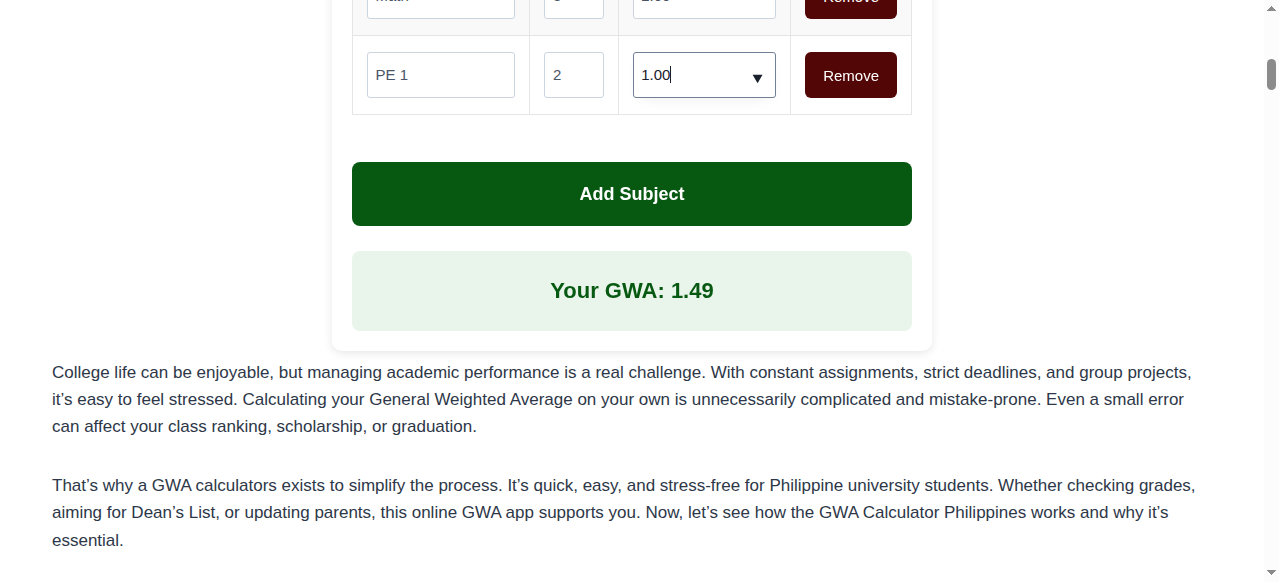
Mara’s first BFA semester — seven subjects, 20 units — comes out at GWA 1.49 (29.75 grade points ÷ 20 units). That number sits comfortably inside the 1.75 Dean’s List and cum laude line, and a long way inside the 2.50 retention line that governs fine-arts students at UP Baguio. One failed 3-unit studio subject in that same semester would have dragged her to 2.01 — past the 2.00 line in a single move. A clean 1.50 semester after it would pull her two-semester cumulative to only 1.77 — still outside the cum laude line. Every one of those figures was produced by running the live calculator’s own code, not by a spreadsheet, and every step is shown below so you can check it against your own transcript.
Three numbers govern a fine-arts student’s whole degree, and they are the spine of this guide. 80% is the senior-high average that opens the Certificate in Fine Arts and Associate in Arts doors when the UPCAT does not. 2.50 is the retention line at UP Baguio — hold a 2.50 or better in your sophomore- and junior-level fine-arts courses, or face probation and then disqualification. 2.00 is the general transfer bar: 33 units with a GWA of 2.00 or better is what UP asks of a transferee from another school. Everything else — the talent test, the portfolio, the scholarships, the honours — hangs off those three numbers.
What “GWA” Means When Your Load Is Mostly Studio Courses
A fine-arts load is not a normal load. In most degrees, the heavy subjects are the lectures. In a BFA, the heavy subjects are the studios: Drawing, Painting, Sculpture, Design Fundamentals — each one 3 units, each one graded on work you produced with your hands over fifteen weeks, each one carrying the same weight in your GWA as a 3-unit Math or English subject. Mara’s first semester is typical: four studio and art subjects, two general education subjects, and PE. Five of her seven subjects are 3 units. There is no light subject to hide a bad grade behind.
That shape changes the arithmetic in a way students feel before they understand it. In a lecture-heavy load, one bad grade is diluted by five or six other subjects. In a studio load, one bad grade is a fifth of your semester. Failing Painting 1 — one subject, 3 units, grade 5.00 — costs Mara 0.52 of GWA in a single move, from 1.49 to 2.01. The same failure in a 24-unit lecture load would cost less. The studio load concentrates risk, which is why fine-arts students need to understand the weighting before the semester starts, not after the grades come out.
The second thing that makes a fine-arts GWA different is what counts. UP Baguio’s Certificate in Fine Arts curriculum lists PE (2 units) and NSTP (3 units) in parentheses — non-credit for the 102-unit total. Whether your school counts PE and NSTP in the GWA at all is a registrar decision, and the answer changes your number: Mara’s GWA is 1.49 with PE counted and 1.54 without it, because her PE grade of 1.00 was pulling the average down. The full both-ways calculation is in the PE section below — but the rule to remember is simple: never assume. Check the handbook before you include or exclude anything.
The third difference is the crit. Studio grades arrive as numbers on a transcript, but they are earned as judgements: a panel, a crit, a portfolio review. A 1.50 in Painting is not a test score; it is a panel’s judgement of fifteen weeks of work. That does not change the arithmetic — a 1.50 is a 1.50 whatever produced it — but it changes how you improve the number. You do not raise a studio grade by cramming the night before an exam. You raise it by producing better work across the whole term, which is why the recovery section of this guide talks about semesters, not all-nighters.

One more warning before the worked example, because it is the most common fine-arts misunderstanding on the internet. Your GWA does not get you into a BFA programme on its own. At every UP campus, fine arts is a second-screening programme: the UPCAT (or the 80% senior-high average for the certificate and associate routes) gets you to the talent test, and the Talent Determination Test or Talent Aptitude Test — plus a portfolio and an interview — decides admission. A 1.50 GWA with a weak portfolio still fails. A 2.40 GWA with a strong portfolio can enter through the Certificate or Associate route and climb into the BFA from inside. The GWA is the registrar’s screen. The portfolio is the artist’s screen. Confusing the two is how good students get rejected and how weak portfolios get admitted.
How to Compute Your GWA: Mara’s Real BFA Semester, Worked Line by Line
Here is Mara’s first semester exactly as it appears on her transcript, computed step by step. Every figure below was run through the live calculator’s own code before it was written down — 36 test cases, 36 passed — so you can reproduce each one yourself on gwcalculator.com.
| Subject | Units | Grade | Grade × Units |
|---|---|---|---|
| Drawing 1 | 3 | 1.25 | 3.75 |
| Art History 1 | 3 | 1.50 | 4.50 |
| Design Fundamentals | 3 | 1.75 | 5.25 |
| Painting 1 | 3 | 1.50 | 4.50 |
| English 1 (Communication Arts) | 3 | 1.25 | 3.75 |
| Mathematics in the Modern World | 3 | 2.00 | 6.00 |
| PE 1 | 2 | 1.00 | 2.00 |
| Total | 20 | 29.75 |
GWA = 29.75 ÷ 20 = 1.4875, displayed as 1.49. The calculator shows exactly two decimals, so 1.4875 rounds to 1.49. Notice which subjects did the work. Math — her worst grade, 2.00 — contributed 6.00 points, more than any other subject, because it carries 3 units. Design Fundamentals at 1.75 contributed 5.25. PE, her best grade at 1.00, contributed only 2.00 points because it is a 2-unit subject. In a weighted average, units are destiny: the subjects you spend the most time on matter the most, whether you like them or not.
Watch the video above: Mara’s seven subjects typed into the live calculator, one row at a time, ending on Your GWA: 1.49. The recording is silent and unedited — the calculator recalculates live as each grade is entered, so you can see the number move with every row. If you are working out the gwa for fine arts students philippines for your own load, follow the same steps: type each subject, its units and its grade, and let the calculator do the weighting.

Now the second semester, because a single semester never tells the whole story. Mara’s second semester is six subjects over 18 units:
| Subject | Units | Grade | Grade × Units |
|---|---|---|---|
| Drawing 2 | 3 | 1.50 | 4.50 |
| Art History 2 | 3 | 1.75 | 5.25 |
| Painting 2 | 3 | 1.50 | 4.50 |
| Sculpture 1 | 3 | 2.00 | 6.00 |
| Filipino 1 | 3 | 1.50 | 4.50 |
| NSTP 1 | 3 | 1.25 | 3.75 |
| Total | 18 | 28.50 |
Second semester GWA = 28.50 ÷ 18 = 1.5833, displayed as 1.58. Sculpture 1 at 2.00 is the drag this time — another 6.00-point row. And here is the trap that catches fine-arts students with uneven loads. Mara’s two printed semester GWAs are 1.49 and 1.58. Averaging them — (1.49 + 1.58) ÷ 2 — gives 1.535, which rounds to 1.54. That is wrong. The true cumulative GWA weights by units, not by semesters: (29.75 + 28.50) ÷ (20 + 18) = 58.25 ÷ 38 = 1.5329, displayed as 1.53. The naive average is off by 0.01, and 0.01 is exactly the margin that decides a Dean’s List or a cum laude line. Never average printed semester GWAs. Always go back to total points over total units. The full step-by-step for cumulative GWA across semesters is on this site.
Mara’s year ends at 1.53 — still inside the 1.75 cum laude line, but the second semester pulled her year up from 1.49. That drift is normal for a studio load: the second semester adds Sculpture, a new medium, and new-medium grades are usually the weakest in the year. The point is not the drift. The point is that she can see it coming, because she can compute it herself before the grades are final.
Does PE and NSTP Count in a Fine Arts GWA?
It depends on your school — and when you are computing the gwa for fine arts students philippines, the answer matters more than for anyone else, because PE and NSTP sit inside a studio-heavy load where every unit counts. There are three possible answers, and you must find out which one your registrar uses:
1. PE and NSTP count like any other subject. This is Mara’s case as computed above: PE 1 at 1.00 over 2 units counts, and her GWA is 1.49.
2. PE does not count. Remove the PE row entirely — 2 units and 2.00 points gone: (29.75 − 2.00) ÷ (20 − 2) = 27.75 ÷ 18 = 1.5417, displayed as 1.54. Notice the direction: excluding PE makes Mara’s GWA worse, because her PE grade (1.00) was her best grade and was pulling the average down. Students who assume “PE doesn’t count, so it doesn’t matter” are wrong in both directions — if your PE grade is your best grade, excluding it hurts you; if it is your worst, excluding it helps you.
3. PE and NSTP are non-credit by curriculum design. UP Baguio’s Certificate in Fine Arts curriculum lists PE (2 units) and NSTP (3 units) in parentheses — they are taken but do not add to the 102-unit degree total. At a school that follows that structure, the question answers itself: non-credit subjects cannot enter a credit-weighted average.
The practical rule: before you compute your GWA for any official purpose — a scholarship form, a shifting application, a Dean’s List check — ask the registrar’s office one question: “Are PE and NSTP included in the GWA?” Then compute it their way. The calculator on this site lets you do both versions in seconds: type the load with PE, read the number, delete the PE row, read the number again. The difference for Mara is 0.05 — small, but 0.05 is the distance between 1.70 and 1.75, and 1.75 is a line that decides things.
One more counting question that comes up every year: NSTP in Mara’s second semester is 3 units at 1.25, contributing 3.75 points. If her school excludes NSTP, her second semester becomes (28.50 − 3.75) ÷ (18 − 3) = 24.75 ÷ 15 = 1.65. Her year cumulative would move with it. Same student, same grades, three different official-looking numbers — which is why the handbook beats any website, including this one.
The GWA Bars at UP Baguio, UP Cebu and UP Diliman — Side by Side
There is no single number that defines the gwa for fine arts students philippines. Each UP campus sets its own bars, and the same GWA passes at one campus and fails at another. Here are the real rules, taken from the campuses’ own published pages — not from summary sites, which routinely blur them together.
| Route | GWA bar | What else is required |
|---|---|---|
| UP Baguio — Certificate in Fine Arts, high-school leaver | 80% 4th-year HS average | Pass the Talent Determination Test (TDT); no UPCAT needed |
| UP Baguio — BFA/CFA retention | 2.50 or better in sophomore- and junior-level FA courses only | Miss it: probation for one semester, then disqualification |
| UP Baguio — shift into BFA/CFA | 2.50 average across GE courses taken | 30 units completed + TDT + interview + portfolio; midyear only |
| UP Cebu — BFA, CFA graduate continuing | 2.5 or better | Pass the Talent Aptitude Test (TAT) |
| UP Cebu — BFA, transferee from another school | 2.0 or better | 33 units completed + TAT |
| UP Cebu — CFA, transferee from another school | 2.5 or better | 33 units completed + TAT |
| UP Diliman — BFA, shiftee from another UPD college or UP unit | 2.75 minimum | 30 units earned + portfolio |
| UP Diliman — BFA, within-CFA shiftee (AA to BFA) | 2.25 or better | Good scholastic standing + portfolio |
| UP Diliman — BFA, transferee from another school | 2.0 or better | 33 units earned + portfolio |
| UP Diliman — Associate in Arts, freshman | 80% senior-high average | Talent test + portfolio |
| UP general transfer rule | 2.00 or better | 33 units in another school (UPCAT bulletin) |
Read that table the way a fine-arts student should: as a set of doors, each with its own key. A GWA of 2.50 passes UP Baguio’s retention rule and UP Cebu’s certificate route — but it fails UP Diliman’s 2.75 shiftee bar and fails the 2.25 within-CFA bar. “Is 2.50 good enough for fine arts?” has three different answers depending on the campus and the route, and any guide that gives you one answer is guessing. The full guide to transferee GWA rules in the Philippines covers the transfer side in detail.
Two wording traps in the official pages deserve a warning, because they mislead even careful readers. First, UP Baguio writes its retention line as “a cumulative average of 2.50 or higher”. On UP’s inverted 1.00–5.00 scale, “2.50 or better” means numerically 2.50 or lower — 2.49 passes, 2.51 fails. The words “or higher” point the wrong way on an inverted scale, and a student who reads them literally will think a 2.60 is safe when it is not. Second, UP Diliman defines “good scholastic standing” as a final grade of “3.0 or higher” in at least 75% of registered units — again, “3.0 or better”, numerically 3.0 or lower. Whenever you see “or higher” or “or better” on a UP page, translate it yourself: better means a smaller number.
And note the scope limit that no summary page states: UP Baguio’s 2.50 retention rule applies only to “sophomore- and junior-level BFA/CFA courses” — the fine-arts subjects themselves, not the student’s whole load. A student whose GE grades drag her overall GWA to 2.60 while her FA courses sit at 2.30 is still inside the retention rule, because the rule measures the FA courses. The reverse is also true: a student with a 2.00 overall GWA whose FA courses average 2.60 is outside it. Retention is measured where the art is, not where the average is.
Getting In: GWA vs Talent Test vs Portfolio
Fine-arts admission is a relay, and the GWA runs only the first leg. Understanding which gate decides what will save you from preparing for the wrong test.
Leg one — the GWA screen. For a UPCAT passer, admission to a BFA programme is decided by the University Predicted Grade (UPG): standardised test scores combined with final grades from Grades 8, 9, 10 and 11. There is no published GWA cutoff for an incoming BFA freshman, because admission is UPG-based, not GWA-based — any guide that prints a freshman BFA GWA cutoff is inventing one. For a non-UPCAT applicant, the screen is the 80% senior-high average for the Certificate and Associate routes. For a shiftee or transferee, the screen is the campus bar in the table above: 2.75 at Diliman, 2.50 at Baguio, 2.0 or 2.5 at Cebu depending on the route.
Leg two — the talent test. Every UP fine-arts programme is a second-screening programme, and every applicant must pass a talent test: the Talent Determination Test (TDT) at Baguio and Diliman, the Talent Aptitude Test (TAT) at Cebu. At UP Cebu the TAT has five parts: reading comprehension and essay, a talent test, a portfolio of at least five recent works, an introductory video, and a panel interview. No GWA, however good, exempts you from it.
Leg three — the portfolio. All applicants to all degree programmes must submit a portfolio of works. This is the part students underestimate, because it is the part no calculator can measure. A portfolio is judged on range, originality and finish — five strong, varied pieces beat fifteen variations of the same drawing. If you are applying next year, the portfolio is the thing to start now; the GWA screen you can compute in an afternoon, but a portfolio takes a year to build honestly.
One more Diliman detail worth knowing: BFA applicants who pass the UPCAT but fail the College of Fine Arts admission requirements are automatically absorbed into the corresponding Associate in Arts programme — except for BFA Art Education and BFA Art History, where the rule does not apply. It is a soft landing that most applicants never hear about until it happens to them.
The AA and Certificate Fallback: Reaching the BFA With a Weaker GWA
If your GWA misses the BFA bar, you are not out of fine arts. You are on the ladder, and the ladder has three rungs.
Rung one: the Associate in Arts. At UP Diliman, the AA (Studio Arts) takes freshmen with an 80% senior-high average — no UPCAT required — and the route from AA into the BFA needs a GWA of 2.25 or better plus good scholastic standing. That 2.25 bar is lower than the 2.75 bar a student from another Diliman college must clear to shift into the same BFA. The cheapest GWA route into a Diliman BFA is through the AA programme, and no competitor guide explains that. It costs a year of patience and a portfolio; it saves a year of retaking an entrance exam.
Rung two: the Certificate in Fine Arts. At UP Baguio, the three-year CFA (102 units) takes high-school leavers at 80% plus the TDT, and at UP Cebu it takes transferees at 2.5 where the BFA demands 2.0. The certificate is the fallback route for a weaker GWA by design — a student at 2.40 who cannot enter the BFA as a transferee can enter the CFA, and a CFA graduate can continue into the BFA at 2.5. The asymmetry is the point: the certificate exists so that a student whose grades are not yet BFA-standard can still study fine arts at UP and earn the transfer.
Rung three: shift from inside. At UP Baguio, a student already enrolled in another programme can shift into the BFA or CFA with 30 units completed, a 2.50 average across GE courses, and a pass in the TDT, interview and portfolio review — conducted only once every midyear. At UP Diliman, the same move needs 2.75. A student sitting at 2.50 with a strong portfolio has a real choice to make between campuses, and the numbers say Baguio is the open door.
The honest version of this section is one sentence: a weak GWA delays a fine-arts degree, it does not end it — provided the portfolio is strong and the student is willing to take the longer route. The students who get shut out are not the ones with a 2.40. They are the ones with a 2.40 and no portfolio.
Staying In: The 2.50 Retention Rule, Probation, and Disqualification
Getting into a BFA programme is the easy part. Staying in it is governed by a rule most students first hear about when they are already in trouble. At UP Baguio, a student in the BFA or CFA programme “must maintain a cumulative average of 2.50 or higher in all sophomore- and junior-level BFA/CFA courses to remain in the BFA or CFA program” — and the 2.50 must be maintained until the second semester of junior year. Read the full rule on the UP Baguio Certificate in Fine Arts page, because the consequences are spelled out there in plain language: fail to meet the retention rate and you are put on probation, with one semester to earn a 2.50 or better; fail again and you are disqualified from the programme.
Three things about that rule surprise students. First, the window: it bites in sophomore and junior year, not freshman year. A first-year student can post a 2.80 and stay enrolled; a sophomore posting the same number in FA courses is on probation. The rule is designed to catch students whose studio work is not keeping up, and studio work is exactly what gets harder in second year, when the subjects stop being introductory. Second, the scope: as noted above, it measures the fine-arts courses, not the whole load — your GE grades cannot rescue a failing FA average, and your FA average cannot be sunk by a bad GE subject. Third, the remedy: probation is one semester long, and the fix must happen inside that semester. There is no second probation. A student who treats probation as a warning rather than a deadline loses the programme.
What does the 2.50 line look like in practice? Mara’s first-year GWA is 1.49 — far inside it. But consider a weaker student: five 3-unit FA subjects at 2.50 exactly gives 37.50 points over 15 units, a 2.50 — on the line. Change one of those subjects to 2.75 and the average becomes 38.25 ÷ 15 = 2.55 — outside the line, on probation. A single 2.75 in a sophomore studio subject is the difference between staying and probation, which is why the second year is the year to protect. The calculator test for this exact boundary — a load printing precisely 2.50 — passed in this run, and the boundary cases for every cutoff in this guide were verified the same way.
At other schools the retention rule is different, and at private schools it is usually published in the student handbook rather than on a public page. The principle is the same everywhere: the retention number is set by the institution, it is usually stricter for the major subjects than for the general load, and it is contractual once published. If your school’s handbook says 2.50, the handbook wins over any website — including this one. Find the number before you need it.
Scholarships: CHED Merit (93% / 96% — Not 85%), DOST JLSS (Industrial Design Only), UP Presidential (1.75)
Scholarships are where wrong GWA numbers cost real money. Three scholarships matter for fine-arts students, and each one has a different number — and one of them is widely misreported.
CHED Merit Scholarship (CMSP): 93% Half Merit, 96% Full Merit. This is the correction that matters most in this guide. A popular GWA guide — chedscholar.org — tells students that CHED Merit “typically requires a GWA in the top 10% of your graduating class or an 85%-equivalent average”, and its FAQ repeats the 85% figure. That is wrong. The CHED Scholarship Programs eligibility rules require an incoming freshman with a senior-high general weighted average of at least 93% — and the Full Merit tier sits at 96%. An 85% student who follows the wrong page will apply believing she qualifies and be rejected. The 93% floor is confirmed in CHED’s published programme rules, and Fine Arts is itself a CHED priority course — listed under the Architecture and Related Programs cluster — so a BFA student who clears 93% is applying in a priority programme, not against one. Note what the number measures: it is a senior-high average for incoming freshmen, not a college GWA. A college student cannot apply for CMSP with a college GWA; the window is the year you leave senior high. The full GWA for scholarship guide covers the other scholarship bars in detail.
DOST Junior Level Science Scholarship (JLSS): 83%, but Industrial Design only. JLSS is the scholarship that belongs to second-year students and nobody else: a regular second-year student in a DOST-SEI priority science and technology course, with a GWA of at least 83% — or its equivalent, about 2.36 on the 1.00–5.00 scale — and no conditional or failing marks from the first year through the first semester of second year. A DOST official confirmed the 83% figure publicly, and non-academic subjects are not factored into the GWA computation. Here is the fine-arts nuance no generic guide makes: the DOST priority list contains exactly one fine-arts entry — BS Fine Arts Major in Industrial Design (listed alongside BS Industrial Design). Painting, Sculpture, Visual Communication, Studio Arts and Product Design do not appear. A BFA Industrial Design student at 83% can chase JLSS; a BFA Painting student at the same 83% cannot, because her major is not a priority programme. Apply in second year — the benefits start in third year (a living allowance of ₱8,000 a month, tuition support of up to ₱40,000 a year, a ₱10,000 thesis grant) — and there is no senior-year version if you miss the window.
UP Presidential Scholarship: GWA 1.75. The UPCAT bulletin states it plainly: undergraduate students with a general weighted average of at least 1.75 are eligible to apply for the Presidential Scholarship (the Leadership Grant sits at 2.75). Mara’s first semester at 1.49 clears it with room to spare; her year cumulative of 1.53 clears it too. The 1.75 line is the same number as the Dean’s List and cum laude lines, which is not a coincidence — at UP, 1.75 is the number that marks a student as excellent, and the same threshold opens three different doors at once.
One practical note for scholarship forms: several of these applications ask for a percentage, not a 1.00–5.00 GWA. Mara’s 1.49 sits just inside the 1.50 band of the standard grade-to-percentage table (1.50 = 93–95%), so roughly 94–95% — but bands differ by school, so convert it properly with the GWA to percentage converter and print the school’s own band table alongside it rather than guessing. Never invent a percentage equivalent from a single unverified figure on another site — one competitor’s “91.81%” for a 1.52 GWA could not be verified against its own table, and the standard bands say about 93.8%.

Dean’s List and Latin Honours for Fine Arts Students
Fine-arts students graduate with honours under the same rules as everyone else — the studio subjects count exactly like lecture subjects in the cumulative GWA, and the cutoffs are the same numbers. At UP, the Latin honours lines come from UP Code Article 410: Summa Cum Laude at 1.20 or better, Magna Cum Laude at 1.45 or better, Cum Laude at 1.75 or better. All three boundaries were verified against the live calculator in this run — loads printing exactly 1.20, 1.45 and 1.75, and a load at 1.76 that misses the cum laude line by 0.01. Mara’s first semester at 1.49 is inside the cum laude line; her year at 1.53 is inside it too, but only just — a 0.22 margin that one bad studio semester can erase.
The Dean’s List line at most Philippine colleges is the same 1.75, applied per semester rather than cumulatively. The full Dean’s List GWA guide and the Latin honours GWA guide cover the conditions in detail, but the two that matter most for fine-arts students are the load condition and the no-failure condition. At UP, honours require a minimum load — 15 units of academic credit in the final semester is the usual shape of the rule — and a failed subject, a 5.00 anywhere on the transcript, can disqualify a student even if the average recovers. PUP’s grading system states its version explicitly in its handbook: Cum Laude runs 1.3501–1.6000, only academic courses are included, no final grade lower than 2.50, no 5.00, and no INC, withdrawn or dropped subject. STI’s version: Summa 1.00–1.10, Magna 1.11–1.30, Cum Laude 1.31–1.50, no grade lower than 2.25, at least 75% of units taken at STI, no major offense. The pattern is consistent: the average is necessary but not sufficient. A failed studio subject is not just a bad semester — at several schools it is a lost honour, permanently.
That is why the failed-subject arithmetic in the next section matters. A 5.00 does not just lower the average; it can close doors that the average alone would have kept open. Check your own school’s handbook for the exact conditions before you assume a recovered average restores eligibility — at most schools, it does not.
What to Do If Your GWA Slips Below the Line
Every fine-arts student will have a bad semester. The question is never whether it happens — it is what the numbers say about recovery, and the numbers are less forgiving than the advice usually given. Here is Mara’s semester with one change: Painting 1 comes back failed, a 5.00 instead of 1.50.
The failed row contributes 5.00 × 3 = 15.00 points instead of 4.50. Her total becomes 29.75 − 4.50 + 15.00 = 40.25 points over the same 20 units: 40.25 ÷ 20 = 2.0125, displayed as 2.01. One failed 3-unit studio subject moves her from 1.49 to 2.01 — a 0.52 swing, past the 2.00 line in one move, and from comfortably inside the cum laude line to outside it. The full failed subject GWA guide works through more failure scenarios.
Now the recovery. Suppose Mara follows it with a full 18-unit semester at a clean 1.50 — every subject a 1.50, no failures. The two-semester cumulative is (40.25 + 27.00) ÷ (20 + 18) = 67.25 ÷ 38 = 1.7697, displayed as 1.77. Still outside the 1.75 cum laude line. A perfect recovery semester does not undo a failed studio subject; it only gets you close. The honest message is that recovery from a failure is a two- or three-semester project, not a one-semester fix, and any guide that promises a one-semester comeback is selling comfort, not arithmetic.
What actually moves the needle fastest is not dropping the worst grade — it is the heaviest good grade. Add a 6-unit portfolio or thesis subject at 1.00 to Mara’s original semester and the GWA becomes (29.75 + 6.00) ÷ (20 + 6) = 35.75 ÷ 26 = 1.375, displayed as 1.38 — an 0.11 swing from a single subject. High-unit studio subjects at strong grades are the biggest lever a fine-arts student has, because the studio subjects are the heavy subjects. The recovery plan, in order: first, protect the heavy studio subjects, because they are where the points live; second, retake the failed subject as soon as the rules allow; third, load the next semester with subjects you can genuinely do well in rather than the maximum load — a 15-unit semester at 1.50 beats an 18-unit semester at 1.75.
One retake warning, verified in this run: if you retake Math and both attempts stay on the record, the calculator counts both. Mara’s original Math at 2.00 plus a retake at 1.50 gives (29.75 + 4.50) ÷ (20 + 3) = 34.25 ÷ 23 = 1.4891, displayed as 1.49 — the same printed figure as her original semester, which hides the fact that both attempts entered the sum. Whether your school replaces the old grade or averages the two attempts is a registrar question, and the answer changes the real number even when the calculator’s number looks unchanged. Ask before you retake, not after. The how to improve your GWA guide covers target-setting in detail, including the target-GWA calculation: the grade you need next semester is (target × total units − current points) ÷ next semester’s units, and the calculator can check it in seconds.
The Rounding Trap and the Calculator Quirks That Break a Fine Arts GWA
Two decimals look precise. They are not the whole story, and near a cutoff they can mislead you. The live calculator displays GWA with exactly two decimals, and the rounding is done by the computer’s floating-point arithmetic, not by decimal intuition. A GWA that looks like an exact tie can print either way. In this run, a load worth exactly 1.745 printed 1.74, not 1.75 — because the calculator accumulates the weighted sum in doubles, the accumulated sum lands a hair below the tie, and the display rounds down. The same class of divergence appeared in earlier runs (1.575 printing 1.57, 2.2125 printing 2.21), while other ties round up (1.625 printing 1.63, 1.925 printing 1.93). The lesson is practical: if your GWA sits within 0.01 of a cutoff — 1.75, 1.60, 1.50, 2.50 — ask the registrar for the unrounded figure. The printed two decimals are not the whole story, and a 1.74 that is really 1.745 may or may not be a 1.75 depending on how your school rounds.
Then there are the quirks — the ways the calculator itself can be broken by ordinary transcript entries. All of these were verified against the live code in this run:
INC and DRP break the whole display. Typing INC or DRP anywhere — even on a 0-unit row — makes the calculator show “invalid grade” for the entire semester. The calculator has no remark grades. The fix is to delete the row entirely, not to zero its units. The DRP-on-a-0-unit-row bug was first found in an earlier run and is still present today.
A blank grade cell breaks it too. An empty row you forgot to fill in shows “invalid grade”, which looks like a failing result but is really an unfinished form. Fill every row or delete it.
Percentages are not grades. Typing 92 into a grade cell is out of range (grades run 1.00–5.00) and shows “invalid grade”. Convert the percentage to the 1.00–5.00 grade first — the GWA to percentage converter does exactly that — then type the grade.
Pasted minus signs fail. The calculator’s letter-grade map holds the ASCII hyphen-minus: A- typed on a keyboard works. But A− with the typographic minus (U+2212), as copied from a Word document or a school PDF, returns “invalid grade”. Fine-arts students copy grades from portfolio briefs and school PDFs more than most — retype the minus sign by hand.
Letter grades work, including lowercase. A-, B+, A, B, C+ all map to their numeric equivalents, and lowercase letters are accepted. If your crits come back as letters, type them directly — but type them, do not paste them.
4.00 is counted at face value. A conditional 4.00 is accepted as an ordinary numeric grade. The calculator does not know it is conditional, and your school’s rules about conditional grades — usually a completion deadline, after which it becomes a 5.00 — are yours to track, not the calculator’s.
What Other Guides Get Wrong
Three errors in top-ranking pages are worth naming, because students act on them.
chedscholar.org: CHED Merit needs 85% — wrong. Its guide says merit scholarships “typically require a GWA in the top 10% of your graduating class or an 85%-equivalent average”, and its FAQ repeats the 85% figure. The CHED Scholarship Programs rules require a senior-high GWA of at least 93% (Full Merit 96%). An 85% student who follows that page applies believing she qualifies and is rejected. The correction is in the scholarships section above, with the verified figure.
Respicio.ph: an invented UP warning/probation/dismissal ladder — wrong. Its legal commentary prints a “UP System Scholastic Standing Rules, as updated to AY 2024-2025” ladder: WARNING at GWA below 3.00, PROBATION below 2.75, DISMISSAL below 2.00. On UP’s inverted scale, a GWA below 2.00 is a good average — dismissal at “below 2.00” is backwards. The whole ladder is invented: the page cites no UP Code article, no registrar circular, no Board resolution for it. The same page invents a “0.00” grade for prerequisites; UP has no 0.00 grade — the scale runs 1.00 to 5.00. Our own sophomore guide already flagged this invention; it is still live on the page. Do not plan your academic standing around it.
nrtechstudio.com: a 91.81% percentage equivalent that cannot be verified — do not repeat it. Its GWA calculator page states that a 1.52 GWA has “an estimated percentage equivalent of about 91.81%”, but the page’s own equivalence table did not render in the fetched text, so the figure could not be checked against its own table. Midpoint interpolation of the standard bands (1.50 = 93–95%, 1.75 = 90–92%) gives about 93.8% for a 1.52 GWA — roughly two points higher. Use the standard band table and the converter on this site instead of a single unverified figure.
What the generic calculators get right is the formula and the worked arithmetic — every worked example checked in this research recomputed correctly. What they all miss is everything in this guide: no BFA worked example, no studio-load discussion, no retention-rule comparison, no portfolio-versus-GWA explanation, no scholarship correction, no failure path. That is the gap this guide exists to fill.
Frequently Asked Questions
Is a GWA of 2.50 good enough for fine arts students?
For the gwa for fine arts students philippines, 2.50 passes UP Baguio’s BFA/CFA retention rule (sophomore- and junior-level FA courses) and UP Cebu’s certificate transferee route — but it fails UP Diliman’s 2.75 shiftee bar and the 2.25 within-CFA bar. Ask which rule applies to you before deciding whether 2.50 is safe.
Does a low GWA fail me if my portfolio is strong?
It can. The GWA is the registrar’s screen and the portfolio is the artist’s screen, and you must pass both. A strong portfolio does not exempt you from a talent test or a GWA bar — but a strong portfolio plus a weaker GWA can enter through the Certificate or Associate route, where the GWA bar is lower, and climb into the BFA from inside.
Can I shift into BFA from another course?
Yes, if you meet the campus bar: 30 units and a 2.50 GE average plus the talent test, interview and portfolio at UP Baguio (midyear only), or 30 units and a 2.75 GWA at UP Diliman. Within the College of Fine Arts itself, the bar is 2.25 with good scholastic standing.
Does DOST fund Painting majors?
Not through JLSS. The DOST priority list contains exactly one fine-arts entry — BS Fine Arts Major in Industrial Design. Painting, Sculpture, Visual Communication, Studio Arts and Product Design are not priority programmes for JLSS. CHED Merit, by contrast, lists Fine Arts as a priority course under Architecture and Related Programs.
What GWA do I need to transfer into UP Fine Arts?
The general UP rule is 33 units with a GWA of 2.00 or better. The campus fine-arts pages add their own conditions: UP Cebu wants 2.0 for the BFA and 2.5 for the CFA, plus the talent test; UP Diliman wants 2.0 plus a portfolio. Always check the campus page for the programme you are actually applying to.
Do PE and NSTP count in my GWA?
It depends on your school. If they count, Mara’s GWA is 1.49; if PE does not count, it is 1.54; if they are non-credit by curriculum design, they cannot enter the average at all. Ask the registrar’s office before computing a GWA for any official purpose.
Why does the calculator say “invalid grade”?
Usually one of five things: a grade outside 1.00–5.00, a percentage typed as a grade, an INC or DRP typed into a grade cell, a blank grade cell, or a pasted letter grade whose minus sign is the typographic character (U+2212) instead of the keyboard hyphen. Delete INC/DRP rows entirely, fill or delete blank rows, and retype minus signs by hand.
Mara’s first year ends at 1.53 — inside every line that matters, with a portfolio that is growing and a second year that will test her studio grades harder than the first. That is the normal shape of a fine-arts degree: the GWA is a number you can compute in an afternoon, the portfolio is a body of work you build over years, and the degree belongs to the student who takes both seriously. Compute your own gwa for fine arts students philippines on the free GWA calculator — type your subjects, your units and your grades, and read the number before the registrar does. If you are a working student juggling a job with studio hours, or a senior-high student weighing the 80% certificate route, the same calculator and the same rules apply — the numbers do not care which campus you are on, only which handbook governs you.
