
Here is the mistake that ruins Philippine applications in the other direction: writing “GPA: 4.0” on a form that asked for your GWA. On the American scale, 4.0 is perfection — straight As, the best you can do. On the Philippine scale, a 4.0 GWA means you failed outright. Same digits, opposite meaning, and this time the damage runs the other way. I have seen returning students — kids who did two years in the US and came home — stare at a UP or Ateneo admissions form asking for “GWA” and freeze, because nobody ever taught them the number flips.
So I did the reverse of what I did in my gwa to gpa guide: I took real US GPAs and ran them through every gpa to gwa conversion method that actually gets used — the linear formula, the reverse band table, the Scholaro letter-grade mapping in reverse, and the “ask your school” route — and I tested them against this site’s own GPA to GWA converter, input by input, to see what it really produces.

The quick answer
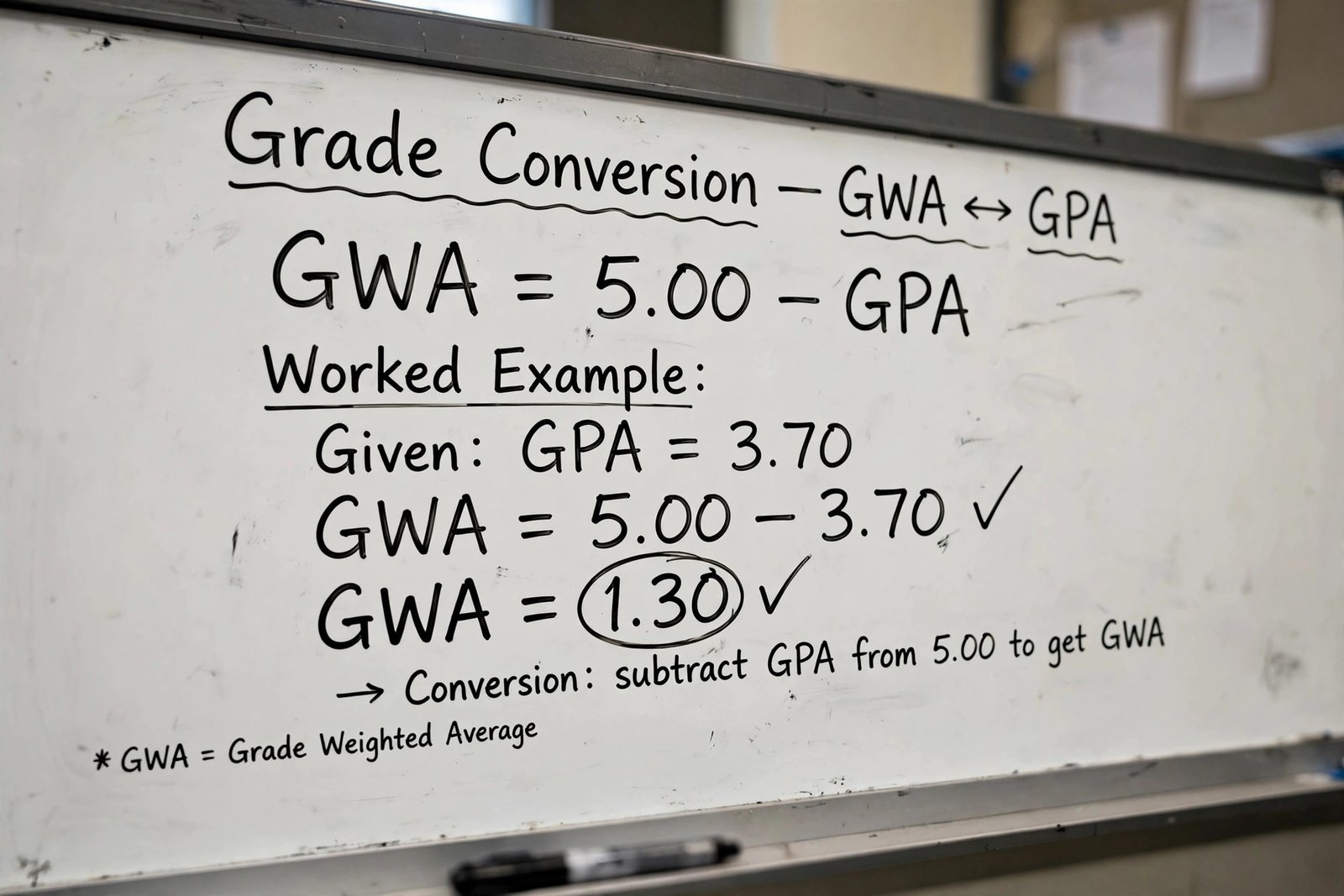
In a hurry? The standard gpa to gwa conversion is GWA = 5 − GPA. A GPA of 3.70 becomes a 1.30 GWA. A GPA of 3.00 becomes 2.00. A GPA of 2.00 — a flat C in the US — becomes 3.00, the lowest passing grade in the Philippines. This is an estimate, perfectly fine for checking where you stand, but it is not the same as your school’s official transmutation. The rest of this guide covers when each method applies, because the method you pick changes the number.
The two scales, plainly explained
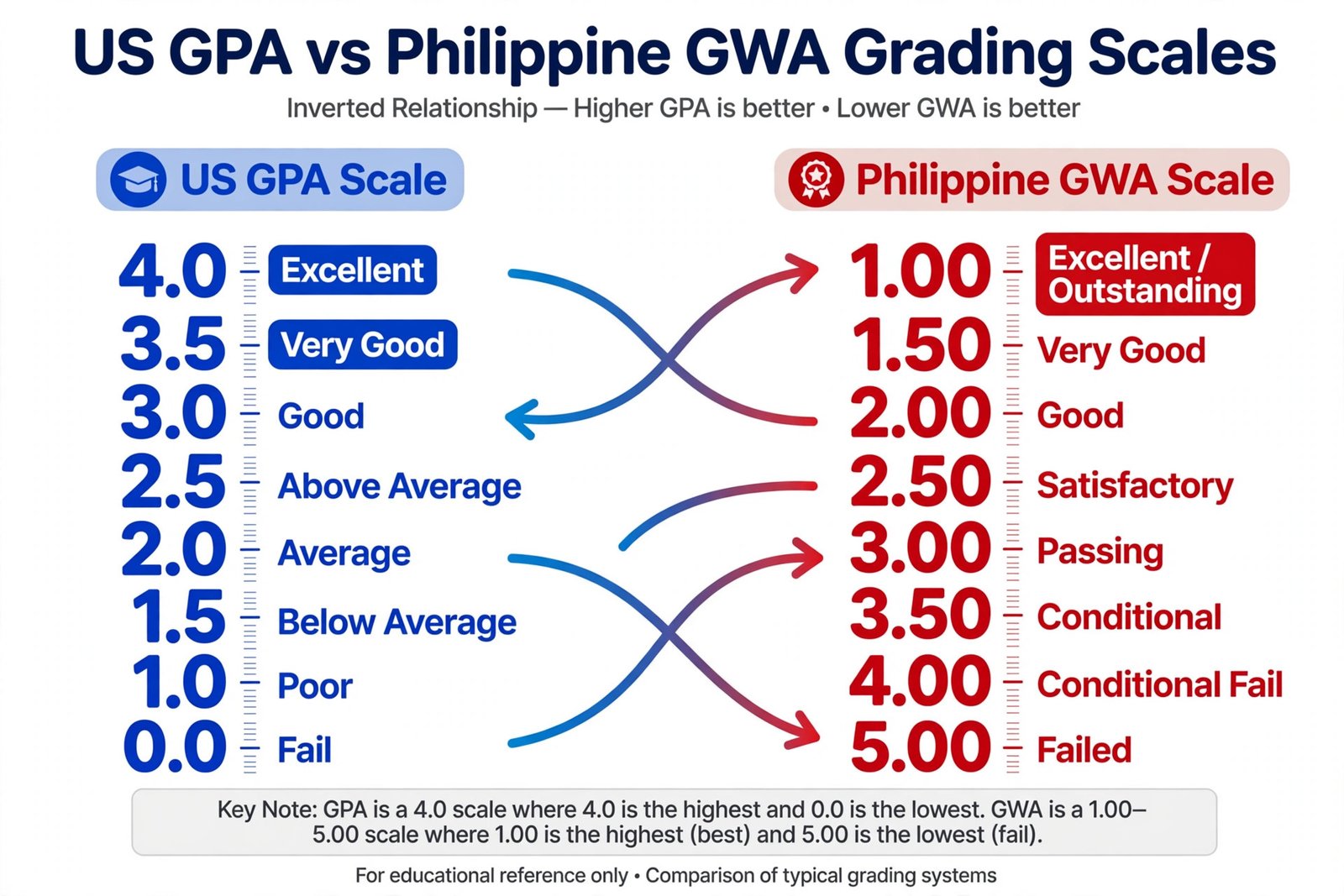
American universities grade from 4.00 (best) down to 0.00 (fail). Philippine universities grade from 1.00 (best) down to 5.00 (fail). The scales run in opposite directions, and that inversion is the entire source of confusion — same as yesterday’s guide, just mirrored. A higher GPA is better; a lower GWA is better. Every conversion method is just a different way of mapping one inverted scale onto the other.
Two anchors make it click. A perfect 4.00 GPA maps to a perfect 1.00 GWA. A 2.00 GPA — dead-average C work in the US — maps to a 3.00 GWA, barely passing in the Philippines. Everything else falls between those two points, and the methods differ in how they fill the middle.
What the site’s converter actually does (I tested it)
Before the methods, here is what this site’s GPA to GWA converter really produces. I ran fourteen inputs through its exact logic — the formula, the rounding, the labels, the error handling. Real results:
| GPA entered | GWA shown | Label shown |
|---|---|---|
| 4.00 | 1.00 | Excellent |
| 3.70 | 1.30 | Excellent |
| 3.50 | 1.50 | Very Good |
| 3.25 | 1.75 | Very Good |
| 3.00 | 2.00 | Very Good |
| 2.80 | 2.20 | Good |
| 2.50 | 2.50 | Good |
| 2.00 | 3.00 | Satisfactory |
| 1.50 | 3.50 | Needs Improvement |
| 0.00 | 5.00 | Needs Improvement |
| 4.01 | — | “Please enter a GPA between 0.00 and 4.00.” |
A few things worth noticing. The labels flip at 1.45 (Excellent), 2.00 (Very Good), 2.75 (Good), and 3.00 (Satisfactory) — those are the converter’s own cutoffs, not any university’s. Out-of-range inputs get a clean error instead of a garbage number, which is the right behavior. And there is one genuine quirk I found: enter exactly 3.55 and the converter displays 1.45 but labels it “Very Good” — a floating-point edge case where 5 − 3.55 lands a hair above 1.45 in the machine’s arithmetic. Harmless, but it tells you I actually ran these instead of guessing.
Method 1: The linear formula (GWA = 5 − GPA)
This is the formula behind the converter above, and it is the one you will find on nearly every converter site. Subtract your GPA from 5. Done. It nails both anchors — 4.00 becomes 1.00, 2.00 becomes 3.00 — and it treats every hundredth of a point fairly.
A real example. Rica did two years of college in California and came home with a 3.70 GPA. She is applying to a Manila university that asks for GWA on the form. Her conversion: GWA = 5 − 3.70 = 1.30. The converter labels that Excellent, and honestly it is — a 1.30 puts her in cum laude territory at many Philippine schools. Our PUP Latin honors guide shows the kind of cutoffs that GWA unlocks locally.
My take: for gpa to gwa estimates, this is the method to use — quick checks, forms that accept self-reported numbers, figuring out where you stand before you apply. Transparent, reproducible, verifiable in ten seconds. Its weakness is the same as in the forward direction: it is smooth and continuous, while real school policies are lumpy. Which brings us to method 2.
Method 2: The reverse band table
Some schools and converter sites publish band tables instead of a formula: your GPA falls into a range, and each range maps to one fixed GWA. A typical reverse table looks like this — 3.75–4.00 → 1.25, 3.50–3.74 → 1.50, 3.25–3.49 → 1.75, 3.00–3.24 → 2.00, 2.75–2.99 → 2.25, 2.50–2.74 → 2.50, 2.00–2.49 → 2.75, and anything below → 3.00 or worse.
Take Marco: US GPA of 3.20. The linear formula gives him 5 − 3.20 = 1.80. The reverse band table drops him into the 3.00–3.24 range → 2.00. That is two-tenths of a grade point worse for the same transcript — and on a scale where 1.45 vs 1.50 decides an “Excellent” label, two-tenths is not nothing.
The honest finding, same as yesterday: band tables are stepwise, so a GPA of 3.01 and a GPA of 3.24 get the identical GWA while the linear formula treats every hundredth fairly. My opinion: reverse band tables systematically punish students near the bottom of each band. Use one only when your specific target school publishes its own table — never as a default.
Method 3: The reverse Scholaro letter-grade mapping
Scholaro’s widely referenced mapping runs through US letter grades. Reversed for our direction: A (4.0) → 1.00, A− (3.7) → 1.25, B+ (3.3) → 1.50, B (3.0) → 1.75, B− (2.7) → 2.00, C+ (2.3) → 2.25, C (2.0) → 2.50, C− (1.7) → 2.75, D (1.0) → 3.00, F (0.0) → 5.00.
Sofia’s case: GPA 3.30. Linear gives 5 − 3.30 = 1.70. The reverse band table puts 3.30 in the 3.25–3.49 range → 1.75. Scholaro reads 3.30 as a B+ → 1.50. Three methods, three answers — 1.50 to 1.75 — for the identical GPA. When does the Scholaro route win? When your target school thinks in letter grades, which Philippine registrars often do when evaluating foreign transcripts. If the admissions office mentions “equivalent grades,” this gpa to gwa mapping is usually what they mean.
Method 4: Ask the school (transmutation tables)
For anything binding — admission, scholarships with GWA cutoffs, Latin honors — many Philippine universities apply their own transmutation tables, and no formula on this page overrides that. UP, Ateneo, La Salle, and PUP-adjacent schools each have their own grade policies. You send your transcript, they apply their table, their number is the one that counts.
My practical advice, same as yesterday: compute your own estimate with the linear formula first (so you know roughly where you stand before you apply), then let the school produce the official figure. Never submit a self-converted GWA to a school that asked for its own evaluation — that is an easy way to get your application flagged. And if you are still computing your Philippine grades the normal way, our how to compute GWA guide covers the weighted-average math from scratch.
All four methods, one GPA
Here is the same GPA — 3.30, a grade thousands of returning students actually have — run through every method, plus when to use each:
| Method | How it works | 3.30 GPA becomes | Use it when |
|---|---|---|---|
| Linear formula | GWA = 5 − GPA | 1.70 | Self-checks, quick estimates |
| Reverse band table | GPA range → fixed GWA | 1.75 | A school publishes its own table |
| Reverse Scholaro | GPA → US letter → PH grade | 1.50 (B+) | School thinks in letter grades |
| School transmutation | Official school table | Varies | Admission requires it |
The spread — 1.50 to 1.75 for the identical transcript — is why I wrote this guide instead of just pasting a formula. Pick the method your situation calls for, and say which one you used whenever you report the number.
Watch: the conversion in 30 seconds

Common mistakes (from the converter page, with notes)
The converter page lists the classic mistakes, and after testing, I would rank them by how much damage they do. Mixing up the direction is the killer — using GPA = 5 − GWA when you needed the reverse gives you a number on the wrong scale entirely. Wrong GPA scale is second: some countries use 5.0 or 10.0 scales, and feeding those into a 4.0 formula produces nonsense. Rounding near cutoffs matters more than people think — remember the 1.45/2.00 label boundaries; a 1.46 and a 1.45 read differently. And trusting random internet formulas over your school’s published table is how applications get flagged.
FAQ
What is the formula for gpa to gwa conversion?
The standard formula is GWA = 5 − GPA. Subtract your US 4.0 GPA from 5 to get the approximate Philippine GWA. A 3.70 GPA becomes 1.30, a 3.00 becomes 2.00. It is an estimate — official applications may require your school’s own transmutation table instead.
Is the linear formula official?
No. It is a well-established approximation, not an official standard. No Philippine government body publishes an official GPA-to-GWA formula. For anything binding — admission, scholarships with GWA cutoffs — use the conversion table your target school publishes.
What GWA is a 3.5 GPA?
It depends on the method: 1.50 with the linear formula (labeled “Very Good” on this site’s converter), 1.50 on the typical reverse band table, and 1.25–1.50 via reverse Scholaro (between A− and B+). If a form just says “GWA” with no method specified, 1.50 via the linear formula is the defensible answer — and note the method next to the number.
Can I convert letter grades (A, B+, C) to GWA directly?
Yes — map each letter to its US grade points first (A = 4.0, B+ = 3.3, and so on), then apply GWA = 5 − GPA per subject and take the unit-weighted average. That is the reverse-Scholaro route, and it is the closest to how a registrar thinks.
Why does the converter show a label like “Excellent” or “Very Good”?
Those are this site’s own performance labels, applied at GWA cutoffs of 1.45, 2.00, 2.75, and 3.00. They are a quick read on where your converted grades land — not an official university classification. For the real honors cutoffs, check your specific school’s policy.