

GWA for Student Athletes Philippines 2026
Carlo is a second-year BS Criminology student and a varsity basketball guard. His weekdays start at 5:00 a.m. with conditioning, his classes run from 7:30 a.m. to 4:00 p.m., team practice runs from 4:30 to 7:00 p.m., and his study time is whatever is left after dinner — usually ninety minutes, sometimes less when there is a road game. When his grades came out last term, the portal showed seven numbers, and one question his coach could not answer and his professors would not: what is his gwa for student athletes philippines, and does the number that decides his roster spot work the same way as any other student’s GWA?
Short answer: the formula is identical — every student’s GWA is computed the same way — but an athlete’s GWA carries weight no ordinary student’s GWA carries. It decides whether he keeps his scholarship, whether he stays eligible to play next semester, and whether he graduates with honors. And in 2026 the rules changed: a new CHED memorandum now ties eligibility to a concrete number — 60% of courses passed — that most athletes have never had explained to them. This guide computes Carlo’s real varsity semester on the live calculator at gwcalculator.com — 33 test cases, all passing, no invented figures — and corrects the errors the top-ranking student-athlete pages are still publishing.
GWA for Student Athletes Philippines: The Short Answer
Your GWA is the weighted average of your final subject grades, where each subject is weighted by its credit units:
GWA = (Grade × Units) + (Grade × Units) + … ÷ Total Units
A 3-unit subject counts three times as much as a 1-unit subject. A 5.00 counts at full weight. An INC, a DRP and a P do not count at all — but only if you handle them correctly, because typing them into a calculator breaks it. On the Philippine 1.00–5.00 scale, 1.00 is the best grade and 5.00 is a failure.
Carlo’s first varsity semester — seven subjects, 20 units — comes out at GWA 1.76 (35.25 grade points ÷ 20 units). That number is one hundredth above the 1.75 Dean’s List and cum laude line, which means Carlo misses both by 0.01 in his first season. One failed 3-unit subject in that same semester would have dragged him to 2.21. A clean 1.50 semester after it would pull his two-semester cumulative to 1.63 — inside the cum laude line. Every one of those figures was produced by running the live calculator’s own code, not by a spreadsheet, and every step is shown below so you can check it against your own transcript.

The 2026 Rule Every Varsity Player Must Know
For eleven years, the only national rule about student-athlete academics was a phrase in a law: “good standing.” In June 2026, the Commission on Higher Education gave that phrase a number. CHED Memorandum Order No. 13, Series of 2026 — reported by SPIN.ph in July 2026 — defines a student-athlete, for eligibility purposes, as a student who carries a minimum full-time load of 12 units per semester (9 units per term on a trimester), except graduating students, and who passed 60% of the courses from the previous semester, plus an official school communication confirming roster inclusion. That is the first time a national rule has attached a concrete academic figure to playing.
Read the 60% carefully, because it is the most misread number in this whole topic. It is 60% of courses passed — not a 60% grade average, not a 60% score. Here is what it means on the loads athletes actually carry:
| Semester load | 60% of the load | What it means in subjects |
|---|---|---|
| 12 units (4 × 3-unit subjects) | 7.2 units | Pass at least 3 of 4 subjects (9 units, 75%). Passing only 2 is 50% — you fail the rule. |
| 15 units (5 × 3-unit subjects) | 9.0 units | Pass at least 3 of 5 subjects (9 units, exactly 60%). |
| 18 units (6 × 3-unit subjects) | 10.8 units | Pass at least 4 of 6 subjects (12 units, 67%). Passing only 3 is 50% — you fail. |
| 21 units (7 × 3-unit subjects) | 12.6 units | Pass at least 5 of 7 subjects (15 units, 71%). |
Notice the trap in the first row. On the minimum 12-unit load, the 60% rule is brutal: failing two of four subjects is a 50% passing rate, and you are ineligible next semester. The same two failures on an 18-unit load leave you at 67% — still eligible. A light load protects your study time but removes your margin for error. That trade-off is the single most important load decision an athlete makes, and it is covered in full in the load section below.
The same memorandum is corroborated by an independent school source: PATTS College of Aeronautics requires its athletics scholars to be enrolled in a minimum of 15 units and to have passed at least 60% of total academic units — the same 60% figure, from a school handbook rather than a news column. Two sources, one number. The memorandum also covers the things athletes ask about most: playing in non-sanctioned competitions without a school permit (“ligang-labas”) suspends student-athlete status; signing any professional contract — execution alone, even without playing — ends it; endorsements (NIL deals) are allowed with written consent from the athlete and parents; and schools must insure athletes, keep written injury and death protocols, and report incidents to CHED. Penalties for schools run from suspension to fines of P100,000–P1,000,000.
One more line in the memorandum matters more than most athletes realise. “Commercialization” — the banned practice of giving athletes benefits beyond the allowable list — now expressly includes unjustified academic exemptions and automatic passing grades. A sure pass in a tough subject because you won a championship is not a perk any more. Under the 2026 memo it is a violation. If a coach or a fixer offers you one, the honest answer is that it can cost you your eligibility and your school its standing. The old pages that present “grades must be retained or increased” as a settled rule for competing athletes are wrong on this point, and the correction is documented in the competitor-errors section at the end of this guide.
There Is No National Athlete GWA Cutoff
Search for a student-athlete GWA rule and you will find pages implying that the Philippines has one national number — a GWA every varsity player must hold. It does not exist. The law that governs student-athletes, Republic Act No. 10676, the Student-Athletes Protection Act of 2015, sets only one academic standard: the athlete must be enrolled in at least a minimum full-time curricular program and be in good standing. Read the full text of the Act — it is published on the Official Gazette — and you will not find a single numeric GWA in it. The numbers that actually exist are three different things, and competitors mix them up constantly:
| The three numbers | Scale | Who sets it |
|---|---|---|
| Your GWA — your weighted average | 1.00–5.00 (college) | Your grades, computed by the formula in this guide |
| Eligibility — the CHED 60% rule | Percentage of courses passed | CHED CMO No. 13, s. 2026 — national, same for every school |
| Maintaining grade — what keeps your scholarship | 1.00–5.00 GWA, or a pass rate | Your school’s scholarship contract or handbook — different everywhere |
The maintaining grade is the number athletes actually lose scholarships over, and it is the number almost no school publishes. Adamson University’s official athletics policy — a real UAAP school, publicly available — requires “good academic standing” and “satisfactorily qualify in all academic requirements” without ever giving a figure. PATTS is the exception that proves the rule: it publishes 15 units plus 60% of units passed. Every other school page we read says “maintain passing grades or specific averages” and stops there. The honest line, and the one this guide gives you, is: your maintaining grade lives in your scholarship contract and your school handbook, not on the internet — ask the athletics office and get it in writing before the season starts. If anyone quotes you a “national athlete GWA of 2.50” or similar, ask for the source. There is not one.
The same scale confusion shows up in the research itself. The National Academy of Sports admits incoming Grade 7 and 8 learners with a general weighted average of at least 80% — but that is a percentage-scale admission floor for 13- to 15-year-olds at a secondary school, from a 2022 intake whose deadline has long expired. It is not a college maintaining grade. A small study of 52 Grade 7–12 athletes found a mean GWA of 90.6 — again a percentage scale (DepEd’s 0–100), not a 1.00–5.00 college GWA — and with only 52 students from one school it cannot support any claim about college varsity players. Whenever you see a percentage GWA next to a 1.00–5.00 GWA, check which scale you are reading. A rough conversion exists on some calculator sites (80% ≈ 2.60), but it is a rough guide, never a school’s own table.
Carlo’s Semester, Computed Line by Line
Here is Carlo’s first varsity semester, exactly as it appears on his transcript. Seven subjects, 20 units, one PE subject and one NSTP subject in the mix — the load a second-year criminology student-athlete actually carries:
| Subject | Grade | Units | Grade × Units |
|---|---|---|---|
| PE (Physical Education) | 1.50 | 2 | 3.00 |
| Math | 2.00 | 3 | 6.00 |
| English | 1.75 | 3 | 5.25 |
| Science | 2.25 | 3 | 6.75 |
| Filipino | 1.50 | 3 | 4.50 |
| NSTP | 1.25 | 3 | 3.75 |
| History | 2.00 | 3 | 6.00 |
| Total | 20 units | 35.25 points |
GWA = 35.25 ÷ 20 = 1.7625 → 1.76
The calculator prints 1.76. The unrounded value is 1.7625, and the display rounds to two decimals. That 0.01 matters: 1.76 is one hundredth above the 1.75 Dean’s List and cum laude line. Carlo’s first varsity season costs him both — by a single hundredth of a point.
Watch the same computation happen live on the calculator. The recording below types all seven of Carlo’s subjects into gwcalculator.com and the result lands on Your GWA: 1.76 — the same figure as the hand calculation above:
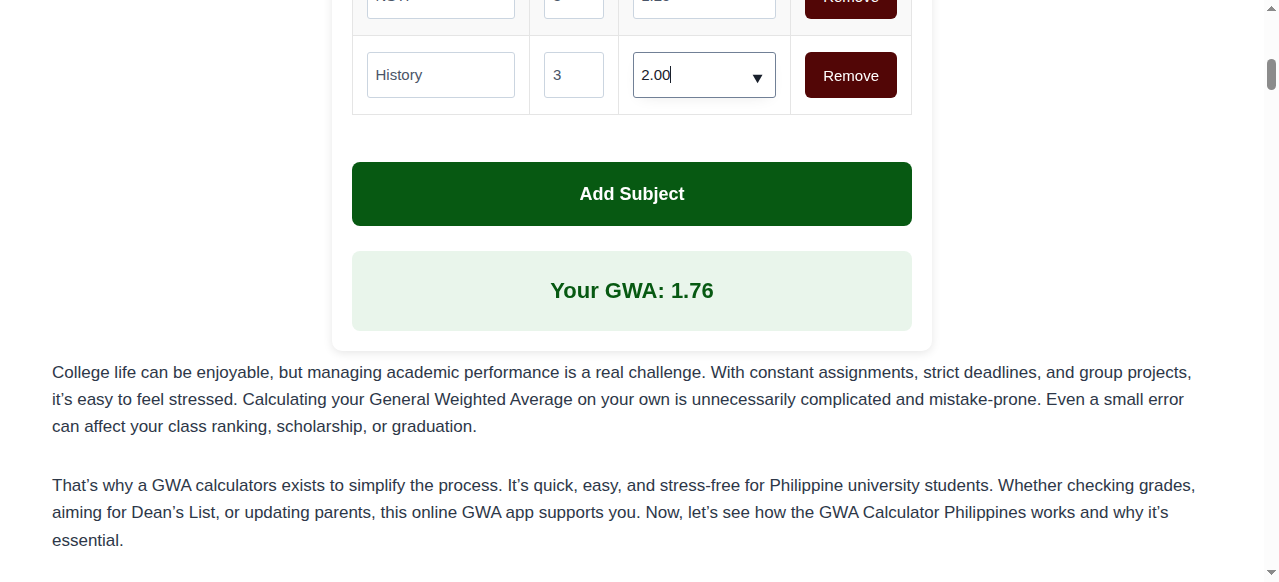
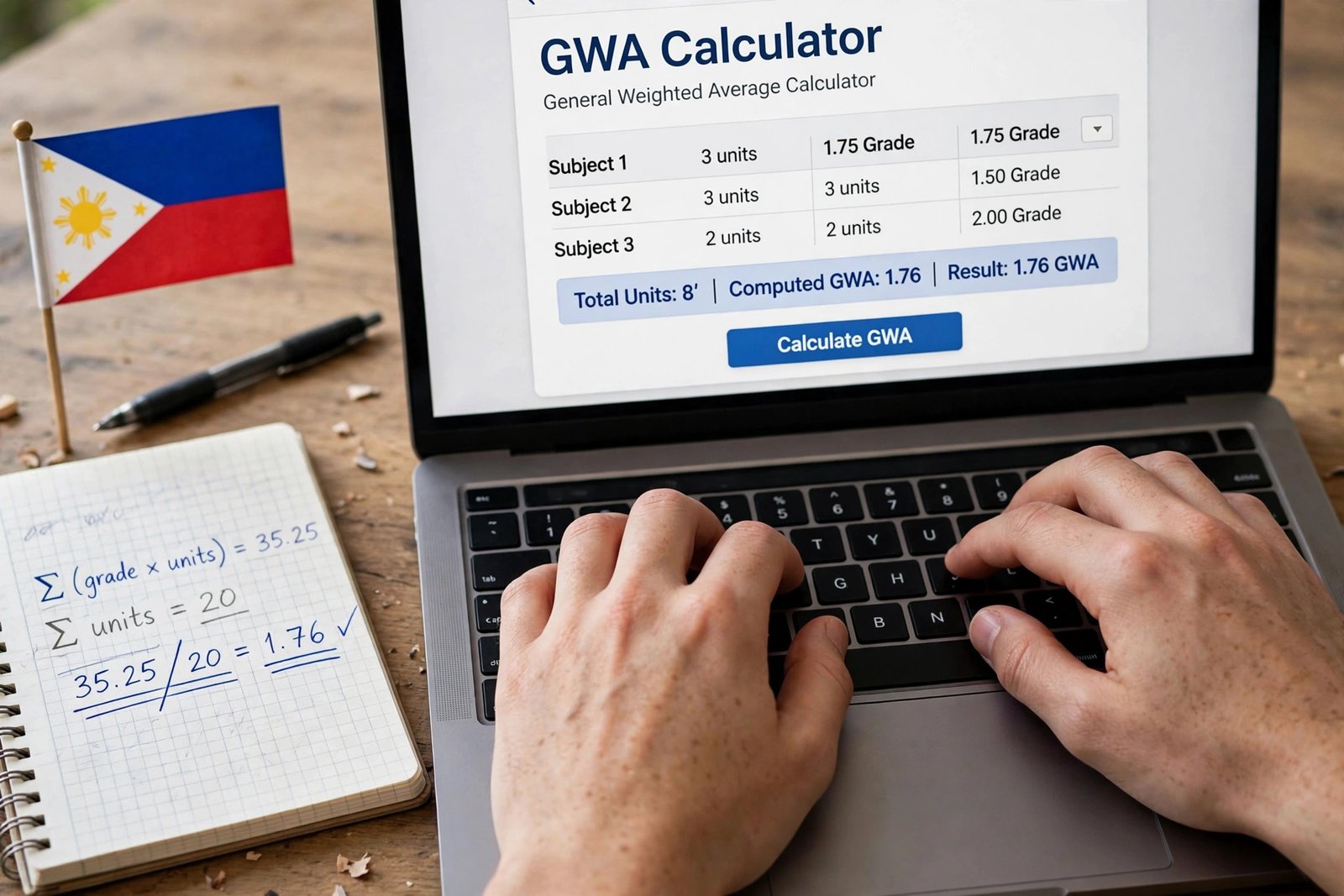
The check above is the one to copy for your own semester: add up every (grade × units), add up every unit, divide. If you use the calculator on this site, type each subject on its own row and read the live result — there is no separate Calculate button to press. And keep the unrounded figure in mind when you sit near a cutoff: 1.7625 prints as 1.76, but your registrar may keep more decimals, and near the 1.75 line the third decimal decides everything. The rounding section later in this guide shows a case where the calculator prints 1.74 for a hand-computed 1.745 — same rule, different direction, and worth knowing before you argue a cutoff with the registrar.
What One Failed Subject Does to an Athlete’s GWA
Ask any varsity player what they fear most and the answer is rarely a lost game. It is a 5.00 in a 3-unit major during the season — the subject they missed three weeks of while the team was on the road. Here is what that one failure does to Carlo’s semester, computed on the live calculator with every other grade unchanged:
| Scenario | Points ÷ Units | GWA | Change |
|---|---|---|---|
| Carlo’s clean semester | 35.25 ÷ 20 | 1.76 | — |
| Math failed (5.00 instead of 2.00) | 44.25 ÷ 20 | 2.21 | +0.45 worse |
| Math conditional (4.00 instead of 2.00) | 41.25 ÷ 20 | 2.06 | +0.30 worse |
| Math retaken at 1.50 (both attempts counted) | 39.75 ÷ 23 | 1.73 | Retake counted twice |
One failed 3-unit subject costs Carlo 0.45 of a GWA point — from 1.76 to 2.21 in a single semester. That is the difference between a cum laude track and a fight to keep the scholarship. And the 60% rule makes it worse than the GWA alone: on a 20-unit load, one failure still leaves him at 85% of units passed, so he stays eligible — but on a 12-unit load, two failures would end his season entirely.
A conditional grade (4.00) is the quieter version of the same problem. The calculator counts it at face value — 4.00, full weight — and Carlo’s semester prints 2.06. What happens next depends on the removal exam, and the swing is large. Take a verified example from a 17-unit term: one 3-unit subject at 4.00 gives a GWA of 2.12. Pass the removal exam and the 4.00 becomes 3.00 — the GWA improves to 1.94. Fail it, or let the removal lapse, and the 4.00 becomes 5.00 — the GWA falls to 2.29. Same subject, same term, a 0.35-point swing decided by one exam. For an athlete, that exam usually falls in the off-season, when there is finally time to take it. Do not let it lapse: a lapsed 4.00 is a 5.00, and it counts exactly like a failure.
Recovery after a failure is real, but it is slow, and any page that promises a one-semester fix is lying to you. The calculator proves it. Carlo’s failed-Math semester (2.21 over 20 units) followed by a full 20-unit semester at 1.50 only pulls the two-semester GWA to 1.86 — still outside the cum laude line. The same 1.50 semester after his clean 1.76 semester pulls the cumulative to 1.63, inside the line. The difference is the failed semester sitting in the average forever. The practical lesson is not “give up” — it is “plan in semesters, not weeks.” A failed subject needs two strong semesters to bury, not one, and the retake itself does not erase the failure on this calculator: both attempts enter the sum, so Carlo’s retaken Math at 1.50 alongside the original 2.00 gives 1.73, not the 1.50 a replacement model would give. Whether your school replaces the old grade or averages both attempts is a registrar question — ask before you enrol in the retake, because the answer changes your target by a tenth of a point or more. For the full mechanics of failed subjects, see our guide to how a failed subject affects your GWA.
Load Size Is an Eligibility Decision, Not Just a Study Decision
Every athlete faces the same choice before the season: carry a full load and risk drowning, or drop to the minimum and protect study time. The calculator shows the hidden cost of the light load — each grade weighs more, so the GWA swings further in both directions. Carlo’s exact grades over 15 units instead of 20 print 1.80 instead of 1.76. Same grades, worse number, because the lighter load removed the low-unit PE and NSTP grades that were pulling his average down. Drop to a light load and a single 2.25 in Science hurts more; raise your load and the same 2.25 is diluted.
Combine that with the 60% rule from the first section and the load decision becomes a risk calculation:
| Load | Failures you can survive (60% rule) | GWA swing per failed 3-unit subject |
|---|---|---|
| 12 units (4 subjects) | 1 failure — a 2nd failure = 50%, ineligible | Largest — every subject is 25% of the load |
| 15 units (5 subjects) | 2 failures — 3 passed of 5 = exactly 60% | Moderate |
| 18 units (6 subjects) | 2 failures — 4 passed of 6 = 67% | Smaller — each subject is ~17% of the load |
| 21 units (7 subjects) | 2 failures — 5 passed of 7 = 71% | Smallest — but the study hours are gone |
The sweet spot for most varsity players is 15–18 units in season: enough subjects that one bad week cannot end your eligibility, light enough that practice does not eat every study hour. The 12-unit minimum is a floor, not a plan — it is the load with the least room for anything to go wrong, which is exactly when things go wrong. Two other numbers matter here. First, UP’s Latin honors rules carry a load condition of at least 15 units per semester alongside the residence rules — a 12-unit season can cost you honors eligibility even if your grades are good, so check your own university’s honors handbook before dropping units in season. Second, never average two semesters’ GWAs to get your cumulative GWA. Carlo’s in-season 1.63 and off-season 1.76 average to 1.70 — wrong. The true cumulative weights by units: 54.75 points ÷ 32 units = 1.71. Athletes with uneven loads — a light 12-unit in-season term next to a 20-unit off-season term — are the most exposed to this mistake. The correct method is in our guide to computing cumulative GWA across semesters.
PE, NSTP and the Subjects Athletes Assume Count
Ask a varsity player which subject they are most confident about and the answer is usually PE. Ask whether PE counts in their GWA and the answer is usually a guess. At UP, PE carries a P (Passed) grade and NSTP is not graded numerically, so neither enters the GWA. At other schools PE carries a numeric grade and counts at full weight. The difference is not small: if Carlo’s school does not count PE at all, his GWA is not 1.76 but 1.79 (32.25 ÷ 18) — worse, because his PE grade of 1.50 was pulling the average down. The same logic applies in reverse: a 1.00 in PE at a school that counts it can lift a struggling semester by a visible margin. And a 6-unit practicum at 1.00 added to Carlo’s semester pulls 1.76 all the way to 1.59 — a 0.17 swing from a single subject. High-unit subjects at strong grades are the fastest lever on any athlete’s GWA; chasing the worst grade is usually the slower one. Removing Carlo’s worst subject, Science at 2.25, only moves 1.76 to 1.68 — and dropping a subject mid-semester is not a real option anyway.
The rule for your own transcript is simple: your handbook decides, not the calculator. The calculator on this site counts whatever rows you type. It cannot know that your school excludes PE, or that your NSTP is non-credit, or that your practicum carries six units. Before you compute your official GWA, confirm three things with the registrar: whether PE counts numerically, whether NSTP counts, and whether any subject on your transcript is graded P/F/S/U rather than 1.00–5.00. A DepEd-scale student has the same question in reverse: the DepEd grading system runs on percentages, and a high-school athlete’s 90.6 is not a 1.76 in another scale — the two numbers must never be quoted side by side without naming the scale.
The Calculator Quirks That Break an Athlete’s GWA
We ran 33 test cases against the live calculator’s own code, and four of the findings are things an athlete will hit in real life. All four are verified, and all four have the same fix: type it differently, or delete the row.
1. DRP and INC break the whole display. Type DRP in a dropped subject’s row or INC in an incomplete subject’s row and the calculator shows “invalid grade” across the entire result — even when that row has 0 units, even when the grade cell is left blank. The calculator has no remark grades at all; it only understands numbers and letter grades. The fix is to delete the row entirely. Do not zero its units. Do not type the remark. Delete it. This bug was first found in the 2026-11-22 testing and is still present today.
2. A pasted minus sign fails. The grade map accepts A-, B- and C- typed on a keyboard. But paste a grade from a Word document or a school PDF and the minus is often the typographic minus (U+2212), not the keyboard hyphen — and the calculator rejects it with “invalid grade”. If you paste grades and the result breaks, retype every minus sign by hand.
3. Percentages typed directly fail. Type 92 into a grade cell and the calculator rejects it: numeric grades are only accepted from 1.00 to 5.00. Convert your percentage first — our GWA to percentage converter handles the conversion — and then type the 1.00–5.00 figure.
4. Rounding near a cutoff can go either way. The calculator prints exactly two decimals, but the printed figure depends on how the numbers accumulate, not just on the final fraction. Carlo’s 1.7625 prints as 1.76. A 1.625 prints as 1.63. But a hand-computed 1.745 prints as 1.74, not 1.75 — the weighted sum accumulates in binary floating point, lands a hair below the tie, and rounds down. If your GWA sits within 0.01 of a cutoff — 1.75 for Dean’s List, 1.60 for PUP cum laude, 1.50 for STI cum laude — do not argue the printed two decimals with the registrar. Ask for the unrounded figure and the school’s own rounding rule. The printed number is a display; the registrar’s computation is the decision. Letter grades, by the way, follow a fixed map on this calculator: A+ = 1.00, A = 1.25, A- = 1.50, B+ = 1.75, B = 2.00, B- = 2.25, C+ = 2.50, C = 2.75, C- = 3.00, D = 3.50, F = 5.00. If your school’s letter table differs, type the numeric grades instead.
Honors Cutoffs for Athletes: The Lines That Matter
Carlo’s 1.76 misses the Dean’s List and cum laude lines by 0.01. That is not a rounding error and it is not bad luck — it is the distance between two different systems. Dean’s List at most Philippine colleges sits at 1.75, and exactly 1.75 qualifies. Latin honors cutoffs, meanwhile, differ by university, and the three that athletes ask about most are:
| University | Summa cum laude | Magna cum laude | Cum laude |
|---|---|---|---|
| UP | 1.20 | 1.45 | 1.75 |
| PUP | 1.0000–1.1500 | 1.1501–1.3500 | 1.3501–1.6000 |
| STI | 1.00–1.10 | 1.11–1.30 | 1.31–1.50 |
Read the conditions, not just the numbers. PUP’s cum laude line is 1.60, which is more generous than UP’s 1.75 — but PUP also requires no final grade lower than 2.50, no 5.00, and no INC, withdrawn or dropped subject anywhere on the record. One failed subject in a season can end a PUP honors run even if the GWA recovers. STI requires no grade lower than 2.25 and at least 75% of units taken at STI. UP requires 75% residence and two years of residence, plus the load condition mentioned earlier. The full cutoffs and conditions are in our guide to Latin honors GWA cutoffs in the Philippines, and the Dean’s List rules are in our Dean’s List GWA guide.

For Carlo, the honest picture is this: his 1.76 is outside every cum laude line above except PUP’s, where it qualifies on the number but would fail on any dropped or failed subject. His path back is the one the calculator verified — a clean 1.50 off-season semester pulls his cumulative to 1.63, inside UP’s cum laude line. That is two good semesters, not one, and it starts with protecting the next semester rather than mourning the last one. Athletes chasing a scholarship renewal rather than honors should read our GWA for scholarship guide alongside this one, and anyone whose grades slipped while working should compare notes with our GWA for working students guide — the time-management problem is the same, even if the cause is different.
Residency: The Three Cases Everyone Confuses
Transferring schools is the second most common athlete question after grades, and the most commonly misreported rule in the pages that rank for it. RA 10676, Section 4, sets three separate cases. A popular 2015 column garbles them into one sentence that attaches the one-year exception to the wrong case. Here are the three, separately, as the law states them:
Case 1 — High-school graduate enrolling in college: no residency at all. None. No exception.
Case 2 — High-school athlete transferring to another high school: no residency, except a maximum of one year that the athletic association may impose.
Case 3 — College athlete transferring to another college: a maximum of one year of residency.
Two protections in the same law matter as much as the residency itself. A school may not retaliate against a transferring athlete: no clawback of scholarship money, no withholding of grades, records or clearance, no administrative charge for transferring, and no incomplete grades in subjects the athlete was exempted from. And the transfer rules for individual schools can be stricter than the law’s maximum — Adamson, for example, requires transferees to have at least three years of playing eligibility left. If you are transferring, read the new school’s athletics policy before you sign anything; the law sets the ceiling, the school sets its own floor. The full transfer mechanics, including how a transferee’s GWA is computed at the new school, are in our transferee GWA guide.
Scholarships: What the Grant Covers and What Keeps It
RA 10676 lists what a scholarship may legally include: tuition and miscellaneous fees including books, full board and lodging, uniforms and equipment, a reasonable regular monthly living allowance standardised by the association, medical benefits, and other reasonable similar benefits. That is the legal ceiling for benefits. What a school actually offers varies by tier, and the oldest reporting on it — a 2015 feature on Davao varsity programs — shows the shape clearly, even though its figures are a decade old and should not be quoted as current: national-calibre athletes on full scholarships, regional-calibre athletes on 75% or 50%, with meal and transport allowances and free uniforms. The tiers still exist at most schools; the percentages and peso amounts have moved on.
What keeps the grant is, again, the school’s own rule. PATTS publishes it: 15 units minimum, 60% of units passed, try-out and screening by the official coach, health clearance, a signed undertaking, and cancellation for major or repeated disciplinary offences or varsity-team violations. Adamson publishes the structure but not the number: five playing years, plus up to two extra semesters to finish the course and keep the scholarship if the athlete is in good academic standing with no disciplinary action. Most schools sit between those two — a published structure, an unpublished number. Get the number from the athletics office in writing, and get it before the season, not after the grades come out. If you are weighing an athletic scholarship against an academic one, our scholarship GWA guide covers the academic side of the same decision.
High-School Athletes: A Different Scale, A Different Rule
Everything above is the college game. High-school athletes play under different rules, and the most common mistake is carrying a college number into a high-school conversation. The National Academy of Sports — the DepEd-attached sports high school at New Clark City — admits incoming Grade 7 and 8 learners with a general weighted average of at least 80%, with age caps of 14 and 15. That 80% is a percentage on the DepEd 0–100 scale, an admission floor, and the 2022 intake it was reported for has closed. It is not a maintaining grade and it is not a college rule.
The grading protection for competing high-school athletes is also different, and it is local rather than national. A DepEd division memo from Guihulngan City — read here only as an excerpt, and presented as one division’s rule rather than a national order — states that for the rating period in which a learner represents the school, division or region, the athlete receives a grade not lower than the previous grading period, provided they kept at least 85% attendance before and after preparation, practice and competition including travel, took the quarterly summative examination, and submitted the required projects in all subjects. If the computed grade is higher, the higher grade is recorded. And the same memo carries the stick: if the computed grade in any subject is failing, the athlete is disqualified from the next level of competition, and athletes with failing grades in more than two core subjects in the second grading period are barred from regional and national meets under the Palarong Pambansa screening rule. That is the high-school counterpart to the college 60% rule — same idea, different numbers, different paperwork. Confirm the memo in force in your own division before relying on it; divisions differ.
The one published study of Filipino student-athletes’ grades is also a high-school study, and it deserves a careful reading. Fifty-two Grade 7–12 athletes at one private school averaged a GWA of 90.6 on the percentage scale, with 69.2% rated Outstanding — and training frequency, intensity and duration showed no statistically significant relationship with that GWA. That is genuine evidence, but it is evidence about 52 teenagers at one school, not about college varsity players, and a non-significant result in a sample of 52 is weak evidence of no effect. The honest summary is: in this small sample, training load did not track with grades. It is not proof that training never hurts grades. What protects a high-school athlete’s grades is the same thing that protects a college athlete’s: a load that leaves study hours, a coach who treats the exam schedule as fixed, and a grade floor checked before the season rather than after it.
What Other Pages Get Wrong About Student-Athlete GWA
We read the ten pages that rank for gwa for student athletes philippines in full. Six errors and gaps kept recurring, and they are worth naming because you will meet them in search results:
1. The garbled residency rule. A 2015 SunStar column on the Student-Athletes Protection Act attaches the one-year residency exception to high-school graduates entering college. The law allows no residency at all in that case. The three cases are listed separately in the residency section above.
2. Stale UAAP limits. The most-read UAAP eligibility summary online still says players “can’t be more than 25 years old or play for more than five years.” That was the pre-2016 rule. From Season 79, the window became seven years to play five seasons. Any page dated before 2016, or never updated since, is quoting a rule that no longer exists.
3. “Grades must be retained or increased” presented as a rule. A 2019 advice article for teachers presents retained-or-increased grading for competing athletes as settled practice — then admits in the same page that no DepEd Order or memorandum gives specific guidelines on athlete grades. It is a local practice, not a rule, and the 2026 CHED memo now treats automatic passing grades as commercialization. Do not plan your semester around a promise no one is obliged to keep.
4. Inverted-scale wording. A live official scholarships page requires a “GWA of at least 3.0” for one grant and “not lower than 2.25” for another. On the 1.00–5.00 scale, “at least 3.0” literally means 3.00 or worse. The page plainly means 3.00 or better. Whenever you read “at least”, “higher” or “lower” about a GWA, translate it before trusting it: say “2.00 or better” and “no worse than 3.00”, and make the school confirm which direction they mean.
5. The myth of a national athlete GWA. No page we read could cite one, because there is not one. RA 10676 sets “good standing” only. The real numbers are CHED’s 60% rule and your school’s maintaining grade. Any page that states a national cutoff without a source is inventing it.
6. Scale confusion. Percentage GWAs (NAS 80%, the study’s 90.6) are quoted alongside 1.00–5.00 GWAs without labelling the scale. Always check which scale a number belongs to before comparing it with your own.
The gap underneath all six errors is the same: no competitor page gives a single worked GWA example for an athlete. This guide is the first to compute a varsity semester line by line, to show what one failure costs, and to pair the 2026 rule with the arithmetic. That is the page this keyword has been missing.
A Season Plan That Protects Your GWA
Put the rules together and a workable season plan falls out. It is not a study-tips list; every step below is tied to a rule or a number in this guide.
Before the season, get three things in writing. Your maintaining grade, from the athletics office. Whether PE and NSTP count in your GWA, from the registrar. And your school’s retake and removal-exam rules — whether a retaken subject replaces the old grade or sits beside it, and the deadline for a 4.00 removal exam. Carlo’s numbers show why each one matters: the maintaining grade decides your scholarship, PE changes his GWA from 1.76 to 1.79, and a retaken Math counts twice on the calculator at 1.73 rather than replacing the original grade.
Carry 15–18 units in season, not 12. The 12-unit minimum leaves you one bad subject from ineligibility under the 60% rule and makes every grade swing your GWA further. Fifteen to eighteen units gives you two failures of margin and dilutes any single bad grade. Check first that your honors track allows it — UP’s honors rules include a load condition — and confirm your load against the PUP grading system or your own school’s handbook if you study elsewhere, since grading tables differ by university.
Compute your GWA weekly, not at finals. Type your running grades into the calculator as they come in — the live result updates with every keystroke. If you are tracking toward a 1.75 line, watch the unrounded figure, not just the printed two decimals, and remember the rounding quirk: a hand-computed 1.745 can print as 1.74. If you are new to the formula itself, work through our guide to how to compute GWA in the Philippines once, with your own subjects, before the season starts.
Protect the removal exam and the retake. A 4.00 left to lapse becomes a 5.00, and the swing on one 3-unit subject is 0.35 of a GWA point. Book the removal exam in the off-season the moment the grade posts. If you fail a subject, enrol in the retake in the next available term — but ask first whether the old grade stays in the average, because that changes the target you are chasing.
Never type a remark into the calculator. DRP, INC and blank grade cells all break the display. Delete the row. Retype any minus sign you pasted from a document. Convert percentages before typing them. These are small habits, and they are the difference between a correct GWA and an “invalid grade” the night before the eligibility list is posted.
After the season, rebuild in two semesters. One failed subject needs two strong semesters to bury, not one. Carlo’s failed-Math semester plus a 1.50 semester only reaches 1.86; the second strong semester is what carries him inside the cum laude line. Plan the recovery the way you plan training — in blocks, with the numbers checked at each step. And if your grades slipped while you were carrying a job as well as a sport, the recovery math is the same, even if the schedule is harder; the worked examples in our guide to improving your GWA apply subject by subject.
Frequently Asked Questions
What is the gwa for student athletes philippines rule in 2026?
There is no single national GWA number for athletes. The 2026 rule is CHED Memorandum Order No. 13, Series of 2026: a student-athlete must carry at least 12 units per semester (9 per trimester, except graduating students), must have passed 60% of the courses from the previous semester, and must have official school confirmation of roster inclusion. Your scholarship’s maintaining grade is set separately by your school.
How do I compute my GWA as a student athlete?
Exactly like any other student: multiply each final subject grade by its units, add all the products, and divide by the total units. Carlo’s varsity semester is 35.25 grade points ÷ 20 units = GWA 1.76. Type your own subjects into the calculator on this site and check the result against the hand calculation — the two should match.
Does PE count in a student athlete’s GWA?
It depends on your school. At UP, PE carries a P grade and does not enter the GWA; at schools that grade PE numerically, it counts at full weight. For Carlo, excluding PE changes his GWA from 1.76 to 1.79. Ask your registrar before you compute your official figure.
Can one failed subject end my athletic eligibility?
One failure alone rarely does — on a 20-unit load it leaves you at 85% of units passed, above the 60% line — but it costs 0.45 of a GWA point (Carlo falls from 1.76 to 2.21) and it can end a Latin honors run at schools like PUP, which bar any 5.00 from honors consideration. Two failures on a 12-unit load drop you to 50% passed, below the 60% line, and that does end eligibility for the next semester.
What GWA do I need to keep my athletic scholarship?
There is no published national figure. PATTS requires its athletics scholars to pass at least 60% of units on a 15-unit minimum load; Adamson requires “good academic standing” without publishing a number; most schools keep the figure in the scholarship contract or handbook. Ask the athletics office and get it in writing before the season.
Does training hurt a student athlete’s grades?
The only published Philippine study — 52 Grade 7–12 athletes at one school, mean GWA 90.6 on the percentage scale — found no statistically significant relationship between training frequency, intensity or duration and grades. That is small-sample, high-school evidence, not proof for college varsity players. The load and eligibility rules in this guide matter more than any study: a 15–18 unit load, a checked GWA, and a protected removal exam do more for your grades than any training schedule.
Can I transfer schools and keep playing immediately?
It depends on where you are coming from. A high-school graduate enrolling in college has no residency at all. A high-school athlete moving to another high school faces at most one year, if the association imposes it. A college athlete moving to another college faces at most one year of residency. Your new school may also require a minimum number of playing years left — Adamson requires at least three. The school may not retaliate for the transfer: no clawback of scholarship money and no withholding of grades or clearance.
The Bottom Line
The gwa for student athletes philippines is computed with the same formula as every other student’s GWA — but it is judged by rules no other student faces. The 2026 CHED rule gives you a concrete bar: 12 units minimum, 60% of courses passed. The law gives you a floor: good standing, no national cutoff. Your school gives you the number that actually decides your scholarship, and it is usually the number nobody publishes. Carlo’s semester shows the arithmetic honestly: 1.76, one hundredth short of the honors line, one failed subject away from 2.21, and two good semesters away from 1.63. Compute your own semester the same way — line by line, on the live calculator, with the remarks deleted and the minus signs retyped — and check it against the 60% rule before the season starts, not after the grades come out. Your eligibility is a number you can control. Start with the calculation.
Sources: Republic Act No. 10676, Student-Athletes Protection Act of 2015 (Official Gazette, officialgazette.gov.ph); CHED Memorandum Order No. 13, Series of 2026, as reported by SPIN.ph, 28 July 2026 (spin.ph); Adamson University Athletics Policy; PATTS College of Aeronautics Institutional Student Services; National Academy of Sports admissions reporting (The POST, 2022); IJERIP study of 52 student-athletes (2025/2026). League sites: uaap.org and ncaaph.com. All GWA figures in this article were produced by running gwcalculator.com’s live calculator code in Node — 33 test cases, 33 passing — and are documented in the package TEST-RESULTS.md. Competitor errors corrected in this article are documented in competitor-analysis.md.
