
GWA for Pharmacy Students Philippines 2026
Rhea is a first-year BS Pharmacy student. Her week is split between two worlds: a pharmaceutical chemistry laboratory where a single misplaced decimal in a dilution can fail the whole practical, and general education lectures with two hundred students in a hall. When her first-semester grades came out, the portal showed seven numbers and one question nobody in the laboratory could answer for her: what is her gwa for pharmacy students philippines, and does the number that decides whether she keeps her slot, keeps her scholarship and eventually sits for the board exam work the same way for a student whose load is mostly heavy-unit major subjects?
This guide answers that question with numbers that were actually tested: every computation below was run against this site’s own calculator code before it was written down — 39 test cases, 39 passed. Rhea’s first semester comes out at 1.55, her second at 1.63, her year at 1.59, and one failed pharmaceutical calculations subject would have dragged her to 2.08. Those four numbers are the whole guide — plus one from a different scale: the Pharmacist Licensure Examination is passed at a 75% general weighted average, with no subject below 50% (Republic Act 10918).
GWA for Pharmacy Students Philippines: The Short Answer
Your gwa for pharmacy students philippines is the unit-weighted average of your final grades on the 1.00–5.00 scale: multiply each grade by its units, add the products, and divide by total units:
GWA = Σ (grade × units) ÷ Σ (units)
Seven gates decide where a BS Pharmacy student stands. One number per gate, all verified in this run:
| Gate | Number | What it decides | Rhea’s position |
|---|---|---|---|
| Dean’s List (semestral) | 1.75 or better | Dean’s List each term at most Philippine colleges | 1.55 — inside, by 0.20 |
| Cum Laude (graduation) | 1.75 or better | Cumulative GWA; no grade below 3.00 | Year 1.59 — inside |
| Magna Cum Laude | 1.45 or better | Cumulative GWA; no grade below 2.50 | 1.59 — outside, by 0.14 |
| Summa Cum Laude | 1.20 or better | Cumulative GWA; no grade below 2.00 | 1.59 — outside, by 0.39 |
| Retention planning line | 2.50 | Probation / retention review starts here at many schools | 1.55 — safely inside |
| Pharmacy scholarships | 2.50 / 80% | Mercury Drug Foundation bar; CHED MTP-SP 80% | 1.55 — comfortably inside |
| Pharmacist Licensure Exam | 75%, no subject below 50% | A percentage GWA, not 1.00–5.00 — RA 10918, Sec. 17 | School GWA does not set this bar |
Two warnings first. The 2.50 retention line is a planning line only: no pharmacy-specific published retention rule stating a single GWA number was verified in this run, so confirm your own school’s rule in its handbook. Second, the school GWA and the board-exam GWA are two different numbers on two different scales — 1.00–5.00 in school, percentages on the licensure exam, where 75% is the pass mark.
What Is GWA for a BS Pharmacy Student?
BS Pharmacy — Bachelor of Science in Pharmacy — is a four-year degree governed by CHED Memorandum Order No. 25, series of 2021, the programme’s policies, standards and guidelines. The curriculum totals 169 units, equivalent to 4,515 hours, and the final year is 1,200 hours of internship or supervised pharmacy practice experience required for the Pharmacist Licensure Examination. That shape is what makes the pharmacy GWA different. First, your units are not your hours: a 3-unit pharmaceutics subject can mean a lecture plus a long laboratory session each week. Second, your grades are practical as well as written: a dispensing laboratory is graded on technique, and one wrong dilution can mean a 5.00. Third, your load is lumpy: a single 6-unit pharmacy practice block at 1.00 moves your GWA more than any three ordinary subjects combined.
The scale itself is the standard Philippine one, and it runs backwards from the American GPA: 1.00 is the highest grade, 3.00 is the lowest passing grade, 5.00 is a failure, and 4.00 is a conditional grade. If your school uses letter grades for laboratory crits, the calculator accepts them directly — A+ 1.00, A 1.25, A- 1.50, B+ 1.75, B 2.00, B- 2.25, C+ 2.50, C 2.75, C- 3.00, D 3.50, F 5.00 — lowercase included. Percentages typed as grades, or remark grades like INC and DRP, break the whole display — see the quirks section.
Two kinds of GWA matter in pharmacy. The semestral GWA covers one term only: it decides the Dean’s List, scholarship retention for that term, and whether you are on probation. The cumulative GWA covers every subject since you enrolled, weighted by units: it decides Latin honors at graduation, and it is the number a transferee application or a scholarship panel usually asks for. Rhea’s numbers show both: her second semester (1.63) is worse than her first (1.55), yet her cumulative figure (1.59) is still inside the 1.75 line. The cumulative GWA is computed by adding all points and all units across semesters, never by averaging two printed GWAs. Not every subject on your Certificate of Registration enters the official average: PE / PATHFit and NSTP are the usual question marks — Rhea’s PE 1 is 2 of her 20 units, NSTP 3 units a term at many schools. Whether they count is your school’s decision: with PE counted Rhea is at 1.55; without PE, 1.58.
How to Compute Your GWA: Rhea’s Real BS Pharmacy Semester, Worked Line by Line
Rhea’s first semester is seven subjects and 20 units, worked exactly as the calculator on this site ran it — every line verified against the live calculator code before it was printed (test case B01, 39/39 passed):
| Subject | Units | Grade | Grade × Units |
|---|---|---|---|
| Pharmaceutical Calculations | 3 | 1.50 | 4.50 |
| Pharmacognosy (Pharmaceutical Botany) | 3 | 1.50 | 4.50 |
| Inorganic Pharmaceutical Chemistry | 3 | 2.00 | 6.00 |
| Human Anatomy and Physiology | 3 | 1.75 | 5.25 |
| Mathematics in the Modern World | 3 | 1.50 | 4.50 |
| Purposive Communication | 3 | 1.25 | 3.75 |
| PE 1 / PATHFit | 2 | 1.25 | 2.50 |
| Total | 20 | 31.00 |
GWA = 31.00 ÷ 20 = 1.55. That is the number Rhea quotes — 0.20 inside the 1.75 Dean’s List and cum laude line. Her worst grade is Inorganic Pharmaceutical Chemistry at 2.00, contributing 6.00 points — in a semester where every subject carries the same units, the worst grade is simply the biggest number. That changes as soon as the units stop being equal.
Her second semester is six subjects and 19 units: Pharmaceutics (3u @ 1.50), Pharmacology (4u @ 1.75), Medicinal Chemistry (3u @ 2.00), Pharmaceutical Analysis (3u @ 1.50), Filipino 1 (3u @ 1.75) and NSTP 2 (3u @ 1.25). The products are 4.50 + 7.00 + 6.00 + 4.50 + 5.25 + 3.75 = 31.00, and 31.00 ÷ 19 = 1.6316, displayed as 1.63. The same 31.00 points, over one fewer unit — so the GWA is worse by 0.08. Pharmacology, at 4 units, contributes 7.00 points — the biggest block in the semester.
Now the number most students get wrong: the year-end cumulative GWA. It is not the average of 1.55 and 1.63. It is the two semesters’ points and units added separately — (31.00 + 31.00) ÷ (20 + 19) = 62.00 ÷ 39 = 1.5897, displayed as 1.59. Averaging the two printed GWAs also gives 1.59 — a coincidence that teaches a wrong method. The full explanation is in our cumulative GWA guide: never average two GWAs; always add points and units.
The trap bites hardest next to a heavy practice term. Take Rhea’s first semester (20 units at 1.55) plus a 6-unit pharmacy practice term at 1.00. The true cumulative is (31.00 + 6.00) ÷ (20 + 6) = 37.00 ÷ 26 = 1.4231, displayed as 1.42 (test B29). Averaging the two printed GWAs gives (1.55 + 1.00) ÷ 2 = 1.275, which prints as 1.28 — wrong by 0.14, in the flattering direction: a student who believes 1.28 thinks she is nearly at summa.
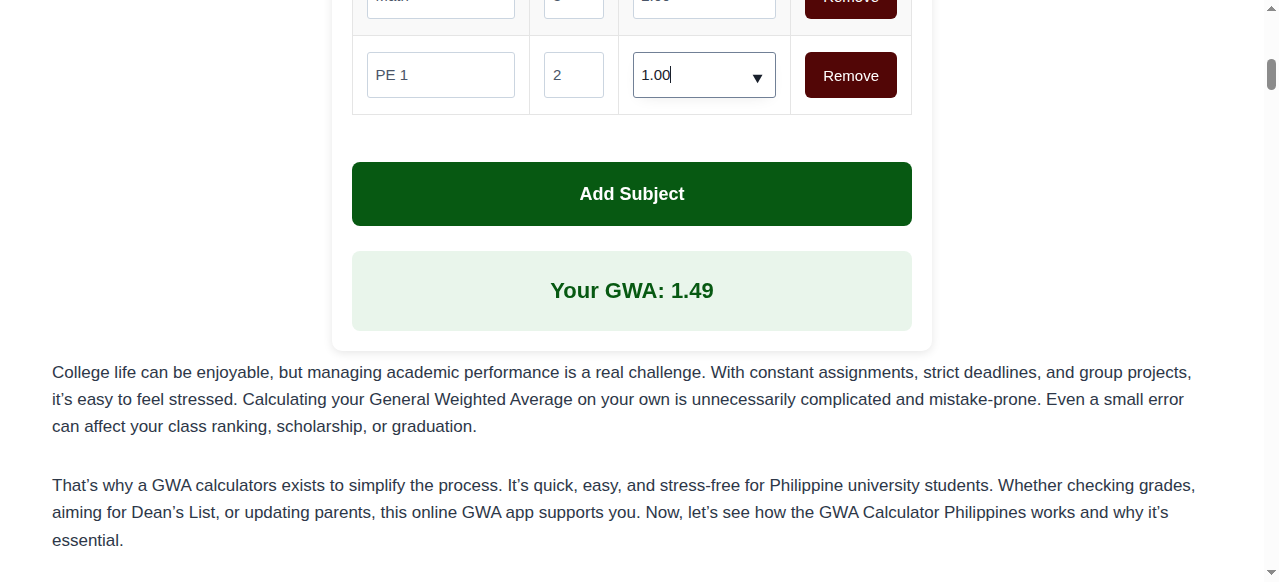
A second worked example, computed live: Pharmaceutical Chemistry 1 (3u @ 1.25), Pharmacology 1 (3u @ 1.50), Pharmaceutical Botany (3u @ 1.75), Dispensing and Compounding (3u @ 1.50), English 1 (3u @ 1.25), Math (3u @ 2.00) and PE 1 (2u @ 1.00). The products are 3.75 + 4.50 + 5.25 + 4.50 + 3.75 + 6.00 + 2.00 = 29.75, and 29.75 ÷ 20 = 1.4875, displayed as 1.49 (test case B39). Do not mix them up: the video and screenshot show 1.49 for this set; Rhea’s semester above is 1.55.
Two details in the video are worth noticing. First, the calculator recalculates live on every keystroke — there is no “Calculate” button to press. Second, the video’s final display of 1.49 matches the hand computation above to the last decimal. See our how to compute GWA guide.
Does PE and NSTP Count in a Pharmacy GWA?
It depends on your school. In Rhea’s first semester, PE 1 is 2 of her 20 units; in her second, NSTP 2 is 3 of her 19 — and a 3-unit NSTP at 1.25 moves the average more than most students expect. The calculator is neutral: a 0-unit row contributes nothing (test B25), and a row with units counts at face value. The decision is your school’s. Here are Rhea’s numbers both ways, verified live:
| What the school counts | Rhea’s GWA | What changes |
|---|---|---|
| Everything, including PE (the usual case) | 1.55 | 31.00 ÷ 20 |
| Everything except PE | 1.58 | 28.50 ÷ 18 — worse, because her PE 1.25 pulled the average down |
| PE entered as a 0-unit row | 1.55 | Nothing |
Notice the trap in the middle row: excluding PE makes Rhea’s GWA worse, from 1.55 to 1.58, because her PE grade (1.25) was better than her average. PE and NSTP grades are typically high — attendance- and performance-based — so excluding them removes your best grades. The DepEd grading system guide explains the same inclusion question for senior high school.
Fractional units are the other entry error: real curricula are full of lecture-plus-laboratory splits — a 1.5-unit pharmacognosy laboratory, for example — and the calculator handles them exactly as the formula says (test B26: 8.25 ÷ 4.5 = 1.83). Enter the unit value exactly as your Certificate of Registration prints it.
GWA to Percentage: The Transmutation Table (and Why Yours May Differ)
Sooner or later a form asks for your gwa for pharmacy students philippines as a percentage: a scholarship application, a job application, a transferee form. The conversion is called transmutation, and there is no single national table — every school publishes its own. The common mapping is below; use your own registrar’s table for anything official.
| GWA (1.00–5.00) | Common percentage equivalent | Usual descriptor |
|---|---|---|
| 1.00 | 97–100% | Excellent |
| 1.25 | 94–96% | Excellent |
| 1.50 | 91–93% | Very Good |
| 1.75 | 88–90% | Very Good |
| 2.00 | 85–87% | Good |
| 2.25 | 82–84% | Good |
| 2.50 | 79–81% | Satisfactory |
| 2.75 | 76–78% | Satisfactory |
| 3.00 | 75% | Passed |
Three warnings, all of which the competitor pages get wrong. First, “2.5 = 80%” is not universal. It is a common transmutation — the Mercury Drug Foundation states its bar as “2.5 or 80% GWA” — but some schools map 2.50 to 82–84%. A student who tells a panel “my 2.50 is 80%” at a school whose table says 83% is understating her own average. Second, “2.0 = 85%” is a school’s own mapping, not a national rule: the University of the Philippines Manila states it for its own transferee applicants (“2.0 or 85% or B or higher”), and it is citable as that school’s mapping, not a universal equivalence. Third, the descriptor bands vary too: the common table calls 1.00–1.25 Excellent, but the University of the Philippines calls 1.00–1.20 Excellent. The GWA to percentage converter on this site states its own table openly for the same reason.
BS Pharmacy Subjects That Move Your GWA Most
Not all subjects are equal in a pharmacy GWA, and the difference is units: a 4-unit pharmacology subject with a laboratory does not pull the average like a 3-unit general education subject, and a 6-unit pharmacy practice block pulls it more than both combined. The map below follows CHED CMO 25, s. 2021.
| Year | What you study | Why it moves the GWA |
|---|---|---|
| Year 1 — Foundations | Pharmaceutical calculations, pharmacognosy / botany, pharmaceutical chemistry, anatomy and physiology, pharmaceutical analysis, plus GE subjects | Calculations is the gatekeeper (test B04) |
| Year 2 — Core | Pharmaceutics, physical pharmacy, pharmacology, medicinal chemistry, pharmacognosy, microbiology | 4-unit pharmacology and pharmaceutics with laboratories outweigh every GE subject |
| Year 3 — Advanced | Pharmacotherapeutics, manufacturing and QA/QC, toxicology, hospital pharmacy, biopharmaceutics and pharmacokinetics | Manufacturing and QA/QC are the subjects most students underestimate |
| Year 4 — Experiential practice | Community, hospital, industrial, public health and regulatory, and institutional pharmacy — 1,200 hours of supervised practice | 6-unit practice blocks at 1.00 are the fastest lever in the whole degree: one pulls a 1.63 to 1.48 (test B32) |
Pharmaceutical Calculations is the single most dangerous subject in the degree: failing it (5.00 instead of 1.50) drags Rhea’s first semester from 1.55 to 2.08 (test B04) — more than half a GWA point from one 3-unit subject, and past the 2.00 line in one move. Calculations is the gatekeeper because everything downstream — dispensing, compounding, dosage regimens, pharmacokinetics — depends on it. At the other end, the 6-unit practice block is the single most powerful lever: add a 6-unit Pharmacy Practice subject at 1.00 to Rhea’s second semester and her GWA moves from 1.63 to 1.48 (test B32) — a 0.15 swing from one subject. Practice grades are usually high — graded on attendance, attitude and supervisor evaluation, not a written exam.
Between those extremes, the 4-unit majors do the steady work: Pharmacology at 4 units contributes 7.00 points to Rhea’s second semester — the biggest single block in it. Medicinal chemistry, pharmaceutics and pharmacognosy at 3–5 units each decide whether a semester lands at 1.55 or 1.85. Protect the heavy-unit majors first, then the 3-unit majors, then the GE subjects.
What GWA Do You Need at Each Stage?
Admission: there is no national college-GWA cutoff for entering BS Pharmacy. Schools look at your senior high school general average — a percentage, not a 1.00–5.00 college GWA — plus, at many schools, an interview or entrance examination. The one admission-stage gate with a published number is the CHED Merit Scholarship: Full Merit 96% or better, Half Merit 93–95% on your Grade 12 average. There is no published “1.75 CHED GWA” for incoming freshmen — any guide that prints one is inventing it.
Retention: 2.50 is the planning line, not a verified pharmacy rule. It is the figure most Philippine programmes use as the point where probation or retention review begins — but no published pharmacy retention rule found in this run states a single GWA number: the comparable published rule from another programme states retention as “no failing grades in all required courses” plus 75% attendance, with no GWA number at all. Treat 2.50 as the line to plan around and confirm your own school’s rule — and remember that a single 5.00 in a required subject can breach retention on its own.
Dean’s List: 1.75 or better in a semester, at most Philippine colleges. This is a semestral award, distinct from cumulative Latin honors at graduation. The typical conditions are a semestral GWA of 1.75 or better, a full regular load, and no failing grade. The boundary is exact: precisely 1.75 qualifies (test B07), while 1.76 misses by 0.01 (test B08). See our Dean’s List guide.
Latin honors: two conditions, not one. At graduation, the widely used convention is Summa Cum Laude at 1.00–1.20, Magna Cum Laude at 1.21–1.45 and Cum Laude at 1.46–1.75 — the University of the Philippines bands, verified from the Supreme Court decision in Morales v. UP Board of Regents, which quotes UP Code Article 410. But the GWA band is only half of the test: your cumulative GWA must fall inside the band, and no single subject grade may fall below a tier floor — commonly 2.00, 2.50 and 3.00 for summa, magna and cum laude. A 1.15 cumulative GWA with a 2.75 somewhere on the transcript is not summa. The floors are judged across the entire degree; the disqualifiers — any 5.00, unremoved 4.00, unresolved INC — apply on top.
CHED grants higher education institutions autonomy over their honors cutoffs — the 1.20 / 1.45 / 1.75 bands are the widely used convention, not a national rule. One claim seen in search results attributes the bands to “CHED CMO 46, s. 2012”; that claim was not verified and this guide does not repeat it. The variations are real: the Polytechnic University of the Philippines is stricter — Summa 1.0000–1.1500, Magna 1.1501–1.3500, Cum Laude 1.3501–1.6000, no final grade lower than 2.50, no 5.00, no INC, withdrawn or dropped subject — so exactly 1.60 is still inside Cum Laude (test B38), and 1.61 is out. STI is stricter still (Cum Laude 1.31–1.50, Magna 1.11–1.30, Summa 1.00–1.10). DLSU and Ateneo do not use the 1.00–5.00 scale at all: DLSU uses a 4.00 CGPA (Summa 3.80, Magna 3.60, Cum Laude 3.40) and Ateneo a Quality Point Index (3.87 / 3.70 / 3.50). See our Latin honours guide.
Shifting and transferring: the bars are published, and they are tight. The University of the Philippines Manila publishes its College of Pharmacy transferee rules for AY 2026–2027: only one shiftee and one transferee are accepted into BS Pharmacy; shiftees and first-category transferees need a GWA of 2.5 or better; second-category transferees need 2.0 or 85% or B or higher from 33 or more units, plus completed Chemistry and Biology, and qualified applicants face a Zoom interview and a Zoom Writing Test. That is the most competitive pharmacy transfer gate in the country. See our transferee guide.

GWA for Pharmacy Scholarships
Scholarships are where the two GWAs cause the most expensive confusion: if the gate is admission or a scholarship for incoming freshmen, the number is a percentage; after you enrol, it is a 1.00–5.00 GWA.
| Scholarship | Entry bar (reported) | Retention bar (reported) | Pharmacy note |
|---|---|---|---|
| Mercury Drug Foundation (MDFI) Pharmacy Scholarship | 2.5 or 80% GWA | Maintain the bar | Last two years of BS Pharmacy; partner school; single; 23 or below; no other scholarship |
| CHED Medical Technologists and Pharmacists Scholarship (MTP-SP) | 80% GWA or equivalent; no failed subjects | No failed subjects; income requirements apply | New admissions deferred for AY 2026–2027 — check future CHED announcements |
| OWWA EDSP | 85% GWA; no failing grades | Maintain the bar | OFW dependents; ODSP passing GWA, ELAP 80% |
| CHED Merit Scholarship (CMSP) — Full Merit | Grade 12 GWA 96% or better | 85% every semester | Percentage on senior high average |
| CHED Merit Scholarship (CMSP) — Half Merit | Grade 12 GWA 93–95% | 80% every semester | Up to ₱60,000 a year (full: up to ₱120,000) |
The pharmacy-specific scholarship is the Mercury Drug Foundation Inc. (MDFI) Pharmacy Scholarship, and it is the one most BS Pharmacy students should check first. The reported bar is a GWA of 2.5 or 80% or higher: last two years of BS Pharmacy, an MDFI partner school, single, 23 or below, and no other scholarship. Note what the bar really means: 2.5 is 80% on the common table, but your school’s table may say 82% or 83% — confirm the equivalence with the registrar before you apply. Rhea’s 1.55 is far inside the bar; the students who need to watch it sit at 2.40–2.60, where the transmutation table decides whether they qualify.
The government scholarship is the CHED Medical Technologists and Pharmacists Scholarship Program (MTP-SP), which supports students taking Medical Technology, Medical Laboratory Science or Pharmacy. The reported bar for higher-year students is at least an 80% GWA or equivalent, the previous term completed without failed subjects, and the programme’s income requirements. But the scholarship listicles bury one fact: acceptance of new MTP-SP scholars for AY 2026–2027 has been deferred — do not plan an application around MTP-SP until CHED reopens it. The CHED AHEAD Grant is the related programme worth knowing: it assists with Related Learning Experience courses — the OJT and practicum terms.
Two things to notice across the whole table. First, the average that qualifies you for a scholarship is not the average that keeps it: CHED Merit retention is 85% (full) or 80% (half) every semester, judged on your college work, and the MDFI and MTP-SP bars are judged term by term as well — a student who slips to 2.60 loses the funding. Second, confirm the figures in this table at ched.gov.ph and with the foundations themselves before you plan an application around them. The full scholarship picture is in our GWA for scholarship guide.
GWA and Your OJT / Internship
On-the-job training — the internship, or experiential pharmacy practice — is the biggest single lever on a pharmacy GWA, and the one most students underestimate, because they think of it as work, not as grades. Under CMO 25, s. 2021, the final year is 1,200 hours of supervised practice across five settings. A 6-unit practice block is a sixth of a 36-unit year in a single grade.
Here is what one heavy practice grade does to Rhea, verified live (test B32): add a 6-unit Pharmacy Practice / hospital immersion subject at 1.00 to her second semester and her GWA moves from 1.63 to 1.48 — 37.00 ÷ 25 = 1.48, a 0.15 swing from one subject. No other single subject in her load can do that. Practice grades are usually high — graded on attendance, attitude, supervisor evaluation and case presentations — which is why the practice year most often lifts a pharmacy student’s GWA. But a 6-unit practice block at 3.00 would drag her to 1.93, and a supervisor’s poor evaluation lands on 6 units at once.
Three practical rules follow. First, entry into OJT is by finished prerequisites, not by a GWA cutoff: you qualify by completing the required subjects, and no competitor page states a GWA bar for entering internship — because there is not one to state. Second, enter OJT units exactly as the COR prints them — 6 units, not 600 hours, not “one semester”. Third, a failed OJT delays graduation regardless of the GWA: the 1,200 hours are a licensure requirement under CMO 25, so a failed practice block must be repeated before you can sit for the board exam. The CHED AHEAD Grant exists for this stage — ask the scholarship office about it before the practice year starts.
GWA and the Pharmacist Licensure Exam (PhLE)
The governing law is Republic Act No. 10918, the Philippine Pharmacy Act of 2016. Section 17 states the passing rule verbatim: a candidate must obtain “a general weighted average of seventy-five percent (75%), with no rating lower than fifty percent (50%) in any of the subjects.” A candidate with a 76% average and a 48% in one subject fails — the whole examination, not just that subject. There is no “conditioned” status under RA 10918: one popular guide claims a candidate who scores 48% in Pharmacology with a 75% average “will be considered ‘conditioned’ and must retake the subjects where you failed to reach 50%”. That is false — the “conditioned” concept belonged to the repealed RA 5921. Under RA 10918, a rating below 50% in any subject fails the whole examination, and the candidate retakes the entire exam.
The six subjects and their weights, from the PRC’s April 2026 examination programme, are:
| PhLE subject | Weight | What it covers |
|---|---|---|
| Pharmaceutical Chemistry | 20% | Medicinal chemistry, pharmaceutical analysis, drug properties |
| Pharmacognosy and Biochemistry | 15% | Natural products, DOH medicinal plants, biosynthetic pathways |
| Practice of Pharmacy | 17.5% | Dispensing, compounding, clinical pharmacy, law and ethics |
| Pharmacology–Pharmacokinetics | 15% | Drug action, receptors, kinetics math |
| Pharmaceutics | 17.5% | Dosage forms, manufacturing, physical pharmacy |
| Quality Assurance / Quality Control | 15% | cGMP, quality systems, testing and validation |
The weights sum to 100% for one sitting’s programme — the April 2026 programme. Check the programme for your own sitting on the PRC website. Here is a worked weighted example — an illustration with invented ratings, since the PRC publishes no computation sheet: Pharmaceutical Chemistry 78, Pharmacognosy/Biochemistry 74, Practice of Pharmacy 80, Pharmacology–Pharmacokinetics 72, Pharmaceutics 76, QA/QC 78 — weighted, 15.60 + 11.10 + 14.00 + 10.80 + 13.30 + 11.70 = 76.50, a pass: every subject above 50%, the weighted average above 75%. Now the trap case: 48% in one subject and 85% elsewhere averages 77.60 — and still fails, because the 48% breaches the 50% floor. The average is not the test. The floor is the test.
Two more rules. First, the third-failure refresher rule: three failures means a refresher course before sitting again. Second, the schedule: the PRC holds the examination twice a year, and the 2026 sittings were April 18–19 and October 15–16. Two popular guides still print “usually in April and November” — November is the old pattern.
Does your school GWA predict whether you will pass? The best evidence is a 2016 study from San Pedro College (Gono, University of Mindanao International Multidisciplinary Research Journal, n = 225, 2013–2014): GWA was the strongest predictor of passing (32.5% influence), followed by Pharmacology–Pharmacokinetics (16.8%) and Pharmaceutical Chemistry (8.1%), while Pharmaceutics and QA/QC pulled the chance of passing down. Mean GWA was 86.11%, mean board rating 79.23. In the study’s simulation, a student with a GWA of 85 needed above 72 in all areas to pass — but that is a simulation from one small school’s 2013–14 data, not a PRC rule, and the study grounded its passing rule on the repealed RA 5921. The honest conclusion is narrower: a strong school GWA predicts a strong board result, and Pharmaceutics is the subject to protect — the lowest mock-board mean (74.24). There is no “85 GWA required to pass the board” — the requirement is 75% on the exam itself.
One small correction for the pharmacognosy student: the Philippine DOH-approved medicinal plant yerba buena is Mentha arvensis. One popular guide lists it as Clinopodium douglasii — the North American plant, not the Philippine one. It is a small error, but it is exactly the kind that costs a point on the Pharmacognosy paper, where the 10 DOH-approved plants are examined by scientific name under RA 8423.
How to Raise a Low Pharmacy GWA
First, compute the real number before you panic: most students who think they are in trouble are working from a wrong number — usually the semester-average trap, or PE/NSTP counted the wrong way.
Second, understand the scale of the repair. The verified numbers are unforgiving but honest: one failed 3-unit major subject costs 0.53 GWA in a 20-unit semester (1.55 to 2.08, test B04), and a full 18-unit semester at 1.50 afterwards only pulls the two-semester figure back to 1.80 (test B31) — still outside the 1.75 line. Recovery is real but slow, and it takes more than one good semester. The target-setting maths is simple: Rhea’s year is 62.00 points over 39 units (1.59). If she takes 21 units next semester and wants the cumulative to reach 1.50, she needs (62.00 + 21x) ÷ 60 = 1.50, so 21x = 28.00 and x = 1.33 — mostly 1.25s and 1.50s, no grade worse than 1.75.
Third, protect the subjects that carry the most weight: the heavy-unit majors first — pharmacology, pharmaceutics, medicinal chemistry, pharmacognosy — then the 3-unit majors, then the GE subjects, and the 6-unit practice block above all of them — a 1.00 there is worth more than a 1.00 in three 2-unit subjects combined (1.63 to 1.48, test B32). Pharmaceutics deserves special attention: the weakest mock-board area in the San Pedro College study, it hurts the GWA and the board result alike.
Fourth, if the slip is a single failed subject rather than a bad semester, talk to the registrar before you retake it. Some schools replace the grade, some average the two attempts, some count both — and the calculator counts both: retaking Inorganic Pharmaceutical Chemistry at 1.50 while the original 2.00 stays in the table gives 1.54 (test B30), barely different from the original 1.55. Whether your school replaces the grade or averages the two attempts is a registrar question. See our failed subject guide and our how to improve your GWA guide.
The Rounding Trap and the Calculator Quirks That Break a Pharmacy GWA
The first surprise is rounding, verified against the live code this run. The calculator prints exactly two decimals, and a GWA that looks like an exact .xx5 tie can print either way. Rhea’s headline is safe — 31.00 ÷ 20 = 1.55 exactly — but the boundary cases are not: 1.625 prints as 1.63, 1.925 as 1.93, 1.575 as 1.57, and 1.745 prints as 1.74, not 1.75 (test B14). A student on an exact 1.745 near the 1.75 line would be told by hand maths they qualify at 1.75, while the calculator prints 1.74. Near any cutoff — 1.75, 1.60, 1.50 — ask the registrar for the unrounded figure; the printed two decimals are not the whole story.
The second surprise is the grade entry itself: the calculator accepts numeric grades only from 1.00 to 5.00, and letter grades A+ through F. Everything else breaks the whole display — not just the one row. Verified live: typing DRP for a dropped subject shows “invalid grade” (test B18), even on a 0-unit row (test B20 — a bug found on 2026-11-22 and still present today). Typing INC for an incomplete practice subject does the same (test B19), as does a blank grade cell (test B21) or a percentage like 92 (test B22). And pasting a letter grade from a Word document or school PDF can do the same: the grade map holds the ASCII hyphen in “A-“, but a pasted letter grade whose minus sign is the typographic character (U+2212) instead of the keyboard hyphen is not in the map and returns “invalid grade” (test B24). The fix is the same in every case: delete the row entirely, fill or delete blank rows, and retype minus signs by hand. A 4.00 conditional grade is accepted at face value (test B27), and numeric and letter grades mix freely (test B37): 18.25 ÷ 11 = 1.66.
What Other Guides Get Wrong
The exact phrase gwa for pharmacy students philippines returns almost no page about computing a GWA for pharmacy students: the ten pages read in full contain no worked BS Pharmacy semester, no pharmacy subject units, and no unified guide between them. That gap is why this guide exists — and the pages that do rank contain errors worth naming.
1. The board-exam rule is still quoted from the repealed RA 5921. The 2016 San Pedro College journal paper grounds its passing rule on “Republic Act No. 5921, article 3 section 20” — 75% with “no rating of 50% in more than two subjects”. RA 5921 (1969) was repealed by RA 10918 (2016): the current rule is 75% GWA with no rating lower than 50% in any subject. A student who believes the old tolerance will sit for the exam thinking a 48% in one subject is survivable. It is not.
2. The invented “conditioned” status. A popular pharmacology guide claims a candidate who scores 48% in Pharmacology with a 75% average “will be considered ‘conditioned’ and must retake the subjects where you failed to reach 50%”. There is no “conditioned” status under RA 10918: below 50% in any subject, you fail the whole examination and retake the entire exam. The same page’s FAQ says the opposite, with no legal source given for the exception, because none exists.
3. “GWA threshold is 85” presented as a passing requirement. The same 2016 paper’s simulation concludes that “given that the student has GWA of 85, he needs to have a score of more than 72 in all areas for him to pass.” That is a simulation artefact from one small school (n = 225, 2013–14 data), not a PRC rule. The requirement is 75% on the exam itself.
4. The exam is “usually in April and November”. Both popular pharmacology and pharmacognosy guides print this. The PRC 2026 schedule is April 18–19 and October 15–16. November is the old pattern, and a student who plans around it misses the October sitting.
5. “2.5 = 80%” stated as universal. The scholarship listicles state the Mercury Drug bar as “2.5 or 80% GWA” as if the equivalence held everywhere. It is a common transmutation, not a universal one — some schools map 2.5 to 82–84%. The same warning applies to “2.0 = 85%”: it is UP Manila’s own stated mapping for its transferee applicants, not a national rule.
6. Pharmacognosy placed in the wrong exam area. One guide says pharmacognosy is “a major component of Area 1: Pharmaceutical Chemistry … or sometimes clustered in Area 3: Biological Sciences.” The current PhLE has six named subjects with published weights: Pharmaceutical Chemistry 20%, Pharmacognosy/Biochemistry 15%, Practice of Pharmacy 17.5%, Pharmacology–Pharmacokinetics 15%, Pharmaceutics 17.5%, QA/QC 15%.
8. Latin honors “standardised by CHED CMO 46”. A claim seen in search results attributes the 1.20 / 1.45 / 1.75 bands to CHED CMO 46, s. 2012. CHED grants higher education institutions autonomy over honors cutoffs; the bands are the widely used convention, not a national rule. This guide states the convention, names the variations, and does not repeat the CMO 46 claim.
9. MTP-SP presented as currently open. The government scholarship listicle lists the CHED Medical Technologists and Pharmacists Scholarship Program with its 80% bar and no warning — while flagging in its own text that “acceptance of new MTP-SP scholars for AY 2026–2027 has been deferred.” A student who applies this year on the strength of that listing is applying to a closed programme.
10. Generic descriptor bands and 0.25 steps presented as universal. A general grading guide labels 1.00–1.25 Excellent and 1.26–1.75 Very Good as the standard, and says grades “go up in steps of 0.25 to 3.00”. UP’s Excellent band is 1.00–1.20; Bicol University uses 0.1 steps; and “3.01–4.00 Conditional” is presented as a band when 4.00 is a single conditional grade, not a range.
The pattern across all ten pages is the same: the arithmetic is usually correct, but the claims around it — the repealed law, the invented status, the wrong dates, the closed scholarship presented as open — are where the errors live. That is why this guide tests its own numbers against the live calculator and quotes its sources.
Frequently Asked Questions
What is a good GWA for pharmacy students in the Philippines?
1.75 or better puts you on the Dean’s List each term and on the cum laude line at graduation; 1.55, like Rhea’s first semester, is strong. 2.00 is the usual “good standing” floor, and 2.50 is the retention planning line.
How do I compute my GWA as a BS Pharmacy student?
Multiply each final grade by its units, add the products, and divide by total units — that is your gwa for pharmacy students philippines. Rhea’s first semester: 31.00 points ÷ 20 units = 1.55. Use the free GWA calculator and enter units exactly as your Certificate of Registration prints them. Never average two printed GWAs.
Do PE and NSTP count in my pharmacy GWA?
It depends on your school. If they count, Rhea’s GWA is 1.55; if PE does not count, it is 1.58 — worse, because her PE 1.25 was pulling the average down. Ask the registrar’s office before computing a GWA for any official purpose.
What GWA do I need to pass the Pharmacist Licensure Exam?
A general weighted average of 75%, with no rating lower than 50% in any of the six subjects, under RA 10918, Sec. 17 — a percentage average on the exam, not your 1.00–5.00 school GWA.
Can I retake just one board subject if I fail it?
No. Under RA 10918 there is no “conditioned” status: a rating below 50% in any subject fails the whole examination, and you retake the entire exam. After three failures you must take a refresher course before sitting again.
What GWA do I need for a pharmacy scholarship?
The Mercury Drug Foundation Pharmacy Scholarship needs a 2.5 or 80% GWA, for last-two-years BS Pharmacy students at a partner school, single, 23 or below, with no other scholarship. The CHED MTP-SP needs 80% with no failed subjects — but new admissions are deferred for AY 2026–2027. OWWA EDSP needs 85% with no failing grades. CHED Merit is different again: 96% (full) or 93–95% (half) on your Grade 12 average.
Does a failed subject ruin my pharmacy GWA?
It costs a lot but it is not fatal: one failed 3-unit subject (5.00) in a 20-unit semester drags a 1.55 to 2.08. Recovery takes at least two strong semesters — a full 18-unit semester at 1.50 afterwards only pulls the two-semester figure back to 1.80, still outside the 1.75 line.
Why does the calculator say “invalid grade”?
Usually one of five things: a grade outside 1.00–5.00, a percentage typed as a grade, an INC or DRP typed into a grade cell, a blank grade cell, or a pasted letter grade whose minus sign is the typographic character (U+2212) instead of the keyboard hyphen. Delete INC/DRP rows entirely, fill or delete blank rows, and retype minus signs by hand.
Sources
Republic Act No. 10918, the Philippine Pharmacy Act of 2016, Sec. 17 (75% general weighted average, no rating lower than 50% in any subject); CHED Memorandum Order No. 25, s. 2021 (169 units, 4,515 hours, 1,200 internship hours); PRC April 2026 Pharmacist Licensure Examination programme (six subjects and weights; sittings April 18–19 and October 15–16, 2026); UP Manila, Admissions — Transferee, AY 2026–2027 (one shiftee, one transferee; 2.5 / 2.0 bars); Mercury Drug Foundation Inc. Pharmacy Scholarship and CHED MTP-SP eligibility pages (MDFI 2.5 / 80%; MTP-SP 80%, new admissions deferred AY 2026–2027); Gono, E. R. Jr. (2016), Univ. of Mindanao Intl. Mult. Res. Journal, 1(2), 132–139 (GWA as strongest predictor; RA 5921 framing corrected); UP Code Art. 410, as quoted in Morales v. UP Board of Regents, G.R. No. 161172 (Latin honors 1.20 / 1.45 / 1.75); PUP Student Handbook (PUP honors 1.1500 / 1.3500 / 1.6000). Calculator figures: 39 test cases run against the verbatim live calculator code of gwcalculator.com, 2026-11-26, 39 passed.
Rhea’s first year ends at 1.59 — inside every line that matters, with a second year that will test her pharmacology and pharmaceutics grades harder than the first. That is the normal shape of a pharmacy degree: the GWA is a number you can compute in an afternoon, the dispensing and clinical record is a body of work you build over years, and the licence belongs to the student who takes both seriously. Compute your own gwa for pharmacy students philippines on the free GWA calculator — type your subjects, units and grades, and read the number before the registrar does. The same calculator and the same rules apply whichever campus you are on.
