

GWA for Dentistry Students Philippines 2026
Angel is a first-year Doctor of Dental Medicine student. Her week is split between two worlds: a basic-sciences laboratory where a single misidentified tooth in a dental anatomy practical can cost her a whole subject, and general education lectures with two hundred students in a hall. When her first-semester grades came out, the portal showed seven numbers and one question nobody in the laboratory could answer for her: what is her gwa for dentistry students philippines, and does the number that decides whether she keeps her slot, keeps her scholarship and eventually sits for the board exam work the same way for a student whose load is mostly heavy-unit major subjects?
This guide answers that question with numbers that were actually tested: every computation below was run against this site’s own calculator code before it was written down — 39 test cases, 39 passed. Angel’s first semester comes out at 1.55, her second at 1.63, her year at 1.59, and one failed dental anatomy subject would have dragged her to 2.08. Those four numbers are the whole guide — plus one from a different scale: the Dentists Licensure Examination is passed at a 75% general weighted average, with no subject below 50% (Republic Act 9484).
GWA for Dentistry Students Philippines: The Short Answer
Your gwa for dentistry students philippines is the unit-weighted average of your final grades on the 1.00–5.00 scale: multiply each grade by its units, add the products, and divide by total units:
GWA = Σ (grade × units) ÷ Σ (units)
Seven gates decide where a dentistry student stands. One number per gate, all verified in this run:
| Gate | Number | What it decides | Angel’s position |
|---|---|---|---|
| Dean’s List (semestral) | 1.75 or better | Dean’s List each term at most Philippine colleges | 1.55 — inside, by 0.20 |
| Cum Laude (graduation) | 1.75 or better | Cumulative GWA; no grade below 3.00 | Year 1.59 — inside |
| Magna Cum Laude | 1.45 or better | Cumulative GWA; no grade below 2.50 | 1.59 — outside, by 0.14 |
| Summa Cum Laude | 1.20 or better | Cumulative GWA; no grade below 2.00 | 1.59 — outside, by 0.39 |
| UP College of Dentistry admission (degree holders) | 2.50 UP / 2.00 non-UP | Current UPCD page, updated 2023 — not the stale 1.75 | — |
| Retention planning line | 2.50 | Probation / retention review starts here at many schools | 1.55 — safely inside |
| Dentists Licensure Examination | 75%, no subject below 50% | A percentage GWA, not 1.00–5.00 — RA 9484, Sec. 16 | School GWA does not set this bar |
Two warnings first. The 2.50 retention line is a planning line only: no dentistry-specific published retention rule stating a single GWA number was verified in this run, so confirm your own school’s rule in its handbook. Second, the school GWA and the board-exam GWA are two different numbers on two different scales — 1.00–5.00 in school, percentages on the licensure exam, where 75% is the pass mark. And one correction before anything else: if you Google the UP College of Dentistry admission bar you will find two different numbers, 1.75 and 2.0, on UP’s own website. The 1.75 figure is from a 2009 page that was never updated; the current page, updated in July 2023, says 2.0 for non-UP degree holders and 2.5 for UP degree holders. Use 2.0. The stale page still ranks second for this exact keyword, which is why this guide states the correction up front.
What Is GWA for a Dentistry Student?
Doctor of Dental Medicine — DMD — is a six-year professional degree in the Philippines, governed by CHED Memorandum Order No. 3, series of 2018, the programme’s policies, standards and guidelines. The curriculum totals 281 units: 108 units of pre-dentistry and general education in the first two years, and 173 units of dentistry proper in the last four. That shape is what makes the dentistry GWA different. First, your units are not your hours: a 3-unit dental anatomy subject can mean a lecture plus long laboratory sessions with tooth models each week. Second, your grades are practical as well as written: a wax-carving or operative practical is graded on technique, and one bad practical can mean a 5.00. Third, your load is lumpy: a single 6-unit clinical dentistry block at 1.00 moves your GWA more than any three ordinary subjects combined. And fourth, dentistry is the only health course with a dexterity examination standing between you and admission — a gate no GWA can open on its own.
The scale itself is the standard Philippine one, and it runs backwards from the American GPA: 1.00 is the highest grade, 3.00 is the lowest passing grade, 5.00 is a failure, and 4.00 is a conditional grade. If your school uses letter grades for laboratory crits, the calculator accepts them directly — A+ 1.00, A 1.25, A- 1.50, B+ 1.75, B 2.00, B- 2.25, C+ 2.50, C 2.75, C- 3.00, D 3.50, F 5.00 — lowercase included. Percentages typed as grades, or remark grades like INC and DRP, break the whole display — see the quirks section.
One naming trap to clear up now: the University of the Philippines calls the degree Doctor of Dental Medicine (DDM); CHED, the PRC and every other school call it DMD. It is the same degree with two initials. This guide uses DMD throughout. And if a guide tells you that passing the board exam earns you the title “Registered Dentist (R.D.)”, close it — R.D. is the Registered Dietitian title under RA 10862. A board passer is a licensed dentist holding the DMD degree.
How to Compute Your GWA: Angel’s First Semester, Tested Live
Angel’s first semester is seven subjects over 20 units. Here is the full table, exactly as it was run through this site’s calculator code. If you have never worked one out by hand, our guide to computing your GWA walks through the same formula with a simpler example first:
| Subject | Units | Grade | Points |
|---|---|---|---|
| Human Anatomy | 3 | 1.50 | 4.50 |
| Dental Anatomy | 3 | 1.50 | 4.50 |
| Biochemistry | 3 | 2.00 | 6.00 |
| Oral Physiology | 3 | 1.75 | 5.25 |
| Mathematics in the Modern World | 3 | 1.50 | 4.50 |
| Purposive Communication | 3 | 1.25 | 3.75 |
| PE 1 / PATHFit | 2 | 1.25 | 2.50 |
| Total | 20 | 31.00 |
31.00 points ÷ 20 units = 1.55. The calculator displays 1.55. That is Angel’s first semester, verified live. Her second semester — Operative Dentistry 3 units at 1.50, Microbiology 4 units at 1.75, Pharmacology 3 units at 2.00, Prosthodontics 3 units at 1.50, Filipino 1 at 3 units at 1.75, NSTP 2 at 3 units at 1.25 — is 31.00 points over 19 units, which is 1.63. Her cumulative GWA for the year is not the average of 1.55 and 1.63. It is the weighted sum: (31.00 + 31.00) ÷ (20 + 19) = 62.00 ÷ 39 = 1.59. In this case the naive average of the two printed GWAs happens to agree at 1.59 — do not let that fool you. The trap bites when the unit loads differ, and dentistry loads differ constantly.
Here is the trap, tested. Put a 6-unit clinical term at 1.00 next to Angel’s 20-unit 1.55 semester. The true cumulative is 37.00 ÷ 26 = 1.42. Averaging the two printed GWAs gives (1.55 + 1.00) ÷ 2 = 1.275, which prints as 1.28 — wrong by 0.14. Dentistry students with a heavy clinical-practice term next to a lecture term are the most exposed to this mistake, because clinical blocks carry 6 to 10 units while lecture subjects carry 3. Never average two GWAs. Always go back to points and units. Our guide on cumulative GWA across semesters works the same calculation step by step.
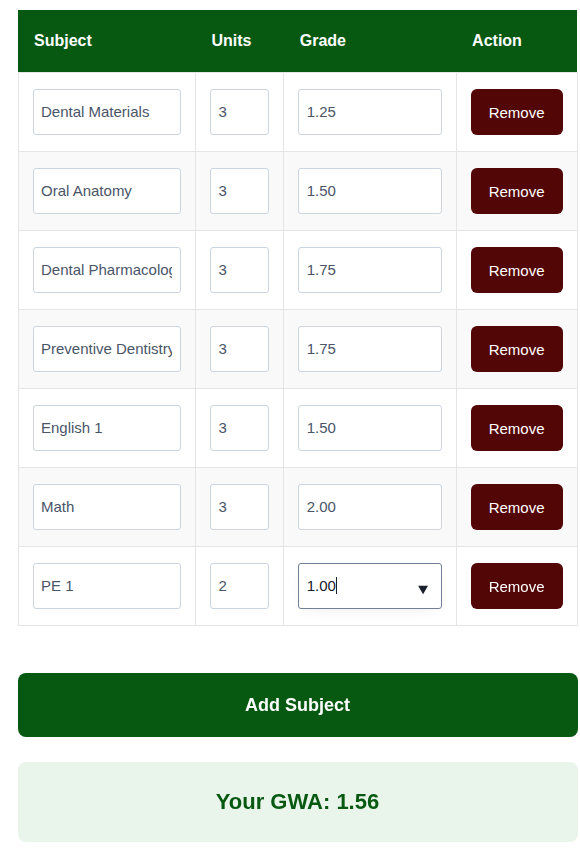
The video below shows a different worked example being typed into the same calculator — seven subjects, 20 units, a different subject list (Dental Materials, Oral Anatomy, Dental Pharmacology, Preventive Dentistry, English 1, Math, PE 1) coming out at 1.56. It is a separate example, verified separately; do not mix its 1.56 with Angel’s 1.55 above.
GWA to Percentage: The Transmutation Table (With a Warning)
Scholarship forms, board-exam papers and research studies quote GWA as a percentage, and students quote it back as a 1.00–5.00 number. The conversion is called transmutation, and the table below is the common one used by many Philippine state universities. It is common, not universal — your school’s table is the only one that counts for your records.
| GWA (1.00–5.00) | Percentage (common) | Meaning |
|---|---|---|
| 1.00 | 97–100% | Excellent |
| 1.25 | 94–96% | Excellent |
| 1.50 | 91–93% | Very Good |
| 1.75 | 88–90% | Very Good |
| 2.00 | 85–87% | Good |
| 2.25 | 82–84% | Good |
| 2.50 | 79–81% | Satisfactory |
| 2.75 | 76–78% | Satisfactory |
| 3.00 | 75% | Passing |
| 5.00 | Below 75% | Failed |
Two traps live in this table. First, the bands shift by school: some schools map 2.50 to 81–83% and others to 79–81%, so a student who copies “2.5 = 80%” onto a scholarship form at a school that maps it to 84% will be wrong. Check your own school’s transmutation table before writing a percentage anywhere official. Senior high school grades run on a percentage scale too — see how the DepEd grading system maps them, since the Grade 12 average is what scholarship and admission bars are set on. Second, research papers record GWA on the percentage scale, not the 1.00 scale — the Laguna dental-school study quoted later in this guide reports GWAs of 85–89%, which is roughly 1.75–2.00 on the 1.00 scale, not a grade of 85. If you need the conversion often, the GWA to percentage converter does it in one step, but it uses the common table — your registrar’s table still wins.
DMD Subjects That Move Your GWA Most
Not every subject pulls your GWA equally. A 5-unit subject at 2.00 costs you 10.00 points; a 2-unit subject at the same grade costs 4.00. In a 281-unit degree, the heavy subjects are where a dentistry GWA is won or lost. The CHED sample curriculum breaks the degree down as follows: pre-dentistry and general education, 108 units; dentistry proper, 173 units. The heaviest single subjects sit in the basic sciences — General Anatomy I and II at 5 units each, Biochemistry at 5, Inorganic and Organic Chemistry at 5, General Zoology at 5, Human Anatomy and Physiology at 5, Genetics at 5, Botany at 5. Those are the subjects that decide a first-year GWA, and they are also the subjects that decide whether you survive into dentistry proper, because anatomy and biochemistry are the two 15% subjects on the board exam as well.

The year-by-year shape, from the CHED sample curriculum, is roughly this: Year 1 and Year 2 are pre-dentistry — chemistry, zoology, botany, anatomy and physiology, genetics, mathematics, communication, Filipino, PE and NSTP, about 24 to 30 units a semester. Year 3 brings the basic medical and dental sciences — anatomy, biochemistry, oral anatomy, dental materials, microbiology, pharmacology. Year 4 is pre-clinical — restorative dentistry, prosthodontics (fixed, removable and complete dentures), anaesthesiology, orthodontics, roentgenology, oral surgery. Years 5 and 6 are clinical — Clinical Dentistry I at 6 units (18 clinic hours), II at 6 units, III at 10 units (30 clinic hours), IV at 10 units, plus Hospital Dentistry and Community Dentistry, research, and dental jurisprudence and ethics.
Three tested numbers show how the weights play out. First, the clinical lever: adding a 6-unit Clinical Dentistry Practice block at 1.00 to Angel’s second semester pulls her 1.63 down to 1.48 — a 0.15 swing from one subject. A heavy 1.00 clinical block is the fastest way to improve a dentistry GWA, and it is also the reason a bad clinical term hurts so much. Second, the failure cost: failing Dental Anatomy — one 3-unit subject at 5.00 instead of 1.50 — drags Angel’s 1.55 to 2.08, more than half a GWA point in one move, and past the 2.00 line. Dental anatomy is the gatekeeper subject of the degree: tooth morphology underpins operative dentistry and prosthodontics, so a bad exam day is the single biggest GWA risk in the programme. Third, the lab split: a 1.5-unit dental anatomy laboratory enters the weighted sum normally (8.25 ÷ 4.5 = 1.83 in our test), so enter the unit value exactly as your Certificate of Registration prints it, not the lab hours. Lecture and laboratory rows go in separately, and letter grades mix freely with numeric ones in the same semester — our test of a mixed semester came out at 18.25 ÷ 11 = 1.66.
What GWA Do You Need at Each Stage?
Dentistry is a degree of gates, and each gate has its own number. Here they are, school by school, from the pages that actually publish them.
Getting in — UP Manila College of Dentistry. The DMD is a straight six-year course and UPCD accepts at most 60 students a year, at most 2 of them international. Senior high graduates of any track must pass the UPCAT with at least 70% in the sciences. Baccalaureate degree holders need a GWA of 2.5 if the degree is from UP, 2.0 if it is from another school — the current figures, updated July 2023, on the UPCD admissions page. Shiftees from other UP colleges need a GWA of 2.5 and a CWA of 2.75 or better, at most four semesters attended at UP, a certificate of good moral character, and they must pass the dexterity examinations; accepted shiftees enrol as Year Level 1 and must finish all pre-clinical courses before Year Level 5, when clinical rotations begin. For admission into dentistry proper itself, the old published weighting was GWA 60%, interview 30%, dexterity examination 10%. And remember the trap: the 2009 UPCD page still live on the same site says non-UP degree holders need 1.75. That figure is stale. If a forum or a guide quotes 1.75, it is quoting a page from 2009.
Getting in — University of the East. UE’s College of Dentistry asks senior high graduates for a Grade 12 average of 85 or better, plus the UE-CET and the DMD Qualifying Examinations. For dentistry proper, a GWA of 2.50 or better over four semesters of pre-dentistry is considered; a GWA of 1.75 or better over the first three semesters of pre-dental at UE can exempt you from the College Entrance Test. Transferees need a GWA of 2.00 with no grade below 2.50, subject to the Academic Committee, and no more than two failing courses. Some listings still mention a CEADC — a Certificate of Eligibility for Admission to the Dental Course issued by CHED. Its currency in 2026 could not be confirmed in this run, so ask UE or CHED directly rather than assuming it still applies.
Staying in. The retention planning line used across this site’s testing is 2.50: a semester GWA at or worse than 2.50 is where probation or retention review starts at many schools. Our test printed exactly 2.50 at that line. But no dentistry-specific published retention rule stating a single GWA number was verified in this run, so treat 2.50 as a planning line and confirm your own school’s rule in its handbook. What is verifiable is the recovery math: after Angel’s failed-anatomy semester, a full 18-unit semester at 1.50 only pulls the two-semester figure back to 1.80 — still outside the 1.75 cum laude line. Recovery is real but slow, and no guide should promise a one-semester fix after a failure.
Dean’s List. The semestral award at most Philippine colleges sits at 1.75 or better in a semester, with no failing grade. It is a per-semester award, not a cumulative one — that distinction matters, because a student can make the Dean’s List every term and still miss Latin honors at graduation if one bad semester drags the cumulative figure, or the reverse. Angel’s 1.55 first semester is inside the Dean’s List line by 0.20. Our Dean’s List GWA guide covers the semestral rules school by school.
Latin honors. Graduation honors use a two-condition test, and both conditions must hold at the same time: your cumulative GWA must sit inside the tier range and no single subject grade may fall below the tier floor, across the whole degree. The widely used convention is Summa Cum Laude 1.00–1.20 with no grade below 2.00; Magna Cum Laude 1.21–1.45 with no grade below 2.50; Cum Laude 1.46–1.75 with no grade below 3.00. One worked example shows why the second condition matters: a student with a 1.18 cumulative GWA and a single 2.25 elective drops from Summa to Magna, because 2.25 is below the Summa floor of 2.00. The usual disqualifiers are any 5.00, an unremoved 4.00, an unresolved INC, a DRP, underloading, failing the residency requirement (commonly 75% of units at the awarding school), exceeding the prescribed duration, or a disciplinary record. UP is the strictest: a 5.00, an unremoved 4.00 or an unresolved INC disqualifies you from all honors, and UP’s bands are 1.20 / 1.45 / 1.75, verified from the UP Code as quoted in a Supreme Court decision. PUP is stricter still on the top end: Summa 1.0000–1.1500, Magna 1.1501–1.3500, Cum Laude 1.3501–1.6000 — see the PUP grading system for the full bands — and our test confirmed that exactly 1.60 is the last qualifying value for PUP cum laude. A dentistry student at a PUP-style school sitting at 1.60 is still inside; 1.61 is out. DLSU and Ateneo run on 4.0 scales (DLSU CGPA, Ateneo QPI), so their bands do not convert by simple arithmetic. And one myth to kill: CHED did not standardise these bands through CMO 46, s. 2012. That memorandum is about horizontal typology — the CHED curriculum document itself says so. CHED grants schools autonomy over honors cutoffs; the 1.20 / 1.45 / 1.75 bands are the widely used convention, not a national rule. Give honors bands in GWA only, never as percentages — one popular guide maps Summa to 97–100% while its own grade table puts 1.20 at about 96–97%. Our Latin honors GWA guide covers the two-condition test with more worked examples.
Shifting and transferring. The numbers above double as the shifting bars: UPCD shiftees need 2.5 GWA plus 2.75 CWA, UE transferees need 2.00 with no grade below 2.50. A retaken subject complicates the arithmetic either way: our test shows the calculator counts both attempts — retaking Biochemistry at 1.50 while the original 2.00 stays in the table gives 35.50 ÷ 23 = 1.54. Whether your school replaces the old grade or averages the two is a registrar question; the calculator has no replacement model, and neither does this guide. Our transferee GWA guide and failed-subject guide cover both situations in detail.
The Dexterity Exam: The Gate No GWA Can Open
Dentistry is the only health course in the Philippines that tests your hands before it tests your grades. UPCD requires every applicant to pass a dexterity examination, and the components are the same ones named on its admissions page: mirror-image drawings, a wire test for steadiness of hands, and wax carvings. The wire test asks you to bend wire into a shape without shaking; the wax carving asks you to reproduce a tooth form in wax, by hand, to a tolerance your eyes cannot quite see. These are not formalities. They exist because operative dentistry and prosthodontics are hand skills performed in a space the size of a molar, and a student with a 1.25 GWA and unsteady hands will struggle in the clinic in ways no grade can predict.
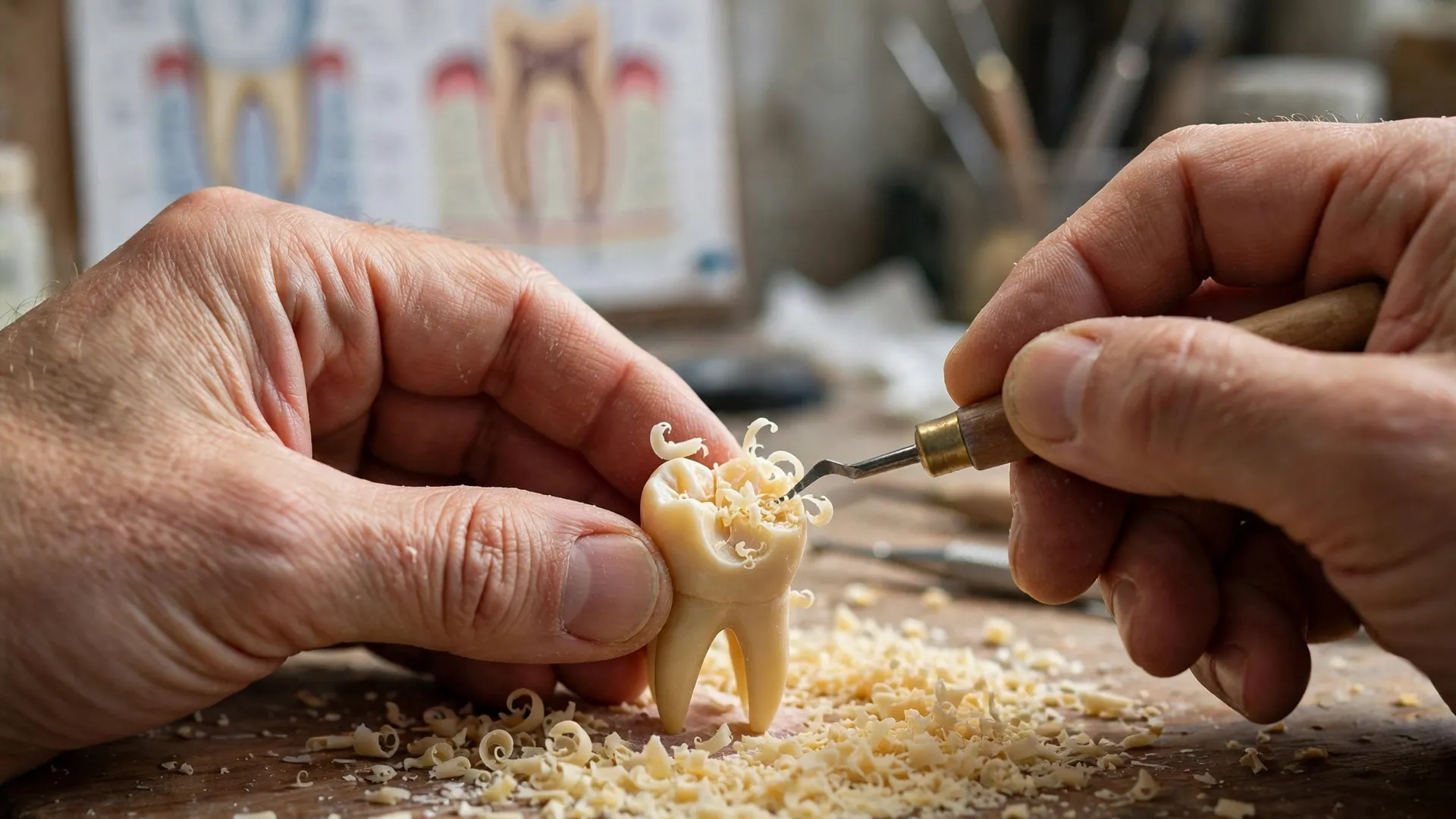
No competitor guide explains this exam or tells applicants how to prepare for it, which is exactly why it belongs in this guide. The honest preparation is practice, not reading: buy carving wax and a basic carving set, copy tooth forms from a dental anatomy atlas, draw with a mirror, and bend wire until your hands stop shaking. It is a pass-or-fail gate at UPCD, and it counts for 10% of the dentistry-proper admission grade in the old published weighting. A strong GWA gets you to the dexterity table; it does not get you past it.
GWA for Dentistry Scholarships
Scholarships in dentistry work the same way they work everywhere else in Philippine higher education: the entry bar is a Grade 12 percentage, and the retention bar is a semester percentage. The CHED Merit Scholarship Programme takes full-merit scholars at a Grade 12 GWA of 96% or better and half-merit scholars at 93–95% — percentages, not a 1.00–5.00 college GWA, so do not quote a “1.75 CHED GWA” for incoming freshmen; no such cutoff exists. Once enrolled, full-merit scholars must keep 85% every semester and half-merit scholars 80%. DOST-SEI undergraduate scholars must maintain a minimum GWA each semester to keep the grant — the general rule is verified, but no dentistry-specific DOST retention figure was found in this run, so confirm the number in your DOST-SEI contract. The Tertiary Education Subsidy is need-based and carries no GWA floor. One honest gap: no dentistry-specific private scholarship was found in the top ten pages read for this guide — no dental equivalent of the pharmacy scholarships that other programmes advertise. If a listicle promises one, ask for the foundation’s name and the application form before believing it. Our scholarship GWA guide covers the CHED and DOST rules in full.
GWA and Your Clinical Requirements
Here is the gate no GWA number covers at all: clinical requirements. In Years 5 and 6 you are graded on patients, not papers. Clinical Dentistry I and II carry 6 units each with 18 clinic hours; III and IV carry 10 units each with 30 clinic hours; Hospital Dentistry and Community Dentistry add their own blocks. Each university sets its own case quotas — a number of completed restorations, extractions, dentures and prophylaxis cases — and unfinished clinical requirements delay graduation regardless of your GWA. A student can hold a 1.50 cumulative GWA and still not graduate on time because three denture cases are incomplete. The GWA measures your grades; the clinical record measures your hands. Both have to be finished.
The clinical years also change the GWA arithmetic. A 10-unit Clinical Dentistry IV block at 1.00 is worth more than three ordinary subjects combined, which is why the clinical lever tested earlier — a 6-unit block at 1.00 pulling a 1.63 to 1.48 — is the single most powerful move in a dentistry GWA. It is also why a bad clinical term is the most dangerous: the same weight that lifts you can sink you. And the PE trap applies here too. If your school does not count PE at all, Angel’s first semester is not 1.55 but 1.58 (28.50 ÷ 18) — worse, because her PE grade of 1.25 was pulling the average down. NSTP is 3 units at several schools, so a 3-unit NSTP grade moves the number more than most students expect. Check the handbook before including or excluding anything.
GWA and the Dentists Licensure Examination (DLE)
Everything in this guide so far has been about the school GWA, on the 1.00–5.00 scale where lower is better. The board exam uses a different GWA entirely: a percentage average where 75% is the pass mark. Confusing the two is the most common mistake in dentistry GWA writing, and several of the pages that rank for this keyword make it. Here is the full rule, verified against the primary sources.
The passing rule (RA 9484, Sec. 16). To pass the Dentists Licensure Examination you need a general weighted average of at least 75%, with no rating below 50% in any subject. Both conditions must hold. The examination has two phases: a written (theoretical) phase worth 60% and a practical phase worth 40%, and you must pass the written phase first — at 75% with no grade below 50% — before you may sit the practical (Board Resolution No. 10, s. 2008). Every examinee takes a complete Board Licensure Examination for Dentists, both phases (Resolution No. 02, s. 2021).
The nine written subjects and their weights (PRC May 2026 programme; confirm the weights in the official programme for your sitting, as they are set per examination): General and Oral Anatomy and Physiology, 15%; General and Oral Pathology, Microscopic Anatomy and Embryology, Microbiology, 15%; and seven subjects at 10% each — Restorative Dentistry and Community Dentistry; Prosthodontics and Dental Materials; Roentgenology, Oral Diagnosis and Oral Surgery; Anesthesiology and Pharmacology; Pediatric Dentistry and Orthodontics; Dental Jurisprudence, Ethics and Practice Management; Periodontics and Endodontics.
Two worked examples show why both conditions matter. First, a passing case (illustrative numbers, honestly labelled as invented): ratings across the nine subjects weighting out to 76.30, with the lowest rating 70 — both conditions met, pass. Second, a failing case with a high average: 90 in eight subjects and 45 in one 10% subject gives a weighted average of 85.5% — comfortably above 75% — and still a fail, because 45 is below the 50% floor. A single weak subject fails the whole examination even when the average is excellent. There is no “conditioned” status in dentistry: fail one subject and you retake the examination.
The forfeiture rule — the fact the other guides could not verify. One popular DLE guide admits it could not verify how long a passed written phase can wait before the practical is taken. The answer is in PRC Resolution No. 02, s. 2021: failure to take the practical phase within two consecutive practical phase-schedules cancels and forfeits the passed written phase, and you must take a new theoretical phase (force majeure excepted, rescheduled by the Board). Pass the written phase in November and skip the next two practical sittings, and your written pass is gone.
Three failures, one refresher. After three complete consecutive failures you must complete a one-year refresher course before sitting again (Resolution No. 03, s. 2009; RA 9484 Sec. 14). A refresher is a formal course, not a review centre. No cap on total retakes is stated in the sources checked.
Dates and passing rates. The November–December 2026 cycle ran the written phase on November 22, 23 and 24, 2026 (NCR, Baguio, Cebu and Davao), the practical phase from November 28 to December 5, 2026 (NCR only), with results targeted for December 14, 2026. Recent national passing rates: May 2026, 88.84% (796 of 896); November 2025, 86.97% (1,282 of 1,474); May 2025, 78.84% (764 of 969); November–December 2024, 67.83% (873 of 1,287). One warning about those rates: the Board itself complained that several dental schools post only their practical-phase performance and present it as their overall rate. In December 2017, 51.35% passed the written phase while 99.22% of those passed the practical — a school that quotes the practical figure as its passing rate is inflating its record by nearly half. The Board now releases Performance of Schools twice, once after each phase. Quote the PRC’s two releases, not a school’s poster.
Does your school GWA predict your board result? The only empirical study in the top ten says yes — with a caveat you must carry. Flores (2024) studied 49 alumni of a Laguna dental school who graduated between 2014 and 2018 and passed the DLE on their first attempt. GWA correlated with DLE performance at r = 0.531, p = 0.000 — the strongest relationship in the study — and GWA correlated with pre-board comprehensive results at r = 0.349, p = 0.014. But the pre-board comprehensive examination itself did not predict the board result: r = −0.037, p = 0.798. And the caveat: the sample is only first-attempt passers. No failers are in the data at all, so the correlations describe variation among passers, not what separates passers from failers. A strong GWA predicts a strong board result among students who pass; it does not guarantee passing. The same study notes the school’s own DLE passing rate fell from 52.63% in 2016 to 37.84% in 2017 — a reminder that a school’s GWA culture and its board culture are two different things. Note also that the study records GWA on the 75–100 percentage scale: its “85–89 GWA” band is roughly 1.75–2.00 on the 1.00 scale.
How to Raise a Low Dentistry GWA
If your GWA is sitting where you do not want it, the arithmetic points to the levers in order of power. First, target the heavy units: a 5-unit anatomy or biochemistry subject at 1.00 is worth more than any three 2-unit subjects, and a 6- or 10-unit clinical block at 1.00 is worth more than a whole semester of GE subjects. Our test proved it — one 6-unit clinical block at 1.00 moved a 1.63 to 1.48. Second, protect the gatekeeper subjects: dental anatomy, anatomy and biochemistry are the 5-unit subjects and the two 15% board subjects. A 5.00 in any one of them costs half a GWA point in a single semester. Third, set the target with arithmetic, not hope: if you have 39 units banked at 1.59 and 20 units left in the year, the average those 20 units must hit to finish at 1.50 is (1.50 × 59 − 62.00) ÷ 20 = 1.33. If that average is below what you can realistically earn, adjust the target. Fourth, fix the process, not the grade: dentistry grades are practical grades. Wax-carving practice, tooth-identification drills and clinic hours move the subjects that move the GWA. Fifth, check the rules before you retake: a retaken subject counts twice in the calculator, and whether your school replaces or averages the two grades decides whether the retake helps at all. Our guide to improving your GWA works the target-setting math for any starting number.
Calculator Quirks Dentistry Students Should Know
Thirty-nine test cases were run against this site’s live calculator code, and the quirks below are all verified, not guessed. First, rounding ties can print either way: a GWA that looks like an exact .xx5 tie can land on either side depending on how the numbers accumulate. One tested case, 34.90 ÷ 20 = 1.745, prints as 1.74, not 1.75, because the accumulated sum lands a hair below the tie in binary floating point. Near a cutoff — 1.75, 1.60, 1.50 — check the unrounded figure with your registrar; the printed two decimals are not the whole story. Second, INC and DRP break the display: typing either remark into a grade cell shows “invalid grade” across the whole calculator, even on a row with 0 units, and a blank grade cell does the same. Delete the row entirely instead of zeroing its units or typing the remark. Third, pasted letter grades can fail: the grade map holds the ASCII hyphen, so A- typed on a keyboard works, but A− with the typographic minus (U+2212), as copied from a Word document or a school PDF, gives “invalid grade”. Retype the minus sign by hand. Fourth, percentages are not grades: typing 92 into a grade cell is out of range and returns “invalid grade” — convert first. Fifth, a 4.00 conditional is accepted at face value: the calculator counts it as an ordinary 4.00 and does not know it is conditional. Sixth, fractional units work: a 1.5-unit laboratory enters the weighted sum normally. And seventh, the calculator recalculates live on every keystroke — there is no separate “Calculate” click, whatever the page copy says.
What Other Guides Get Wrong
Ten errors and omissions were found across the pages read for this guide. They are listed here so you can recognise them when you meet them elsewhere.
1. The UPCD 1.75 cutoff. UP’s own 2009 admissions page says non-UP degree holders need a GWA of 1.75. The current page, updated July 2023, says 2.0. The stale page still ranks second for this exact keyword. Use 2.5 UP / 2.0 non-UP.
2. The repealed law. The same 2009 page cites Republic Act No. 4419, the Philippine Dental Act of 1965, as the governing law. RA 4419 was repealed by RA 9484, the Philippine Dental Act of 2007. Any guide still citing RA 4419 as current is nineteen years out of date.
3. The “Registered Dentist (R.D.)” title. A broad dentistry pillar guide says board passers are granted the title Registered Dentist (R.D.). There is no such title. R.D. is Registered Dietitian under RA 10862. DLE passers are licensed dentists holding the DMD degree.
4. The incomplete board-exam rule. The best DLE logistics guide states the 75% average and the 50% floor but never mentions the 60/40 written–practical split, the must-pass-written-first gate, or the two-schedule forfeiture rule. A reader of that page alone would not know the written phase is a gate, not just a part.
5. The unverified waiting limit. A DLE guide admits it could not verify how long a passed written phase can wait before the practical. The limit is verifiable: two consecutive practical phase-schedules (PRC Resolution No. 02, s. 2021). This guide states what that guide could not.
6. The CMO 46 myth. A claim seen in search results attributes the Latin honors bands to CHED CMO 46, s. 2012. That memorandum is about horizontal typology — the CHED curriculum document itself says so. CHED grants schools autonomy over honors cutoffs; the 1.20 / 1.45 / 1.75 bands are the widely used convention, not a national rule.
7. “2.5 = 80%” stated as universal. Scholarship listicles and grade tables present one transmutation as standard. It is a common mapping, not a universal one — some schools map 2.50 to 82–84%. Always check your school’s table.
8. Latin honors given as percentages. One popular guide maps Summa Cum Laude to 97–100% while its own grade table puts 1.20 at about 96–97%. Give honors bands in GWA only.
9. DDM and DMD presented without comment. UPCD writes DDM; CHED and the PRC write DMD. They are the same degree. Guides that do not say so leave readers wondering whether they are two different programmes.
10. School-published passing rates quoted as overall rates. The Board’s own resolution documents schools posting practical-phase-only performance as their overall rate — December 2017: 51.35% passed the written phase, 99.22% of those passed the practical. Quote the PRC’s two-release Performance of Schools, not a school’s poster.
The pattern across all twelve pages is the same: the arithmetic is usually correct, but the claims around it — the repealed law, the stale cutoff, the invented title, the missing forfeiture rule — are where the errors live. That is why this guide tests its own numbers against the live calculator and quotes its sources.
Frequently Asked Questions
What is a good GWA for dentistry students in the Philippines?
1.75 or better puts you on the Dean’s List each term and on the cum laude line at graduation; 1.55, like Angel’s first semester, is strong. 2.00 is the usual “good standing” floor, and 2.50 is the retention planning line.
How do I compute my GWA as a dentistry student?
Multiply each final grade by its units, add the products, and divide by total units — that is your gwa for dentistry students philippines. Angel’s first semester: 31.00 points ÷ 20 units = 1.55. Use the free GWA calculator and enter units exactly as your Certificate of Registration prints them. Never average two printed GWAs.
Do I need a GWA of 1.75 or 2.0 for UP College of Dentistry?
2.0, if your bachelor’s degree is from a non-UP school; 2.5 if it is from UP. The 1.75 figure comes from a 2009 UPCD page that was never updated. The current page, updated July 2023, says 2.5 UP / 2.0 non-UP — and you must also pass the dexterity examination.
Is DDM different from DMD?
No. They are the same degree: Doctor of Dental Medicine. UPCD writes DDM; CHED and the PRC write DMD. This guide uses DMD throughout.
Do PE and NSTP count in my dentistry GWA?
It depends on your school. If they count, Angel’s GWA is 1.55; if PE does not count, it is 1.58 — worse, because her PE 1.25 was pulling the average down. Ask the registrar’s office before computing a GWA for any official purpose.
What GWA do I need to pass the Dentists Licensure Examination?
A general weighted average of 75%, with no rating lower than 50% in any subject, under RA 9484, Sec. 16 — a percentage average on the exam, not your 1.00–5.00 school GWA. The written phase is 60% and the practical 40%, and you must pass the written phase first.
Can I retake just the practical if I fail it?
No — and the timing matters. Every examinee takes a complete Board Licensure Examination for Dentists, both phases. If you pass the written phase but do not take the practical within two consecutive practical phase-schedules, the written pass is forfeited and you take a new theoretical phase (PRC Resolution No. 02, s. 2021). After three complete consecutive failures you must complete a one-year refresher course before sitting again.
Does a high GWA guarantee passing the DLE?
No. In the only study that measured it, school GWA predicted board performance among first-attempt passers (r = 0.531, p = 0.000) — but the sample contained no failers at all, so it cannot say what separates passers from failers. A strong GWA is the best predictor available, not a guarantee.
Do dentists get the title R.D.?
No. R.D. is Registered Dietitian, under RA 10862. A Dentists Licensure Examination passer is a licensed dentist holding the Doctor of Dental Medicine degree.
Does a failed subject ruin my dentistry GWA?
It costs a lot but it is not fatal: one failed 3-unit subject (5.00) in a 20-unit semester drags a 1.55 to 2.08. Recovery takes at least two strong semesters — a full 18-unit semester at 1.50 afterwards only pulls the two-semester figure back to 1.80, still outside the 1.75 line.
Why does the calculator say “invalid grade”?
Usually one of five things: a grade outside 1.00–5.00, a percentage typed as a grade, an INC or DRP typed into a grade cell, a blank grade cell, or a pasted letter grade whose minus sign is the typographic character (U+2212) instead of the keyboard hyphen. Delete INC/DRP rows entirely, fill or delete blank rows, and retype minus signs by hand.
Sources
Republic Act No. 9484, the Philippine Dental Act of 2007, Sec. 14 and Sec. 16 (75% general weighted average, no rating below 50% in any subject; refresher after three consecutive failures); PRC Professional Regulatory Board of Dentistry Resolution No. 02, s. 2021 (complete BLED, 60/40 split, two-schedule forfeiture rule, twice-released Performance of Schools); Board Resolution No. 10, s. 2008 (written 60% / practical 40%, written-first gate); Board Resolution No. 03, s. 2009 (one-year refresher course); CHED Memorandum Order No. 3, s. 2018 (current DMD policies, standards and guidelines); CHED Sample Outcomes-Based Curriculum for the Doctor of Dental Medicine (281 units: 108 pre-dental + 173 dental proper; clinical dentistry 6/6/10/10 units); University of the Philippines Manila College of Dentistry, Applicants page, updated 2023-07-12 (2.5 UP / 2.0 non-UP; dexterity examinations; maximum 60 students per year) and its 2009 ADMISSIONS page (stale 1.75 figure; RA 4419 citation corrected); University of the East Manila admissions requirements via Edukasyon.ph (Grade 12 average 85; pre-dental GWA 2.50 over four semesters; 1.75 CET exemption; transferee GWA 2.00); PRC 2026 schedule of licensure examinations, Resolution No. 2113, s. 2025 (written November 22–24, practical November 28 – December 5, results target December 14, 2026); Flores, K. J. T. (2024), 11th International Scholars Conference (GWA–DLE r = 0.531, p = 0.000; pre-board–DLE r = −0.037, p = 0.798; n = 49 first-attempt passers); UP Code Art. 410, as quoted in Morales v. UP Board of Regents, G.R. No. 161172 (Latin honors 1.20 / 1.45 / 1.75); PUP Student Handbook (PUP honors 1.1500 / 1.3500 / 1.6000). Calculator figures: 39 test cases run against the verbatim live calculator code of gwcalculator.com, 2026-11-27, 39 passed.
Angel’s first year ends at 1.59 — inside every line that matters, with a second year that will test her anatomy and biochemistry grades harder than the first. That is the normal shape of a dentistry degree: the GWA is a number you can compute in an afternoon, the clinical record is a body of work you build over six years, and the licence belongs to the student who takes both seriously. Compute your own gwa for dentistry students philippines on the free GWA calculator — type your subjects, units and grades, and read the number before the registrar does. The same calculator and the same rules apply whichever campus you are on.
