

GWA for Online Students Philippines 2026
Mara is a second-year BS Information Technology student, and she has not sat in a physical classroom since first year. Her lectures stream live on weekday mornings, her quizzes open in the LMS at midnight and close before dawn, her lab exercises are submitted as screen recordings, and her final exams are proctored through her webcam. When her grades came out last term, the portal showed seven numbers — and one question she could not answer from the portal alone: what is her gwa for online students philippines, and does it count the same way as a face-to-face student’s GWA?
Short answer: yes, it counts the same way — the formula never changes — but which subjects count, and how each online subject’s grade is built, is where online students lose marks they never knew they were losing. A discussion-board grade, a proctored exam, a dropped online subject, an INC that never got resolved, a PE or NSTP subject delivered online: each one has a rule, and the rule decides your number. This guide computes Mara’s real online semesters on the live calculator at gwcalculator.com — 47 test cases, all passing, no invented figures — and corrects the errors the top-ranking GWA pages are still publishing.
GWA for Online Students Philippines: The Short Answer
Your GWA is the weighted average of your final subject grades, where each subject is weighted by its credit units:
GWA = (Grade × Units) + (Grade × Units) + … ÷ Total Units
A 3-unit subject counts three times as much as a 1-unit subject. A 5.00 counts at full weight. An INC, a DRP and an S do not count at all — but only if you handle them correctly, because typing them into a calculator breaks it.
Mara’s first fully online semester — seven subjects, 20 units — comes out at GWA 1.50 (30.00 grade points ÷ 20 units). Her second online semester comes out at 1.48. Her whole online year is 1.49, and her two-year cumulative — one face-to-face year plus one online year — is 1.60, exactly on the PUP Cum Laude line. Every one of those numbers was computed on the live calculator and cross-checked by hand before a word of this article was written.
Three things online students get wrong most often, before we go any further:
- Averaging semester GWAs instead of weighting by units. Mara’s two online semesters are 1.50 and 1.48. The plain average is 1.49 — which happens to match the true cumulative here only because both semesters carry exactly 20 units. Add a 6-unit summer term and the shortcut breaks: the true cumulative is 1.38, the shortcut says 1.25. Both semesters equal in units is the only case where the shortcut works.
- Counting subjects your school excludes. PE, NSTP, and pass-fail (S/U) subjects are excluded at many schools — including UP, which excludes PE from the GWA. One competitor’s worked example silently includes a 2-unit PE subject and reports 1.47; without it, the same semester is a different number.
- Typing INC or DRP into the calculator. The calculator has no INC or DRP grade. Typing either one shows “invalid grade” for the whole computation — even on a row with zero units. Delete the row instead.

What “Online Student” Means for Your GWA
An online student in the Philippines today is usually studying under one of two arrangements. The first is a regular degree programme delivered through flexible learning: some subjects synchronous (live video classes at a fixed schedule), some asynchronous (recorded lectures, discussion boards, self-paced modules), with proctored online exams. The second is a fully open distance programme, the model the University of the Philippines Open University (UPOU) has run for decades. Both are legitimate, and both are now governed by the same national policy.
That policy is CHED Memorandum Order No. 12, series of 2025 — Policies and Guidelines on Open Distance and e-Learning (ODeL) — signed on 3 July 2025 and superseding CMO No. 27, s. 2005. The Commission on Higher Education (CHED) requires a school to hold a Government Authority to teach a programme online, and at least 51% of a programme’s units must be delivered through ODeL for it to count as an online programme. Programmes regulated by the Professional Regulation Commission — engineering, nursing, education — may deliver only their non-laboratory components online; non-PRC programmes such as liberal arts, business and IT may be fully online. The same order requires proctored examinations with firm student identification, fee and technology disclosure, and grievance procedures.
None of that changes the GWA formula. What it changes is the evidence behind each grade: a proctored exam taken at home, a discussion post graded on a rubric, a laboratory exercise submitted as a video. Your GWA is still the weighted average of final grades — but you need to know how each final grade was formed, because the components are where online students gain or lose the fractions that decide honors and scholarships.
How to Compute the GWA for Online Students Philippines
Computing the gwa for online students philippines takes four steps. The steps are identical to the face-to-face method — the differences are all in step one, deciding what goes on the list.
Step 1 — List every subject with a final numeric grade, and only those subjects. Include every subject with a final grade from 1.00 to 5.00, including letter grades your school converts (A = 1.25, B+ = 1.75, and so on). Exclude INC subjects (no final grade yet), dropped subjects (DRP), subjects marked S (Satisfactory) or U (Unsatisfactory) at schools like UPOU, and PE/NSTP if your school excludes them. When in doubt, your Certificate of Registration and your student handbook decide — not a calculator page.
Step 2 — Multiply each grade by its units. A 3-unit subject at 1.50 contributes 4.50 grade points. A 1-unit subject at 1.25 contributes 1.25.
Step 3 — Add all the grade points, and add all the units. Both totals matter. The units total is the denominator, and it is the part students most often get wrong.
Step 4 — Divide points by units, and keep two decimals. The calculator at gwcalculator.com prints two decimals. Near a cutoff — 1.75 for Dean’s List, 1.60 for PUP Cum Laude, 1.45 for UP Magna — the two printed decimals are not the whole story: 1.475 prints as 1.48, but 2.025 prints as 2.02. Binary floating point decides ties, not decimal intuition. We verified both on the live calculator; the rounding section below shows the full table.
For the full step-by-step method with a face-to-face comparison, see how to compute GWA in the Philippines. For the running total across semesters, see cumulative GWA across semesters.
Worked Example 1: Mara’s First Online Semester — GWA 1.50
Mara’s first fully online semester, BS IT second year, first term. Seven subjects, 20 units. Four subjects are synchronous (live classes), three are asynchronous (recorded lectures plus discussion boards). The table below is the exact input typed into the live calculator in the video — every grade point was verified by hand first.
| Subject | Mode | Units | Grade | Grade × Units |
|---|---|---|---|---|
| Programming 2 | Synchronous | 3 | 1.50 | 4.50 |
| Data Structures | Synchronous | 3 | 1.25 | 3.75 |
| Discrete Mathematics | Asynchronous | 3 | 1.75 | 5.25 |
| IT Fundamentals | Synchronous | 3 | 1.25 | 3.75 |
| Web Systems | Asynchronous | 3 | 1.50 | 4.50 |
| Purposive Communication | Asynchronous | 2 | 1.50 | 3.00 |
| Physical Education 2 | Synchronous | 3 | 1.75 | 5.25 |
| Total | 20 | 30.00 |
30.00 ÷ 20 = 1.50. That is Mara’s first online semester. The video below shows the same seven subjects typed into the live calculator at gwcalculator.com, with the result printing as Your GWA: 1.50. No step was edited or re-recorded — the recording is the real calculator, running its real code, on the real site.
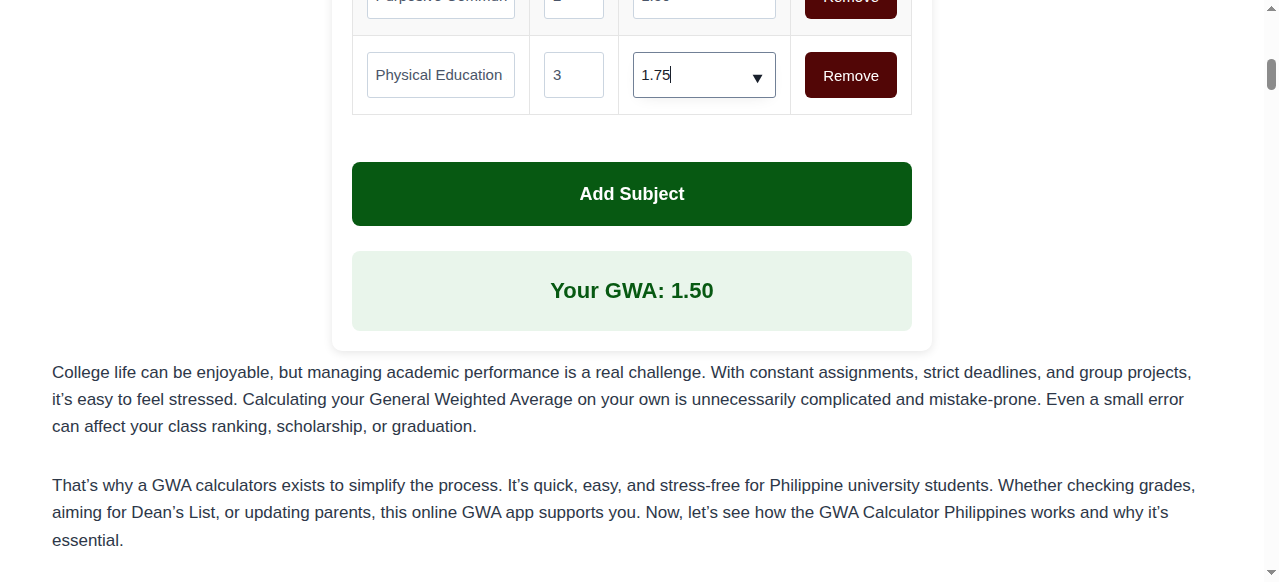
Two observations from this table are worth more than the number itself. First, the mode — synchronous or asynchronous — does not appear anywhere in the arithmetic. The calculator never asks how a subject was delivered, and neither does your registrar’s formula. Second, Physical Education 2 is included here because Mara’s school counts it. At UP it would be excluded, and the same six subjects would give 24.75 ÷ 17 = 1.46 instead of 1.50. That 0.04 is the difference between Cum Laude and Magna at some schools — which is why the “what counts” section below exists.

How One Online Subject’s Grade Is Built
Before a subject grade ever reaches the GWA, it is built from components — and online subjects build theirs differently from classroom subjects. A typical online subject in a Philippine college weights three components: written work (quizzes, assignments, discussion posts), performance tasks (laboratory exercises, projects, presentations), and a summative assessment (midterm and final examinations, usually proctored). The weights vary by syllabus — 40/40/20 is common — so always read your own subject outline. The arithmetic, though, is the same everywhere.
Take Mara’s Programming 2, the 1.50 in the table above. Her written work averaged 92 (quizzes 90, assignments 94). Her performance tasks averaged 93 (laboratory exercises 91, course project 95). Her proctored final examination was 90. At 40/40/20:
- Written work: 92 × 0.40 = 36.8
- Performance tasks: 93 × 0.40 = 37.2
- Final examination: 90 × 0.20 = 18.0
- Subject percentage: 36.8 + 37.2 + 18.0 = 92.0%
On the standard Philippine grade-to-percentage table, 91–93% transmutes to 1.50 — which is exactly the grade in the worked example. The two numbers agree because the transmutation table and the calculator use the same scale; if your school uses its own transmutation table, the percentage-to-grade step can differ by a quarter-point, and that is a registrar question, not a calculator question.
The practical lesson is about where effort pays. In a 40/40/20 subject, the final exam is only a fifth of the grade; the written work and performance tasks together are four-fifths. An online student who skips discussion posts and late-submits laboratory exercises has already lost the semester before the proctored exam opens. Conversely, a student who banks strong continuous-assessment marks can afford one bad exam day — the arithmetic protects them.
One warning about proctored exams specifically: under CHED CMO 12, s. 2025, online programmes must run proctored examinations with firm student identification. A failed identity check or a disconnection during a proctored exam is usually recorded as a missed assessment, not a technical excuse — and a missed assessment is a zero in the component it belongs to. If your connection drops mid-exam, report it to your instructor the same day, in writing, with a screenshot. The grade you protect may be the one that decides your GWA.
Worked Example 2: Second Online Semester, the Online Year, and the Two-Year Cumulative
Mara’s second online semester has the same shape — seven subjects, 20 units — but a different result. One subject, Rizal, was delivered fully asynchronously, and her NSTP 2 was an online community-service module. The table below is again the exact input verified on the live calculator.
| Subject | Mode | Units | Grade | Grade × Units |
|---|---|---|---|---|
| Object-Oriented Programming | Synchronous | 3 | 1.25 | 3.75 |
| Database Systems | Synchronous | 3 | 1.50 | 4.50 |
| Operating Systems | Asynchronous | 3 | 1.75 | 5.25 |
| Ethics | Asynchronous | 3 | 1.25 | 3.75 |
| Rizal | Asynchronous | 3 | 1.50 | 4.50 |
| Statistics | Synchronous | 2 | 1.25 | 2.50 |
| NSTP 2 | Asynchronous | 3 | 1.75 | 5.25 |
| Total | 20 | 29.50 |
29.50 ÷ 20 = 1.475, which prints as 1.48. That last step is the rounding rule in action: the exact value 1.475 sits exactly on a half-cent boundary, and the calculator’s binary arithmetic lands a hair above it, so it rounds up. The same tie at a different value goes the other way — 2.025 prints as 2.02. Both were verified on the live calculator in this run, and the full rounding table is in the rounding section below.
Now the cumulative figures, which is where most online students stop too early:
- Online year (both semesters): 30.00 + 29.50 = 59.50 grade points; 20 + 20 = 40 units; 59.50 ÷ 40 = 1.4875 → 1.49.
- Two-year cumulative (face-to-face first year + online second year): Mara’s first year was face-to-face: 42 units, 71.40 grade points, GWA 1.70. Add the online year: 71.40 + 59.50 = 130.90 points; 42 + 40 = 82 units; 130.90 ÷ 82 = 1.5963 → 1.60.
That 1.60 is not a coincidence we arranged — it is the arithmetic of her two years — but it is a useful one, because 1.60 is exactly the PUP Cum Laude ceiling. At PUP, a GWA of 1.6000 qualifies for Cum Laude; 1.61 does not. Mara is standing on the line. The honors section below explains what else has to be true for the line to count — the GWA alone is never the whole rule.
One more cumulative warning, specific to mixed-mode students. Mara’s first year was face-to-face and her second year online, and the formula treats them identically: all 82 units go into one sum. There is no separate “online GWA” and “face-to-face GWA” on a transcript. If your school ever shows you a per-mode average, that is a report, not your GWA. Your GWA is the single weighted figure over every included subject, whatever mode each one was delivered in.
UPOU: The Online University’s Own Grading Rules
The University of the Philippines Open University (upou.edu.ph) is the Philippines’ dedicated open and distance university, and its grading rules are the clearest published example of how online study maps onto the 1.00–5.00 scale. UPOU uses eleven numeric grades that count toward the GWA — 1.0 Excellent through 3.0 Passed, 4.0 Conditional, 5.0 Failed — plus four administrative marks that earn credit or record a status but are excluded from the GWA: S (Satisfactory), U (Unsatisfactory), DRP (Dropped) and EXT (Extended).
Two UPOU traps are worth working through with numbers, because both appear in other schools’ online programmes under different names.
The S-course trap. An S course earns credit but does not enter the GWA at all — neither the numerator nor the denominator. A student with a 1.50 semester who adds an S course still has a 1.50 semester. The trap is the reverse assumption: students who count an S course as a 1.00 (or as a 3.00) invent a GWA their transcript will never show. If a subject on your record is marked S, U, DRP or EXT, leave its row out of the calculator entirely.
The 4.00 trap. A 4.00 counts in the GWA at full weight but earns no credit. One 4.00 in a 9-unit UPOU semester moves the whole semester sharply: grades 1.00 (3 units), 1.50 (3 units) and 4.00 (3 units) give (3.00 + 4.50 + 12.00) ÷ 9 = 19.50 ÷ 9 = 2.1667 → 2.17. The same semester without the conditional subject would be 7.50 ÷ 6 = 1.25. A single conditional grade costs nearly a full GWA point here — and the calculator we tested confirms it: a 4.00 is accepted as an ordinary numeric grade and counted at face value (test case S22c, verified). A 4.00 is removed by passing a removal examination within the period your school sets; pass and it typically becomes 3.00, miss it and it becomes 5.00. Either way, while it sits on your record it counts.
UPOU also rounds semester and cumulative averages to two decimals, the same display rule the calculator on this site follows. The rounding behaviour is identical in practice — but note the caveat: UPOU’s own public sources do not state the rounding precision as a formal rule, so treat two decimals as the working convention, and the registrar’s printed figure as final.
What Counts, What Does Not — and What Breaks the Calculator
Online study produces more edge cases than classroom study, because subjects get dropped, deferred and re-taken more often when the classroom is a laptop. Here is every edge case we tested on the live calculator, with the exact result.
PE and NSTP. Whether they count is a school decision, not a calculator decision. We tested both treatments on Mara’s first semester. As zero-unit rows they change nothing — the semester stays 1.50. Counted at 3 units with a 1.00, the same semester becomes 33.00 ÷ 23 = 1.43. And a competitor’s own published example shows the same effect: an 8-subject semester with PE and NSTP is 31.00 ÷ 20 = 1.55, and without them 24.50 ÷ 15 = 1.63. That is a 0.08 swing from two subjects most students never think about. UP excludes PE from the GWA; some UST programmes include it. Check your handbook, then compute once with the right rule — never average the two versions.
INC (Incomplete). An INC has no final grade, so it cannot enter a weighted average. The calculator has no INC grade: typing “INC” shows “invalid grade” for the whole computation. Delete the row, compute the GWA of your completed subjects, and remember the INC is a debt, not a disappearance — at most schools an unresolved INC converts to 5.00 after the deadline in your handbook, and a 5.00 counts at full weight. Resolve it before the deadline, and the resolved grade enters the GWA of the term in which the subject was taken, not the term in which you finished it.
DRP (Dropped). A dropped subject is excluded from both the numerator and the denominator — it is as if the subject never existed for GWA purposes. But the calculator cannot represent that: typing “DRP” breaks the display even on a row with zero units (test case S07c, new in this run). Delete the row. The same rule applies to any administrative mark: if it is not a number from 1.00 to 5.00 or a letter grade, it does not belong in the calculator.
Failed subjects and retakes. A 5.00 counts at full weight, and it is expensive. One failed 3-unit subject in Mara’s first semester drags it from 1.50 to 2.02 (40.50 ÷ 20 = 2.025, which prints as 2.02 — the rounding tie again). A retake is where schools diverge, and the calculator models only one of the two treatments: it counts both attempts. If your school replaces the old grade, your official GWA will be better than the calculator’s figure; if your school averages both attempts, the calculator’s figure is the right model. Ask your registrar which treatment applies, and never assume the retake erases the failure. For the full failed-subject guide, see failed subject GWA Philippines.
Letter grades from asynchronous work. A discussion-board grade of “A” in a 1-unit asynchronous course maps to 1.25 and enters the weighted sum exactly like a 3-unit exam grade of 1.25 — only the units differ (test case S09c). The calculator accepts letter grades case-insensitively: A+ = 1.00, A = 1.25, A− = 1.50, B+ = 1.75, B = 2.00, B− = 2.25, C+ = 2.50, C = 2.75, C− = 3.00, D = 3.50, F = 5.00.
Percentages typed directly. Typing 92 or 88 into the grade field shows “invalid grade” — the calculator accepts only the 1.00–5.00 scale (and letters). Convert first: on this site’s own converter, percentage = 100 − (GWA − 1.00) × 12.5, so 92% is roughly GWA 1.64 and 88% is roughly GWA 1.96. Use the GWA to percentage converter rather than guessing, and remember that your school’s own transmutation table may differ slightly from this linear mapping.
Different scales in one record. Never mix scales in one sum. If one subject is graded 1.00–5.00, another as a percentage, and a third as S/U, convert the percentage subjects to the 1.00–5.00 scale first (using your school’s table), drop the S/U subjects, and only then add. A single percentage figure smuggled into a 1.00–5.00 sum will corrupt the whole result — and the calculator will not warn you, because 92 is simply out of range and shows “invalid grade”.
Conditional 4.00. Counted at face value 4.00 (test case S16). The calculator does not know it is conditional. If you are carrying a 4.00, your printed GWA is a snapshot that will move when the removal exam result lands.
Honors and Dean’s List for Online Students
Online delivery does not change honors eligibility — only which subjects count. The bands below are the ones that decide Latin honors at the schools online students most often attend, and every figure was verified against a primary source or flagged as secondary. For the full honors guide, see Latin honors GWA Philippines.
| School | Summa Cum Laude | Magna Cum Laude | Cum Laude |
|---|---|---|---|
| UP (all campuses) | 1.20 or better | 1.45 or better | 1.75 or better |
| PUP | 1.0000–1.1500 | 1.1501–1.3500 | 1.3501–1.6000 |
| STI | 1.00–1.10 | 1.11–1.30 | 1.31–1.50 |
| Adamson | below 1.24 | below 1.49 | below 1.74 |
| UST (guide’s table) | 1.000–1.200 | 1.201–1.450 | 1.451–1.750 |
The GWA is only the first condition. The disqualifiers are where online students get caught:
- UP: the bands come from the UP Code, Article 410, as quoted by the Supreme Court in Morales v. UP Board of Regents (G.R. No. 161172, 13 December 2004) — Summa 1.20, Magna 1.45, Cum Laude 1.75. But the per-band grade floor is stricter than the GWA: for Summa, no grade below 2.0; for Magna, no grade below 2.5; for Cum Laude, no grade below 3.0. A single 2.50 in one subject can already end a Summa, whatever the average says. University Scholar needs 1.45 or better with at least 15 units and no grade below 3.00; College Scholar is better than 1.45 up to 1.75 on the same load.
- PUP: from the PUP Student Handbook itself (p. 44) — Cum Laude ends at exactly 1.6000, only academic courses are included, no final grade lower than 2.50, no 5.00, and no INC, withdrawn or dropped subject. Mara’s two-year 1.60 qualifies on the number; whether it qualifies in full depends on her worst grade and her record. We tested the boundary on the live calculator: exactly 1.60 qualifies, 1.61 misses.
- STI: from the STI Tertiary Student Handbook (via gwacalculators.ph) — Cum Laude ends at 1.50, no grade lower than 2.25, at least 75% of units taken at STI, and no major offense. Tested: exactly 1.50 qualifies, 1.51 misses.
- Adamson: from Adamson University’s own published graduation page — Summa below 1.24, Magna below 1.49, Cum Laude below 1.74, with no grade lower than 2.5. Note the strict “below”: exactly 1.74 does not qualify. Tested: 1.74 misses, 1.73 qualifies. Adamson also requires a regular student taking 100% of the regular semestral load, no failed or dropped subject, no disciplinary case, and residency of one school year with 36 units and two-thirds of the major field taken at Adamson.
- UST: the table above is from a secondary guide, not verified against UST’s own handbook — treat it as the guide’s figures and confirm with the registrar.
Dean’s List is the more common target, and the cutoff most Philippine colleges use is 1.75. We tested it: exactly 1.75 makes it, 1.76 misses. For the full Dean’s List guide, see Dean’s List GWA Philippines.

Can an online student still graduate with honors? Yes — and Mara’s own numbers show the trajectory. From a 1.70 first year, an online year averaging 1.495 or better over 40 units lands exactly on the PUP Cum Laude line of 1.60 (test case S15a). A perfect 1.00 online year pulls her two-year GWA to 1.36, inside UP’s Magna ceiling of 1.45 (test case S25). The recovery is real, but it is arithmetic, not hope: every future semester’s average needed is fixed by the units already taken, and the calculator on this site will tell you the number before you enrol.
Scholarships: The Numbers Competitors Get Wrong
Scholarship cutoffs are where the top-ranking GWA pages make their most expensive mistakes, and online students — who often study while working, and depend on the grant — pay for them. Three corrections matter, and each one was verified against the official policy.
DOST-SEI: the UP-System bar is 2.75, not a flat 2.50. One popular scholarship guide states “DOST requires a semestral GWA of 2.50 or better” as a flat rule for all scholars. The official DOST-SEI S&T Scholarship policy says otherwise: for first year, an annual weighted average of 2.75 or better if you are enrolled in the UP System, and 2.50 or 85% or better if you are enrolled in another college or university — and the same 2.75 semestral figure for UP-System scholars in second year. A UP or UPOU online scholar holding a 2.60 would pass the competitor’s test and still lose the grant. The 2.50 figure is correct only for non-UP schools. Retention is also judged on the semestral GWA, not the cumulative figure — another competitor claims most scholarships “look at the cumulative figure”, which is wrong for DOST. And for third, fourth and fifth years, the DOST-SEI Scholar’s Handbook states no GWA number at all: passing grades in all academic subjects, a regular load, and completion within the prescribed period.
DOST JLSS: 83% means GWA 2.36. The Junior Level Science Scholarship is for regular second-year college students in DOST-SEI priority science and technology courses, with a GWA of at least 83% or equivalent and no conditional or failing mark from the first semester of first year until the first semester of second year. On this site’s converter, 83% is exactly GWA 2.36 — verified as test case S23b (59.00 ÷ 25 = 2.36). The benefits are ₱8,000 a month in living allowance for ten months a year, tuition up to ₱40,000 a year, ₱10,000 for learning materials and a ₱10,000 thesis grant. One caution: the AY 2026–2027 cycle ran from 17 April to 15 May 2026 with the exam on 28 June 2026. That cycle is closed; do not treat those dates as open.
CHED Merit: 85% is the maintaining grade, not the entry bar. A long competitor guide says the CHED Merit Scholarship requires “a GWA in the top 10% of your graduating class or an 85%-equivalent average” — and in its FAQ, that “merit scholarships often require an 85%-equivalent GWA or better (roughly 1.75 or better)”. Both statements confuse the maintaining grade with the entry grade. Entry to the CHED Merit Scholarship is judged on the senior high school general average — 96% for Full Merit and 93% for Half Merit under CHED’s programme guidance (CMO 8, s. 2019). The 85% figure is the maintaining grade for Full Merit scholars once enrolled (80% for Half Merit); on this site’s converter, 85% is GWA 2.20 and 80% is GWA 2.60 (test case S23). Presenting 85% as the entry bar understates the real bar by eight to eleven points. For the full scholarship guide, see GWA for scholarship Philippines. For the PUP grading system that many scholars study under, see PUP grading system, and for the DepEd grading system that senior high school averages come from, see DepEd grading system.
The practical rule for any online scholar: keep a screenshot of your semestral GWA the day grades are released, and check the maintaining grade for your scholarship against the official policy, not a calculator blog. The two numbers that decide whether the money continues are your semestral GWA and the policy’s exact threshold — and both are knowable before the semester starts.
Rounding: When 1.475 Prints as 1.48 and 2.025 Prints as 2.02
The calculator prints two decimals, and two decimals hide a trap. An exact value that ends in 5 at the third decimal can print either way, because the computer stores the value in binary and the binary representation is a hair above or below the decimal tie. We verified every case below against the live calculator function, run unmodified in Node — these are not estimates.
| Exact value | Prints as | Why |
|---|---|---|
| 1.475 (29.50 ÷ 20) | 1.48 | Double is a hair above 1.475 — rounds up |
| 2.025 (40.50 ÷ 20) | 2.02 | Double is a hair below 2.025 — rounds down |
| 1.725 (13.80 ÷ 8) | 1.73 | Double is a hair above 1.725 — rounds up |
| 1.375 (57.75 ÷ 42) | 1.38 | 1.375 is exact in binary — half rounds up |
| 1.625 (29.25 ÷ 18) | 1.63 | 1.625 is exact in binary — half rounds up |
| 1.675 (67 ÷ 40) | 1.68 | Double is a hair above 1.675 — rounds up |
| 1.575 (31.50 ÷ 20) | 1.57 | Double is a hair below 1.575 — rounds down |
Two consequences follow. First, near a cutoff — 1.75, 1.60, 1.50, 1.74 — check the unrounded figure with your registrar. Mara’s second semester is exactly such a case: 1.475 prints as 1.48, and if a Dean’s List cutoff were 1.48, the printed figure would decide it. Second, grades are rounded to two places on entry: typing 1.925 stores 1.93, because the page rounds with Math.round(grade × 100) ÷ 100 and 1.925 × 100 is exactly 192.5 in binary. Typing 1.333 stores 1.33. If your school reports grades to three decimals, enter the two-decimal value your transcript shows — the calculator will do the rest.
The Semester-Average Trap — and the Cumulative Across Modes
The most common arithmetic mistake in GWA computation is also the most natural: averaging two semester GWAs. Mara’s online semesters are 1.50 and 1.48, and their plain average is 1.49 — which matches the true cumulative only because both semesters carry exactly 20 units. Change the loads and the shortcut fails. Add a 6-unit online summer term at 1.00 to the first semester: the true cumulative is (30.00 + 6.00) ÷ (20 + 6) = 36.00 ÷ 26 = 1.38, while the naive average (1.50 + 1.00) ÷ 2 = 1.25 is wrong by 0.13. One competitor is the only page we found that demonstrates this correctly (1.6458 versus the naive 1.625 in its cumulative example); the rest either skip cumulative GWA entirely or leave the trap unmentioned.
The rule is simple and absolute: never average averages. Always go back to grade points and units. The cumulative GWA is (all grade points ever) ÷ (all units ever), with each semester’s points and units added separately. That is also why a light summer term is so powerful: six units at 1.00 pull a 1.50 semester to 1.38, because six units are nearly a third of the new total. Online students, who can pick up short summer terms more easily than classroom students, should use that — but they should also know the reverse: six units at 3.00 would drag the same semester to 1.85.
Conversions: Percentages, GPA, and the Tables You Should Not Trust
Online students apply for scholarships, transfer credits and study abroad more often than most, so they meet conversion tables more often — and the tables online are full of errors. Here are the corrections, with the standard bands.
Percentage bands (standard table). 1.00 = 97–100% Excellent; 1.25 = 94–96%; 1.50 = 91–93%; 1.75 = 88–90% Very Good; 2.00 = 85–87% Good; 2.25 = 82–84%; 2.50 = 79–81%; 2.75 = 76–78%; 3.00 = 75% Passing; 4.00 = 65–74% Conditional Failure; 5.00 = below 65% Failed. Two competitors get this wrong: one labels 1.75 (88–90%) as merely “Good” — it is Very Good, and “Good” starts at 2.00 — and another’s table gives 1.00 as 99–100% and 1.75 as 90–92%, which disagrees with the standard table by two points at both ends.
GWA to percentage on this site. The converter at gwcalculator.com uses percentage = 100 − (GWA − 1.00) × 12.5, so 80% = 2.60, 83% = 2.36, 85% = 2.20, 90% = 1.80, 93.75% = 1.50. That linear mapping is the site’s own convention; schools with their own transmutation tables may map slightly differently. Use the GWA to percentage converter for the conversion, and your school’s table for anything official.
GWA to GPA: there is no official conversion. One calculator page presents “US 4.0 equivalent ≈ 5.00 − GWA” as the formula. It is labelled “rough”, but as a formula it overstates: 1.50 GWA becomes 3.50 by subtraction, while another site’s own GWA-to-GPA table maps 1.50 to 3.30 and 1.75 to 3.00 (against 3.25 by subtraction). A third site’s table is worse: it maps 3.00 GWA — the minimum passing grade, 75% — to a 1.00 GPA, which on a 4.0 scale is near-failing; the correct approximation is about 2.00. There is no official conversion because no authority publishes one. If an application abroad asks for a GPA, ask the receiving institution how it converts, or submit the transcript and let it convert. Never put a subtraction-formula GPA on a form.
CHED publishes no single national grade-to-percentage table. One grading-system explainer presents its table as “the standard CHED grade scale for higher education institutions”. CHED does not publish a mandatory national table; each higher education institution sets its own grading system under CHED’s programme standards. The percentages in the table are the commonly used ones — but the attribution to CHED is wrong, and a student quoting “CHED’s table” to a registrar will be corrected.
What the Calculator Cannot Do (and the Workarounds That Work)
The calculator on gwcalculator.com is a faithful implementation of the weighted-average formula — 47 test cases, all passing — but it is a calculator, not a registrar. Here is what it cannot do, and what to do instead.
- INC, DRP, S, U, EXT. It has no such grades. Typing any of them shows “invalid grade” for the whole computation. Workaround: delete the row and compute the completed subjects only.
- Retake replacement. It counts both attempts. If your school replaces the old grade, compute twice — once with both attempts (the calculator’s figure) and once with only the new grade — and use the second for your own planning while the registrar’s figure governs officially.
- PE/NSTP policy. It cannot know whether your school counts them. Compute both versions (we did: 1.50 with PE counted at 3 units, 1.46 without it in Mara’s first semester) and use the one your handbook supports.
- Conditional 4.00. It counts 4.00 at face value and cannot know a removal exam is pending. Treat the printed GWA as provisional until the removal result lands.
- Percentage grades. It accepts only the 1.00–5.00 scale and letter grades. Convert percentages first, using your school’s transmutation table.
- Rounding ties. It prints two decimals and rounds by binary rules (1.475 → 1.48, 2.025 → 2.02). Near a cutoff, ask your registrar for the unrounded figure — the printed decimals are not the whole story.
None of these is a defect. They are the boundary between a formula and a policy, and the policy always belongs to the school. The calculator’s job is to make the formula transparent — which is why every test case in this article ran against its actual code, unmodified, rather than against a re-implementation.
Competitor Errors Corrected in This Guide
We read the top ten pages ranking for this topic in full. No dedicated guide to the GWA for online students exists — the exact phrase returns only generic calculator homepages — so the errors below are the ones an online student meets when they search for help. Each one is quoted, corrected, and sourced.
- DOST 2.50 as a flat rule (gwacalc.online). “DOST requires a semestral GWA of 2.50 or better” for all scholars. Correct: UP-System scholars need 2.75 or better; 2.50 applies only to non-UP schools. Source: official DOST-SEI S&T Scholarship policy.
- CHED Merit entry at 85% (chedscholar.org). Entry needs “an 85%-equivalent average”. Correct: 85% is the maintaining grade for Full Merit scholars. Entry is judged on the senior high school general average — 96% Full Merit, 93% Half Merit (CHED CMO 8, s. 2019).
- GWA 3.00 → GPA 1.00 (chedscholar.org). A 3.00 is the minimum passing grade (75%). Correct: about 2.00 GPA, not 1.00.
- Percentage table shifted (chedscholar.org). 1.00 = 99–100%, 1.75 = 90–92%, 3.00 = 75–77%. Correct (standard table): 1.00 = 97–100%, 1.75 = 88–90%, 3.00 = 75%.
- 1.75 labelled “Good” (gwacalculatorpro.com). 88–90% is “Very Good”; “Good” starts at 2.00 (85–87%).
- Scholarships “look at the cumulative figure” (gwacalculatorpro.com). Wrong for DOST: retention is judged on the semestral GWA.
- No 4.00 row (takenokri.com). The grading-scale table omits the conditional grade entirely. Correct: 4.00 = Conditional Failure — removal exam, pass to 3.00, miss to 5.00.
- “The standard CHED grade scale” (openeducat.org). CHED publishes no single mandatory national grade-to-percentage table; each institution sets its own.
- Honors need “no grade of 4.00 or 5.00” (openeducat.org). UP’s rule is stricter and per-band: Summa — no grade below 2.0; Magna — no grade below 2.5; Cum Laude — no grade below 3.0. A single 2.50 can already end a Summa.
- “US 4.0 equivalent ≈ 5.00 − GWA” (zencalcy.com). No official conversion exists; the subtraction disagrees with other published tables (1.50 → 3.50 by subtraction vs 3.30 in another site’s table). Never present it as “the” equivalent.
- Unverified budget figure (gwacalc.online). “₱8.67 billion … to fund 67,504 undergraduate scholars” is presented as fact with no source or link. We do not repeat it.
- “Credit hours per course: 0.0 to 30.0” (gpaworld.com, UPOU page). Implausible — no UPOU course carries 30 units. A data-entry artefact, not a rule.
- PE silently included in worked examples (gwacalculatorpro.com, aralai.app). Both include a 2-unit PE subject in the GWA with no exclusion note. UP excludes PE; always show the with-PE and without-PE versions.
- “A single failing, dropped, or even an Incomplete grade can disqualify” (chedscholar.org). A DRP is normally excluded from the GWA entirely and does not by itself disqualify; the usual disqualifier is a 5.00, with per-school variations.
The full analysis — all ten pages, what each covers, and what each misses — is documented in the article’s research file. The gap it leaves is the reason this guide exists: nobody had written the online student’s version of the GWA, so we wrote it from the calculator up.
Transferring, Working, and the Four-Year GWA for Online Students Philippines
Most online students do not stay in one mode for four years. They transfer, they work, they pause a semester, they move from face-to-face to online when a job starts — and every change touches the GWA. The rules below are the ones that surprise people, because they live in handbooks rather than in calculators.
Transferring between online and face-to-face. Transferred units come across as credit, but the grades attached to them do not always come across the same way. Adamson, for example, accepts transferees with zero credit for honors purposes — a transferred subject counts toward the degree but not toward the honors GWA. PUP requires residency and counts only academic courses taken at PUP toward Latin honors, and STI requires at least 75% of units taken at STI. The practical consequence: if you transfer after two online years, your honors GWA may restart from zero at the new school while your degree credits carry over. Ask the registrar, in writing, which of your transferred subjects enter the honors computation — before you enrol, not in your final year. For the transfer rules in detail, see GWA for graduate school Philippines for how graduate schools read a mixed transcript, and the transfer guidance in our earlier transfer article’s method: always compute the GWA twice, once with transferred grades and once without, and keep the version your school will actually use.
Working while studying online. The flexible schedule is the reason many working students choose online study — and the reason their GWA slips. A working student who misses synchronous sessions loses the participation component of those subjects, and in a 40/40/20 subject the participation and written-work components together are worth more than the final exam. The fix is boring and effective: front-load the asynchronous work on weekends, when the LMS is quiet and the deadlines are not, and treat a synchronous class like a shift — non-negotiable, on the calendar, with a backup connection. For the full working-student guide, see GWA for working students Philippines. If your grades are already behind, the recovery plan in how to improve your GWA starts with the same arithmetic used in this guide: the units already taken fix the average you need next.
Mara’s four-year projection. After two years Mara holds 130.90 grade points over 82 units — GWA 1.60. She has 80 units left (40 a year for years three and four). The averages she needs are fixed by arithmetic, not by effort alone:
| Final four-year target | Points needed in years 3–4 (80 units) | Average needed | What it means |
|---|---|---|---|
| 1.75 (UP Cum Laude) | 152.60 | 1.91 | Comfortable — her online year already averaged 1.49 |
| 1.60 (PUP Cum Laude) | 128.30 | 1.60 | Hold her current standard exactly |
| 1.50 (STI Cum Laude) | 112.10 | 1.40 | A step up — one 1.25 for every 1.75 |
| 1.45 (UP Magna) | 104.00 | 1.30 | Hard — near-straight 1.25s and 1.50s for two years |
Every figure in that table was computed the same way: target total points minus points already earned, divided by units remaining. For 1.60: 162 units × 1.60 = 259.20 total points needed; 259.20 − 130.90 = 128.30; 128.30 ÷ 80 = 1.60375, so an average of 1.60 or better. For 1.45: 162 × 1.45 = 234.90; 234.90 − 130.90 = 104.00; 104.00 ÷ 80 = 1.30 exactly. You can run the same projection for yourself on the calculator: enter your completed subjects, note the points and units, and solve for the average you need over the units you have left. That number — not a vague “study harder” — is your target for next semester.
What actually moves the number for an online student. The levers are the same as for any student, but their weights differ online. Continuous assessment — discussion posts, quizzes, laboratory exercises — is usually 60–80% of a subject grade, so it moves the GWA more than the final exam does. A dropped subject costs nothing if it is dropped properly (DRP, excluded) and costs a full 5.00 if it is abandoned and left to fail. A single INC resolved on time costs nothing; an INC left to convert to 5.00 costs a semester. And a 6-unit online summer term at 1.00 is the cheapest GWA improvement available to any student in the Philippines — it pulled Mara’s first semester from 1.50 to 1.38 in our test. The gwa for online students philippines is not a different formula. It is the same formula, applied to a record with more moving parts — and the students who win are the ones who track the parts.
One last practical point about the record itself. Online grades live in a portal, and portals change: subjects disappear from view after a term closes, and an LMS migration can bury a whole semester. Download your grades every term — a PDF of the portal page, a screenshot of each subject’s breakdown — and keep them with your COR and TOR. When a grade is corrected, the correction enters the term the subject was taken in, and your cumulative GWA changes retroactively. Without your own copy, you cannot check the correction. With it, the check takes two minutes on the calculator.
Frequently Asked Questions
Is the GWA for online students computed differently from face-to-face students?
No. The formula is identical: grade points divided by units. What differs is which subjects count and how each online subject’s final grade is formed — synchronous participation, asynchronous outputs, proctored exams. The calculator never asks how a subject was delivered, and neither does the formula.
Does an online degree count for Latin honors?
Yes, if the programme is legitimate — a Government Authority to teach online under CHED CMO 12, s. 2025 — and you meet the GWA band plus your school’s other conditions (no grade below the per-band floor, no failed subject, load and residency rules). Online delivery does not change honors eligibility.
Do PE and NSTP count in an online student’s GWA?
It depends on your school. UP excludes PE; some UST programmes include it; NSTP is usually excluded but counted at some schools. In Mara’s first semester, counting PE at 3 units gives 1.50; excluding it gives 1.46. Check your handbook — the difference can cross a honors line.
What happens to my GWA if I drop an online subject?
Nothing — a dropped (DRP) subject is excluded from both the numerator and the denominator. But do not type “DRP” into the calculator: it shows “invalid grade” for the whole computation. Delete the row instead.
What happens if I get an INC in an online subject?
An INC has no final grade and cannot enter the GWA. Compute your completed subjects only, resolve the INC before your handbook’s deadline, and remember that an unresolved INC usually converts to 5.00 — which counts at full weight.
Can I type a percentage grade into the GWA calculator?
No. The calculator accepts only the 1.00–5.00 scale and letter grades; typing 92 shows “invalid grade”. Convert first with your school’s transmutation table, or with the site’s converter as a first approximation (percentage = 100 − (GWA − 1.00) × 12.5).
What GWA do I need for a DOST scholarship as an online student?
There is no GWA entry threshold for DOST-SEI — entry is by the qualifying examination. Once you hold the grant, the maintaining grade is semestral: 2.50 or better at non-UP schools, 2.75 or better in the UP System (including UPOU). For the Junior Level Science Scholarship, the bar is 83% or equivalent — GWA 2.36 on this site’s converter.
What GWA do I need for the CHED Merit Scholarship?
Entry is judged on your senior high school general average — 96% for Full Merit, 93% for Half Merit — not on an 85% college GWA. Once enrolled, you must maintain 85% (Full) or 80% (Half), which is GWA 2.20 and 2.60 on this site’s converter.
Why does my GWA print as 1.48 when my hand calculation says 1.475?
The calculator prints two decimals, and binary rounding decides ties: 1.475 is stored a hair above the tie, so it prints 1.48. The same rule prints 2.025 as 2.02. Near a cutoff, ask your registrar for the unrounded figure.
Can I raise my GWA with online summer classes?
Yes — and the arithmetic is generous, because summer units add to both totals. Six units at 1.00 pull a 1.50 semester to 1.38. But the reverse is equally true: six units at 3.00 would drag it to 1.77. Never average semester GWAs; always recompute from grade points and units.
Do transferred online subjects count toward my GWA at a new school?
It depends on the receiving school. Some schools count transferred grades in the cumulative GWA; others count only the credit, and for honors purposes some accept transferees with zero credit — Adamson is one. Always ask the registrar in writing before you transfer, and compute your GWA both ways so you know where you stand either way.
I work full-time and study online. What GWA should I aim for?
Aim for the maintaining grade of whatever you need to keep — 2.50 semestral for a DOST grant at a non-UP school, 2.75 in the UP System, 85% for CHED Full Merit — and then one band better, as insurance against a bad term. A working student who holds 2.00 has room for a 2.50 semester; a working student holding exactly 2.50 does not.
The Online-Student Checklist: What to Do This Week
If you are studying online in the Philippines, do these seven things before your next enrolment — they take an afternoon and they protect every number in this guide.
- Pull your COR and your portal grades. List every subject with a final numeric grade. Mark every INC, DRP, S and U subject and leave those rows out of the calculator.
- Compute your GWA for online students philippines on the live calculator. Type the subjects in, units and grades, and compare the result with your hand calculation. If they disagree, one of your rows is wrong — usually a percentage typed as a grade, or a PE/NSTP subject that should not be there.
- Check the PE/NSTP rule in your handbook. Compute both versions if you are unsure, and use the one your school supports. Never average the two.
- Resolve every INC before its deadline. An INC that converts to 5.00 costs more than any single bad exam.
- Work out your next semester’s target average. If you need a 1.60 for Cum Laude, the units already taken fix the average you need — the calculator will tell you the number. Mara needed 1.495 over 40 online units; work out your own figure the same way.
- Check your scholarship’s maintaining grade against the official policy. DOST retention is semestral — 2.50 non-UP, 2.75 UP System. CHED Merit maintenance is 85% Full, 80% Half. Do not trust a blog’s summary, including this one: verify against the policy and your award letter.
- Keep the receipts. Screenshot your semestral GWA the day grades are released, and keep your TOR and COR. If a grade is ever corrected, the correction enters the term the subject was taken in — and you will want the paper trail.
Mara’s story ends where it started: seven subjects, 20 units, 30.00 grade points, GWA 1.50. The number is small and the arithmetic is simple — but it is the same arithmetic that decides Dean’s List, Latin honors, a DOST grant and a first job. Online study did not change the formula. It changed the evidence, the edge cases and the traps. Now you know all three — and you have a calculator that will show its work, a video that proves it, and 47 test cases that say the numbers are real.
For the next step in the series, read GWA for senior students Philippines for the final-year rules, GWA for working students Philippines if you study while employed, and how to improve your GWA for the recovery plan. And if your grades are not where you need them, the recovery math in this guide is the place to start: the units already taken fix the average you need, and the average is always reachable one subject at a time.
