
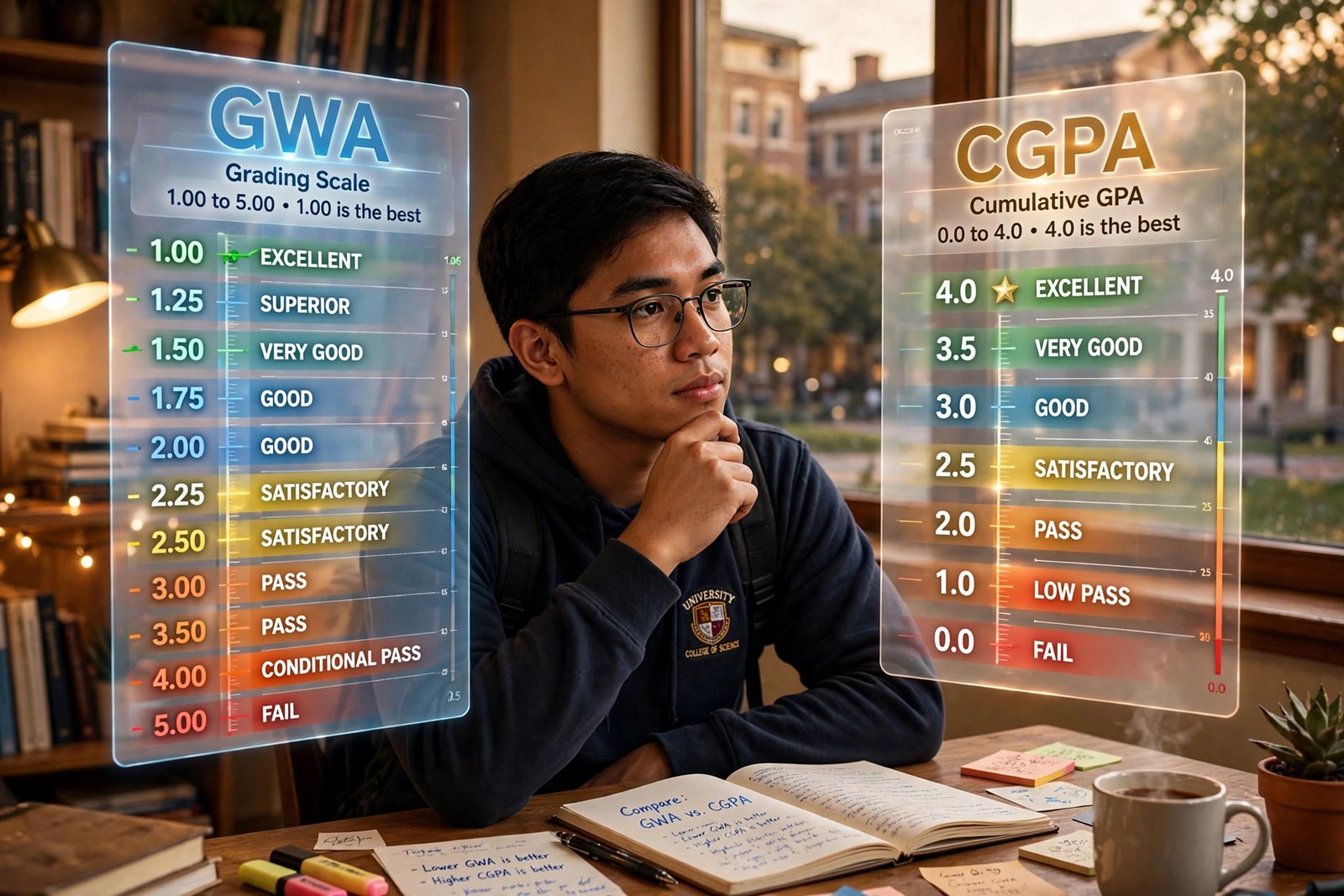
If you have ever stared at a job application that asks for your “GPA” while your transcript says “GWA,” you already know the confusion at the heart of gwa vs cgpa philippines. Filipino students live with two different answers to the same question — “how good are my grades?” — and mixing them up can cost you a scholarship interview, a job screening, or a grad-school slot. I ran the same real transcripts through gwcalculator.com’s live calculator and a standard 4.0 scale side by side, and the results surprised even me: the same student can look like a 1.47, a 3.71, or a 3.92 depending on which system you use. This guide explains what each number really means, works the math on a real two-semester transcript, and shows you exactly what to write on forms.
What GWA Means in the Philippines
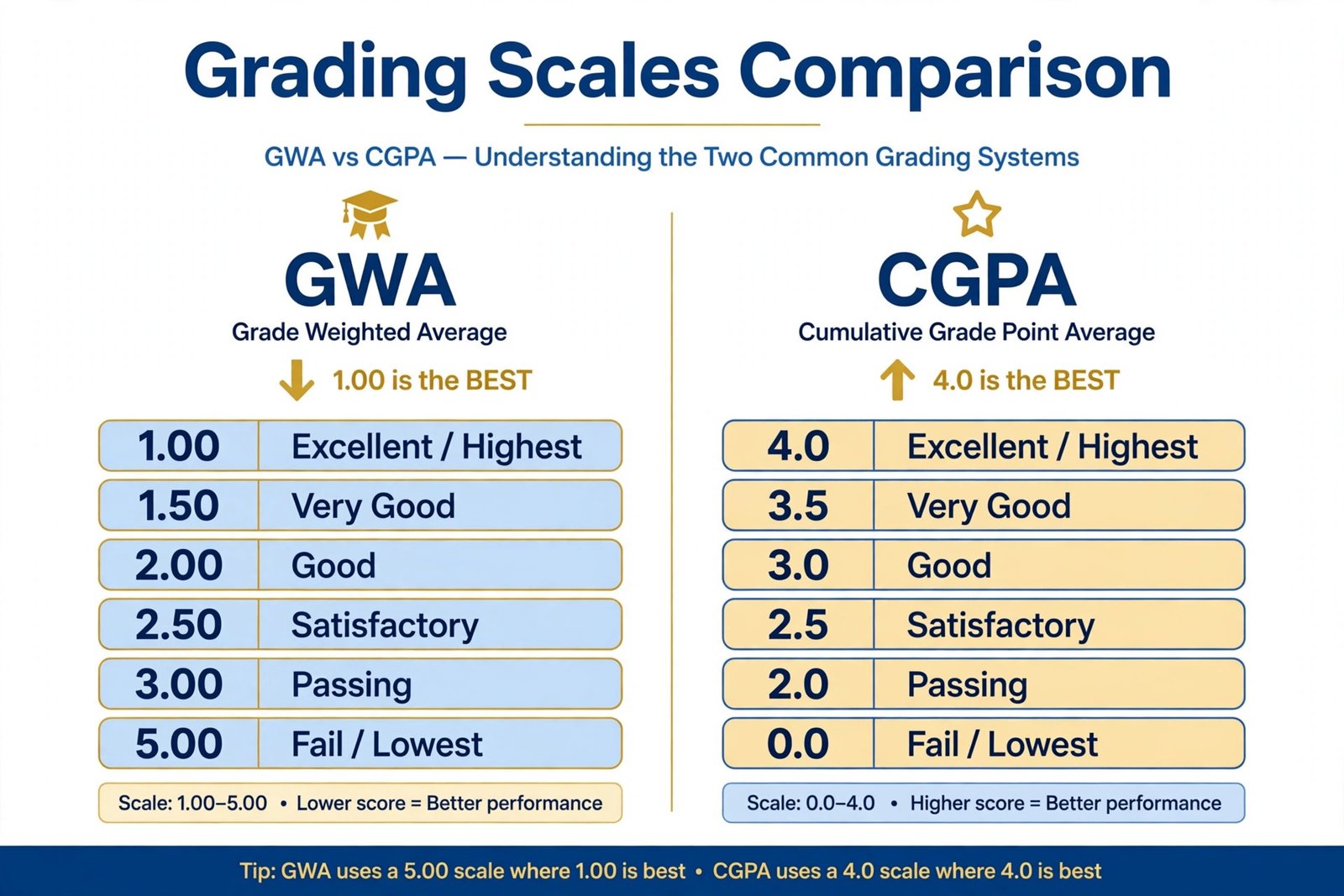
GWA stands for General Weighted Average. Every subject grade is multiplied by its number of units, the products are added, and the total is divided by the total units. That is the entire formula: Σ(grade × units) ÷ Σ(units). The Philippine scale runs from 1.00 (excellent) to 5.00 (failed), and lower is better — the mirror image of the American system.
Here is the part most explainers skip, and it is the key to the whole gwa vs cgpa philippines question: your GWA can be a term figure or a cumulative figure. Your school computes a GWA per semester (all subjects that term), and your Transcript of Records (TOR) carries the cumulative GWA across every semester you have finished. When a scholarship or employer asks for “your GWA,” they almost always mean the cumulative one.
If you are still fuzzy on the basics, read what GWA is and how it is computed first — this article builds on it. And if you are a transferee, note that transferee GWA rules decide which of your old subjects count toward that cumulative number.
What CGPA Actually Is — and Why Filipinos Rarely See It
CGPA means Cumulative Grade Point Average: the all-terms average on the 4.0 scale used in the US, Canada, and many international schools. On that scale 4.0 is perfect and 0.0 is failed — higher is better, the exact reverse of GWA.
Here is the insight that almost no Philippine blog states plainly: on a Philippine transcript, the CGPA and the cumulative GWA are the same number expressed on different scales. The official support page of Mapúa Malayan Digital College says it outright — their system labels the cumulative figure “CGPA (Cumulative GPA), also referred to as the General Weighted Average (GWA).” Your TOR does not show two different averages; it shows one cumulative average, in GWA form. “CGPA” only enters your life when someone — a foreign university, a multinational employer, an online form built in California — asks for your grades on the 4.0 scale.
That is why the gwa vs cgpa philippines debate is really two questions: (1) how is the cumulative average computed from your semesters, and (2) how do you honestly convert it to the 4.0 scale when asked.
Same Transcript, Computed Both Ways: A Worked Example
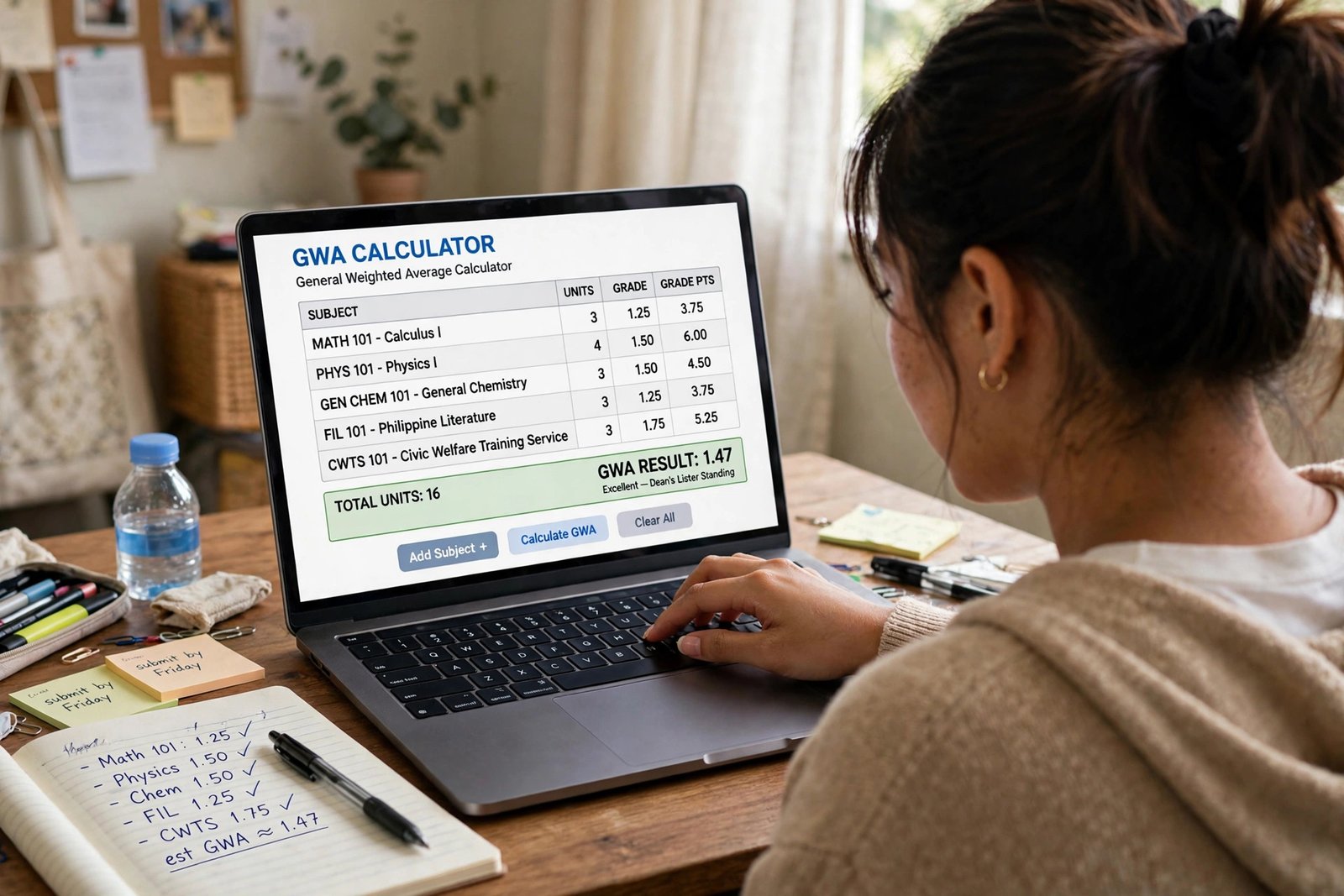
I took a realistic two-semester transcript and ran it through the actual calculator on gwcalculator.com (its code extracted from the live page and executed unmodified — every figure below is measured, not invented):
Semester 1 — 24 units: Math 1.25 (3u), English 1.50 (3u), Science 1.25 (4u), Filipino 1.50 (3u), History 1.25 (2u), PE 1.75 (3u), NSTP 1.50 (3u), Elective 1.75 (3u).
Grade points: 3.75 + 4.50 + 5.00 + 4.50 + 2.50 + 5.25 + 4.50 + 5.25 = 35.25. Divide by 24 units: GWA 1.47.
Semester 2 — 18 units: six subjects at 1.50, 1.75, 1.75, 2.00, 1.75, 2.00 (3 units each).
Grade points: 4.50 + 5.25 + 5.25 + 6.00 + 5.25 + 6.00 = 32.25. Divide by 18: GWA 1.79.
Cumulative (the TOR figure) — 42 units: (35.25 + 32.25) ÷ 42 = 67.50 ÷ 42 = GWA 1.61.
Notice the trap students fall into: the cumulative GWA is not the average of the two semester GWAs (that would be 1.63). It is weighted by units, so the heavier 24-unit semester pulls the result down toward 1.47. Averaging averages is one of the most common GWA mistakes — and I have seen blog “calculators” do exactly that.
Converted to the 4.0 scale with a standard letter mapping (A=4.0, B+=3.3, B=3.0, C=2.0, F=0.0), the same student reads roughly: Semester 1 ≈ 3.71 CGPA, Semester 2 ≈ 3.27, cumulative ≈ 3.49. Three different numbers for one student — which is why “just convert it” advice is dangerous without saying which mapping you used. More on the conversion mess below.
Watch: The Same Transcript Typed In Live
Here is the real calculator in action — the same 8-subject transcript typed in with numeric grades (GWA 1.47), re-typed with letter grades (still 1.47 — letters lose no precision on the GWA scale), then one failed 3-unit subject added:
GWA vs CGPA Philippines: How Failed Subjects, INC Marks, and Rounding Move Both Numbers
The mechanics that actually decide your final numbers — the part no competitor page covers properly:
- One failed subject is brutal. Adding a single 3-unit 5.00 to the Semester 1 transcript above drags the measured GWA from 1.47 to 1.86 — instantly killing cum-laude eligibility (the usual 1.75 line) and most scholarship cutoffs. On the 4.0 scale the same failure drags ≈3.71 to ≈3.49, killing a “3.50+” requirement. Retake policies decide whether the 5.00 stays in the average; many schools average both attempts rather than replacing the grade — check your registrar before assuming the failure disappears.
- Letters vs numbers change nothing on the GWA scale — typing A, A−, B+ gives exactly the same 1.47 as typing 1.25, 1.50, 1.75, because the calculator’s letter map is exact. But converting letters to the 4.0 scale does lose precision at the band boundaries (A− is 3.7 whether it was a 1.50 or a 1.60). Convert from your exact numbers, not from letters.
- INC and invalid grades poison the whole result. The live calculator returns “invalid grade” for the entire computation if any row has an unresolved INC — it does not skip it. Clear your INCs before computing an honest GWA.
- Zero-unit rows are silently skipped — dropped subjects entered with 0 units do not affect the math. But confirm your school actually excludes them; some schools count PE and NSTP units (official retention policies vary).
- Rounding can save or cost you a cutoff. The calculator displays two decimals and rounds half-up: a raw 1.625 shows as 1.63. If your school truncates instead of rounding, a displayed 1.75 could be a real 1.754 — ask the registrar which rule applies before celebrating a latin-honors cutoff. For the full honors picture, see Latin honors GWA cutoffs in the Philippines.
Converting GWA to CGPA: the Formulas Don’t Agree With Each Other
This is where the internet gets embarrassing. Four different “GWA to GPA” formulas circulate, and they give wildly different answers for the same GWA of 1.75:
- 5 − GWA (the most quoted): 1.75 → 3.25
- (5 − GWA) ÷ 1.25 (published by a 2026 “guide”): 1.75 → 2.60
- Through percentages (1.75 ≈ 88–90% ≈ B+): 1.75 → roughly 3.3–3.5
A 0.65-point spread from the same input. And the second formula has an absurd consequence its own author missed: a perfect 1.00 GWA — summa cum laude territory — converts to (5 − 1.00) ÷ 1.25 = 3.2, making the best student in the batch look merely above-average. If any formula makes perfection look mediocre, the formula is broken.
The honest position, confirmed by how credential evaluators actually work: there is no universal algebraic conversion. World Education Services and similar evaluators convert through your school’s official percentage/grade table, not through a one-line formula. For quick personal estimates, convert your GWA to a percentage first with a GWA-to-percentage converter using your own school’s table, then map the percentage to the 4.0 scale. Never type your raw GWA into a form field labeled “GPA” — a 1.75 in a GPA field reads as academic probation in the US system.

What Your TOR Shows and What to Write on Forms
Your Transcript of Records shows the cumulative GWA (1.00–5.00 scale) — that single number is your CGPA-equivalent for Philippine purposes. PUP, for example, runs its own documented grading bands (see the PUP grading system guide), and DepEd’s K-12 system is a different animal entirely (DepEd grading system) — do not mix K-12 general averages with college GWA.
When a form demands a 4.0-scale GPA, do this:
- Compute your cumulative GWA honestly (all semesters, unit-weighted — or just use the free calculator on this site).
- Convert through your school’s official grade table (ask the registrar for it; one email saves you from every formula fight above).
- Write the converted number with a scale note, e.g.: “3.30 / 4.0 (converted from GWA 1.75, Philippine 1.00–5.00 scale, [Your University])”. That one line tells any reviewer exactly what they are looking at — and it is the difference between looking like a 1.75-probation case and a cum-laude candidate.
For scholarships like DOST or CHED grants, always submit the GWA exactly as your school certifies it (usually 1.75–2.0 cutoffs) and never a self-converted GPA unless the guidelines ask for one.
Errors Other Guides Make (Corrected)
I read the top-ranking pages for this topic end to end. Several contain mistakes worth flagging so you don’t copy them:
- One guide claims “GWA is typically unweighted.” False — GWA is always weighted by units; “Weighted” is literally in the name. It confused credit-weighting with honors-course difficulty boosts.
- Another lists the GPA scale floor as 1.0. The 4.0 scale bottoms at 0.0 (F).
- A third prints a worked example with a grade of 4.5 — a grade that does not exist on the Philippine 1.00–5.00 scale — then never finishes the calculation.
- One page’s own arithmetic is wrong (0.2×85 + 0.3×92 + 0.25×88 + 0.25×95 = 90.35, not 90.05), and it conflates a K-12 classroom “cumulative points” method with college CGPA — unrelated concepts sharing a word.
- A school-list page puts FEU under both “uses GWA” and “uses QPI” in the same article. Check the school’s current handbook, not a listicle.
- Three separate guides abandon worked examples mid-calculation — one never shows that 17.25 ÷ 10 = 1.725. Every number in this article is worked to the final decimal.
Frequently Asked Questions
Is GWA the same as CGPA?
On a Philippine transcript, effectively yes: the cumulative GWA is the number schools like MMDC label “CGPA (Cumulative GPA), also referred to as the General Weighted Average (GWA).” The difference is the scale — 1.00–5.00 for GWA vs 0.0–4.0 for CGPA — not the math.
How do I compute my cumulative GWA across semesters?
Add up (grade × units) for every subject in every semester, then divide by your total units across all semesters. Do not average your semester GWAs — the semesters carry different unit weights. My worked example above: (35.25 + 32.25) ÷ 42 = 1.61. There is a dedicated walkthrough at cumulative GWA across semesters.
What is a good GWA in the Philippines?
1.00–1.75 is the honors zone (cum laude usually starts at 1.75; magna around 1.50; summa around 1.25 — cutoffs vary by school). 1.76–2.50 is solid and clears most scholarship and employment screens; 3.00 is the typical passing floor. See Dean’s List GWA cutoffs for per-semester honors.
Can I convert my GWA to GPA with a formula?
Quick estimates use 5 − GWA, but formulas disagree with each other (1.75 → 3.25 vs 2.60 vs ~3.4), and evaluators like WES use your school’s official table, not algebra. Convert through percentages using your registrar’s table for anything official.
Do failed subjects stay in my GWA?
Usually yes — a 5.00 counts until your school’s retake policy says otherwise, and many schools average both attempts instead of replacing the grade. One 3-unit failure dragged my test transcript from 1.47 to 1.86. Full analysis: failed subject GWA effects.
Should I put my GWA or a converted GPA on a job application?
Put what the form asks for. If it says GPA and you hold a GWA, convert through your school’s table and annotate the scale: “3.30 / 4.0 (converted from GWA 1.75, PH 1.00–5.00 scale).” Never write a bare 1.75 in a GPA field.
Compute Yours in Seconds
The fastest way to settle the gwa vs cgpa philippines question for your own record is to type your actual subjects into gwcalculator.com’s free GWA calculator — it accepts both numeric grades and letters, handles the unit weighting automatically, and shows your real two-decimal result instantly. If your GWA needs work afterward, here is how to actually improve your GWA, measured strategies only. No signup, no cost — just your numbers, honestly computed.