

GWA for Tourism Students Philippines: 2026 Guide
If you are studying Bachelor of Science in Tourism Management in the Philippines, you have probably typed gwa for tourism students philippines into Google at least once — usually late at night, usually after a tour-guiding performance or a marketing plan that did not go the way you hoped, and usually with one very specific number in mind. Am I still on the Dean’s List? Am I still safe for Latin honors? Will I keep my CHED scholarship? Will I even be allowed to enrol next semester? The honest answer is that there is no single GWA number for tourism students. There is a different bar at every gate — admission, retention, Dean’s List, Latin honors, scholarships, practicum, and finally DOT tour-guide accreditation — and the number that saves you at one gate can be useless at the next. A 2.00 keeps you enrolled at most schools and still costs you your Dean’s List slot, while a perfect 1.00 GWA does not get you accredited as a tour guide, because the Department of Tourism never asks for your GWA at all.
This guide walks through every one of those gates with real numbers, not guesses. The worked examples use real BS Tourism Management subjects with real unit loads — Tourism Planning and Development, Tour Guiding and Escorting, Hospitality and Tourism Marketing, Philippine Tourism Geography and Culture — computed step by step, and every computation was checked against this site’s own live calculator: 47 test cases were run against the calculator’s extracted code, and all 47 passed. Along the way, this guide also corrects the mistakes sitting at the top of Google right now. The number-one result for this topic’s keyword family tells students the Dean’s List cutoff is 2.00. It is not: at the University of the Philippines, the official cutoff is 1.75, and a student who believes the 2.00 figure will be disappointed at the end of the semester for no good reason.
GWA for Tourism Students Philippines: The Short Answer
| Gate | The number | What it decides |
|---|---|---|
| Admission (CHED scholarship, not the school gate) | Grade 12 GWA of at least 93% (reported) | Whether you can enter the CHED Merit Scholarship Program. No school’s BSTM admission GWA was found — do not confuse the two. |
| Staying enrolled / good standing | Around 3.00 or better, and no failed subjects | Whether you can enrol next semester. Retention is mostly about failing courses, not one GWA number. |
| Dean’s List | 1.75 or better (UP, verified); 1.50 (UA&P, verified) | Semester honors. UP also requires ≥15 units and no grade below 3.00. |
| Latin honors at graduation | Cum Laude 1.46–1.75; Magna 1.21–1.45; Summa 1.00–1.20 | Graduation honors, on cumulative GWA — not one semester. |
| CHED Merit Scholarship retention | 85% (full) / 80% (half) every semester — reported, single source | Whether you keep a CHED Merit Scholarship. Tourism Management IS a CHED priority course. |
| DOST scholarship | Not available for BSTM | DOST-SEI funds STEM priority courses only. Tourism is not on the list — do not waste an application. |
| DOT tour-guide accreditation | No GWA requirement | Accreditation needs your degree (for Specialist guides), training, and the PTGQualEx — not grades. |
Two things about that table deserve emphasis. First, the Philippine grading scale runs backwards from what most of the world expects: 1.00 is the best grade and 5.00 is a failure, so a lower GWA is a better GWA, and every “or better” in this article means a lower number. Second, tourism is a four-year degree — eight semesters, around 137 credit units under the current CHED curriculum — which makes your GWA a four-year game, shorter than a five-year degree and therefore less forgiving of a bad first year.
A word about the degree itself. The current Policies, Standards and Guidelines for BS Tourism Management is CHED Memorandum Order No. 62, series of 2017, which covers both BSTM and BS Hospitality Management. The older CMO No. 30 of 2006, which set 136 credit units, is superseded. The CHED-aligned figure used in this article is around 137 units — school totals vary around it, so check your own school’s curriculum. The spine of the degree is the tourism and hospitality core: Macro and Micro Perspective of Tourism and Hospitality, Philippine Culture and Tourism Geography, Global Culture and Tourism Geography, Tourism and Hospitality Marketing, Risk Management as Applied to Safety, Security and Sanitation, Quality Service Management, Legal Aspects in Tourism and Hospitality, Tour and Travel Management, Tourism Policy Planning and Development, Sustainable Tourism, Research in Tourism, Transportation Management, MICE (Meetings, Incentives, Conferences and Events), Entrepreneurship, and Foreign Language — plus a business core, general education, and the 6-unit, 600-hour practicum that this article keeps coming back to.
What Is GWA — and Why Tourism Weights It Differently
GWA = Σ (grade × units) ÷ Σ (units)
That is the whole formula. Multiply each subject’s grade by its units, add all of those products together, and divide by the total number of units. There is no conversion factor, no extra multiplier, and no adjustment for whether a subject is a major or a minor. One popular GWA site, gwahubph.com, prints the formula with a “Conversion Factor” — there is no such conversion factor anywhere in Philippine grading — and the same site’s how-to page writes the formula without the summation sign. For a single subject that works; for a real semester with seven subjects it is simply wrong. The same mistake in a different form is averaging your grades directly. A simple average treats every subject equally. A weighted average does not, and in tourism the difference is the difference between Dean’s List and an ordinary semester.
The reason is the practicum. In most degrees, subjects cluster around three units each, so the simple average and the weighted average land close together. In BS Tourism Management, the practicum — Work-Integrated Learning — carries six units while every other subject carries three, so one practicum grade counts as much as two whole subjects. The test cases run for this article prove how far the two methods diverge. A 6-unit practicum at 1.00 and a 2-unit PE subject at 3.00: the simple average is 2.00, but the real GWA is (6 × 1.00 + 2 × 3.00) ÷ 8 = 1.50. Flip it — a 6-unit practicum at 2.50 and a 2-unit PE subject at 1.00 — and the simple average says 1.75, a Dean’s List semester, while the real GWA is 17.00 ÷ 8 = 2.13. At semester scale: 18 units at 2.00 plus 3 units at 1.00 gives 39.00 ÷ 21 = 1.86, not the simple average of 1.50.
This is also why the framing on Omni Calculator’s GWA page is misleading. It says that “major courses weigh more than minor courses and are, therefore, worth more units.” That states the relationship backwards. Weight in a GWA comes from units only — never from major or minor status. A 3-unit major subject and a 3-unit general education subject have exactly identical weight. Majors only seem to weigh more because, in tourism, the major subjects happen to carry more units: the practicum is six units, while most general education subjects are three. Students who understand “units weigh more” will look at their enrolment form, find the biggest unit numbers, and protect those grades first.
One more thing the formula hides: the grade scale itself. Most Philippine universities use the 1.00 to 5.00 scale, where 1.00 is excellent, 3.00 is the passing mark, 4.00 is conditional — removable by a removal exam, not a failure — and 5.00 is failed. One competitor page claims that anything above 3.00, “specifically 5.00,” means the student has failed the subject. That skips 4.00 entirely, and a student with a conditional grade who reads that page could wrongly conclude they had failed a subject they can still save. Some schools use a different scale altogether — De La Salle University runs a 4.0 scale where higher is better — which is why this article always says which scale a number belongs to.
How to Compute Your GWA: A Real BS Tourism Management Semester
Enough theory. Here is a real first-year, first-semester BS Tourism Management load, with the subjects and units taken from CHED-aligned curricula and the grades chosen to look like an actual strong-but-human semester — not a perfect one. This is the MAIN example behind the 47 test cases in this article’s research, and the calculator on this site returns 1.59 for it.
| Subject | Units | Grade | Grade × Units |
|---|---|---|---|
| Fundamentals of Tourism | 3 | 1.50 | 4.50 |
| Tourism Planning and Development | 3 | 1.25 | 3.75 |
| Tour Guiding and Escorting | 3 | 1.75 | 5.25 |
| Philippine Tourism Geography and Culture | 3 | 2.00 | 6.00 |
| Hospitality and Tourism Marketing | 3 | 1.50 | 4.50 |
| Mathematics in the Modern World (GE) | 3 | 1.75 | 5.25 |
| PE 1 | 2 | 1.25 | 2.50 |
| Total | 20 | 31.75 |
The steps are the same every semester. Step 1: multiply each grade by its units — the right-hand column. Step 2: add all the products: 4.50 + 3.75 + 5.25 + 6.00 + 4.50 + 5.25 + 2.50 = 31.75. Step 3: add all the units: 3 + 3 + 3 + 3 + 3 + 3 + 2 = 20. Step 4: divide: 31.75 ÷ 20 = 1.5875, which rounds to 1.59. At 1.59, this student clears the UP Dean’s List bar of 1.75 comfortably and sits inside the Cum Laude band of 1.46–1.75 if it were a cumulative figure — despite a 2.00 in Philippine Tourism Geography and Culture and two 1.75s, because the strong grades in the 3-unit core subjects anchor the average.
Now change one grade and watch what happens. Give the same student a 2.50 in Tour Guiding and Escorting instead of 1.75, with everything else unchanged. The Tour Guiding product becomes 3 × 2.50 = 7.50, the total rises from 31.75 to 34.00, and the GWA becomes 34.00 ÷ 20 = 1.70 — still inside the Dean’s List bar, but only just. Put the weak grade in the 2-unit PE subject instead, a 2.50 there instead of 1.25, and the total becomes 34.25, giving 34.25 ÷ 20 = 1.71 — nearly the same result, because in a first-year semester every subject carries nearly the same weight. If you take one practical habit from this article, let it be this: when time is limited, spend the extra hours on the subject with the most units. For the step-by-step method for any semester, see the general guide at how to compute GWA in the Philippines.
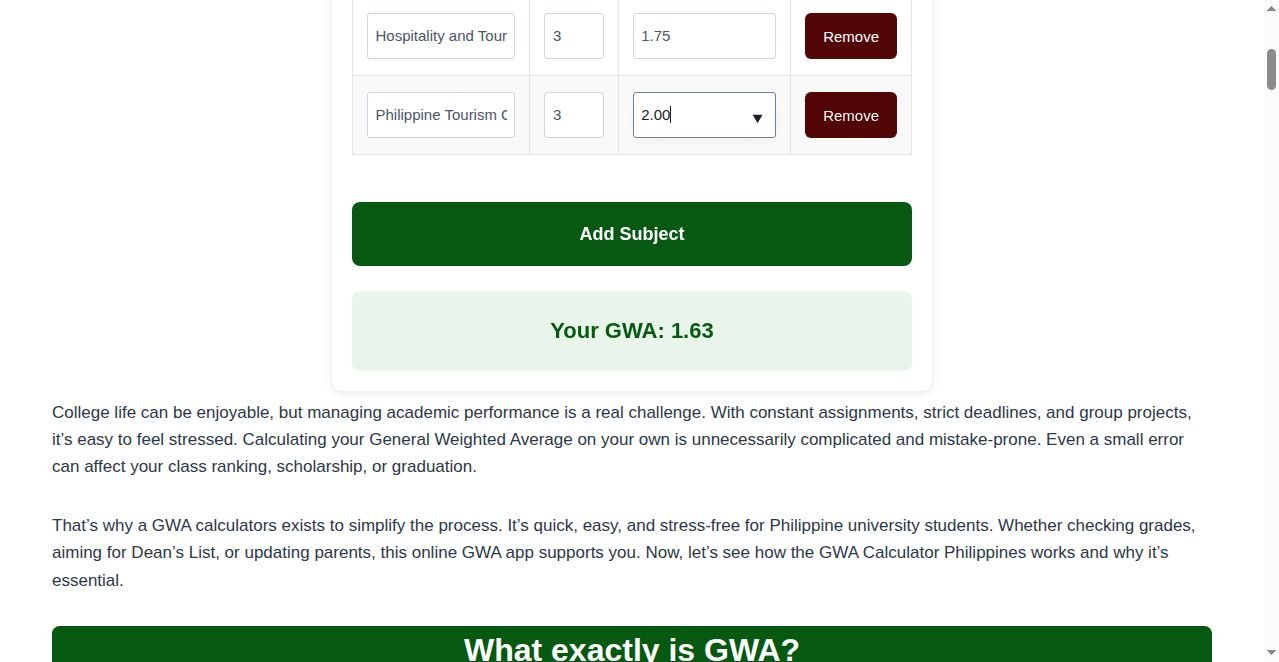
The screenshot above is the live calculator on this site: Tourism Planning and Development at 1.25, Tour Guiding and Escorting at 1.50, Hospitality and Tourism Marketing at 1.75, and Philippine Tourism Geography and Culture at 2.00, three units each — (3 × 1.25) + (3 × 1.50) + (3 × 1.75) + (3 × 2.00) = 19.50, and 19.50 ÷ 12 = 1.625, which rounds to 1.63. The video below shows the same calculation done live.
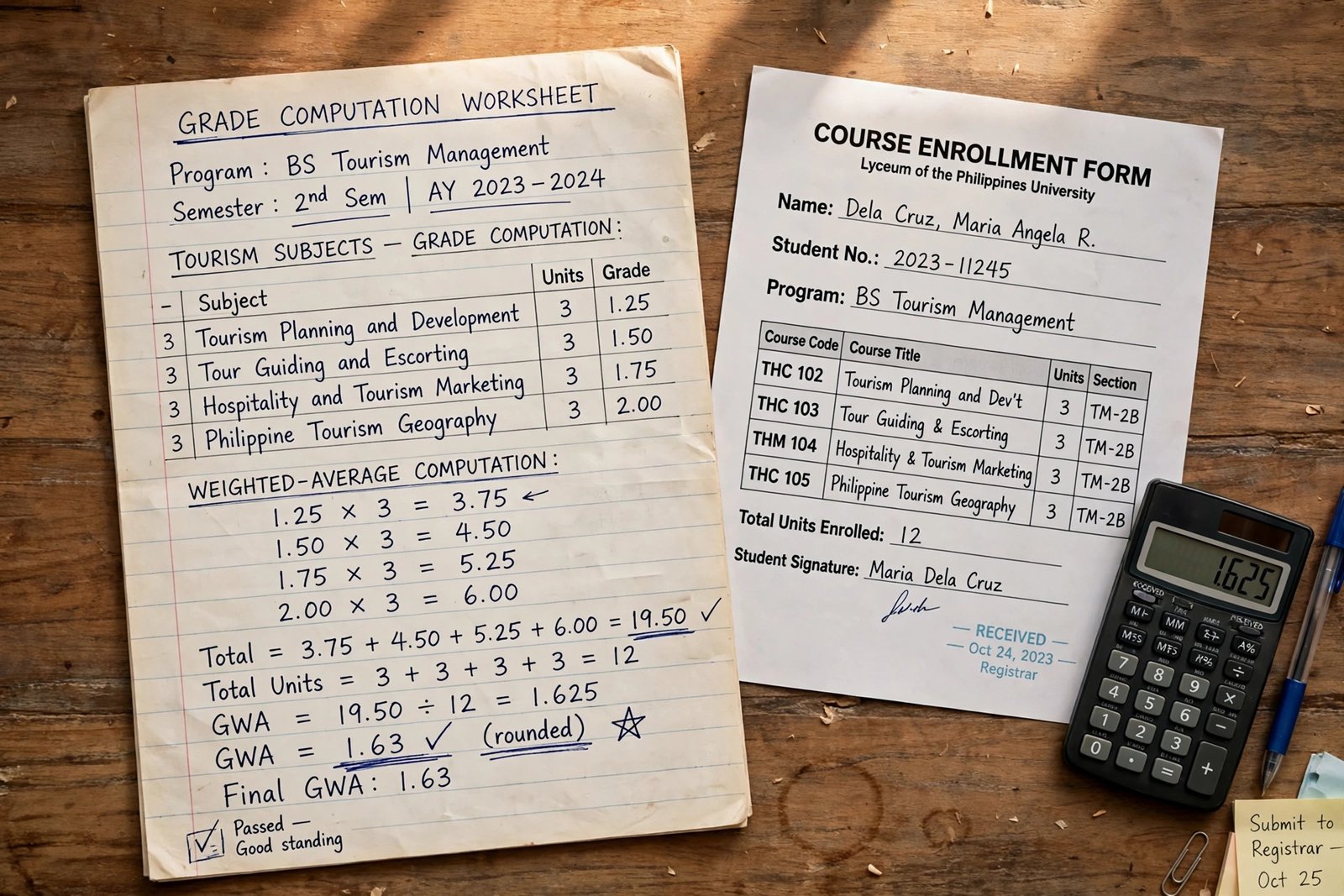
The NSTP and PE Trap: The Same Grades, Three Different GWAs
Here is a trap that catches thousands of Philippine students every semester, and it has nothing to do with how hard your subjects are. It is about which subjects your school counts in the GWA at all. PE (now usually called PATHFIT) and NSTP are the two usual suspects. The University of the Philippines excludes both — and because both subjects are usually graded generously, including or excluding them can move your GWA by a tenth of a point.
The clearest demonstration comes from a competitor’s own worked example, recomputed three ways. The page gwacalculatorph.com works an example — Math 101 (1.50, 5u), English 101 (1.75, 3u), Filipino 101 (2.00, 3u), PE 1 (1.25, 2u), NSTP (1.50, 3u) — and reports “25.75 ÷ 16 = 1.609 GWA.” The arithmetic is correct: the products total 25.75 over 16 units, and 25.75 ÷ 16 = 1.609375, which rounds to 1.609. But the method is wrong for any school that excludes PE and NSTP, and the page never warns the reader. Without NSTP only, the products are 21.25 over 13 units, giving 1.635. Fully the UP way, without PE and without NSTP, they are 18.75 over 11 units, giving 1.705. The same five grades are 1.609, 1.635, or 1.705 — a swing of almost a tenth that crosses the 1.75 region students care about most.
The same effect shows up in this article’s own MAIN semester. Add an NSTP subject at 1.00 for 3 units and the GWA falls from 1.59 to 1.51: the total becomes 34.75 grade points over 23 units, and 34.75 ÷ 23 = 1.5109. A 1.00 in NSTP makes the semester look nearly a tenth better — but only if your school counts NSTP. At UP, it does not count, and the semester stays at 1.59. The calculator on this site handles exclusion the way you would expect: a row with zero units is skipped entirely. Before you compute your GWA for any official purpose, check your handbook: does your school include PE and PATHFIT, and does it include NSTP?
Dean’s List for Tourism Students
Dean’s List is the most searched honors question in Philippine higher education, and it is also the one where the top Google results are most confidently wrong. The number-one result for this topic’s keyword family tells students that “most Philippine universities require a semester GWA of 2.00 or better” for the Dean’s List. That is false: 2.00 is good academic standing at UP, PUP, and UST — it is not the Dean’s List at any of them. The official UP rule, published in the UP Diliman Rules on Scholastic Standing, sets College Scholar — UP’s name for the Dean’s List — at a GWA of 1.75 or better, and University Scholar at 1.45 or better, with at least 15 units and no grade below 3.00.
| University | Dean’s List cutoff | Conditions | Verification |
|---|---|---|---|
| University of the Philippines (all campuses) | 1.75 or better = College Scholar (Dean’s List); 1.45 or better = University Scholar | At least 15 units; no grade below 3.00 | Verified — UP Rules on Scholastic Standing (official) |
| University of Asia and the Pacific (UA&P) | 1.50 or better | No failing mark during entire stay; no INC for the semester | Verified — UA&P Student Handbook (official) |
| De La Salle University (DLSU) | GPA 3.400+ = First Honors; GPA 3.000–3.39 = Second Honors (4.0 scale) | At least 12 units; no grade below 2.0; no cheating or discipline offense | Verified — DLSU handbook |
| Isabela State University (ISU) | 1.75 Dean’s List; 1.50 President’s List | Per ISU handbook | Verified — ISU PPP handbook |
| Polytechnic University of the Philippines (PUP) | 1.75 or better; President’s Lister 1.50 | Reported: no grade lower than 2.50 | Reported — confirm with your registrar |
| University of Santo Tomas (UST) | 1.75 or better | Reported: full load; no failing or INC | Reported — confirm with your registrar. |
| Far Eastern University (FEU) | QPA 3.51–4.00 first honors; 3.35–3.50 second honors (4.0 scale) | No failing grades | Reported — confirm with your registrar. FEU runs BSTM (Travel and Tours track). |
| Mapúa University | 1.75 or better per term | Reported: running GWA 2.00+; no F/5.00/ABS/I/C/W; full load | Reported — confirm with your registrar |
Read the pattern in that table, not just the numbers. The verified rows — UP, UA&P, DLSU, ISU — all sit at 1.75 or stricter, and the reported rows agree. Nobody credible puts the Dean’s List at 2.00. The 1.75 figure is also the consensus across the better secondary sources, and it matches the Cum Laude boundary: the Dean’s List is, in effect, the semester-level version of the graduation honours bar. Notice also the conditions column, which is where most Dean’s List hopes actually die. At UP, a single grade below 3.00 disqualifies you even if your average is 1.30. At UA&P, an INC in the semester blocks you. The calculator can compute the average, but only your handbook can tell you whether the average is enough. The same caution applies to Adamson University, whose Dean’s List cutoff no source in this research could find at all — this article will not invent one.
What does a Dean’s List semester actually look like for a tourism student? The test run for this article built one: Tourism Planning and Development at 1.25 for 3 units, Tour Guiding and Escorting at 1.50 for 3, Hospitality and Tourism Marketing at 1.25 for 3, Philippine Tourism Geography and Culture at 1.50 for 3, Fundamentals of Tourism at 1.25 for 3, Purposive Communication at 1.50 for 3, and PE 2 at 1.00 for 2. The products total 26.75 over 20 units, giving 26.75 ÷ 20 = 1.3375, which rounds to 1.34 — 95.8%, Excellent, on this site’s percentage converter. It clears every Dean’s List bar in the table above with room to spare, without a single 1.00. You do not need perfection — you need consistency.

The image above shows the calculator being used the way a Dean’s List–chasing student would use it — grades typed in one by one, the result checked before the semester ends. If your own semester is tracking near a cutoff, compute it now, while there is still time to pull a grade up. For the full cutoffs across Philippine universities, see Dean’s List GWA requirements in the Philippines.
Latin Honors for BS Tourism Management
If the Dean’s List is a semester award, Latin honors are the degree award — and the difference between the two is the single most misunderstood fact in Philippine student life. Latin honors are computed on your cumulative GWA at graduation: every subject, every semester, all ~137 units of the CHED curriculum, averaged together with the same weighted formula. One brilliant semester does not earn them. One disastrous semester can cost them. The bands themselves are, unusually for Philippine higher education, consistent across the universities that publish them.
| Honor | Cumulative GWA band | What it means |
|---|---|---|
| Summa Cum Laude | 1.00 – 1.20 | With highest honors — the top band, achieved by very few graduates in any program. |
| Magna Cum Laude | 1.21 – 1.45 | With great honors — at UP this is also the University Scholar range. |
| Cum Laude | 1.46 – 1.75 | With honors — the same 1.75 boundary as the UP Dean’s List. |
The bands are only half the story. The conditions attached to them, verified across UP and ISU, are where tourism students most often lose honors they had the grades for. At UP, you must have earned at least 75% of your total units at the granting university, with at least two years of residence immediately before graduation; you must have carried a normal load of at least 15 units every semester; you must finish within the prescribed four years; and you must have no finding of cheating or dishonesty. ISU adds a per-subject condition: no grade below 2.50 in any subject for honors candidates. A transferee who did two years elsewhere, an irregular student who underloaded for a semester, or a student with one 2.75 can all have a cumulative GWA inside the Cum Laude band and still not receive the honor. Check the conditions in your own handbook early — ideally in first year. The full picture is covered in Latin honors GWA requirements in the Philippines.
The cumulative mathematics is where the four-year length of the degree becomes either your best friend or your worst enemy. Take a student with 96 units behind them — roughly five semesters — who then posts the MAIN semester from this article, the 20-unit semester at 1.59. If those 96 prior units sit at 1.85, the cumulative figure becomes (96 × 1.85 + 31.75) ÷ 116 = 209.35 ÷ 116 = 1.80: still outside the Cum Laude band. At 1.70, it becomes 194.95 ÷ 116 = 1.68, which clears the 1.75 bar; at 1.45, it becomes 170.95 ÷ 116 = 1.47. And at 1.80, it becomes 204.55 ÷ 116 = 1.76 — missing the 1.75 bar by just 0.01, because a single grade step in a single 3-unit subject earlier in the degree would have closed it. Early semesters matter enormously: 96 units of history outweigh 20 units of present by nearly five to one. The reverse is also true: a strong start is a cushion that survives a bad semester later. Treat first and second year as the honors years, not fourth year — that is the single most useful fact in this guide to gwa for tourism students philippines. For cumulative averaging in general, see cumulative GWA across semesters.
First, UST is widely reported as having stricter Latin honors bands than the standard 1.20 / 1.45 / 1.75 — one calculator site reports UST’s bands as Summa 1.00–1.10, Magna 1.11–1.35, Cum Laude 1.36–1.60, while two other sites say UST uses the standard bands, and one site contradicts itself on a single page. No official UST source was found in this research, so this article will not state any UST figure as fact: if you are at UST, confirm the bands with the College of Tourism and Hospitality Management registrar. This matters for tourism students in particular, because UST runs one of the largest BSTM programs in the country.
Second, one secondary source claims PUP’s current handbook sets Cum Laude at 1.6000 — but the PUP handbook text read in this research covers warnings, probation, and dismissal, and contains no such honors figure, while another source says PUP follows the standard bands. Do not plan your degree around the 1.6000 figure until it is confirmed from an official PUP document.
Retention: What Actually Gets Tourism Students Kicked Out
Ask a room of tourism students what GWA gets you kicked out, and most of them will name a number — 2.50, or 3.00, or something they heard from a senior. The truth is stranger and, for most students, more reassuring: there is no national GWA retention rule for BS Tourism Management in the Philippines. CHED does not set one. Retention is set by each university in its own student handbook, and in tourism it is overwhelmingly based on failing courses — not on your GWA. A student with a mediocre GWA of 2.30 who has never failed a subject is, at most schools, perfectly safe. A student with a sparkling GWA of 1.60 who has failed the practicum is, at some schools, already on the way out.
The general university retention rules still apply underneath the tourism-specific ones, and those do use numbers — usually failure percentages rather than GWA. The PUP Student Handbook sets the pattern: failing 25% of enrolled units earns a warning, failing 50% earns probation, failing 51% to 75% means being dropped from the college, and failing more than 75% means dismissal from the university and permanent disqualification. Two successive probations mean being dropped from the college rolls. At UP Diliman, good scholastic standing requires a final grade of 3.00 or better in at least 75% of enrolled academic units. The practical translation: your GWA can absorb one bad grade, but your enrolment cannot absorb a failed practicum, because the practicum is six units of a 17-unit semester — more than a third of the load.
The calculator test cases put numbers on the danger zone. A semester of 17 units all at 2.00 returns exactly 2.00 — the boundary itself, and a figure you should treat as a warning light rather than a safe harbour. A realistic retention-risk semester — Tourism Planning and Development at 2.25, Tour Guiding and Escorting at 2.50, Hospitality and Tourism Marketing at 2.50, Philippine Tourism Geography and Culture at 1.75, Fundamentals of Tourism at 2.00, Mathematics in the Modern World at 2.00, and PE 1 at 1.00 — computes to 41.00 ÷ 20 = 2.05. That student has not failed anything, and yet the semester is a warning: one more weak grade in a core subject next semester, and the cumulative figure starts sliding toward the region where scholarships lapse and probation begins. A 2.05 in first year is recoverable; a 2.05 in third year is a much heavier problem.
Scholarships: CHED Says Yes, DOST Says No
Here is a piece of news that no competitor GWA page mentions, and it will save some tourism students a wasted application: BS Tourism Management is a CHED priority course — and it is not a DOST priority course. The two scholarship systems have different lists, and tourism sits on only one of them. The CHED priority-course list under CMO No. 07, series of 2023 (for academic years 2023–2024 to 2027–2028) names “Tourism Management / Tourism” and “Hospitality Management / Hotel and Restaurant Management” in its Business and Management cluster, confirmed across five independent lists in this research. The CHED Bagong Pilipinas Merit Scholarship 2026 list names “Bachelor of Science in Tourism Management” and “Bachelor of Science in International Travel and Tourism Management” directly. DOST-SEI, by contrast, funds priority science and technology fields only — engineering, natural sciences, mathematics, IT, agriculture, health sciences — and no tourism program appears on its priority lists. A tourism student who follows generic “apply for DOST” advice will be turned away at the first check.
The CHED Merit Scholarship Program has the same shape and the same caveat as every other figure in this section. The figures found in this research — entry at a Grade 12 GWA of 93% or equivalent, and maintenance at 85% or equivalent for a full scholar and 80% for a half scholar, every semester, with failure to maintain the grade as a ground for termination, applying to replacement scholars as well — come from a single source, CHED Memorandum Order No. 13, series of 2025, as reproduced on Scribd. Confirm them at ched.gov.ph before relying on them. But the shape of the rule is the important part: CHED’s bar is expressed in percentages, not GWA, and it is checked every semester — and that conversion is per-school. The CHED Tulong Dunong Program also lists “Tourism/Travel Management” among its priority courses — confirm the details with your school’s TDP focal person. For the scholarship-specific GWA picture across programs, see GWA requirements for scholarships in the Philippines.
| Scholarship | Tourism eligible? | Entry bar (reported) | Retention bar (reported) | Status |
|---|---|---|---|---|
| CHED Merit Scholarship Program | Yes — Tourism Management is a CHED priority course (CMO 07, s. 2023) | Grade 12 GWA at least 93% | 85% (full scholar) / 80% (half scholar) every semester | Single source (CMO 13, s. 2025 via Scribd) — confirm at ched.gov.ph |
| CHED Tulong Dunong Program | Yes — Tourism/Travel Management listed as priority | Enrolled in a CHED-registry HEI; not a TES/CSP/StuFAP beneficiary | Per UniFAST guidelines — confirm with school focal person | Secondary source — confirm with your school |
| CHED Bagong Pilipinas Merit Scholarship | Yes — BSTM named directly in the 2026 priority list | Per program guidelines | Per program guidelines | Secondary list — confirm at ched.gov.ph |
| DOST-SEI (RA 7687 / Merit / JLSS) | No — STEM priority courses only; tourism not listed | — | — | Do not apply for DOST-SEI as a BSTM student |
| TESDA (NC II qualifications) | Yes — free at public training centres; no GWA requirement | Basic math + English communication | Pass the competency assessment | Verified — TESDA training regulations |
Practicum and OJT: The 600-Hour, 6-Unit Semester
Students ask about OJT for tourism the way students in other courses ask about it — as if it were a small subject tucked into one semester. For BS Tourism Management, that assumption is wrong in the most important way: the practicum is the biggest single grade in the degree. Under CHED CMO No. 62, series of 2017, the Practicum / Work-Integrated Learning subject carries 6 units and 600 hours — confirmed in the University of the Visayas BSTM curriculum — which makes it worth exactly two ordinary 3-unit subjects. FEU runs the same idea under a different name, the Tourism Apprenticeship Program, in the fourth year, where the whole semester’s load drops to 7.5 units because the apprenticeship dominates it.
The test run for this article built a final-year load around it: Practicum at 1.50 for 6 units, Tourism Planning and Development at 1.75 for 3, Events Management at 2.00 for 3, Ethics at 1.25 for 3, and PE 4 at 1.25 for 2. The products total 26.50 over 17 units, giving 26.50 ÷ 17 = 1.5588, which rounds to 1.56. Now watch what the practicum alone does to that semester. Give the student a 2.50 in the practicum instead of 1.50, with everything else unchanged, and the total rises from 26.50 to 32.50, giving 32.50 ÷ 17 = 1.91 — past the Dean’s List bar and past the good-standing comfort zone, from a single grade. Give the same student a 2.50 in the 2-unit PE subject instead, and the total becomes 29.00, giving 29.00 ÷ 17 = 1.71 — still inside the bar. The same weak grade costs 0.35 of GWA in the practicum and 0.15 in PE. If you take one practical habit from this section, let it be this: treat the practicum semester like a final exam that lasts four months, because that is what the arithmetic says it is.
There is also a finding about the practicum that should take some pressure off. A 2026 study from the University of Cebu–Banilad — the only real data found in this research on tourism students’ grades — tracked 71 BSTM students in school year 2023–2024 and compared their GWA with their practicum performance ratings from the College of Tourism Management. The GWA distribution was: Very Good (1.1–1.5) 28.17% of students, Good (1.6–2.5) 70.42%, and Fair (2.6–2.9) 1.41%. And the study’s own conclusion was that no correlation was found between GWA and practicum performance. Use that study with its caveats — one university, one school year, a small sample, and the school’s own GWA bands — but the message stands: a 1.6–2.5 GWA is the typical tourism-student reality, and a middling GWA does not predict a middling practicum. The practicum grades what you do on the job — showing up, handling guests, keeping the itinerary on time — and those are skills the classroom average only partly measures.
The practical advice is straightforward. First, check your own school’s curriculum for the practicum’s exact unit load and hour requirement before assuming it is 6 units and 600 hours — FEU’s apprenticeship model differs, as the official FEU BSTM Travel and Tours curriculum shows, and other schools vary. Second, if your school does have a 6-unit practicum, treat it like two subjects, because the GWA does.
Tour Guide Accreditation: Your GWA Does Not Get You In
Every tourism student eventually asks the question that this section answers, so here it is plainly: your GWA does not matter for tour-guide accreditation. Not a little. Not as a tiebreaker. Not at all. There is no PRC board exam for tourism — unlike architecture, nursing, or engineering, a BSTM graduate takes no licensure examination. The credential that matters for guiding is DOT accreditation from the Department of Tourism, governed by DOT Memorandum Circular No. 2021-002 and Republic Act No. 9593, the Tourism Act of 2009. The accreditation requirements list education, training, health, clearances, and an examination — GWA appears nowhere in them.
The circular classifies accredited guides into three types, and the education requirement is different for each. A Specialist Tour Guide — someone with technical expertise in a specific field of interest — must have completed a college degree, and a BSTM degree satisfies that requirement directly. A Regional Tour Guide must have completed the Senior High School program (or, before K-12, at least second year of college or a two-year vocational course). A Community Tour Guide has no formal education requirement. There is also a Master Regional Tour Guide category for guides accredited for at least ten consecutive years with a commendation for superior guiding performance. The training requirement is met through a TESDA-accredited institution — at least NC II Tour Guiding — or through DOT or DOT-accredited training, plus a valid Basic First Aid / Basic Life Support certificate where applicable. Community guides show proof of a 40-hour tourism-related course completed within the last three years.
The examination is the Professional Tour Guide Qualification Examination (PTGQualEx) — a three-part national qualification examination administered by the DOT — and a DOT certification of passing it is a documentary requirement for accreditation. The remaining requirements are a certificate of good health, an NBI clearance for regional guides (a police clearance for community guides), a mayor’s permit, and the latest income tax return. Accreditation is time-limited and must be renewed — the old 1992 rules set it at one year and later summaries state two years, and the circular excerpts read in this research did not state a figure, so confirm the current validity period with the DOT regional office before you plan around it.
That leaves the TESDA ladder, which runs parallel to the degree and carries no GWA requirement at all. Tour Guiding Services NC II takes 72 hours and covers researching destination and itinerary information, managing tour arrangements, and guiding clients. Local Guiding Services NC II takes 196 hours and covers coordinating tour programs and accompanying tourists in a locality. Travel Services NC II takes a nominal 223 hours including 200 hours of supervised industry training, and leads to counter, reservations, documentation, and ticketing work. Tourism Promotion Services NC II takes a minimum of 72 hours and leads to tourist information officer and travel adviser roles. The DepEd senior high school Tourism Services strand feeds the same ladder: completers are eligible for NC II assessment in Local Tour Guiding, Travel Promotion Services, and Tourism Services. A BSTM student who holds an NC II certificate already has the training proof the DOT asks for — and the certificate itself never asked for a GWA. For the board-exam GWA picture across professions that do have licensure exams, see GWA requirements for board exams in the Philippines.
Recovery: What a Failed Subject Really Costs
Every tourism student eventually faces the question this section answers, usually in the middle of a semester that has gone wrong: what does it actually cost if I fail a subject? The answer, computed against the live calculator, depends on which subject — and the reason is units. Take the MAIN semester from this article, the 20-unit semester at 1.59. Add a failed 3-unit Tour Guiding and Escorting subject at 5.00, and the semester becomes (31.75 + 15.00) ÷ 23 = 46.75 ÷ 23 = 2.03. One failed subject moves the semester from 1.59 — comfortably on the Dean’s List — to 2.03, past the 2.00 good-standing boundary and past every scholarship bar in this article.
What happens next depends on a rule that varies by school and that you must confirm with your registrar: when you retake the failed subject, does the failing grade stay in your GWA, or is it replaced? Both systems exist in Philippine universities, and the difference is worth nearly half a GWA point. Retake the failed 3-unit subject at 1.50 with the failing grade still counted, and the semester computes as (31.75 + 15.00 + 4.50) ÷ 26 = 51.25 ÷ 26 = 1.97. Retake it with the failing grade replaced, so only the 1.50 counts, and the semester is (31.75 + 4.50) ÷ 23 = 36.25 ÷ 23 = 1.58 — essentially back to the original 1.59.
The deeper problem is time. A four-year degree gives you eight semesters to build a cumulative average, and the later you try to repair it, the less repair is mathematically possible. The test run proves it: a student with 96 units of history at 2.20 who then posts a perfect final semester of 17 units, every subject at 1.00, ends at (96 × 2.20 + 17 × 1.00) ÷ 113 = 228.20 ÷ 113 = 2.02. A perfect semester — not a good one, a perfect one — and the student still misses a 2.00 retention bar, because 96 units of 2.20 outweigh 17 units of 1.00 by more than five to one. That is the mathematics of “too late”: fix it now, in the semester you are in, while there are still units ahead of you to do the diluting.
The remaining test cases fill in the rest of the recovery picture. An irregular student carrying three subjects — Tourism Planning and Development at 1.25 for 3 units, Tour Guiding and Escorting at 1.50 for 3, and Art Appreciation at 2.00 for 3 — computes to 14.25 ÷ 9 = 1.58: a light load is not a penalty in itself, though it may not satisfy the normal-load conditions for Dean’s List or Latin honors. A transferee with 45 credited units at 2.00 plus the MAIN semester computes to 121.75 ÷ 65 = 1.87. An INC or DRP grade makes the calculator return “invalid grade” until it is resolved — an incomplete subject is not a zero and not a pass, so complete the INC as soon as you can. The OJT final-year load (Practicum 6u at 1.50, Tourism Planning and Development 3u at 1.75, Events Management 3u at 2.00, Ethics 3u at 1.25, PE 4 2u at 1.25) computes to 26.50 ÷ 17 = 1.56. A heavy 26-unit load computes to 1.65.
| Scenario (all verified against the live calculator) | Computation | GWA |
|---|---|---|
| MAIN semester, no failure | 31.75 ÷ 20 | 1.59 |
| MAIN + failed 3-unit Tour Guiding (5.00) | 46.75 ÷ 23 | 2.03 |
| Retake at 1.50, fail still counted | 51.25 ÷ 26 | 1.97 |
| Retake at 1.50, fail replaced | 36.25 ÷ 23 | 1.58 |
| 96 units at 2.20 + perfect final 17 units at 1.00 | 228.20 ÷ 113 | 2.02 — still misses 2.00 |
| Irregular partial load (9 units) | 14.25 ÷ 9 | 1.58 |
| Transferee: 45 credited units at 2.00 + MAIN | 121.75 ÷ 65 | 1.87 |
| OJT final-year load (17 units) | 26.50 ÷ 17 | 1.56 |
| Heavy 26-unit load | 43.00 ÷ 26 | 1.65 |
| Dean’s List-target semester (20 units) | 26.75 ÷ 20 | 1.34 |
GWA to Percentage: What Your Number Means
Sooner or later, every tourism student needs to translate a GWA into a percentage — for a CHED scholarship form or a job application. The converter on this site does it with a simple formula: percentage = 100 − (GWA − 1.00) × 12.5, clamped between 0 and 100, with a label attached. The test run verified it across eleven cases, and the results are the table below. A GWA of 1.59 — the MAIN semester — converts to 92.6%, Excellent; the video worked example of 1.63 converts to 92.1%, Excellent; 1.75, the Dean’s List bar, to 90.6%, Excellent; 2.00 to 87.5%, Very Good; 2.50 to 81.3%, Good; 3.00 to 75.0%, Satisfactory (passing); 5.00 to 50.0%, Below passing. A perfect 1.00 is 100.0%, the Dean’s List-target semester of 1.34 is 95.8%, and a 4.00 converts to 62.5%, Below passing. Use the converter at GWA to percentage converter whenever you need the number.
| GWA | Percentage (this site’s converter) | Label | What it is |
|---|---|---|---|
| 1.00 | 100.0% | Excellent | Perfect GWA |
| 1.34 | 95.8% | Excellent | Dean’s List-target semester in this article |
| 1.59 | 92.6% | Excellent | MAIN semester in this article |
| 1.63 | 92.1% | Excellent | Video worked example in this article |
| 1.75 | 90.6% | Excellent | Dean’s List / Cum Laude bar |
| 2.00 | 87.5% | Very Good | Good-standing / retention bar |
| 2.50 | 81.3% | Good | CHED retention region (reported, in %) |
| 3.00 | 75.0% | Satisfactory (passing) | Passing mark |
| 4.00 | 62.5% | Below passing | Conditional — removable by exam |
| 5.00 | 50.0% | Below passing | Failed |
Now the warning, and it is an important one: that table is this site’s converter, and it is a straight-line formula. It is not your school’s transmutation table, and no table on any website is universal. Percentage-to-GWA conversion is per-school. One site’s table is, in fact, Isabela State University’s transmutation — 1.00 equals 97–100%, 1.75 equals 88–90%, 2.50 equals 79–81% — presented under the generic title “GWA to Grade Conversion Guide,” with no warning that it belongs to one university. Another site’s table says 1.75 equals 85–88% and 2.50 equals 73–76% — a different school’s table, equally presented as if it were general. A third site’s table says 1.00 equals 96–100% and 2.50 equals 78–80%, bands that match no other source found in this research — do not use that table. If a form asks for your percentage, use your own school’s transmutation table, or the converter on this site as a labelled estimate. The PUP grading system has its own structure — see PUP grading system — and the DepEd grading system is a different system again, covered at DepEd grading system. If you are comparing your GWA with a CGPA, see GWA vs CGPA in the Philippines.
The GWA Ladder for Tourism Students
Here is the whole guide as one ladder — every rung from enrolment to graduation honors, with the scholarship rungs in between. Check your cumulative GWA against it at the end of every semester.
| Rung | GWA | What it opens |
|---|---|---|
| Stay enrolled | 3.00 or better, no failed subjects | Good standing; enrolment next semester. |
| Keep CHED scholarship | 85% (full) / 80% (half) every semester (reported) | CHED Merit retention, in percentage terms — check your school’s transmutation. |
| Good standing / retention bar | 2.00 or better | At UP, good standing also needs 3.00+ in 75% of units. |
| Dean’s List + Cum Laude | 1.75 or better | Semester Dean’s List (UP verified, 1.75) and the Cum Laude band at graduation (1.46–1.75). |
| Magna Cum Laude / University Scholar | 1.45 or better | Magna band is 1.21–1.45; UP University Scholar is 1.45 or better. |
| Summa Cum Laude | 1.20 or better | Top band, 1.00–1.20 cumulative, with residency and load conditions. |
Notice the shape of the ladder. The gaps between rungs are not even: from 3.00 to 2.00 is a long, forgiving stretch where ordinary steady work keeps you safe, while from 1.75 to 1.45 to 1.20 the rungs get closer together and harder to climb. The ladder has no rung for tour-guide accreditation, because accreditation has no GWA rung at all — its gate is a degree, training, and the PTGQualEx. And there is no DOST rung on this ladder, because DOST does not fund tourism students.
What the Top Google Results Get Wrong
Error 1 — “Dean’s List = 2.00 or better.” Wrong. The UP official rule sets College Scholar (Dean’s List) at 1.75 or better and University Scholar at 1.45, with at least 15 units and no grade below 3.00. UA&P sets it at 1.50, ISU at 1.75. The 2.00 figure is good academic standing, not Dean’s List.
Error 2 — “Including NSTP in the GWA worked example,” and “one semester at 1.609 = Cum Laude standing.” Both wrong. UP excludes PE and NSTP from the GWA, and the same five grades compute as 1.609 with both included, 1.635 without NSTP, and 1.705 without either. Latin honors are cumulative at graduation, not a single semester’s pace.
Error 3 — “UST’s Latin honors bands stated as fact.” Unresolved conflict, not a fact. Three sources give three different answers for UST, one site contradicts itself on a single page, and no official UST source was found. The standard bands are 1.20 / 1.45 / 1.75; whether UST is stricter is reported but unverified — and it matters for tourism students because UST runs one of the largest BSTM programs in the country.
Error 4 — “The GWA formula includes a Conversion Factor.” Wrong. The formula is GWA = Σ (grade × units) ÷ Σ (units), with no conversion factor and no adjustment for major versus minor status. A related page on the same site writes the formula without the summation, which is wrong for any semester with more than one subject.
Error 5 — “One universal GWA-to-percentage table.” Misleading. Percentage conversion is per-school. The most widely copied table is Isabela State University’s transmutation; another site’s table is a different school’s; a third site’s table matches no source at all.
Error 6 — “Major courses weigh more than minor courses.” Wrong framing. Weight comes from units only. A 3-unit major and a 3-unit GE subject weigh exactly the same. Majors only seem heavier in tourism because the practicum carries six units.
Error 7 — “Tourism has a board exam, and your GWA matters for it.” Wrong on both counts. There is no PRC board exam for tourism. The credential is DOT accreditation under MC No. 2021-002, the examination is the PTGQualEx, and the GWA is not an input to any step of it. Generic “GWA for board exam” advice does not apply to BSTM graduates.
If you take one habit from this section, let it be the habit of checking the arithmetic and the source before trusting a number on a calculator site — including this one. That is the standard a guide to gwa for tourism students philippines should meet, because students make four-year decisions on these numbers. If you are applying for jobs after graduation, GWA for job applications in the Philippines covers how employers read your GWA.
FAQ: GWA for Tourism Students Philippines
What GWA do tourism students need for the Dean’s List?
At the University of the Philippines, the Dean’s List — called College Scholar — requires a semester GWA of 1.75 or better, with at least 15 units and no grade below 3.00; University Scholar requires 1.45 or better. Those figures are verified against the official UP Diliman Rules on Scholastic Standing. UA&P sets its Dean’s List at 1.50, DLSU at a GPA of 3.400+ for First Honors and 3.000+ for Second Honors on its 4.0 scale, and ISU at 1.75. PUP, UST, FEU, and Mapúa are all reported at 1.75 or its 4.0-scale equivalent, but each figure rests on a single secondary source — confirm them with your own registrar. The one number you should not believe is 2.00: that is good academic standing, not the Dean’s List.
Does my GWA matter for tour-guide accreditation?
No. Accreditation as a tour guide comes from the Department of Tourism under Memorandum Circular No. 2021-002, not from your grades. A Specialist Tour Guide needs a college degree (a BSTM degree qualifies), a Regional Tour Guide needs senior high school, and a Community Tour Guide needs no formal education. Applicants also need TESDA NC II Tour Guiding or equivalent training, a first-aid certificate where applicable, health and clearance documents, and a pass in the Professional Tour Guide Qualification Examination (PTGQualEx). There is no PRC board exam for tourism, and your GWA is not asked for at any step.
What is a good GWA for a BS Tourism Management student?
Against the bars in this article: 1.75 or better puts you on the Dean’s List and inside the Cum Laude band; 2.00 or better keeps you in good standing everywhere; 85% or better keeps a CHED Merit Scholarship (reported). Against reality, a sub-1.75 GWA is genuinely hard to achieve. The only real distribution data found in this research — a University of Cebu–Banilad study of 71 BSTM students in school year 2023–2024 — found 28.17% at 1.1–1.5 (Very Good), 70.42% at 1.6–2.5 (Good), and 1.41% at 2.6–2.9 (Fair). Seven in ten tourism students sit between 1.6 and 2.5. Use that study with its caveats — a small sample, one university, the school’s own GWA bands — but the message stands: if you are at 2.10 in second year, you are a typical tourism student.
How many units is BS Tourism Management?
The CHED-aligned figure under the current Policies, Standards and Guidelines (CMO No. 62, series of 2017) is around 137 credit units over four years and eight semesters. The older figure of 136 units comes from the superseded CMO No. 30 of 2006 and should not be quoted as current. School totals vary — FEU’s Travel and Tours track runs 22.5 units in each first-year semester — so check your own school’s curriculum. The practicum alone is 6 units and 600 hours.
Can tourism students get a DOST scholarship?
No — not for the DOST-SEI undergraduate scholarships. DOST-SEI funds priority science and technology courses only, and BS Tourism Management does not appear on its priority lists. Do not waste an application. Tourism students should look to CHED instead: Tourism Management is a CHED priority course under CMO No. 07, series of 2023, so BSTM students can apply for the CHED Merit Scholarship Program and the CHED Tulong Dunong Program. The CHED Merit figures — Grade 12 GWA of at least 93% to enter, 85% (full scholar) or 80% (half scholar) to maintain every semester — are reported from a single source and should be confirmed at ched.gov.ph.
What happens if I fail a subject in BSTM?
First, your GWA takes a hit proportional to the subject’s units: in the worked example in this article, a failed 3-unit Tour Guiding subject moves a 1.59 semester to 2.03. Second, your retention is at risk, because retention is course-fail based: at PUP, failing 25% of enrolled units earns a warning, 50% earns probation, and more than 75% means dismissal. Third, your recovery depends on your school’s retake policy: if the failing grade is replaced, a retake at 1.50 brings the example semester back to 1.58; if both attempts are counted, it only recovers to 1.97. And if the failed subject is the 6-unit practicum, the damage is double — treat that semester accordingly.
Do PE and NSTP count in my GWA?
It depends on your school, and the answer is worth about a tenth of a GWA point. The University of the Philippines excludes both PE (PATHFIT) and NSTP from GWA computation. Other schools include one or both. The same five grades compute as 1.609 with both included, 1.635 without NSTP, and 1.705 without either — so a student who uses the wrong rule will misstate their own GWA by nearly 0.10. Check your student handbook or ask your registrar before computing your GWA for any official purpose, and if you use this site’s calculator, model an excluded subject by giving it zero units, which the calculator skips entirely.
What GWA do I need for Latin honors in BS Tourism Management?
The standard bands, agreed by six sources including the official UP rules, are Summa Cum Laude 1.00–1.20, Magna Cum Laude 1.21–1.45, and Cum Laude 1.46–1.75, computed on your cumulative GWA at graduation — not on any single semester. The conditions matter as much as the bands: at least 75% of your units earned at the granting university, at least two years of residence immediately before graduation, a normal load of at least 15 units every semester, finishing within the four prescribed years, no failing grade, and no grade below 2.50 in any subject at schools that apply that condition. UST is widely reported as stricter, but the sources conflict and no official UST figure was found — confirm UST’s bands with its College of Tourism and Hospitality Management registrar.
How do I compute my GWA as a tourism student?
Multiply each subject’s grade by its units, add all the products, and divide by the total units: GWA = Σ (grade × units) ÷ Σ (units). For the worked example in this article — Fundamentals of Tourism at 1.50 for 3 units, Tourism Planning and Development at 1.25 for 3, Tour Guiding and Escorting at 1.75 for 3, Philippine Tourism Geography and Culture at 2.00 for 3, Hospitality and Tourism Marketing at 1.50 for 3, Mathematics in the Modern World at 1.75 for 3, and PE 1 at 1.25 for 2 — the products total 31.75 over 20 units, giving 31.75 ÷ 20 = 1.59. Enter the same subjects in the calculator on this site and it returns 1.59, verified in 47 test cases. Remember the weighting: the 6-unit practicum counts as much as two ordinary subjects, so protect it first.
The Bottom Line
There is no single GWA number for tourism students, and anyone who gives you one is selling you a shortcut that does not exist. There is a ladder — 3.00 to stay enrolled, 85% to keep a CHED scholarship, 2.00 for good standing, 1.75 for the Dean’s List and Cum Laude, 1.45 for Magna and University Scholar, 1.20 for Summa — and a DOT accreditation at the end of it that does not ask for your GWA at all, only for your degree, your training, and your pass in the PTGQualEx. The students who climb that ladder are rarely the ones with the most talent. They are the ones who understood, early, that a weighted average rewards the heaviest subjects: the practicum first, the core tourism subjects second, and everything else in proportion to its units.
So compute your GWA tonight, with your real grades and your real units, using the formula in this article or the calculator on this site — and compute the cumulative figure, not just the semester one, because the cumulative figure is the one that decides your honors. Then look at your enrolment form, find the subject with the most units, and give it the hours it deserves. That is the whole strategy for gwa for tourism students philippines, in one sentence: protect the practicum, track the cumulative average, and confirm every cutoff with your registrar before you plan your degree around it.