

GWA for IT Students Philippines: 2026 Guide
If you are studying information technology in the Philippines — BSIT, BS Computer Science or BS Information Systems — one number follows you from your first programming subject to the day a recruiter asks for your transcript: your GWA. This guide to gwa for it students philippines starts with the honest answer most guides skip: there is no single GWA number for IT students. The bar changes at every stage — getting into a BSIT programme, staying in it, making the Dean’s List, graduating with Latin honours, keeping a DOST or CHED scholarship, qualifying for your OJT, and getting hired. Each stage has its own number, its own rule, and in one case no number at all. What follows is the whole journey in one place, built on the rules as published by universities, CHED and DOST — including the number-one Google result for this exact topic teaching a worked example with the wrong total, a popular calculator using a grade that does not exist, and 46 test cases run against this site’s own calculator so every number below is one you can reproduce yourself.
That matters because IT is one of the few degrees where your grades are checked by more people, more often, than almost any other course. A state university checks your senior high school GWA before it lets you in. Your college checks your semester GWA before it lets you stay. Your registrar checks your cumulative GWA before it prints “cum laude” on your diploma. DOST and CHED check your GWA before they pay for your degree. Your practicum coordinator checks your grades — but not your GWA — before it lets you start your OJT. And an employer checks your transcript when you apply for your first junior developer or IT support job. If you aim at the wrong number at the wrong gate, you waste effort in the wrong place. This guide tells you which number matters where, shows you worked examples run through this site’s own calculator, and corrects the errors other guides are still repeating.
GWA for IT Students Philippines: The Short Answer
When people search for gwa for it students philippines, they are really asking which of six different bars they belong under. Here are the six gates, in one table, before the detail:
| Gate | The number | What it decides |
|---|---|---|
| 1. Admission | Senior high school GWA, usually 85% or better at state universities for board and licensure programmes; BSIT is not a board programme, so most schools admit on entrance-exam rank and strand, not a published GWA bar — check the school you are actually applying to | Whether you get into BSIT, BSCS or BSIS at all |
| 2. Retention | GWA 2.00 or better every semester is the common retention bar; fail a programming subject and you retake it — and the 5.00 stays on your transcript at most schools | Whether you stay in the programme — and whether your OJT is delayed |
| 3. Dean’s List | 1.75 or better in a semester at UP, PUP, UST and ISU (1.50 at UA&P; DLSU uses GPA 3.000+) | Whether you are a Dean’s Lister for that semester |
| 4. Latin honours | Cumulative GWA Summa ≤1.20 · Magna ≤1.45 · Cum Laude ≤1.75 across the whole degree (146 units minimum for BSIT under CHED CMO 25, s. 2015) | Whether you graduate with honours |
| 5. Scholarships | DOST-SEI: keep 2.50 (2.75 at UP) with no failing grade; CHED Merit: enter at 93%+, maintain 85% (full) / 80% (half); DOST-JLSS: 83% to apply in third year | Whether the government pays for your degree |
| 6. OJT and the first job | Practicum is 6 units / 486 hours and entry is by finished prerequisites, not by a GWA cutoff — no GWA cutoff for OJT eligibility is published anywhere; for jobs, no employer publishes a GWA cutoff either, but ≤2.00 is safe and ≤1.75 is competitive (guidance, not a rule) | Whether you start your OJT on time — and how strong your first application looks |
Two of those rows surprise almost everyone. The OJT — the 486-hour practicum that every BSIT student must finish — does not have a GWA cutoff at all: you qualify by passing your major subjects and your capstone, not by hitting a number. And a GWA of 2.00, which many students think of as merely “average”, is actually right in the danger zone for scholarships and honours at the same time: it is exactly the retention bar at many schools, the line below which a DOST scholar loses funding, and 0.25 away from the Dean’s List. The gates where your GWA genuinely decides your fate are retention, honours and funding. The rest of this guide walks each gate in order, with the exact numbers, the sources they come from, and worked examples you can check yourself on the calculator below.
What GWA Means for an IT Student
GWA stands for General Weighted Average — not “Grade Weighted Average”, as one ranking calculator site claims. It is the average of all your subject grades in a semester or across your whole degree, weighted by the number of units each subject carries. A 3-unit programming subject counts three times as much as a 1-unit subject, and one and a half times as much as a 2-unit PATHFIT class. That weighting is the whole game for IT students, because almost every professional subject in BSIT is 3 units — and many of them come as lecture-plus-laboratory pairs.
The formula is the same everywhere in the Philippines, and no competitor disputes it:
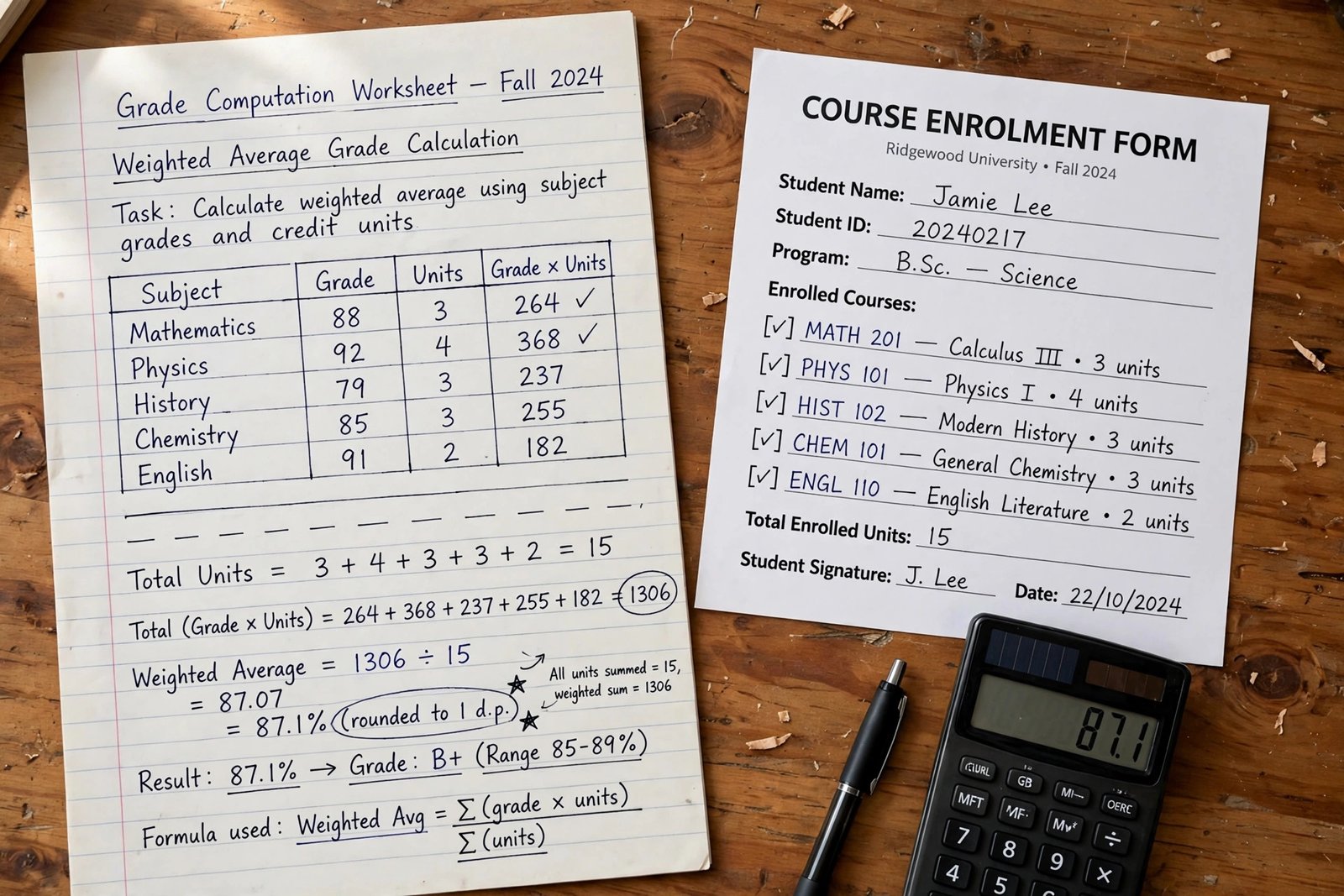
GWA = Σ (Grade × Units) ÷ Σ (Units)
Multiply each subject’s grade by its units, add all of those products together, then divide by the total number of units. That is all there is to it — there is no “conversion factor”, despite one popular calculator page inventing one.
On the Philippine 1.00–5.00 scale, lower is better: 1.00 is the best grade you can get and 5.00 means failed. The valid grade steps are 1.00, 1.25, 1.50, 1.75, 2.00, 2.25, 2.50, 2.75, 3.00 (passing), 4.00 (conditional — you must complete a requirement to convert it, or it becomes 5.00) and 5.00 (failed). One ranking site’s worked example uses a grade of “4.5”, which does not exist on this scale at all — a student copying that example would be typing an impossible grade into their calculator. Here is the scale in full:
| Grade | Meaning | Rough percentage |
|---|---|---|
| 1.00 | Excellent | 97–100% |
| 1.25 | Excellent | 94–96% |
| 1.50 | Very Good | 91–93% |
| 1.75 | Very Good | 88–90% |
| 2.00 | Good | 85–87% |
| 2.25 | Good | 82–84% |
| 2.50 | Fair | 79–81% |
| 2.75 | Fair | 76–78% |
| 3.00 | Passed (lowest passing grade) | 75% |
| 4.00 | Conditional | Below 75%, removable |
| 5.00 | Failed | Below 75% |
Two warnings before you use any percentage column, including this one. First, percentage equivalents are school-specific, not universal: competitors disagree with each other (one says 1.00 is 96–100%, another says 97–100%), because each university sets its own bands. Treat any percentage table as an approximation unless it comes from your own school’s handbook. Second, DLSU does not use this scale at all — it uses a 4.00 GPA scale, where the Dean’s List needs a GPA of 3.000 or better. If you are at DLSU, Ateneo or FEU, read the QPI/QPA sections of this guide instead of converting your grades into the 1.00–5.00 scale.
There are two GWAs you need to keep straight, because they answer different questions. Your semester GWA (sometimes called semestral GWA) covers one semester only — it decides the Dean’s List and your retention standing. Your cumulative GWA covers your whole degree so far — it decides Latin honours and is the number employers and scholarship bodies usually ask for. A student can have a 1.34 semester and a 1.81 cumulative at the same time, and both numbers are “their GWA” for different purposes. Confusing the two is the most common mistake in GWA questions, and it is also the reason a single good semester almost never rescues a weak cumulative record — the recovery math in the targets section below shows why.
How the GWA Formula Works — With Real BSIT Numbers
The fastest way to understand GWA is to work one real semester by hand, then check it on a calculator. Here is a typical first-year, first-semester BSIT load — seven subjects, 20 units — run through this site’s own calculator on 11 November 2026. Every number below was produced by the site’s actual calculator code, extracted from the live page and run in Node.js; 46 test cases were run in total and all 46 passed, so you can reproduce every figure here yourself.
| Subject | Units | Grade | Points |
|---|---|---|---|
| Programming 1 | 3 | 1.50 | 4.50 |
| Computer Organization | 3 | 1.75 | 5.25 |
| Discrete Structures | 3 | 2.00 | 6.00 |
| Introduction to Computing | 3 | 1.25 | 3.75 |
| Mathematics in the Modern World (GE) | 3 | 1.50 | 4.50 |
| Understanding the Self (GE) | 3 | 1.75 | 5.25 |
| PE 1 (PATHFIT) | 2 | 1.50 | 3.00 |
| Total | 20 | 32.25 |
GWA = 32.25 ÷ 20 = 1.6125 → 1.61. That is a solid first semester: comfortably inside the 2.00 retention bar, 0.14 away from the 1.75 Dean’s List line, and — on this site’s GWA to percentage converter — equal to 92.4%, labelled “Excellent”. Notice what the table shows about weighting. Discrete Structures at 2.00 contributes 6.00 points, twice as much as PE 1 at 1.50 contributes 3.00 points, even though the PE grade is better. In BSIT, your professional subjects decide your GWA; your GE subjects and PE soften it. That is the first strategic fact of the degree: an hour spent lifting a 3-unit programming subject from 2.00 to 1.75 moves your GWA more than the same hour spent lifting a 2-unit subject from 1.50 to 1.25.
Here is the same kind of calculation done live on this site’s calculator, with four core BSIT subjects — Programming 1 at 1.00, Data Structures at 1.50, Discrete Structures at 1.25 and Web Systems and Technologies at 1.75. The four grades total 16.50 grade points over 12 units, which is 1.375, shown as 1.38:
One quirk of this site’s calculator is worth knowing before you use it, because it affects letter grades. The calculator’s own grade table — the code it actually runs — counts a D as 3.50 and a C as 2.75, while the dropdown on the homepage labels D as 3.00 and C as 2.50. We verified this by extracting the calculator’s code from the live page: the grade map reads D = 3.50, C = 2.75. A semester of the example above plus a 3-unit D comes out at 1.86 on the calculator, where the dropdown’s 3.00 would give 1.79. Quote the calculator’s value (1.86) when you use this site, and if your school uses a different letter-to-number map, type the numeric grade directly instead of the letter. Two more behaviours to know: a row with an INC or DRP grade makes the calculator show “invalid grade” — it cannot compute until the grade is resolved — and a row with 0 units is skipped entirely, which is how you model an NSTP or PE subject your school excludes from the GWA.

Three Worked Examples Every IT Student Should See
The first-semester example above is the baseline for gwa for it students philippines. These three go further: a Dean’s List semester, a final-year capstone semester, and the one every student dreads — a failed programming subject, and what retaking it actually does to your GWA.
Example 1 — A Dean’s List-target semester: GWA 1.34
This is a second-year BSIT semester with the same 20-unit shape as the baseline, but with the stronger grades a Dean’s List run needs:
| Subject | Units | Grade | Points |
|---|---|---|---|
| Programming 1 | 3 | 1.25 | 3.75 |
| Data Structures | 3 | 1.50 | 4.50 |
| Discrete Structures | 3 | 1.25 | 3.75 |
| Web Systems and Technologies | 3 | 1.50 | 4.50 |
| Database Management Systems | 3 | 1.25 | 3.75 |
| Purposive Communication (GE) | 3 | 1.50 | 4.50 |
| PE 2 (PATHFIT) | 2 | 1.00 | 2.00 |
| Total | 20 | 26.75 |
GWA = 26.75 ÷ 20 = 1.3375 → 1.34, which the converter reads as 95.8% “Excellent”. That clears the 1.75 Dean’s List bar at UP, PUP, UST and ISU with 0.41 to spare, and it clears the 1.45 University Scholar bar at UP too. Note the pattern: no grade below 1.50, and the two 1.25s are both in 3-unit professional subjects. A Dean’s List semester is not built on perfect GE grades — it is built on keeping every 3-unit major at 1.50 or better. One 2.50 in Data Structures instead of 1.50 would add 3.00 points and push this semester to 1.49; one 3.00 would push it to 1.56. The margin is thinner than it looks, and it is entirely in the professional subjects.
Example 2 — A final-year capstone semester: GWA 1.57
Fourth year looks different: fewer units, heavier subjects. A typical final-year load is 14 units — Capstone Project 1, Software Engineering, Networking 2, one GE subject and PE 4:
| Subject | Units | Grade | Points |
|---|---|---|---|
| Capstone Project 1 | 3 | 1.75 | 5.25 |
| Software Engineering | 3 | 1.50 | 4.50 |
| Networking 2 | 3 | 2.00 | 6.00 |
| Ethics (GE) | 3 | 1.25 | 3.75 |
| PE 4 (PATHFIT) | 2 | 1.25 | 2.50 |
| Total | 14 | 22.00 |
GWA = 22.00 ÷ 14 = 1.5714 → 1.57. Still Dean’s List territory at the 1.75 bar, even with a 2.00 in Networking 2. But notice the trap of a light final year: with only 14 units, each grade swings the average hard. That 2.00 in Networking contributes 6.00 of the 22.00 points — more than a quarter of the semester. In a 20-unit semester the same 2.00 would be diluted by six more subjects; in a 14-unit semester it is not. And the capstone matters twice: a low capstone grade hurts the semester GWA, and an unfinished capstone delays the practicum, because practicum entry requires passing all major courses and the capstone. Protect the capstone first.
Example 3 — The failed subject: one 5.00, and what retaking it does
Take the baseline first-year semester (GWA 1.61) and add one failed 3-unit subject — Data Structures at 5.00:
| Scenario | Points ÷ Units | GWA | What it means |
|---|---|---|---|
| Baseline semester | 32.25 ÷ 20 | 1.61 | Safe, 0.14 from Dean’s List |
| + Data Structures 3u @ 5.00 | 47.25 ÷ 23 | 2.05 | Below the 2.00 retention bar — probation territory |
| Retake at 1.75, fail still counted | 52.50 ÷ 26 | 2.02 | Still below 2.00 — the 5.00 keeps dragging |
| Retake at 1.75, fail replaced | 37.50 ÷ 23 | 1.63 | Nearly back to baseline — if your school replaces |
One failed 3-unit subject moves a 1.61 semester to 2.05 — a swing of 0.44, enough to cross the retention line. And the retake math is the part most students get wrong. At most Philippine schools, the original 5.00 stays on your transcript of records even after you retake the subject, and both grades count in the cumulative GWA — so retaking Data Structures at 1.75 only brings the semester to 2.02, still below the retention bar. Only if your school’s policy replaces the failed grade does the retake restore you to 1.63. Ask your registrar which rule applies before you assume a retake fixes the damage — and know that even a replaced 5.00 can still void Latin honours at some schools, because the honours rules look at your whole record, not just the averaged number. The same test run found that an INC grade behaves the same way in the other direction: until it is completed, the calculator cannot compute at all, and a completed INC at 2.00 brings the baseline semester to 1.66.
The Weighting Traps That Catch IT Students
Three traps catch more IT students than any other GWA mistake, and all three come from forgetting that units are weights.
Trap 1: the simple average. A student with a 2.50 in a 3-unit Programming subject and a 1.00 in a 2-unit PE class often averages them as (2.50 + 1.00) ÷ 2 = 1.75. Wrong. The weighted answer is (7.50 + 2.00) ÷ 5 = 1.90 — the calculator confirms it. The 3-unit subject pulls three times harder than the 2-unit one, so the bad grade wins. The same trap at semester scale: a 17-unit block at 2.00 plus one 3-unit subject at 1.00 is not (2.00 + 1.00) ÷ 2 = 1.50. It is 37.00 ÷ 20 = 1.85. If you have ever wondered why your GWA is worse than the “average of your grades”, this is why — and it is also why the popular advice to “just average your grades” is bad advice for any student whose subjects carry different units.
Trap 2: the lab split. Many BSIT professional subjects are split into lecture and laboratory components — commonly 2 units of lecture plus 1 unit of lab, or 3 units total across two rows on your grade slip. Students enter only the lecture grade and forget the lab, or enter both at the same grade. A 1.50 lecture with a 2.50 lab is not a 1.50 subject: it is (3.00 + 2.50) ÷ 3 = 1.83 for that course. Laboratory grades are where IT students quietly lose GWA points, because labs are graded on output — working code, submitted on time — and a late or broken submission costs more than a wrong quiz answer. Treat every lab row as its own subject with its own weight.
Trap 3: the light semester. An irregular student taking only three subjects — Programming 1 at 1.25, Web Systems at 1.75 and a GE at 2.00, 9 units total — gets 15.00 ÷ 9 = 1.67. That is a fine GWA, but it is fragile: one 2.50 in that 9-unit load would push it to 1.92, while the same 2.50 in a 20-unit load would barely move the needle. Light loads amplify every grade, good and bad. The other side of the same trap is the heavy load: the baseline semester plus Networking 1 and Software Engineering (26 units) comes out at 43.50 ÷ 26 = 1.67 — the extra subjects dilute the average, which is why overloading to “catch up” rarely improves a GWA, even when the extra grades are decent.

One more practical note for calculator use: this site’s calculator treats letter grades through its own map (A+ = 1.00, A = 1.25, A− = 1.50, B+ = 1.75, B = 2.00, B− = 2.25, C+ = 2.50, C = 2.75, C− = 3.00, D = 3.50, F = 5.00). The full letter ladder from A+ down to F, one 3-unit subject each, averages 1.63 for the top half and 3.35 for the bottom half — and the calculator accepts lowercase letters too, so “a-” works the same as “A-“. If your school’s letter map differs from this one, type the numeric grade instead of the letter; the numbers are what count.
Per-Semester GWA Targets: Your Road Map to Latin Honors
Latin honours are decided by your cumulative GWA at graduation, over the whole degree — a minimum of 146 units for BSIT, BSCS and BSIS under CHED CMO No. 25, s. 2015 (36 GE units, 18 common courses, 48 professional courses, electives, PE and NSTP). That means the target is a total number of grade points, not a per-semester feeling. To finish 146 units at 1.75 (Cum Laude) you need 255.50 points in total. To finish at 1.45 (Magna) you need 211.70. To finish at 1.20 (Summa) you need 175.20. Every semester either banks points toward that total or spends them.
Here is what that means in practice, after different first semesters:
| After your first 20-unit semester | To finish Cum Laude (≤1.75) | To finish Magna (≤1.45) | To finish Summa (≤1.20) |
|---|---|---|---|
| 20 units at 1.25 (25.00 pts) | Average 1.83 over the remaining 126 units | Average 1.48 | Average 1.19 |
| 20 units at 1.61 (32.25 pts — the baseline example) | Average 1.77 | Average 1.42 | Average 1.13 — nearly every remaining subject at 1.00 or 1.25 |
| 20 units at 2.00 (40.00 pts) | Average 1.71 | Average 1.36 | Average 1.07 — effectively impossible in practice |
| 20 units at 2.05 (41.00 pts — one failed subject) | Average 1.70 | Average 1.35 | Average 1.07 — effectively impossible in practice |
The Summa column is the honest one. A 1.61 first semester leaves 126 units to average 1.13 for Summa — possible on paper, but it means almost every remaining subject at 1.00 or 1.25, with no room for a single 2.00. After a 2.00 first semester the required average is 1.07, which is effectively impossible in practice. In other words, Summa is decided in the first year. That is not discouragement; it is the reason the first two semesters matter more than the last two, and why the students who graduate Summa are usually the ones who treated Programming 1 like a major subject from week one.
The same arithmetic shows the recovery limits further along. After 96 units at 1.85, adding the baseline 20-unit semester at 1.61 gives 209.85 ÷ 116 = 1.81 — still above the 1.75 line. After 96 units at 1.70, the same semester gives 195.45 ÷ 116 = 1.68, which clears it. After 96 units at 1.45, it gives 171.45 ÷ 116 = 1.48, inside the Magna band. And the hard limit: after 96 units at 2.20, even a perfect final 17-unit semester at 1.00 leaves you at 228.20 ÷ 113 = 2.02 — still above a 2.00 retention bar. Recovery is possible early and nearly impossible late, because the units you have already banked outweigh the units you have left. If you are in your first year, your GWA is still mostly unwritten. If you are in your third year at 2.20, the realistic goal is not a 1.75 finish — it is a strong final year, a clean transcript, and a good OJT.
A practical way to use this: after every semester, run your cumulative GWA through the calculator and compare it against the targets above. If your cumulative is 1.70 after 80 units (two years), you need to hold 1.81 or better over the remaining 66 units to stay Cum Laude — very doable. If it is 1.85, you need 1.63 — harder, but still a Dean’s List pace. If it is 2.00, you need 1.45 — a near-perfect run. The number tells you how hard the remaining road is, and it tells you early enough to change course.
Dean’s List Cutoffs by University
The Dean’s List is a semester honour, not a cumulative one: you earn it one semester at a time, and you can lose it the next. The most common cutoff in the Philippines is 1.75 or better, but the details — minimum load, the lowest grade allowed, whether PE counts — differ by school, and the differences are where students get caught. This table uses only verified figures; where a number could not be verified, it says so instead of guessing.
| University | Dean’s List cutoff | Extra rules | Status |
|---|---|---|---|
| UP | 1.75 or better (College Scholar); 1.45 or better = University Scholar | At least 15 units; no grade below 3.00; PE/NSTP excluded | Corroborated by multiple sources |
| PUP | 1.75 or better; President’s Lister 1.00–1.50 | At least 15 units or prescribed load; no grade below 2.50; no 4.00, INC or DRP | Corroborated; PE/NSTP treatment contested (see below) |
| DLSU | GPA 3.000+ (2nd Honors); 3.400+ (1st Honors) | At least 12 units; no grade below 2.0 in any academic course; no failure in any course including NSTP | Verified from DLSU’s own honours page |
| UA&P | 1.50 or better | No failing mark during entire stay; no incomplete for the semester | Verified from UA&P student handbook |
| ISU (Isabela State) | 1.75 or better; President’s List 1.50 | Full-time load; PE/NSTP excluded from GWA | Verified from ISU faculty manual |
| UST | 1.75 or better | Full load; no failing grade or INC | Single competitor source — needs handbook check |
| FEU | QPA 3.51–4.00 first honours; 3.35–3.50 second honours | No failing grades | Single competitor source — check the FEU handbook |
| Mapúa | 1.75 or better per term + running GWA 2.00 or better | Full curricular load; no F, 5.00, ABS, I, C or W | Single competitor source |
| BulSU | 1.21–1.75 Dean’s; 1.00–1.20 President’s | No grade below 2.0; second year and up | Single competitor source |
| LCUP | Two consecutive semesters at Dean’s List level | No grade below 2.0 in major/minor; INC disqualifies; transferee grades from the previous school excluded | Verified from LCUP policy |
| TIP | No published cutoff found | — | Not published — do not trust any number you see quoted for TIP |
Three patterns in that table matter for IT students specifically. First, the load rule: UP and PUP require at least 15 units, DLSU at least 12 — DLSU’s own honours support page states the 12-unit minimum and the GPA 3.000/3.400 tiers directly. An irregular student carrying 9 units cannot make the Dean’s List at UP or PUP no matter how good the grades are — the 1.67 irregular example in the traps section would not qualify. Second, the lowest-grade rule: a single 2.50 can disqualify you at PUP even if your average is 1.40, and a single INC disqualifies you almost everywhere. Third, UA&P’s 1.50 bar is stricter than the common 1.75 — a 1.61 semester that makes the list at UP would not make it at UA&P. Check your own school’s handbook, not a generic list, before you plan a semester around a cutoff.
For the full picture on how Dean’s List, Latin honours and scholarships compare — which one is semestral, which is cumulative, which one resets — see our guides to Latin honors GWA in the Philippines and GWA for scholarships in the Philippines.
Latin Honors for IT Students
Latin honours use your cumulative GWA over the whole degree, and the bands are the same across most Philippine universities — a widely used convention, not a CHED order. No CHED memorandum number for these thresholds was found in any source, despite two competitor pages claiming CHED authority for them, so treat the bands as the standard convention and confirm them with your registrar:
| Honour | Cumulative GWA | What it takes (146-unit degree) |
|---|---|---|
| Summa Cum Laude | 1.00 – 1.20 | No more than 175.20 grade points in total — effectively 1.00s and 1.25s for four years |
| Magna Cum Laude | 1.21 – 1.45 | No more than 211.70 points — a Dean’s List pace, every semester |
| Cum Laude | 1.46 – 1.75 | No more than 255.50 points — strong semesters with room for one weak one |
The bands are only half the rule. The other half is the disqualification traps, and they are what end most honours runs. A 5.00 anywhere on your record can void Latin honours even after a retake. Underloading below the prescribed load forfeits honours eligibility for that semester. Exceeding the maximum residency — taking longer than the allowed years — can disqualify you. A disciplinary case can too. One source also reports a tiered “no grade below” rule — no grade worse than 2.00 for Summa, 2.50 for Magna, 3.00 for Cum Laude — but that comes from a single source, and Isabela State University’s published manual uses a flat “no grade below 2.50 for any honours tier” instead, so treat the tiered version as reported, not settled, and check your handbook.
Then there is the rounding trap, which is small, cruel and real. Honours cutoffs are applied to the GWA as computed, usually to three or four decimal places — a cumulative GWA of 1.751 does not round down to 1.750 for Cum Laude, and 1.451 does not round down to 1.450 for Magna. If your cumulative sits at 1.751, you miss Cum Laude by 0.001 — one hundredth of a grade point in one 3-unit subject. That is why the targets table above matters: you do not aim for exactly 1.75, you aim for 1.70, so that a single bad quiz cannot push you over the line in your final semester. For the full honours rules, including residency and the no-grade-below conditions, see our Latin honors guide.
Do PE, NSTP and PATHFIT Count Toward Your GWA?
This is the most confidently wrong topic in Philippine GWA content. Two ranking calculator sites make opposite blanket claims — one says PE, NSTP and electives are always counted, the other says they are excluded in most universities — and both are wrong. The truth is per-school, and for one major university the two sites directly contradict each other. Here is what is actually verified:
| School / body | PE / PATHFIT and NSTP | Status |
|---|---|---|
| UP | Excluded from GWA | Agreed by all sources |
| ISU | Excluded from GWA | Verified from faculty manual |
| PUP | Contested — one site says included, another says excluded | Unresolved — check the PUP handbook |
| UST | Reported as included | Single source |
| FEU | Reported as included | Single source |
| DOST-SEI scholarships | PE, NSTP and religious subjects excluded from the scholar’s GWA | Verified from official DOST text |
The difference is not academic. Take the baseline semester at 1.61, which includes PE 1 at 1.50 over 2 units. Count NSTP at 1.00 over 3 units and the semester becomes 35.25 ÷ 23 = 1.53 — better by 0.08. Exclude it and you stay at 1.61. That 0.08 is the difference between clearing and missing a 1.60 scholarship bar. So before you type PE or NSTP into any calculator, find out your school’s rule — and if you are a DOST scholar, remember that DOST computes your GWA without PE and NSTP even if your school includes them. The calculator on this site lets you model either rule: give the PE/NSTP row 0 units and it is skipped entirely.
Scholarships That Pay for an IT Degree
BSIT, BSCS and BSIS are priority science and technology courses, which makes IT students eligible for the two biggest government scholarships — and both of them check your GWA every year. These are the verified numbers; no calculator page we reviewed gives them.
DOST-SEI Undergraduate Scholarship (Merit, RA 7687 and JLSS). The retention rule, from DOST-SEI’s own published guidelines: keep an annual GWA of 2.50 or better at a non-UP school, or 2.75 or better at UP, with no failing grade in any academic subject. PE, NSTP and religious subjects are excluded from the DOST GWA computation. The Junior Level Science Scholarship (JLSS), for students entering third year in priority S&T courses including IT, requires a GWA of at least 83% to apply — and note the distinction one scholarship guide gets wrong: 83% is the bar to apply, 85% is the bar to keep the scholarship. If you are a DOST scholar, the tested retention boundary is exact: a 17-unit semester all at 2.00 gives exactly 2.00, and the retention-risk semester in our test run — Programming 1 at 2.25, Computer Organization at 2.50, Discrete Structures at 2.50 and the rest at 1.75–2.00 — came out at 41.00 ÷ 20 = 2.05, already past the line.
CHED Merit Scholarship Program (CMSP, CMO No. 13, s. 2025). Entry requires a senior high school GWA of at least 93% — 93–95% for Half Merit, 96% and above for Full Merit — and scholars must maintain a GWA of at least 85% for full merit or 80% for half merit, with a household income cap of ₱500,000 a year. Some secondary pages wrongly state the maintaining grade as “2.5” without the percentage context; the CMO text says 85% and 80%. On the 1.00–5.00 scale, 85% sits roughly at 2.00 — which is why the 2.00 retention bar and the scholarship bar so often coincide, and why a semester at 2.05 can cost you both your standing and your funding at once.
Two practical consequences follow. First, the scholarship GWA and the school GWA are not always the same number — DOST excludes PE and NSTP, your school may not — so track both. Second, the bar that matters most is the retention bar, not the entry bar: getting the scholarship is a one-time achievement, keeping it is a four-year discipline. A student who enters DOST at 90% and then posts two semesters at 2.05 has lost the scholarship by the end of first year. For the full scholarship rules, see our GWA for scholarships guide and the PUP grading system and DepEd grading system pages for how percentage and 1.00–5.00 scales map onto each other.
OJT and Practicum: The GWA Question Nobody Answers Honestly
Every BSIT student must complete a practicum — the on-the-job training (OJT) — before graduating. It is typically 6 units and 486 hours of supervised work in a company, governed by CHED CMO No. 104, s. 2017 (the Student Internship Program in the Philippines) and CMO No. 17, s. 2021. And here is the finding no other guide states plainly: there is no published GWA cutoff for OJT eligibility. We checked the practicum guides, the CHED orders and employer OJT postings. Entry to the practicum is prerequisite-based — you must have passed all your major and specialization courses and your capstone — not GWA-based. One university’s published practicum guide lists the requirements as passing all majors plus capstone, paying an OJT fee (that university charges ₱4,220), and securing an endorsement letter. No number. Employer OJT postings, for example for IT support roles, list enrollment status, an endorsement letter and the degree field — and no GWA requirement.
That does not mean your GWA is irrelevant to your OJT. It means it works differently from the other gates. Your GWA does not decide whether you can do OJT; it decides which company takes you. The competitive OJT slots — the software houses, the banks’ IT departments, the BPO tech accounts — choose among applicants, and a 1.50 transcript beats a 2.25 transcript when both applicants have the same endorsement letter. The honest advice is therefore twofold: first, protect your prerequisites, because a single failed major subject delays your OJT by a semester no matter how good your GWA is; second, treat the semesters before your practicum as your application to the companies you want, because that is what they are. A GWA of 1.75 or better going into your practicum year puts you in the competitive pool; a GWA of 2.50 does not disqualify you, but it means you will be competing for the remaining slots.
One more timing point: the practicum is 6 units, so it counts in the semester GWA of the term you take it — usually your final year. A 1.00 in a 6-unit practicum contributes 6.00 points and can lift a light final semester noticeably; a 2.50 contributes 15.00 and can drag it down just as hard. Treat the practicum like the 6-unit subject it is, not like a formality.
Transferees, Irregular Students and Shiftees
Not every IT student follows the straight four-year path, and the GWA rules change when you do not. Here is what the tested numbers and the published policies say.
Transferees. When you transfer, your new school credits some of your old subjects and computes your GWA from the credited load. A tested case: 45 credited units at 2.00 plus the baseline 20-unit semester at 1.61 gives 122.25 ÷ 65 = 1.88 — the credited units anchor your new GWA, and one good semester cannot move it far. Just as important, at several schools your previous school’s grades are excluded from Dean’s List computation entirely — La Consolacion University’s published policy, for example, excludes transferee grades from the previous school and requires two consecutive semesters at the new school before you qualify. If you transferred to chase a Dean’s List, know that the clock restarts.
Irregular students. If you carry a partial load — three subjects, 9 units, as in the traps section — your GWA is 15.00 ÷ 9 = 1.67 in the tested example. The number is fine; the risk is the load rule. UP and PUP require at least 15 units for the Dean’s List, so a 9-unit semester cannot earn the honour however good the grades. Underloading also has a second cost: it stretches your degree, and exceeding the maximum residency can void Latin honours at graduation. If you must go irregular, do it for one semester, not four.
Shiftees. Shifting into BSIT from another course — or out of it — usually means your general education subjects transfer and your professional subjects start over. Your cumulative GWA follows you, including the grades from the course you left. A student who shifts after a 2.20 first year in another programme carries those 2.20 units into the BSIT cumulative, and the recovery math above applies in full: even a perfect final 17-unit semester at 1.00 cannot pull 96 units at 2.20 back under a 2.00 bar (228.20 ÷ 113 = 2.02). Shift early, or shift with your eyes open.
Second coursers and returning students. The same arithmetic, the same advice. Your old units count. Run your cumulative GWA through the calculator before you enrol, so you know whether you are chasing Cum Laude, chasing retention, or chasing graduation — the strategy is different for each.
We Checked the Other Calculators’ Math — and Found Errors
Part of this guide’s research was reading the ten top-ranking GWA pages in full and checking their arithmetic. Five of them publish worked examples with errors, and the errors are not trivial — they tell students the wrong GWA. Here are the worst, quoted and corrected.
The 1.28 that is really 1.58. The top-ranking calculator site gwahubph.com works an example with English 1.25 × 5 units, History 2.00 × 3, Science 1.75 × 3 and Math 1.50 × 2. The weighted sum is 20.50 — correct. But the page then writes “Sum of credit units: 5+6+3+2=16”. It added History’s weighted grade (6.00) instead of History’s units (3). The correct total is 5+3+3+2 = 13 units, so the correct GWA is 20.50 ÷ 13 = 1.58, not the 1.28 the page publishes. A student following that page would believe they have a 1.28 — Dean’s List, nearly Magna — when they actually have 1.58. That is a 0.30 error, and it is the single most consequential mistake in Philippine GWA content.
The grade that does not exist. The calculator site gwatools.com builds its worked example on a subject graded “4.5”. There is no 4.5 on the Philippine scale. The valid steps are 1.00, 1.25, 1.50, 1.75, 2.00, 2.25, 2.50, 2.75, 3.00, then 4.00 conditional and 5.00 failed. The same example never finishes: it lists weighted scores totalling 35.75 over 14 units and never states the final GWA. It is 35.75 ÷ 14 = 2.55.
The backwards Dean’s List. The same gwahubph.com page writes “A high GWA (1.75 or more) is very important for Dean Lister’s”. That is backwards. Lower is better: the Dean’s List needs 1.75 or better — 1.75 and below. “1.75 or more” means 1.76, 2.00 and worse, which is the direction away from the list.
The invented formula. The same page gives “GWA = (Total Grade Points / Total Units) × Conversion Factor”. There is no conversion factor in GWA computation. The formula is Σ(Grade × Units) ÷ Σ(Units), and nothing else.
The wrong name. The calculator site gwacalculator.ph states “The full form of GWA is Grade Weighted Average”. It is General Weighted Average. A small error, but it tells you how carefully the page was written.
Two more errors worth knowing, because they shape how you read any GWA guide. One popular explainer says Magna Cum Laude is “around 1.5” and Summa is “around 1.2–1.3” — the standard bands are Summa 1.00–1.20, Magna 1.21–1.45, Cum Laude 1.46–1.75, and “around 1.5” for Magna is wrong, since 1.46–1.50 is Cum Laude territory. And two different sites claim the Latin honours bands come from “CHED CMO guidelines” without naming any CMO number — no such CMO was found in any source. The bands are a widely used convention, not a cited CHED order, and any guide that cites a CHED order for them without a number is bluffing. The lesson is simple: check the worked example before you trust the guide. If the site cannot divide 20.50 by 13, it cannot be trusted with your GWA.
GWA to Percentage and GPA: What the Numbers Mean
IT students convert their GWA to a percentage or a GPA more than most, because job applications, scholarship forms and foreign-university applications all ask for one or the other. Here is what this site’s converter actually produces — all ten values below were tested against the converter page’s own code:
| GWA | Percentage (this site’s converter) | Label |
|---|---|---|
| 1.00 | 100.0% | Excellent |
| 1.34 (Dean’s List-target semester) | 95.8% | Excellent |
| 1.61 (baseline semester) | 92.4% | Excellent |
| 1.75 (Dean’s List bar) | 90.6% | Excellent |
| 2.00 (retention bar) | 87.5% | Very Good |
| 2.50 | 81.3% | Good |
| 3.00 (lowest passing) | 75.0% | Satisfactory (passing) |
| 5.00 (failed) | 50.0% | Below passing |
The converter’s formula is a straight line: percentage = 100 − (GWA − 1.00) × 12.5, clamped to 0–100. Every conversion on every calculator site uses some version of this linear formula, and every one of them is an unofficial estimate. There is no official CHED or WES conversion table for Philippine GWA, and the honest competitor pages label their conversions as estimates. Use the converter to answer a form or to understand where you stand — do not present a converted percentage as your official grade, because your transcript is the only official record, and your school’s own percentage bands may differ from the converter’s. The same applies to GWA-to-GPA conversion for foreign applications: the common linear estimate is US GPA ≈ 5.00 − GWA, so a 1.61 GWA is roughly a 3.39 GPA — but WES and foreign universities apply their own evaluation, and no online converter’s output is an official credential. For step-by-step conversion, use our GWA to percentage converter and our guide to GWA vs CGPA.
Does Your GWA Matter for IT Jobs?
Yes — but not in the way students fear. No employer in the Philippines publishes a GWA cutoff for IT fresh graduates. We looked: job postings ask for your transcript or your GWA on the application form, and none states a minimum. That is the verified fact, and it is good news: there is no published bar you can fail.
What actually happens is softer and harder to see. Recruiters for junior developer, QA, IT support and systems analyst roles use your GWA as a first filter when they have a hundred applications for ten interview slots. A 1.75 transcript gets read; a 2.75 transcript needs a portfolio or a referral to get the same reading. For the full guide to how employers use your GWA, see our GWA for job applications article. As guidance — clearly labelled as guidance, not a rule — treat 2.00 or better as safe and 1.75 or better as competitive. Below 2.00, your portfolio, your OJT performance and your capstone project have to do the talking, and they can: a GitHub profile with working projects and a strong OJT evaluation outweigh a 2.25 GWA at most companies hiring junior developers. Above 1.75, your GWA opens doors and your portfolio closes the hire. Either way, the GWA is the first line of your transcript, not the whole of your application — but it is the line the recruiter reads first.
How to Improve Your GWA as an IT Student
The advice that works for gwa for it students philippines is specific to how BSIT is weighted. Generic “study harder” does not help; this does.
1. Rank your subjects by weight, not by difficulty. List every subject with its units and multiply the units by the grade you expect. A 3-unit programming subject at 2.00 costs you 6.00 points; a 2-unit PATHFIT at 1.00 earns you 2.00. Spend your study hours where the points are: the 3-unit professional subjects first, the GE subjects second, PE last. The baseline semester shows the payoff directly — lifting Discrete Structures from 2.00 to 1.75 alone moves the semester from 1.61 to 1.57.
2. Treat labs as separate subjects. A lab is usually 1 unit, but a 2.50 in a lab is a 2.50 in your average just the same. Submit lab work on time and working — late or broken submissions are the most common reason IT students lose points they did not expect to lose. If your subject is split into lecture and lab rows, enter both rows in the calculator; never enter only the lecture grade.
3. Protect Programming 1 and Data Structures. These are the prerequisite chain for everything after them: fail Programming 1 and you cannot take Programming 2; fail Data Structures and your third-year subjects lock. A failure here costs a semester of delay on top of the GWA damage — the tested example shows one 5.00 moving a 1.61 semester to 2.05. If you are struggling in week four, ask for help in week four, not week fourteen.
4. Use the recovery math before you enrol. Before each semester, run your cumulative GWA through the calculator with the grades you expect, and check it against the targets table. If you need a 1.66 average over the remaining semesters to stay Cum Laude and your last two semesters were 1.90, you are already off pace — adjust the load, drop an elective, or accept the target has moved. The number is only useful if you read it while there is still time to act.
5. Never average your grades by hand. Use the calculator, and use the weighted formula. The simple-average trap (1.75 instead of the real 1.90) has misled more students than any other GWA mistake, and it always misleads in the flattering direction — which is why it survives. Check your GWA on the calculator after every grading period, not just at the end of the semester.
6. Keep your load at or above the honours minimum. If you want the Dean’s List, carry at least 15 units at UP and PUP (12 at DLSU). An irregular 9-unit semester at 1.67 is a good GWA that earns no honour. If you must underload for a valid reason, know the cost in advance.
For the general playbook — including how to compute your GWA from scratch and how to plan a recovery semester — see our guides on how to compute GWA in the Philippines and cumulative GWA across semesters.
Frequently Asked Questions
What is a good GWA for IT students in the Philippines?
A GWA of 1.75 or better is good: it clears the Dean’s List bar at UP, PUP, UST and ISU, sits inside the Cum Laude band, and is competitive for jobs. A GWA of 1.61 — the tested baseline semester in this guide — is solid and safe. A GWA of 2.00 is the common retention bar: you are passing, but you are not earning honours and you are at the edge of most scholarship bars. Below 2.00, you are in probation or scholarship-loss territory at many schools.
How do I compute my GWA as a BSIT student?
Multiply each subject’s grade by its units, add all the products, and divide by the total units: GWA = Σ(Grade × Units) ÷ Σ(Units). For the tested first-year BSIT semester in this guide — Programming 1, Computer Organization, Discrete Structures, Introduction to Computing, two GE subjects and PE 1 — that is 32.25 ÷ 20 = 1.61. Use the calculator on this site rather than averaging by hand, because a simple average of your grades gives the wrong answer whenever your subjects carry different units.
What GWA do I need for the Dean’s List as an IT student?
1.75 or better in a single semester at UP, PUP, UST, ISU and Mapúa; 1.50 or better at UA&P; a GPA of 3.000 or better at DLSU. You also need the minimum load (at least 15 units at UP and PUP, 12 at DLSU) and no failing, incomplete or dropped subject that semester. PUP additionally requires no grade below 2.50.
What GWA do I need for Latin honors in BSIT?
Cumulative GWA over the whole degree: Summa Cum Laude 1.00–1.20, Magna Cum Laude 1.21–1.45, Cum Laude 1.46–1.75. These are the standard bands used by most Philippine universities — a widely used convention, not a CHED order. A 5.00 anywhere on your record, underloading, or exceeding the maximum residency can void honours even if your average is inside the band.
Do PE and NSTP count in my GWA?
It depends on your school. At UP and ISU, PE/PATHFIT and NSTP are excluded from the GWA. At PUP the sources contradict each other — one says included, another says excluded — so check the PUP handbook. DOST-SEI excludes PE, NSTP and religious subjects from its scholarship GWA computation even if your school includes them. Never assume a blanket rule.
Is there a GWA requirement for OJT or practicum?
No. No published GWA cutoff for OJT eligibility exists. BSIT practicum entry is prerequisite-based: you must pass all your major and specialization courses and your capstone, and the practicum itself is 6 units and 486 hours. Your GWA affects which company takes you, not whether you are eligible.
What GWA do I need to keep a DOST scholarship as an IT student?
Keep an annual GWA of 2.50 or better at a non-UP school, or 2.75 or better at UP, with no failing grade in any academic subject. For the Junior Level Science Scholarship, you apply in your incoming third year with a GWA of at least 83%. For CHED Merit, you enter at 93% or better in senior high school and maintain 85% (full merit) or 80% (half merit).
Can I still graduate with honors if I failed a subject?
Probably not, and the retake does not fix it the way students expect. At most schools the original 5.00 stays on your transcript and both grades count in the cumulative GWA — retaking a failed 3-unit subject at 1.75 only moves the tested semester from 2.05 to 2.02. Even where the failed grade is replaced, a 5.00 on the record can still void Latin honours under the no-failure rule. Check your registrar’s policy before you assume a retake restores you.
What GWA do employers look for in IT fresh graduates?
No employer publishes a GWA cutoff, so there is no number you can fail. As guidance, 2.00 or better is safe and 1.75 or better is competitive. Below 2.00, your portfolio, OJT evaluation and capstone project carry more weight than your transcript. Above 1.75, your GWA gets your application read; your portfolio gets you hired.
Conclusion
Your GWA as an IT student is not one number — it is a set of bars, and the bar that matters depends on where you are. In your first year, the number that matters is the retention bar: stay at 2.00 or better, and protect your programming prerequisites, because a single failed subject costs you 0.44 of GWA and a semester of delay. In your second and third years, the numbers that matter are the Dean’s List bar (1.75, or 1.50 at UA&P) and the scholarship bars (2.50 for DOST, 85% for CHED Merit) — and the per-semester targets in this guide tell you exactly what average you need to hold. In your final year, the number that matters is the cumulative one: 1.75 for Cum Laude, 1.45 for Magna, 1.20 for Summa, with the rounding trap waiting at 1.751. And at the end of it all, the OJT has no GWA bar at all — only prerequisites — and the job market has no published bar either, only a first impression.
If you are working out gwa for it students philippines for your own record, run your own numbers through the calculator before every semester, check them against the targets, and do not trust any guide whose worked example does not divide correctly. The GWA is a weighted average, the weights are the units, and the professional subjects carry the most weight. That is the whole secret, and it is the reason the students who finish with honours are usually the ones who figured it out in Programming 1.