

GWA for Business Administration Students Philippines 2026
If you are studying Bachelor of Science in Business Administration in the Philippines, you have probably typed gwa for business administration students philippines into Google at least once — usually the night the grades come out, usually with one very specific number in mind. Am I still on the Dean’s List? Am I still safe for Latin honors? Will I keep my CHED scholarship? Can I shift into BSBA Marketing Management at PUP with this GWA? The honest answer is that there is no single GWA number for BSBA students. There is a different bar at every gate — admission, shifting, retention, Dean’s List, Latin honors, scholarships, OJT, and finally the job application — and the number that saves you at one gate can be useless at the next. A 2.00 keeps you enrolled at most schools and still costs you your Dean’s List slot, while a 3.00 on a PSBA transcript is a Dean’s Lister’s number and a 3.00 on a UP transcript is barely passing — because those two schools do not even use the same scale.
This guide walks through every one of those gates with real numbers, not guesses. The worked examples use real BSBA subjects with real unit loads — Financial Management, Human Resource Management, Operations Management, Strategic Management, Principles of Management, Marketing Management, Business Law — computed step by step, and every computation was checked against this site’s own live calculator: 28 test cases were run against the calculator’s extracted code, and all 28 passed. Along the way, this guide also corrects the mistakes sitting at the top of Google right now. One of the most-shared GWA pages in the country tells students that a 1.75 “lands on the Dean’s List edge at schools that use a strict cutoff of 1.50” — it does not: a 1.75 fails a 1.50 cutoff outright. Another page claims Dean’s List rules “trace back to guidelines from CHED” — they do not: CHED gives universities the freedom to set their own honors rules, and the cutoffs differ by school. And no page in the top ten of Google is actually written for BSBA students at all. This one is.
GWA for Business Administration Students Philippines: The Short Answer
| Gate | The number | What it decides |
|---|---|---|
| Shifting into BSBA (PUP CBA) | GWA 2.0 or better, no failing, INC or dropped subjects | Whether a shiftee can enter BSBA Marketing Management at PUP. Note the wording: “2.0 or better”, never “2.0 or higher” — on this scale higher is worse. |
| Staying enrolled / good standing | Around 3.00 or better, and no failed subjects | Whether you can enrol next semester. Retention is mostly about failing courses, not one GWA number. |
| Dean’s List | 1.75 or better (UP, UST, PUP); 3.00 GPA or better (PSBA, 4.0 scale) | Semester honors. Conditions differ: full load, no grade below a floor, PE/NSTP counted at UST but excluded at UP. |
| Latin honors at graduation | Cum Laude 1.46–1.75; Magna 1.21–1.45; Summa 1.00–1.20 (UP reference) | Graduation honors, on cumulative GWA — not one semester. PSBA uses the mirror-image 4.0 scale: Cum Laude 3.400–3.599. |
| CHED Merit Scholarship entry | Grade 12 GWA 96% (full) / 93–95% (half) — reported | Whether you can enter the CHED Merit Scholarship Program. BSBA is a CHED priority course. |
| CHED Merit Scholarship retention | 85% (full) / 80% (half) every semester — reported | Whether you keep a CHED Merit Scholarship. |
| DOST scholarship | Not available for BSBA | DOST-SEI funds STEM priority courses only. BSBA is not on the list — do not waste an application. |
| Management-trainee job screens | Often 2.00 or 1.75 or better — employer-set, not national | Whether your resume passes the first screen. See the job-application guide for the full picture. |
Two things about that table deserve emphasis. First, the Philippine grading scale runs backwards from what most of the world expects: 1.00 is the best grade and 5.00 is a failure, so a lower GWA is a better GWA, and every “or better” in this article means a lower number. The single most common GWA phrasing mistake in the country — even on a university’s own official page — is writing “2.0 or higher” when the rule means “2.0 or better”. PUP’s own College of Business Administration page does exactly that for BSBA shiftees, and this article corrects it below. Second, BSBA is a four-year degree — eight semesters — and your GWA is a four-year game. A bad first year is not fatal, but it is expensive: every unit you have already taken dilutes every good grade you earn afterwards, and the cumulative figure is the one that decides your honors at graduation.
A word about the degree itself. BSBA is the generalist business degree: every student takes the same business core — accounting, management, marketing, finance, business law, operations, human resource management, business economics — and then specialises in a major such as Financial Management, Marketing Management, Human Resource Management, Operations Management, or Business Economics. That structure is exactly why the GWA traps in this article are BSBA-specific: the core subjects are heavy, the majors are graded hard, and the practicum semester concentrates a large share of your units into a handful of grades. The worked examples below use those real subjects, in the proportions a real BSBA semester actually has them.
What Is GWA — and Why BSBA Weights It Differently
GWA = Σ (grade × units) ÷ Σ (units)
That is the whole formula. Multiply each subject’s grade by its units, add all of those products together, and divide by the total number of units. There is no conversion factor, no extra multiplier, and no adjustment for whether a subject is a major or a minor. One popular GWA site prints the formula with a “Conversion Factor” — there is no such conversion factor anywhere in Philippine grading. The same mistake in a different form is averaging your grades directly. A simple average treats every subject equally. A weighted average does not, and in BSBA the difference is the difference between Dean’s List and an ordinary semester.
The reason is the shape of a BSBA semester. Most BSBA subjects carry three units each, so in an ordinary semester the simple average and the weighted average land close together — which is why students get away with the wrong method for a year and then get burned. That is the full context behind every gwa for business administration students philippines search: the number is a weighted average, the weights are the units, and the scale runs backwards. The divergence appears in three places. First, PE and NSTP carry one or two units, so a bad grade there barely moves the average while a bad grade in a 3-unit major moves it three times as much. Second, some schools run the OJT or practicum at six units, so one practicum grade counts as much as two whole subjects. Third, the cumulative GWA across semesters is weighted by units too — a 21-unit semester counts more than a 15-unit semester, and averaging your two semester GWAs directly is wrong. The test cases run for this article prove each of these points with real numbers, and they are worked out in the sections below.
One more thing the formula hides: the grade scale itself. Most Philippine universities use the 1.00 to 5.00 scale, where 1.00 is excellent, 3.00 is the passing mark, 4.00 is conditional — removable by a removal exam, not a failure — and 5.00 is failed. One competitor page claims that anything above 3.00, “specifically 5.00,” means the student has failed the subject. That skips 4.00 entirely, and a BSBA student with a conditional grade in Business Law who reads that page could wrongly conclude they had failed a subject they can still save. Some schools use a different scale altogether — the Philippine School of Business Administration runs a 4.0 scale where higher is better, the exact mirror image — which is why this article always says which scale a number belongs to. For the full comparison of the two systems, see the guide on GWA vs CGPA in the Philippines.
How to Compute Your GWA: A Real BSBA Semester
Enough theory. Here is a real second-year, first-semester BSBA load, with the subjects and units taken from a standard BSBA curriculum and the grades chosen to look like an actual strong-but-human semester — not a perfect one. This is the MAIN example behind the 28 test cases in this article’s research, and the calculator on this site returns 1.48 for it.
| Subject | Units | Grade | Grade × Units |
|---|---|---|---|
| Principles of Management | 3 | 1.25 | 3.75 |
| Marketing Management | 3 | 1.50 | 4.50 |
| Financial Management | 3 | 1.00 | 3.00 |
| Business Law | 3 | 1.75 | 5.25 |
| Operations Management | 3 | 1.50 | 4.50 |
| Mathematics in the Modern World (GE) | 3 | 2.00 | 6.00 |
| PE 1 | 2 | 1.25 | 2.50 |
| Total | 20 | 29.50 |
The steps are the same every semester. Step 1: multiply each grade by its units — the right-hand column. Step 2: add all the products: 3.75 + 4.50 + 3.00 + 5.25 + 4.50 + 6.00 + 2.50 = 29.50. Step 3: add all the units: 3 + 3 + 3 + 3 + 3 + 3 + 2 = 20. Step 4: divide: 29.50 ÷ 20 = 1.475, which rounds to 1.48. At 1.48, this student clears the UP Dean’s List bar of 1.75 comfortably and sits inside the Cum Laude band of 1.46–1.75 if it were a cumulative figure — despite a 2.00 in the GE mathematics subject and a 1.75 in Business Law, because the 1.00 in Financial Management and the 1.25s anchor the average. For the step-by-step method for any semester, see the general guide at how to compute GWA in the Philippines.
Now change one grade and watch what happens. Give the same student a 5.00 — a failure — in Business Law instead of 1.75, with everything else unchanged. The Business Law product becomes 3 × 5.00 = 15.00, the total rises from 29.50 to 39.25, and the GWA becomes 39.25 ÷ 20 = 1.96. One failed subject costs this student 0.48 GWA points and, at most schools, the Dean’s List slot for the semester, because a failing grade disqualifies you regardless of the average. Put the weak grade in the 2-unit PE subject instead — a 2.50 there instead of 1.25 — and the total becomes 32.00, giving 32.00 ÷ 20 = 1.60: barely a dent, because the subject only carries two units. If you take one practical habit from this article, let it be this: when time is limited, spend the extra hours on the subject with the most units. A 3-unit major moves your GWA half again as much as a 2-unit PE subject, and a 6-unit practicum moves it three times as much.
The same semester computed two other ways shows why the rules matter. Exclude PE entirely — the way the University of the Philippines computes GWA, leaving out PE and NSTP — and the total becomes 27.00 over 18 units, giving 27.00 ÷ 18 = 1.50. Include PE, the way UST computes it, and you get 1.48. The same grades, the same semester, two different official GWAs 0.02 apart — small here, but the gap grows to nearly 0.10 when the excluded subjects carry weak grades, and it is the reason a student who uses the wrong rule will misstate their own GWA on a scholarship form. The calculator on this site models an excluded subject by giving it zero units, which the calculator skips entirely — verified in the test run.
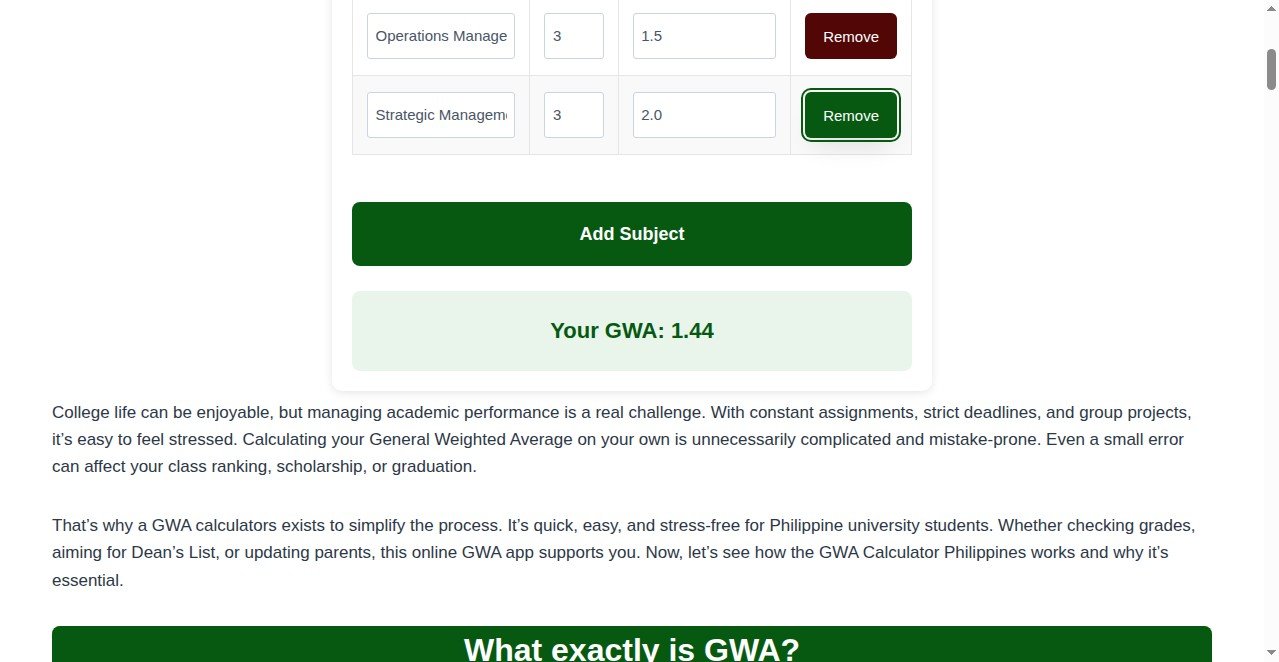
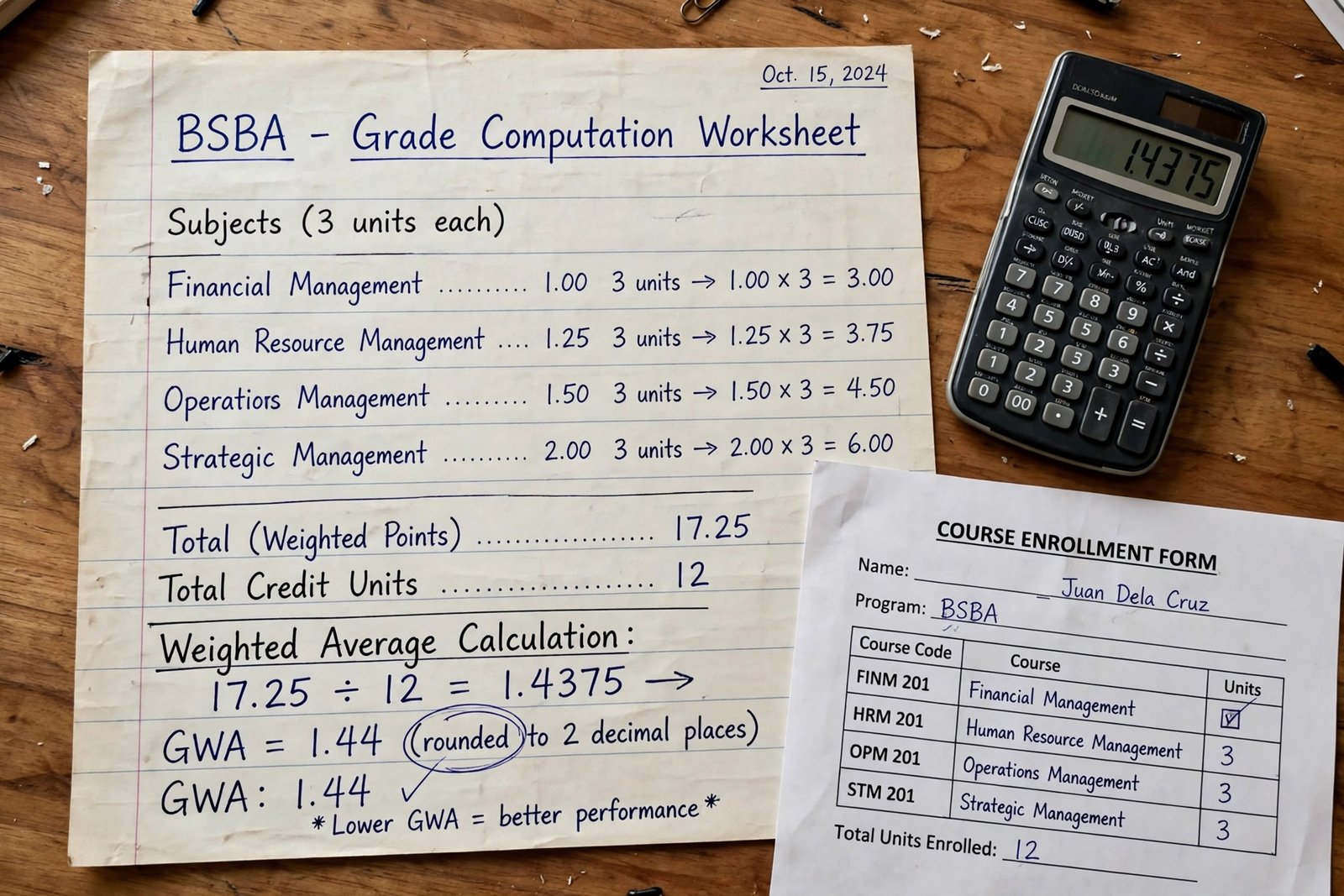
The screenshot above is the live calculator on this site, running a shorter four-subject version of the same BSBA load: Financial Management at 1.00, Human Resource Management at 1.25, Operations Management at 1.50, and Strategic Management at 2.00, three units each — (3 × 1.00) + (3 × 1.25) + (3 × 1.50) + (3 × 2.00) = 17.25, and 17.25 ÷ 12 = 1.4375, which rounds to 1.44. The video below shows the same calculation done live.

One more computation every BSBA student gets wrong: the cumulative GWA. You do not average your semester GWAs. You weight each semester by its units. Take the two semesters in this article — first semester 1.44 over 12 units, second semester 1.48 over 20 units. The wrong method gives (1.44 + 1.48) ÷ 2 = 1.46. The right method gives (12 × 1.44 + 20 × 1.48) ÷ 32 = 46.88 ÷ 32 = 1.465, which rounds to 1.47. The difference is only 0.01 here, but it grows whenever your semesters carry different unit loads, and the cumulative figure is the one that decides Latin honors. For the full method, see the guide on cumulative GWA across semesters.
Dean’s List for BSBA Students
The Dean’s List is the most common honors target in the country, and the one point on which nearly every GWA page agrees: the cutoff is 1.75 or better at most schools on the 1.00–5.00 scale. What the pages disagree on — and what actually decides whether you make the list — are the conditions attached to that number. A 1.75 with a failing grade in one subject does not make the list anywhere. A 1.75 on 12 units may not make it either, if your school requires a full load. And a 1.75 that includes PE and NSTP may be a 1.80 once your school strips those subjects out.
| University | Dean’s List cutoff | Conditions | Verification |
|---|---|---|---|
| University of the Philippines | College Scholar: 1.46–1.75; University Scholar: 1.45 or better | At least 15 units; no grade below 3.00; PE and NSTP excluded from GWA | UP rules, via the UP wiki entry read in this research |
| University of Santo Tomas | 1.75 or better | PE and NSTP counted in the GWA — “all grades for academic courses and non-academic courses” | UST grading data, via the UST calculator read in this research (data sourced from BSBA-HRM) |
| Polytechnic University of the Philippines | 1.75 or better; President’s Lister 1.50 or better | No grade below 2.50, as reported by the Dean’s List guide read in this research | Reported, not verified against the PUP handbook — confirm with your college registrar |
| Philippine School of Business Administration | GPA 3.00 or better (4.0 scale); First Honor above 3.50 | No grade below 2.5 in any academic subject, including Typing | PSBA’s own Dean’s Honor List page |
| De La Salle University | GPA 3.000 or better (4.0 scale) | No grade below 2.0, as reported | Reported secondhand — confirm current policy |
| Far Eastern University | QPA 3.51–4.00 (Dean’s List), 3.35–3.50 (Honorable Mention) | 4.0 scale; conditions per FEU handbook | Reported — confirm with your college registrar |
Three corrections to what Google currently tells BSBA students about the Dean’s List. First, a widely shared GWA page says a 1.75 “lands on the Dean’s List edge at schools that use a strict cutoff of 1.50 or lower”. It does not. A 1.75 fails a 1.50 cutoff; it meets the common 1.75 cutoff. The page contradicts itself in the same paragraph, and a student planning around it would be disappointed for no good reason. Second, another top-ranking page claims Dean’s List rules “trace back to guidelines from the Commission on Higher Education”. They do not. Under CHED Memorandum Order No. 40, series of 2008, higher education institutions have academic freedom to set their own grading and honors rules — which is exactly why the cutoffs in the table above differ from school to school. Your school’s student handbook is the authority, not CHED and not a calculator site. Third, the Dean’s List is automatic at most schools: the registrar posts the list. One FAQ page says students “apply for Dean’s Lister” when their GWA reaches 1.75 — application letters are the exception, not the rule. For the full per-school picture, see the guide on Dean’s List GWA in the Philippines.
The test run behind this article shows how much room a Dean’s List semester actually leaves. Five 3-unit BSBA subjects at 1.00, 1.00, 1.25, 1.00 and 1.25 give 16.50 ÷ 15 = 1.10 — comfortably inside any Dean’s List bar. But the bar is not the hard part; the conditions are. A single 2.75 in a subject where your school requires no grade below 2.50 ends the semester’s honors run even if your average is 1.30. Check the no-grade-below floor first, then the average.
Latin Honors for BSBA Students
Latin honors are decided by your cumulative GWA at graduation, not by any single semester, and the standard bands are the most agreed-upon numbers in Philippine grading. The UP reference — the one six sources in this research agree on — is Summa Cum Laude 1.00–1.20, Magna Cum Laude 1.21–1.45, and Cum Laude 1.46–1.75. One top-ranking GWA page instead gives Latin honors as “commonly 1.75, 1.50, and 1.25” — those figures are used by some schools, but they are not the common thresholds, and presenting them without attribution misleads a student planning a four-year degree.
| Honor | Cumulative GWA band (UP reference) | What it means |
|---|---|---|
| Summa Cum Laude | 1.00–1.20 | The top band. At UP this also requires University Scholar standing in the final semesters. |
| Magna Cum Laude | 1.21–1.45 | One bad semester early on can still be recovered from, but only just — the cumulative math is unforgiving. |
| Cum Laude | 1.46–1.75 | The realistic target for a strong BSBA student: the 1.48 semester in this article sits inside this band. |
The bands are only half the rule. At UP, Latin honors also require residency (at least 75% of your units earned at UP), no grade below 3.00, completion within the prescribed four-year period, and a clean disciplinary record. One UP wiki entry claims that being a consistent College Scholar “will reward the student the Latin honor of Cum Laude upon graduation” — it will not, on its own. Dean’s List every semester does not guarantee cum laude if you fail the residency rule or carry a grade below 3.00. For the full checklist, see the guide on Latin honors GWA in the Philippines.
First, UST is widely reported as having stricter Latin honors bands than the standard 1.20 / 1.45 / 1.75 — one calculator site reports UST’s bands as Summa 1.00–1.10, Magna 1.11–1.35, Cum Laude 1.36–1.60, while other sites say UST uses the standard bands, and one site contradicts itself on a single page. No official UST source was found in this research, so this article will not state any UST figure as fact: if you are at UST, confirm the bands with your college registrar. This matters for BSBA students in particular, because UST runs one of the largest BSBA programs in the country, and its grading data is the source for the UST calculator read in this research.
Second, one secondary source claims PUP’s current handbook sets Cum Laude at 1.6000 — but the PUP handbook text read in this research covers warnings, probation, and dismissal, and contains no such honors figure, while another source says PUP follows the standard bands. Do not plan your degree around the 1.6000 figure until it is confirmed from an official PUP document.
The Scale Trap: GWA vs 4.0 GPA
Here is the trap that catches more BSBA students than any other, because business schools are the one place in the Philippines where two opposite scales sit side by side. Most universities grade on the 1.00–5.00 GWA scale, where lower is better. The Philippine School of Business Administration — a business school, the exact audience of this article — grades on a 4.0-style GPA scale, where higher is better. A PSBA student who needs a 3.00 and a UP student who needs a 1.75 are both chasing honors, but a student who mixes the two scales up will conclude that PSBA is easier. It is not. The scales are inverted.
| Standing | On the 1.00–5.00 GWA scale (UP, UST, PUP) | On the PSBA 4.0 GPA scale |
|---|---|---|
| Dean’s List / Honor List | 1.75 or better | 3.00 or better, no grade below 2.5 |
| Top honors tier | 1.45 or better (University Scholar) | Above 3.50 (First Honor) |
| Cum Laude | 1.46–1.75 cumulative | 3.400–3.599 cumulative |
| Magna Cum Laude | 1.21–1.45 cumulative | 3.600–3.799 cumulative |
| Summa Cum Laude | 1.00–1.20 cumulative | 3.800 or above cumulative |
| Failing | 5.00 | Below the passing GPA — the scale has no 5.00 |
The confusion is not hypothetical. One FAQ page in Google’s top ten for this topic pastes US answers into a Philippine question — “Dean’s List GPA requirements typically fall between 3.50 and 3.80”, “Summa cum laude: 3.9–4.0 GPA”, even “federal student loans do not offer financial perks for dean’s list students” — and on the Philippine 1.00–5.00 scale those numbers are meaningless or inverted: a 3.5 GWA in the Philippines is a failing average. The same page quotes PSBA’s “GPA of at least 3.00” rule beside 1.75 GWA advice with no warning that PSBA’s scale runs in the opposite direction. PSBA publishes its own Dean’s Honor List rules on its site, and the 4.0-scale numbers there are the ones PSBA students should use. A BSBA student at a 4.0-scale school who follows the 1.75 advice is aiming at a number that does not exist on their transcript. If your school uses a 4.0 scale, ignore every 1.75 in this article and use the right-hand column instead. One small detail worth knowing: PSBA’s own published Latin honors table numbers its rows 1, 2, 2 — Summa is 1, Magna is 2, and Cum Laude should be 3. It is a typo on the school’s own page, and it is a useful reminder that even official pages need a second look.
Shifting Into BSBA and Staying Enrolled
BSBA is one of the most shifted-into programs in the country, and the PUP College of Business Administration publishes the clearest version of the rules. For its BSBA major in Marketing Management, freshmen enter through the PUPCET with an 82% high school average, 82% in English, and an interview. Shiftees need one year of residence, a GWA of 2.0, and no failing, INC or dropped subjects. Transferees face similar bars. The retention rules are course-fail based: no failures, good moral character, and finishing within the prescribed years plus a one-year extension.
Read the shiftee rule carefully, because PUP’s own page writes it wrong. It says shiftees need “GWA of 2.0 or higher”. On the 1.00–5.00 scale, “2.0 or higher” literally means 2.0 or worse — 2.5, 3.0, all the way down to failure. PUP means 2.0 or better. This is the single most common GWA phrasing mistake in the Philippines, and it appears on the university’s own program page. Whenever you see a GWA requirement written as “or higher”, translate it in your head to “or better” — or better still, check the handbook, because the page that makes this mistake also prints a garbled retention rule (“No failures of grade equivalent to 75% on the total units enrolled in the previous semester”) that is unintelligible as written. Students must confirm retention rules with the CBA registrar rather than trusting a web page, including this one.
Staying enrolled is a lower bar than shifting in, and it is mostly about failures rather than averages. At most schools, a GWA around 3.00 or better with no failed subjects keeps you in good standing. The danger for BSBA students is concentration: fail two 3-unit major subjects in one semester and you have failed six units, which at many schools is a quarter of your load and the first step toward probation. Fail the practicum as well and the numbers get worse fast. The retention ladder at PUP, as reported in the handbook text read for this article, runs warning, then probation, then dismissal as the share of failed units grows — check your own school’s version of that ladder before the semester starts, not after the grades come out.
Scholarships: What BSBA Students Can Actually Get
Scholarship advice on GWA pages is where the invented numbers live. One top-ranking page tells students that “anything above 2.00 starts to threaten scholarship renewals” and “anything above 3.00 often triggers academic probation”. Neither band exists. Many scholarships set retention at 2.50, and 3.00 is the passing mark, not a probation trigger — probation follows failing grades or a GWA worse than the school’s own retention line, which varies. The honest version of this section names the actual scholarships, with their actual numbers, and labels what is reported rather than verified. For the full scholarship picture, see the guide on GWA for scholarship in the Philippines.
| Scholarship | BSBA eligible? | Entry bar (reported) | Retention bar (reported) |
|---|---|---|---|
| CHED Merit Scholarship Program | Yes — BSBA is a CHED priority course | Grade 12 GWA 96% (full merit) / 93–95% (half merit) | 85% (full) / 80% (half) every semester |
| Bagong Pilipinas Merit Scholarship | Yes | 95% Grade 12 GWA and Top 5 of the graduating class | Per program rules — confirm at application |
| LANDBANK scholarship | Yes | Per program rules | GWA 2.5 or better, no grade below 3.0 |
| DOST-SEI undergraduate scholarships | No — STEM priority courses only | Not applicable | Not applicable |
| School and private scholarships | Usually yes | Commonly 2.00 or 1.75 or better, per donor | Per donor — check the per-subject floor, not just the average |
Two things to notice. First, the CHED Merit entry bar is a percentage, not a 1.00–5.00 GWA — 96% for full merit, 93–95% for half merit — because it is set on your Grade 12 general average. If you are already in college, the entry bar no longer applies to you; the retention bar does, and it is also a percentage: 85% for full scholars, 80% for half scholars, every semester. Convert your college GWA to a percentage with the converter on this site before comparing it to those bars, and remember that each school’s percentage conversion is its own. Second, the per-subject floor matters as much as the average: LANDBANK scholars must keep a 2.5 GWA with no grade below 3.0, so one 3.25 in a single subject can cost the scholarship even when the average is safe. The figures in this table are reported from the sources read in this research and should be confirmed at ched.gov.ph before you plan an application around them.
And DOST: no. DOST-SEI undergraduate scholarships fund priority science and technology courses, and BSBA does not appear on the priority lists. Every year, BSBA students waste applications on DOST because a generic GWA page lists it alongside CHED without saying who it is for. Do not be one of them. If you need funding, CHED is the route for BSBA — BSBA is a CHED priority course — plus your school’s own scholarships and private donors.
OJT and Practicum: The Heavy Semester
The practicum is the semester where BSBA students discover what weighting actually means, because it is the one semester where the unit loads stop being uniform. Most BSBA subjects carry three units. The OJT or practicum carries three units at some schools and six at others, and either way it concentrates a large share of the semester into a single grade — a grade that is usually based on a supervisor’s evaluation and a final report, not on an exam you can cram for.
Take the semester from this article and add a practicum at 1.25. Without it, the semester is 1.48 over 20 units. Add a 6-unit practicum at 1.25 and the total becomes 29.50 + 7.50 = 37.00 over 26 units, giving 37.00 ÷ 26 = 1.4231, which rounds to 1.42. The strong practicum grade pulls the whole semester up by 0.06 — and the same arithmetic works in reverse: a 6-unit practicum at 2.50 would drag that 1.48 semester to 1.71 (44.50 ÷ 26). At three units the effect is half as large, but the lesson is the same: in the practicum semester, the practicum is the semester. Treat the report and the supervisor’s evaluation with the same seriousness you would give a final exam in a 6-unit subject, because that is what it is.
The other thing the practicum changes is your load. A practicum semester usually carries fewer subjects, which means each remaining subject carries more weight in the average and there is less room to absorb a bad grade. A single grade worsening by 0.50 in a 3-unit subject costs 1.50 ÷ 20 = 0.08 in a 20-unit semester, but 1.50 ÷ 12 = 0.13 in a 12-unit semester — the same mistake, nearly twice the damage, just because the semester is lighter. Plan the practicum semester the way you would plan a short semester: protect the heavy grades first.
Recovery: What a Failed Subject Really Costs
Failure in BSBA is common enough that every student should know the price before it happens, and the price is exact. Take a four-subject BSBA load — Financial Management 1.25, Human Resource Management 1.50, Operations Management 1.75, Strategic Management 2.00, three units each — and the GWA is 1.63. Replace the 2.00 with a 5.00 and the GWA becomes 2.38: a 0.75-point swing from one subject. Retake that subject and pass it at 2.00, and the GWA comes back to 1.63. The numbers are verified against the live calculator, and they tell the whole story: a failed subject is recoverable, but only if you retake it, and only if the retake grade is good.
| Scenario (all verified against the live calculator) | Computation | GWA |
|---|---|---|
| Clean semester (four 3-unit subjects) | 19.50 ÷ 12 | 1.63 |
| One subject failed (5.00) | 28.50 ÷ 12 | 2.38 |
| Failed subject retaken at 2.00 (grade replaced) | 19.50 ÷ 12 | 1.63 |
| Dean’s List semester (five 3-unit subjects, 1.00–1.25) | 16.50 ÷ 15 | 1.10 |
| Mixed units (3u + 2u + 1u) | 8.75 ÷ 6 | 1.46 |
Whether the retake actually restores the 1.63 depends on your school’s repeat rule, and no competitor page answers this properly — they all say “check your catalog” and stop there. There are three rules in use. Some schools replace the failing grade with the retake grade, which is the 1.63 recovery above. Some schools average the two attempts. Some count both attempts in the cumulative GWA, which means the 5.00 stays in your average forever and the recovery is only partial. Ask your registrar which rule your school uses before you retake, because the difference between replacement and both-counted is the difference between a recovered semester and a permanently damaged cumulative GWA. A related trap: one popular GWA page claims that a low GWA can lead to “outright disqualification” from the CPA board exam if the corrected GWA “falls below a required floor”. There is no GWA floor for PRC licensure. Board eligibility turns on degree completion, not on a GWA cutoff, and BSBA graduates heading for the CPA or other licensure exams should not let that claim frighten them.
Two more recovery facts from the test run. First, a 4.00 — a conditional grade — is accepted by this site’s calculator as a number, so you can enter it directly while you wait for your removal exam. A conditional grade is not a failure: it is a grade you can still save, and the removal exam is the way you save it. Second, INC and DRP are not handled by the calculator at all: typing INC or DRP, or leaving a grade blank, makes the whole result read “invalid grade”. That is the correct behaviour, because an INC subject carries no grade yet — leave those subjects out of the table entirely until they are resolved, and compute your GWA only on completed subjects.
GWA to Percentage: What Your Number Means
Sooner or later, someone will ask for your GWA as a percentage — a scholarship form, a job application, a parent comparing your grades to a cousin’s. There is no single national conversion table, and the competitors disagree with each other: one page maps 1.75 to 88–90%, another maps the same 1.75 to 85–88%. Both pages present their table as if it were the table. Neither says plainly that each school sets its own conversion, and that is the fact that matters. Use your own school’s table first. If your school does not publish one, use the converter on this site as a working estimate and say so on the form — never present a converted percentage as an official figure. For the conversion itself, use the GWA to percentage converter, and for the grading-system context behind it, the PUP grading system guide and the DepEd grading system guide show how the scales behind the numbers actually work.
What the number means in plain terms: 1.00–1.25 is the Dean’s List and honors zone; 1.50–1.75 is strong and still inside the Cum Laude band; 1.75–2.00 is good standing with most options open; 2.00–2.50 is ordinary, keeps you enrolled and employed, but closes the honors and most scholarship doors; 2.50–3.00 is the edge of good standing, where retention rules and scholarship floors start to bite; and anything past 3.00 is a warning sign that needs a plan, not a shrug. Those bands are working descriptions, not official cutoffs — the official cutoff is always your school’s handbook.
What the Top Google Results Get Wrong
No article should end with a list of other people’s mistakes, but this one has to, because the mistakes are the reason BSBA students miscalculate. Ten pages were read in full for this article — GWA calculators, Dean’s List guides, business-school honor rules, and BSBA program pages — and twelve errors were found. The five that cost students the most are the ones this guide corrects in its own text. The rest are catalogued here, with the correction beside each one, so you can check the pages yourself.
| Competitor | Wrong claim (quoted) | Correction |
|---|---|---|
| freetooler.com | “How to Compute Your GWA in Three Steps” — then lists four steps | It is four steps, not three |
| freetooler.com | “Maria’s 1.75 lands her right on the Dean’s List edge at schools that use a strict cutoff of 1.50 or lower” | 1.75 fails a 1.50 cutoff; it meets the common 1.75 cutoff |
| freetooler.com | “Anything above 2.00 starts to threaten scholarship renewals; anything above 3.00 often triggers academic probation” | Real thresholds are named per scholarship (e.g. LANDBANK 2.5); 3.00 is the passing mark |
| freetooler.com | Latin honors “commonly 1.75, 1.50, and 1.25” | UP reference is 1.75 / 1.45 / 1.20 |
| freetooler.com | CPA/ECE boards disqualify on a GWA floor | PRC licensure turns on degree completion, not a GWA floor |
| phgwacalculator.com | Dean’s List rules “trace back to guidelines from CHED” | CHED sets no Dean’s List cutoffs; CMO 40 s. 2008 gives HEIs academic freedom — rules come from each school’s handbook |
| gwacalculatorph.com | Table: 65–68% = 3.00 “Passing” vs FAQ: “minimum percentage grade of 75% … to pass” | Both cannot hold for one school; the table is a generic bracket, not a passing rule |
| spainexchange.com | “Dean’s List GPA requirements typically fall between 3.50 and 3.80”; “Summa cum laude: 3.9–4.0 GPA” | US 4.0-scale figures pasted into a Philippine question; Philippine honors are 1.20 / 1.45 / 1.75 on the 1.00–5.00 scale |
| spainexchange.com / PSBA | PSBA “GPA of at least 3.00” quoted beside 1.75 GWA advice with no scale warning | PSBA uses a 4.0-style scale (higher = better) — the opposite direction from GWA |
| PUP CBA (official page) | Shiftees need “GWA of 2.0 or higher” | Must read “2.0 or better” — on the 1.00–5.00 scale, higher is worse |
| PSBA (official page) | Latin honors table numbered 1, 2, 2 | Cum Laude row should be 3 |
| iskomunidad.upd.edu.ph | “Consistent grant [of College Scholar] will reward the student the Latin honor of Cum Laude” | Also requires residency, no grade below 3.0, prescribed-period completion, clean record |
The pattern across all twelve errors is the same: pages that teach careful calculation are careless with their own numbers. A page that cannot count its own steps, or that quotes a 3.50 GPA into a country where 3.50 is failing, should not be trusted for the number that decides your scholarship. The full competitor research behind this section — all ten pages read in full — is saved with this article’s research files.
The GWA Ladder for BSBA Students
| Rung | GWA | What it opens |
|---|---|---|
| Summa Cum Laude | 1.00–1.20 cumulative | The top of the ladder, plus University Scholar standing |
| Magna Cum Laude | 1.21–1.45 cumulative | Graduation honors; needs a near-perfect run from first year |
| Cum Laude / Dean’s List | 1.46–1.75 | Semester honors and graduation honors; the 1.48 semester in this article sits here |
| Strong standing | 1.75–2.00 | Good standing, most job screens open, some scholarships |
| Shifting into BSBA (PUP CBA) | 2.00 or better | Entry to BSBA Marketing Management as a shiftee |
| Ordinary standing | 2.00–2.50 | Enrolled, employable, but honors and most scholarships closed |
| Scholarship floor (LANDBANK) | 2.50 or better, no grade below 3.0 | Keeps a LANDBANK scholarship; one 3.25 can end it |
| Good standing | Around 3.00 or better | Enrolment next semester, as long as nothing is failed |
FAQ: GWA for Business Administration Students Philippines
What is a good GWA for a BSBA student?
Against the bars in this article: 1.75 or better puts you on the Dean’s List and inside the Cum Laude band; 2.00 or better keeps you in good standing everywhere and meets the PUP CBA shiftee bar; 2.50 or better keeps a LANDBANK scholarship. Against reality, a sub-1.75 GWA is genuinely hard to achieve and a 1.48 semester — the worked example in this article — is a strong one. If you are at 2.10 in second year, you are a typical business student with most options still open, but the honors doors are already closing.
How do I compute my GWA as a BSBA student?
Multiply each subject’s grade by its units, add all the products, and divide by the total units: GWA = Σ (grade × units) ÷ Σ (units). For the worked example in this article — Principles of Management at 1.25 for 3 units, Marketing Management at 1.50 for 3, Financial Management at 1.00 for 3, Business Law at 1.75 for 3, Operations Management at 1.50 for 3, Mathematics in the Modern World at 2.00 for 3, and PE 1 at 1.25 for 2 — the products total 29.50 over 20 units, giving 29.50 ÷ 20 = 1.48. Enter the same subjects in the calculator on this site and it returns 1.48, verified in 28 test cases. Remember the weighting: a 3-unit major counts half again as much as a 2-unit PE subject, and a 6-unit practicum counts as much as two whole subjects.
What GWA do I need for Dean’s List in BSBA?
1.75 or better at UP, UST and PUP on the 1.00–5.00 scale, with conditions: a full load (at least 15 units at UP), no grade below the school’s floor (3.00 at UP, 2.50 at PUP as reported), and no failing or INC grades. At PSBA the rule is a GPA of 3.00 or better on the 4.0 scale, with no grade below 2.5 — the opposite direction, so do not mix the two numbers. At most schools the list is automatic: the registrar posts it. One more condition students miss: PE and NSTP count at UST but are excluded at UP, so the same grades can produce two different official GWAs.
Can BSBA students get a DOST scholarship?
No — not for the DOST-SEI undergraduate scholarships. DOST-SEI funds priority science and technology courses only, and BSBA does not appear on its priority lists. Do not waste an application. BSBA students should look to CHED instead: BSBA is a CHED priority course, so BSBA students can apply for the CHED Merit Scholarship Program (Grade 12 GWA 96% for full merit, 93–95% for half merit; retention 85% and 80% respectively, as reported) and the Bagong Pilipinas Merit Scholarship (95% plus Top 5 of the graduating class, as reported). Confirm the current figures at ched.gov.ph.
What happens if I fail a subject in BSBA?
First, your GWA takes a hit proportional to the subject’s units: in the four-subject load in this article, a failed 3-unit subject moves a 1.63 semester to 2.38. Second, your retention is at risk, because retention is course-fail based: at PUP, failing a large share of enrolled units earns a warning, then probation, then dismissal. Third, your recovery depends on your school’s retake policy: if the failing grade is replaced, a retake at 2.00 brings the example semester back to 1.63; if both attempts are counted, the 5.00 stays in your cumulative average forever. And if the failed subject is the practicum, the damage is doubled — treat that semester accordingly.
Do PE and NSTP count in my GWA?
It depends on your school, and the answer is worth a few hundredths of a GWA point. The University of the Philippines excludes both PE (PATHFIT) and NSTP from GWA computation. UST counts both — its rule is that GWA is based on all grades for academic and non-academic courses. The same seven-subject semester in this article computes as 1.48 with PE included and 1.50 without it. Check your student handbook or ask your registrar before computing your GWA for any official purpose, and if you use this site’s calculator, model an excluded subject by giving it zero units, which the calculator skips entirely.
What GWA do I need to shift into BSBA?
At PUP’s College of Business Administration, shiftees into BSBA Marketing Management need one year of residence, a GWA of 2.0 or better, and no failing, INC or dropped subjects. Note the wording: 2.0 or better. PUP’s own page writes “2.0 or higher”, which on the 1.00–5.00 scale literally means 2.0 or worse — the most common GWA phrasing mistake in the country, on the university’s own page. Other schools set their own shifting bars, so confirm yours with the college registrar before you plan around the PUP figure.
What GWA do I need for a management-trainee job?
There is no national number — each employer sets its own screen, and the common ones are 2.00 or 1.75 or better. The GWA matters most at the first screen: once you are in the interview, nobody asks about it again. What matters more for BSBA graduates is that the GWA on your resume matches the GWA on your transcript, converted with your school’s own table if a percentage is asked for. For the full picture, see the guide on GWA for job application in the Philippines.
The Bottom Line
There is no single GWA number for BSBA students, and anyone who gives you one is selling you a shortcut that does not exist. There is a ladder — 3.00 to stay enrolled, 2.50 to keep a LANDBANK scholarship, 2.00 to shift into BSBA at PUP and to pass most job screens, 1.75 for the Dean’s List and Cum Laude, 1.45 for Magna and University Scholar, 1.20 for Summa — and a DOST scholarship at the end of it that does not exist for BSBA students at all, whatever a generic GWA page tells you. The students who climb that ladder are rarely the ones with the most talent. They are the ones who understood, early, that a weighted average rewards the heaviest subjects: the practicum first, the 3-unit business core second, and everything else in proportion to its units.
So compute your GWA tonight, with your real grades and your real units, using the formula in this article or the calculator on this site — and compute the cumulative figure, not just the semester one, because the cumulative figure is the one that decides your honors. Then look at your enrolment form, find the subject with the most units, and give it the hours it deserves. That is the whole strategy for gwa for business administration students philippines, in one sentence: protect the heavy subjects, track the cumulative average, and confirm every cutoff with your registrar before you plan your degree around it.