

GWA for Architecture Students Philippines: 2026 Guide
If you are studying Bachelor of Science in Architecture in the Philippines, you have probably typed gwa for architecture students philippines into Google at least once — usually late at night, usually after a plate review that did not go the way you hoped, and usually with one very specific number in mind. Am I still on the Dean’s List? Am I still safe for Latin honors? Will I lose my scholarship? Will I even be allowed to enrol next semester? The honest answer is that there is no single GWA number for architecture students. There is a different bar at every gate — admission, retention, Dean’s List, Latin honors, scholarships, internship, and finally the board exam — and the number that saves you at one gate can be useless at the next. A 2.00 keeps you enrolled at most schools and still costs you your Dean’s List slot, while a perfect 1.00 GWA does not get you anywhere near the board exam, because the board exam does not ask for your GWA at all.
This guide walks through every one of those gates with real numbers, not guesses. The worked examples use real BS Architecture subjects with real unit loads — Architectural Design studios, Building Technology, History of Architecture, Theory of Architecture — computed step by step, and every computation was checked against this site’s own live calculator: 46 test cases were run against the calculator’s extracted code, and all 46 passed. Along the way, this guide also corrects the mistakes sitting at the top of Google right now. The number-one result for this topic tells students the Dean’s List cutoff is 2.00. It is not: at the University of the Philippines, the official cutoff is 1.75, and a student who believes the 2.00 figure will be disappointed at the end of the semester for no good reason.
GWA for Architecture Students Philippines: The Short Answer
| Gate | The number | What it decides |
|---|---|---|
| Admission (PUP, dated 2013 source) | High school GWA of at least 85% | Whether you can apply for BS Architecture at PUP (PUPCET + drawing test also required). No other school’s admission GWA was found. |
| Staying enrolled / good standing | Around 3.00 or better, and no failed subjects | Whether you can enrol next semester. Retention is mostly about failing courses, not one GWA number. |
| Dean’s List | 1.75 or better (UP, verified); 1.50 (UA&P, verified) | Semester honors. UP also requires ≥15 units and no grade below 3.00. |
| Latin honors at graduation | Cum Laude 1.46–1.75; Magna 1.21–1.45; Summa 1.00–1.20 | Graduation honors, on cumulative GWA — not one semester. |
| DOST scholarship retention | 2.50 or better (non-UP); 2.75 (UP) — reported, single source | Whether you keep a DOST-SEI scholarship. BS Architecture is a DOST priority course. |
| CHED Merit Scholarship retention | 85% (full) / 80% (half) every semester — reported, single source | Whether you keep a CHED Merit Scholarship. Entry is reported at a Grade 12 GWA of 93%. |
| Board exam (ALE) | No GWA requirement | Eligibility needs your degree + 2 years (3,840 hours) of experience — not grades. |
Two things about that table deserve emphasis. First, the Philippine grading scale runs backwards from what most of the world expects: 1.00 is the best grade and 5.00 is a failure, so a lower GWA is a better GWA, and every “or better” in this article means a lower number. Second, architecture is a five-year degree — ten semesters, 218 credit units in the CHED sample curriculum — which makes your GWA a long game.
A word about the degree itself. The current Policies, Standards and Guidelines for BS Architecture is CHED Memorandum Order No. 61, series of 2017. The older CMO No. 61 of 2006, which set 232 credit units, is superseded. The CHED-hosted OBE-aligned sample curriculum totals 218 credit units, and that is the figure this article uses as current. School totals still vary: Benilde runs 238 units including a 3-unit apprenticeship, while the University of San Agustin runs 205 units — so check your own school’s curriculum. The spine of the degree is Architectural Design 1 to 10, supported by Theory of Architecture, History of Architecture, Building Technology, Building Utilities, Architectural Visual Communications, CADD, Professional Practice, Business Management for Architecture, and the Architecture Comprehensive Course in fifth year, plus mathematics, natural sciences, and basic engineering.
What Is GWA — and Why Architecture Weights It Differently
GWA = Σ (grade × units) ÷ Σ (units)
That is the whole formula. Multiply each subject’s grade by its units, add all of those products together, and divide by the total number of units. There is no conversion factor, no extra multiplier, and no adjustment for whether a subject is a major or a minor. One popular GWA site, gwahubph.com, prints the formula as “GWA = (Total Grade Points / Total Units) × Conversion Factor” — there is no such conversion factor anywhere in Philippine grading — and the same site’s how-to page writes the formula without the summation sign. For a single subject that works; for a real semester with seven subjects it is simply wrong. The same mistake in a different form is averaging your grades directly. A simple average treats every subject equally. A weighted average does not, and in architecture the difference is the difference between Dean’s List and an ordinary semester.
The reason is the Design studio. In most degrees, subjects cluster around three units each, so the simple average and the weighted average land close together. In BS Architecture, the Design studio can carry five units while a theory subject carries two, so one Design grade counts two and a half times as much as one theory grade. The test cases run for this article prove how far the two methods diverge. A 5-unit Design subject at 1.00 and a 2-unit Theory subject at 3.00: the simple average is 2.00, but the real GWA is (5 × 1.00 + 2 × 3.00) ÷ 7 = 1.57. Flip it — a 5-unit Design studio at 2.50 and a 2-unit PE subject at 1.00 — and the simple average says 1.75, a Dean’s List semester, while the real GWA is 14.50 ÷ 7 = 2.07. At semester scale: 18 units at 2.00 plus 3 units at 1.00 gives 39.00 ÷ 21 = 1.86, not the simple average of 1.50.
This is also why the framing on Omni Calculator’s GWA page is misleading. It says that “major courses weigh more than minor courses and are, therefore, worth more units.” That states the relationship backwards. Weight in a GWA comes from units only — never from major or minor status. A 3-unit major subject and a 3-unit general education subject have exactly identical weight. Majors only seem to weigh more because, in architecture, the major subjects happen to carry more units: the Design studio is five units, while most general education subjects are three. Students who understand “units weigh more” will look at their enrolment form, find the biggest unit numbers, and protect those grades first.
One more thing the formula hides: the grade scale itself. Most Philippine universities use the 1.00 to 5.00 scale, where 1.00 is excellent, 3.00 is the passing mark, 4.00 is conditional — removable by a removal exam, not a failure — and 5.00 is failed. One competitor page claims that anything above 3.00, “specifically 5.00,” means the student has failed the subject. That skips 4.00 entirely, and a student with a conditional grade who reads that page could wrongly conclude they had failed a subject they can still save. Some schools use a different scale altogether — De La Salle University runs a 4.0 scale where higher is better, 4.0 is the top, and 1.0 is the lowest passing grade — which is why this article always says which scale a number belongs to.
How to Compute Your GWA: A Real BS Architecture Semester
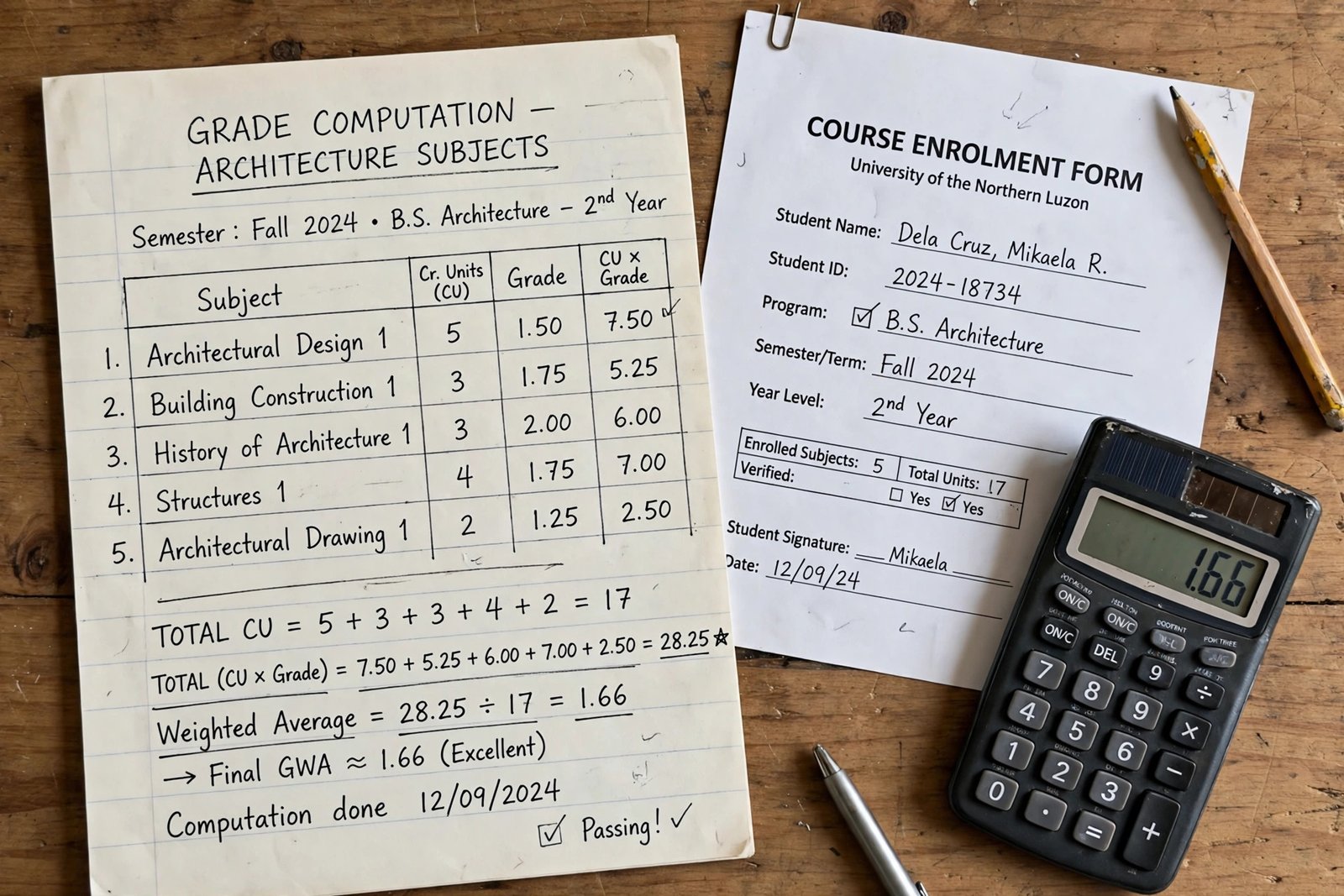
Enough theory. Here is a real first-year, first-semester BS Architecture load, with the subjects and units taken from the CHED sample curriculum and the grades chosen to look like an actual strong-but-human semester — not a perfect one. This is the MAIN example behind the 46 test cases in this article’s research, and the calculator on this site returns 1.62 for it.
| Subject | Units | Grade | Grade × Units |
|---|---|---|---|
| Architectural Design 1 | 5 | 1.50 | 7.50 |
| Building Technology 1 | 3 | 1.75 | 5.25 |
| History of Architecture 1 | 3 | 2.00 | 6.00 |
| Theory of Architecture 1 | 2 | 1.25 | 2.50 |
| Architectural Visual Communication 1 | 3 | 1.50 | 4.50 |
| Mathematics in the Modern World (GE) | 3 | 1.75 | 5.25 |
| PE 1 | 2 | 1.50 | 3.00 |
| Total | 21 | 34.00 |
The steps are the same every semester. Step 1: multiply each grade by its units — the right-hand column. Step 2: add all the products: 7.50 + 5.25 + 6.00 + 2.50 + 4.50 + 5.25 + 3.00 = 34.00. Step 3: add all the units: 5 + 3 + 3 + 2 + 3 + 3 + 2 = 21. Step 4: divide: 34.00 ÷ 21 = 1.6190, which rounds to 1.62. At 1.62, this student clears the UP Dean’s List bar of 1.75 comfortably and sits inside the Cum Laude band of 1.46–1.75 if it were a cumulative figure — despite a 2.00 in History and two 1.75s, because the 5-unit Design grade of 1.50 anchors the average.
Now change one grade and watch what happens. Give the same student a 2.50 in Architectural Design 1 instead of 1.50, with everything else unchanged. The Design product becomes 5 × 2.50 = 12.50, the total rises from 34.00 to 39.00, and the GWA becomes 39.00 ÷ 21 = 1.86 — past the 1.75 Dean’s List bar entirely. Put the weak grade in the 2-unit Theory subject instead, a 2.50 there instead of 1.25, and the total becomes 36.50, giving 36.50 ÷ 21 = 1.74 — still inside the Dean’s List bar, barely. The same grade costs 0.24 of GWA in the studio and 0.12 in the theory subject. If you take one practical habit from this article, let it be this: when time is limited, spend the extra hours on the subject with the most units. For the step-by-step method for any semester, see the general guide at how to compute GWA in the Philippines.
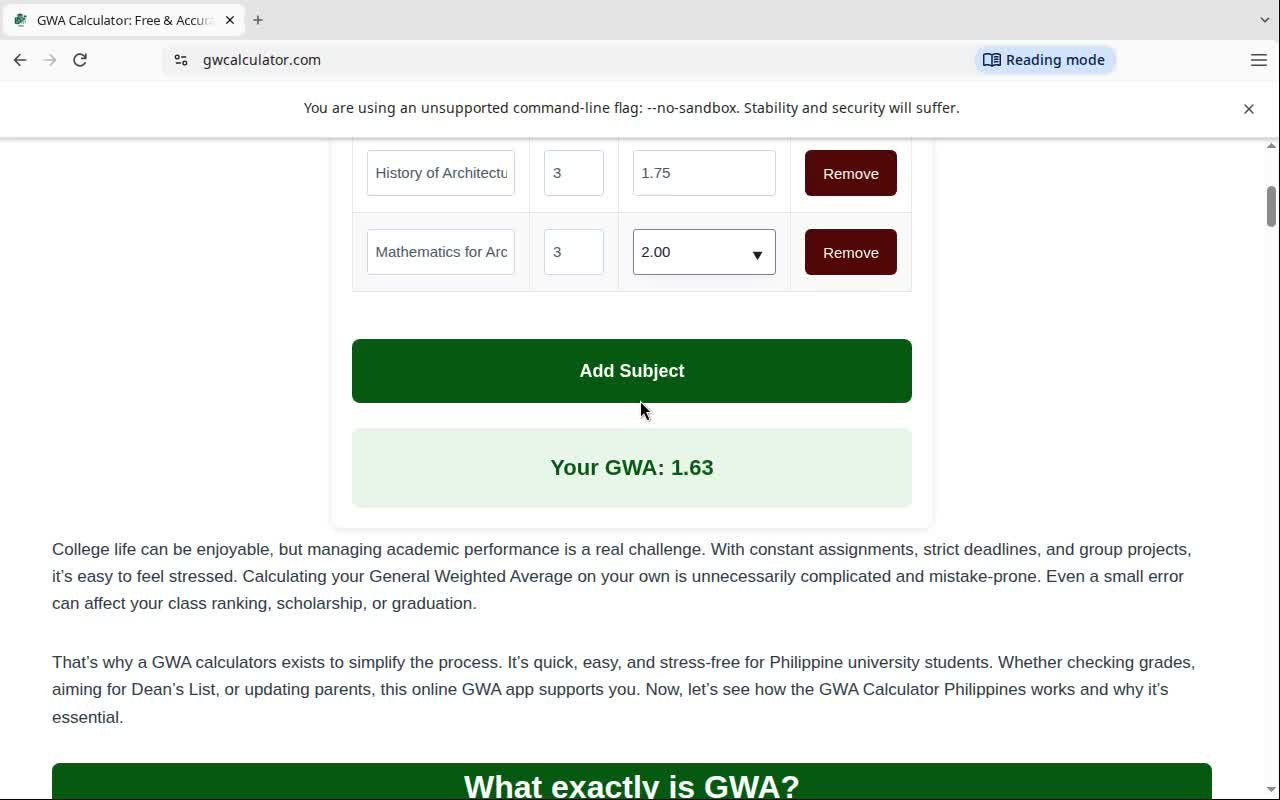
The screenshot above is the live calculator on this site: Architectural Design 1 at 1.25, Building Technology 1 at 1.50, History of Architecture 1 at 1.75, and Mathematics for Architecture at 2.00, three units each — (3 × 1.25) + (3 × 1.50) + (3 × 1.75) + (3 × 2.00) = 19.50, and 19.50 ÷ 12 = 1.625, which rounds to 1.63. The video below shows the same calculation done live.
The NSTP and PE Trap: The Same Grades, Three Different GWAs
Here is a trap that catches thousands of Philippine students every semester, and it has nothing to do with how hard your subjects are. It is about which subjects your school counts in the GWA at all. PE (now usually called PATHFIT) and NSTP are the two usual suspects. The University of the Philippines excludes both — and because both subjects are usually graded generously, including or excluding them can move your GWA by a tenth of a point.
The clearest demonstration comes from a competitor’s own worked example, recomputed three ways. The page gwacalculatorph.com works an example — Math 101 (1.50, 5u), English 101 (1.75, 3u), Filipino 101 (2.00, 3u), PE 1 (1.25, 2u), NSTP (1.50, 3u) — and reports “25.75 ÷ 16 = 1.609 GWA.” The arithmetic is correct: the products total 25.75 over 16 units, and 25.75 ÷ 16 = 1.609375, which rounds to 1.609. But the method is wrong for any school that excludes PE and NSTP, and the page never warns the reader. Without NSTP only, the products are 21.25 over 13 units, giving 1.635. Fully the UP way, without PE and without NSTP, they are 18.75 over 11 units, giving 1.705. The same five grades are 1.609, 1.635, or 1.705 — a swing of almost a tenth that crosses the 1.75 region students care about most.
The same effect shows up in this article’s own MAIN semester. Add an NSTP subject at 1.00 for 3 units and the GWA falls from 1.62 to 1.54: the total becomes 37.00 grade points over 24 units, and 37.00 ÷ 24 = 1.5417. A 1.00 in NSTP makes the semester look nearly a tenth better — but only if your school counts NSTP. At UP, it does not count, and the semester stays at 1.62. The calculator on this site handles exclusion the way you would expect: a row with zero units is skipped entirely, so entering NSTP with 0 units leaves the MAIN semester exactly at 1.62. Before you compute your GWA for any official purpose, check your handbook: does your school include PE and PATHFIT, and does it include NSTP?
Dean’s List for Architecture Students
Dean’s List is the most searched honors question in Philippine higher education, and it is also the one where the top Google results are most confidently wrong. The number-one result for this topic’s keyword family tells students that “most Philippine universities require a semester GWA of 2.00 or better” for the Dean’s List. That is false: 2.00 is good academic standing at UP, PUP, and UST — it is not the Dean’s List at any of them. The official UP rule, published in the UP Diliman Rules on Scholastic Standing, sets College Scholar — UP’s name for the Dean’s List — at a GWA of 1.75 or better, and University Scholar at 1.45 or better, with at least 15 units and no grade below 3.00.
| University | Dean’s List cutoff | Conditions | Verification |
|---|---|---|---|
| University of the Philippines (all campuses) | 1.75 or better = College Scholar (Dean’s List); 1.45 or better = University Scholar | At least 15 units; no grade below 3.00 | Verified — UP Rules on Scholastic Standing (official) |
| University of Asia and the Pacific (UA&P) | 1.50 or better | No failing mark during entire stay; no INC for the semester | Verified — UA&P Student Handbook (official) |
| De La Salle University (DLSU) | GPA 3.400+ = First Honors; GPA 3.000–3.39 = Second Honors (4.0 scale) | At least 12 units; no grade below 2.0; no cheating or discipline offense | Verified — DLSU handbook |
| Isabela State University (ISU) | 1.75 Dean’s List; 1.50 President’s List | Per ISU handbook | Verified — ISU PPP handbook |
| Polytechnic University of the Philippines (PUP) | 1.75 or better; President’s Lister 1.50 | Reported: no grade lower than 2.50 | Reported — confirm with your registrar |
| University of Santo Tomas (UST) | 1.75 or better | Reported: full load; no failing or INC | Reported — confirm with your registrar |
| Far Eastern University (FEU) | QPA 3.51–4.00 first honors; 3.35–3.50 second honors (4.0 scale) | No failing grades | Reported — confirm with your registrar |
| Mapúa University | 1.75 or better per term | Reported: running GWA 2.00+; no F/5.00/ABS/I/C/W; full load | Reported — confirm with your registrar |
Read the pattern in that table, not just the numbers. The verified rows — UP, UA&P, DLSU, ISU — all sit at 1.75 or stricter, and the reported rows agree. Nobody credible puts the Dean’s List at 2.00. The 1.75 figure is also the consensus across the better secondary sources, and it matches the Cum Laude boundary: the Dean’s List is, in effect, the semester-level version of the graduation honours bar. Notice also the conditions column, which is where most Dean’s List hopes actually die. At UP, a single grade below 3.00 disqualifies you even if your average is 1.30. At UA&P, an INC in the semester blocks you. The calculator can compute the average, but only your handbook can tell you whether the average is enough. The same caution applies to Adamson University, whose Dean’s List cutoff no source in this research could find at all — this article will not invent one.
What does a Dean’s List semester actually look like for an architecture student? The test run for this article built one: Design 2 at 1.25 for 5 units, Building Technology 2 at 1.50 for 3, History 2 at 1.25 for 3, Theory 2 at 1.50 for 2, Visual Communication 2 at 1.25 for 3, Purposive Communication at 1.50 for 3, and PE 2 at 1.00 for 2. The products total 27.75 over 21 units, giving 27.75 ÷ 21 = 1.3214, which rounds to 1.32 — 96.0%, Excellent, on this site’s percentage converter. It clears every Dean’s List bar in the table above with room to spare, without a single 1.00: the best grade in the whole semester is a 1.25 in the Design studio. You do not need perfection — you need consistency, and a strong Design studio.

The image above shows the calculator being used the way a Dean’s List–chasing student would use it — grades typed in one by one, the result checked before the semester ends. The all-studio semester in the test run is a good example: Architectural Design at 1.50 for 5 units, Building Technology at 1.50 for 3 units, Visual Communication at 1.75 for 3 units, and Computer-Aided Design at 1.25 for 3 units give 21.00 over 14 units, which is 21.00 ÷ 14 = 1.50 exactly — a semester that would earn the “Dean’s Lister” remark at a 1.75 school. If your own semester is tracking near a cutoff, compute it now, while there is still time to pull a plate grade up. For the full cutoffs across Philippine universities, see Dean’s List GWA requirements in the Philippines.
Latin Honors for BS Architecture
If the Dean’s List is a semester award, Latin honors are the degree award — and the difference between the two is the single most misunderstood fact in Philippine student life. Latin honors are computed on your cumulative GWA at graduation: every subject, every semester, all 218 units of the CHED sample curriculum, averaged together with the same weighted formula. One brilliant semester does not earn them. One disastrous semester can cost them. The bands themselves are, unusually for Philippine higher education, consistent across the universities that publish them.
| Honor | Cumulative GWA band | What it means |
|---|---|---|
| Summa Cum Laude | 1.00 – 1.20 | With highest honors — the top band, achieved by very few graduates in any program. |
| Magna Cum Laude | 1.21 – 1.45 | With great honors — at UP this is also the University Scholar range. |
| Cum Laude | 1.46 – 1.75 | With honors — the same 1.75 boundary as the UP Dean’s List. |
The bands are only half the story. The conditions attached to them, verified across UP and ISU, are where architecture students most often lose honors they had the grades for. At UP, you must have earned at least 75% of your total units at the granting university, with at least two years of residence immediately before graduation; you must have carried a normal load of at least 15 units every semester; you must finish within the prescribed five years; and you must have no finding of cheating or dishonesty. ISU adds a per-subject condition: no grade below 2.50 in any subject for honors candidates. A transferee who did two years elsewhere, an irregular student who underloaded for a semester, or a student with one 2.75 can all have a cumulative GWA inside the Cum Laude band and still not receive the honor. Check the conditions in your own handbook early — ideally in first year. The full picture is covered in Latin honors GWA requirements in the Philippines.
The cumulative mathematics is where the five-year length of the degree becomes either your best friend or your worst enemy. Take a student with 96 units behind them — roughly four and a half semesters — who then posts the MAIN semester from this article, the 21-unit semester at 1.62. If those 96 prior units sit at 1.85, the cumulative figure becomes (96 × 1.85 + 34.00) ÷ 117 = 211.60 ÷ 117 = 1.81: still outside the Cum Laude band. At 1.70, it becomes 197.20 ÷ 117 = 1.69, which clears the 1.75 bar; at 1.45, it becomes 173.20 ÷ 117 = 1.48. And at 1.80, it becomes 206.80 ÷ 117 = 1.77 — missing the 1.75 bar by just 0.02, because a single grade step in a single 3-unit subject earlier in the degree would have closed it. Early semesters matter enormously: 96 units of history outweigh 21 units of present by more than four to one. The reverse is also true: a strong start is a cushion that survives a bad semester later. Treat first and second year as the honors years, not fifth year — that is the single most useful fact in this guide to gwa for architecture students philippines. For cumulative averaging in general, see cumulative GWA across semesters.
First, UST is widely reported as having stricter Latin honors bands than the standard 1.20 / 1.45 / 1.75 — one calculator site reports UST’s bands as Summa 1.00–1.10, Magna 1.11–1.35, Cum Laude 1.36–1.60, while two other sites say UST uses the standard bands, and one site contradicts itself on a single page. No official UST source was found in this research, so this article will not state any UST figure as fact: if you are at UST, confirm the bands with the College of Architecture registrar.
Second, one secondary source claims PUP’s current handbook sets Cum Laude at 1.6000 — but the PUP handbook text read in this research covers warnings, probation, and dismissal, and contains no such honors figure, while another source says PUP follows the standard bands. Do not plan your degree around the 1.6000 figure until it is confirmed from an official PUP document.
Retention: What Actually Gets Architecture Students Kicked Out
Ask a room of architecture students what GWA gets you kicked out, and most of them will name a number — 2.50, or 3.00, or something they heard from a senior. The truth is stranger and, for most students, more reassuring: there is no national GWA retention rule for BS Architecture in the Philippines. CHED does not set one. Retention is set by each university in its own student handbook, and in architecture it is overwhelmingly based on failing courses — not on your GWA. A student with a mediocre GWA of 2.30 who has never failed a subject is, at most schools, perfectly safe. A student with a sparkling GWA of 1.60 who has failed Architectural Design twice is, at some schools, already on the way out.
Holy Angel University’s official retention policy for architecture students is the clearest published example. In first year, failing any two of the core first-year subjects — Architectural Design 1, Architectural Graphics 1, Visual Techniques 1, History of Architecture 1, Architectural Drawing, Theory of Architecture 1, or Solid Mensuration in the first semester, or their second-semester equivalents — triggers an academic warning plus mandatory tutorials. Fail again a second time and the student is de-loaded to a minimum of three units. Fail a third time and the student is advised to shift to a non-board degree — in plain language, the end of the architecture track. The same structure applies in second year, and in third and fourth year, failing any three professional courses triggers a de-load to a minimum of six units. Notice what is absent from that entire policy: a GWA threshold.
Other schools use different instruments for the same purpose. Far Eastern University runs an annual qualifying examination at the end of each academic year, and students must pass all board-related courses in a semester to be eligible for it. The University of Santo Tomas runs the AMACE, the Architecture Midterm Aptitude Comprehensive Examination, in fourth year, followed by an Architecture Review Course in fifth year. Mapúa runs exit examinations in Theory of Architecture and Professional Practice as prerequisites for later courses. Holy Angel University adds a comprehensive examination of its own: fourth-year students must pass the Architecture Comprehensive Exam before entering fifth year, and failing the retake means a de-load of six units in the first semester of fifth year. These are all course-and-exam gates, not GWA gates.
That said, the general university retention rules still apply underneath the architecture-specific ones, and those do use numbers — usually failure percentages rather than GWA. The PUP Student Handbook sets the pattern: failing 25% of enrolled units earns a warning, failing 50% earns probation, failing 51% to 75% means being dropped from the college, and failing more than 75% means dismissal from the university and permanent disqualification. Two successive probations mean being dropped from the college rolls. At UP Diliman, good scholastic standing requires a final grade of 3.00 or better in at least 75% of enrolled academic units. The practical translation: your GWA can absorb one bad grade, but your enrolment cannot absorb a failed Design studio, because the studio is five units of a 21-unit semester — nearly a quarter of the load.
The calculator test cases put numbers on the danger zone. A semester of 17 units all at 2.00 returns exactly 2.00 — the boundary itself, and a figure you should treat as a warning light rather than a safe harbour. A realistic retention-risk semester — Design 1 at 2.25, Building Technology 1 at 2.50, History 1 at 2.50, Theory 1 at 1.75, Visual Communication 1 at 2.00, Mathematics in the Modern World at 2.00, and PE 1 at 1.00 — computes to 43.75 ÷ 21 = 2.08. That student has not failed anything, and yet the semester is a warning: one more weak grade in the studio next semester, and the cumulative figure starts sliding toward the region where scholarships lapse and probation begins. A 2.08 in first year is recoverable; a 2.08 in fourth year is a much heavier problem.
Scholarships: BS Architecture Is a DOST Priority Course
Here is a piece of good news that no competitor GWA page mentions: BS Architecture is a DOST-SEI priority course. That was confirmed against four independent lists in this research, including the DOST-SEI Annex A document itself, which lists BS Architecture by name. Architecture students may therefore apply for the DOST-SEI undergraduate scholarships under RA 7687, the Merit program, and the Junior Level Science Scholarship, subject to their school being a recognised study placement — a state university or college, a CHED Centre of Excellence or Centre of Development, or a FAAP Level III accredited institution. Keeping the scholarship depends on a GWA bar that is much more forgiving than the honors bars, but still very real.
That bar, however, comes with a caveat you should read carefully. The DOST grade-retention figures found in this research — an annual weighted average of 2.75 or better for UP System students, and 2.5 or 85% or better for students at other schools in first year, moving to a semestral average of 2.75 (UP) or 2.5 (other schools) in second year, then passing grades in all academic subjects plus a regular load and finishing within the prescribed period in third to fifth year, with no failing grade throughout — rest on a single source, a Scribd copy of the DOST-SEI scholarship guidelines. They are reported here because they are the best figures available, but confirm them at science-scholarships.ph before you rely on them. The same caution applies to the Merit entry figures: a graduating high school GWA of at least 90% and a Merit Scholarship Examination score of at least 85%. DOST coverage runs four to five years for the five-year degree.
The CHED Merit Scholarship Program has the same shape and the same caveat. The figures found in this research — entry at a Grade 12 GWA of 93% or equivalent, and maintenance at 85% or equivalent for a full scholar and 80% for a half scholar, every semester, with failure to maintain the grade as a ground for termination, applying to replacement scholars as well — come from a single source, CHED Memorandum Order No. 13, series of 2025, as reproduced on Scribd. Confirm them at ched.gov.ph before relying on them. But the shape of the rule is the important part: CHED’s bar is expressed in percentages, not GWA, and it is checked every semester, so you need to know how your school converts between the two — and that conversion is per-school. For the scholarship-specific GWA picture across programs, see GWA requirements for scholarships in the Philippines.
| Scholarship | Entry bar (reported) | Retention bar (reported) | Status |
|---|---|---|---|
| DOST-SEI (RA 7687 / Merit / JLSS) | Merit: HS GWA at least 90%, exam at least 85% | 2.50 or better (non-UP); 2.75 (UP); no failing grade | BS Arch is a priority course (verified). Grade figures single-source — confirm at science-scholarships.ph |
| CHED Merit Scholarship Program | Grade 12 GWA at least 93% | 85% (full scholar) / 80% (half scholar) every semester | Single source (CMO 13, s. 2025 via Scribd) — confirm at ched.gov.ph |
OJT, Apprenticeship and the 240-Hour Internship
Students ask about OJT for architecture the way students in other courses ask about it — as if there were a standard internship subject in the third or fourth year that everyone must complete to graduate. For BS Architecture, that assumption is mostly wrong. There is no CHED-mandated in-course OJT subject in the BS Architecture sample curriculum. The real “practicum” happens after graduation: the two-year, 3,840-hour Diversified Architectural Experience that the board exam requires, covered in the next section.
The exceptions are school-level, and they are worth knowing because they are real and specific. Far Eastern University, on its official BS Architecture page, runs a 240-hour internship with industry partners — private firms, government offices, and NGOs — and the internship explicitly counts toward the PRC diversified-experience requirement, which makes it doubly valuable: a learning experience and a head start on the 3,840 hours. FEU also offers three specialization tracks — Urban Design, Housing Design, and Building Construction. Benilde’s program specification includes a 3-unit apprenticeship program inside its 238-unit curriculum, so Benilde students do have a formal in-course apprenticeship, and it carries GWA weight. The University of Santo Tomas runs its fourth-year AMACE and fifth-year Architecture Review Course rather than an OJT. Mapúa’s equivalent gate is its exit examinations in Theory of Architecture and Professional Practice.
The practical advice is straightforward. First, check your own school’s curriculum for an internship or apprenticeship subject before assuming you have one or you do not. Second, if your school does have one, treat it like any graded subject with real units: it counts in your GWA.
The Board Exam: Your GWA Does Not Get You In — Your 3,840 Hours Do
Every architecture student eventually asks the question that this section answers, so here it is plainly: your GWA does not matter for the Architect Licensure Examination. Not a little. Not as a tiebreaker. Not at all. Eligibility under Section 13 of Republic Act No. 9266 lists five things: Filipino citizenship, good moral character, a BS Architecture degree from a CHED-recognised school, at least two years of diversified architectural experience certified by a licensed architect, and no conviction involving moral turpitude. GWA appears nowhere in that list.
That experience is called Diversified Architectural Experience, and it is measured in hours: 3,840 of them, which is two years of full-time work including overtime and holiday work, documented in the UAP Document No. 210 Logbook of Diversified Experience, with an affidavit of experience signed and sealed by the mentor-architect. The logbook is required for first-time examinees. A recognised Master’s Degree in Architecture counts as one year of credit toward the two years.
The exam itself is held twice a year, in January and June — January 2026 was held on January 20 and 22, and June 2026 on June 8 and 10, with the Davao testing moved to June 22 and 24 after the earthquake. The passing rule is twofold: a weighted general average of at least 70%, and no subject below 50%. Both conditions must hold. The coverage is commonly described in three blocks — History and Theory, Planning, and Practice at 30%; Structural Design, Building Materials and Construction, and Utilities at 30%; and Architectural Design and Site Planning, including urban design and interiors, at 40% — but those weights are labelled “commonly used” by the source that publishes them, not official PRC weights. For the board-exam GWA picture across professions, see GWA requirements for board exams in the Philippines.
| Exam | Examinees | Passers | Passing rate (verified) |
|---|---|---|---|
| June 2026 | 3,290 | 2,799 | 85.08% (2,799 ÷ 3,290) |
| January 2026 | 2,434 | 1,998 | 82.09% (1,998 ÷ 2,434) |
| June 2025 | 2,075 | 1,352 | 65.16% (1,352 ÷ 2,075) |
| January 2025 | 1,792 | 1,052 | 58.71% (1,052 ÷ 1,792) |
| June 2024 | 3,370 | 2,094 | 62.14% (2,094 ÷ 3,370) |
| 2025 combined | 3,867 | 2,404 | 62.16% (2,404 ÷ 3,867) |
Read that table as a story. For years, the architecture board exam passed roughly six in ten examinees — 62.14% in June 2024, 58.71% in January 2025, 65.16% in June 2025, a combined 62.16% for the whole of 2025. Then something changed: January 2026 jumped to 82.09%, and June 2026 rose again to 85.08%, with 2,799 passers out of 3,290 examinees. Two corrections to the record are needed here. One site still calls the January 2026 figure of 82.09% “the highest ever documented in modern times.” It was true in January 2026; it was superseded five months later by June 2026’s 85.08%. Another site’s January 2026 results table lists the June 2025 passers as “1.352” — a decimal-point typo for 1,352. A third site lists a “2025” row with 1,352 passers and 2,075 examinees — the June 2025 figures only — so it understates 2025: the true combined totals are 2,404 passers out of 3,867 examinees, or 62.16%.
The school-level results are just as striking. In January 2026, Bicol University–Legazpi passed 72 of 73 examinees — 98.63% — and UST passed 73 of 75, or 97.33%. In June 2025, Mapúa Manila passed 62 of 63, or 98.41%, and UST passed 97 of 103, or 94.17%. In January 2025, UST passed 74 of 84, or 88.10%; in June 2024, PUP Sta. Mesa passed 56 of 60, or 93.33%, and UST passed 143 of 161, or 88.82%. These are hand-verified figures: the established architecture schools pass their graduates at rates far above the national average, year after year. One claim that is not repeated here is a school guide’s statement that one university “consistently produces a 100% passing rate for first-time examinees” — a single-source, unverified claim. Your GWA will not be asked for at the door. Your logbook will.
Recovery: What a Failed Design Studio Really Costs
Every architecture student eventually faces the question this section answers, usually in the middle of a plate season that has gone wrong: what does it actually cost if I fail Architectural Design? The answer, computed against the live calculator, is worse than most students expect — and the reason is, again, the five units. Take the MAIN semester from this article, the 21-unit semester at 1.62. Add a failed 5-unit Architectural Design subject at 5.00, and the semester becomes (34.00 + 25.00) ÷ 26 = 59.00 ÷ 26 = 2.27. One failed studio moves the semester from 1.62 — comfortably on the Dean’s List — to 2.27, past the 2.00 good-standing boundary and past every scholarship bar in this article.
What happens next depends on a rule that varies by school and that you must confirm with your registrar: when you retake the failed subject, does the failing grade stay in your GWA, or is it replaced? Both systems exist in Philippine universities, and the difference is worth a third of a GWA point. Retake the failed 5-unit studio at 1.75 with the failing grade still counted, and the semester computes as (34.00 + 25.00 + 8.75) ÷ 31 = 67.75 ÷ 31 = 2.19. Retake it with the failing grade replaced, so only the 1.75 counts, and the semester is (34.00 + 8.75) ÷ 26 = 42.75 ÷ 26 = 1.64 — essentially back to the original 1.62.
The deeper problem is time. A five-year degree gives you ten semesters to build a cumulative average, and the later you try to repair it, the less repair is mathematically possible. The test run proves it: a student with 96 units of history at 2.20 who then posts a perfect final semester of 17 units, every subject at 1.00, ends at (96 × 2.20 + 17 × 1.00) ÷ 113 = 228.20 ÷ 113 = 2.02. A perfect semester — not a good one, a perfect one — and the student still misses a 2.00 retention bar, because 96 units of 2.20 outweigh 17 units of 1.00 by more than five to one. That is the mathematics of “too late”: fix it now, in the semester you are in, while there are still units ahead of you to do the diluting.
The remaining test cases fill in the rest of the recovery picture. An irregular student carrying three subjects — Design 1 at 1.25 for 5 units, Building Technology 1 at 1.75 for 3, and Art Appreciation at 2.00 for 3 — computes to 17.50 ÷ 11 = 1.59: a light load is not a penalty in itself, though it may not satisfy the normal-load conditions for Dean’s List or Latin honors. A transferee with 45 credited units at 2.00 plus the MAIN semester computes to 124.00 ÷ 66 = 1.88. An INC or DRP grade makes the calculator return “invalid grade” until it is resolved — an incomplete subject is not a zero and not a pass, so complete the INC as soon as you can. The thesis load (Thesis 6u at 1.75, Professional Practice 3u at 1.50, Building Utilities 3u at 2.00, Ethics 3u at 1.25, PE 4 2u at 1.25) computes to 27.25 ÷ 17 = 1.60. A heavy 26-unit load computes to 1.67, and an all-studio semester to 21.00 ÷ 14 = 1.50.
| Scenario (all verified against the live calculator) | Computation | GWA |
|---|---|---|
| MAIN semester, no failure | 34.00 ÷ 21 | 1.62 |
| MAIN + failed 5-unit Design studio (5.00) | 59.00 ÷ 26 | 2.27 |
| Retake at 1.75, fail still counted | 67.75 ÷ 31 | 2.19 |
| Retake at 1.75, fail replaced | 42.75 ÷ 26 | 1.64 |
| 96 units at 2.20 + perfect final 17 units at 1.00 | 228.20 ÷ 113 | 2.02 — still misses 2.00 |
| Irregular partial load (11 units) | 17.50 ÷ 11 | 1.59 |
| Transferee: 45 credited units at 2.00 + MAIN | 124.00 ÷ 66 | 1.88 |
| Thesis final-year load (17 units) | 27.25 ÷ 17 | 1.60 |
| Heavy 26-unit load | 43.50 ÷ 26 | 1.67 |
| All-studio semester (14 units) | 21.00 ÷ 14 | 1.50 |
GWA to Percentage: What Your Number Means
Sooner or later, every architecture student needs to translate a GWA into a percentage — for a scholarship form, for a job application, or for a CHED scholarship whose bar is written as 85%. The converter on this site does it with a simple formula: percentage = 100 − (GWA − 1.00) × 12.5, clamped between 0 and 100, with a label attached. The test run verified it across ten cases, and the results are the table below. A GWA of 1.62 — the MAIN semester — converts to 92.3%, Excellent; 1.75, the Dean’s List bar, to 90.6%, Excellent; 2.00 to 87.5%, Very Good; 2.50 to 81.3%, Good; 3.00 to 75.0%, Satisfactory (passing); 5.00 to 50.0%, Below passing. A perfect 1.00 is 100.0%, the Dean’s List-target semester of 1.32 is 96.0%, and a 4.00 converts to 62.5%, Below passing. Use the converter at GWA to percentage converter whenever you need the number.
| GWA | Percentage (this site’s converter) | Label | What it is |
|---|---|---|---|
| 1.00 | 100.0% | Excellent | Perfect GWA |
| 1.32 | 96.0% | Excellent | Dean’s List-target semester in this article |
| 1.62 | 92.3% | Excellent | MAIN semester in this article |
| 1.75 | 90.6% | Excellent | Dean’s List / Cum Laude bar |
| 2.00 | 87.5% | Very Good | Good-standing / retention bar |
| 2.50 | 81.3% | Good | DOST retention bar (non-UP, reported) |
| 3.00 | 75.0% | Satisfactory (passing) | Passing mark |
| 4.00 | 62.5% | Below passing | Conditional — removable by exam |
| 5.00 | 50.0% | Below passing | Failed |
Now the warning, and it is an important one: that table is this site’s converter, and it is a straight-line formula. It is not your school’s transmutation table, and no table on any website is universal. Percentage-to-GWA conversion is per-school. One site’s table is, in fact, Isabela State University’s transmutation — 1.00 equals 97–100%, 1.75 equals 88–90%, 2.50 equals 79–81% — presented under the generic title “GWA to Grade Conversion Guide,” with no warning that it belongs to one university. Another site’s table says 1.75 equals 85–88% and 2.50 equals 73–76% — a different school’s table, equally presented as if it were general. A third site’s table says 1.00 equals 96–100% and 2.50 equals 78–80%, bands that match no other source found in this research — do not use that table. If a form asks for your percentage, use your own school’s transmutation table, or the converter on this site as a labelled estimate. The PUP grading system has its own structure — see PUP grading system — and the DepEd grading system is a different system again, covered at DepEd grading system. If you are comparing your GWA with a CGPA, see GWA vs CGPA in the Philippines.
The GWA Ladder for Architecture Students
Here is the whole guide as one ladder — every rung from enrolment to graduation honors, with the scholarship rungs in between. Check your cumulative GWA against it at the end of every semester.
| Rung | GWA | What it opens |
|---|---|---|
| Stay enrolled | 3.00 or better, no failed subjects | Good standing; enrolment next semester. |
| Keep DOST (non-UP) | 2.50 or better | DOST-SEI retention (reported). No failing grade allowed. |
| Good standing / retention bar | 2.00 or better | At UP, good standing also needs 3.00+ in 75% of units. |
| Dean’s List + Cum Laude | 1.75 or better | Semester Dean’s List (UP verified, 1.75) and the Cum Laude band at graduation (1.46–1.75). |
| Magna Cum Laude / University Scholar | 1.45 or better | Magna band is 1.21–1.45; UP University Scholar is 1.45 or better. |
| Summa Cum Laude | 1.20 or better | Top band, 1.00–1.20 cumulative, with residency and load conditions. |
Notice the shape of the ladder. The gaps between rungs are not even: from 3.00 to 2.50 is a long, forgiving stretch where ordinary steady work keeps you safe, while from 1.75 to 1.45 to 1.20 the rungs get closer together and harder to climb. The ladder has no rung for the board exam, because the board exam has no GWA rung at all — its gate is 3,840 hours of experience.
What the Top Google Results Get Wrong
Error 1 — “Dean’s List = 2.00 or better.” Wrong. The UP official rule sets College Scholar (Dean’s List) at 1.75 or better and University Scholar at 1.45, with at least 15 units and no grade below 3.00. UA&P sets it at 1.50, ISU at 1.75. The 2.00 figure is good academic standing, not Dean’s List.
Error 2 — “Including NSTP in the GWA worked example,” and “one semester at 1.609 = Cum Laude standing.” Both wrong. UP excludes PE and NSTP from the GWA, and the same five grades compute as 1.609 with both included, 1.635 without NSTP, and 1.705 without either. Latin honors are cumulative at graduation, not a single semester’s pace.
Error 3 — “UST’s Latin honors bands stated as fact.” Unresolved conflict, not a fact. Three sources give three different answers for UST, one site contradicts itself on a single page, and no official UST source was found. The standard bands are 1.20 / 1.45 / 1.75; whether UST is stricter is reported but unverified.
Error 4 — “The GWA formula includes a Conversion Factor.” Wrong. The formula is GWA = Σ (grade × units) ÷ Σ (units), with no conversion factor and no adjustment for major versus minor status. A related page on the same site writes the formula without the summation, which is wrong for any semester with more than one subject.
Error 5 — “One universal GWA-to-percentage table.” Misleading. Percentage conversion is per-school. The most widely copied table is Isabela State University’s transmutation; another site’s table is a different school’s; a third site’s table matches no source at all.
Error 6 — “Major courses weigh more than minor courses.” Wrong framing. Weight comes from units only. A 3-unit major and a 3-unit GE subject weigh exactly the same. Majors only seem heavier in architecture because the Design studios carry five units.
If you take one habit from this section, let it be the habit of checking the arithmetic and the source before trusting a number on a calculator site — including this one. That is the standard a guide to gwa for architecture students philippines should meet, because students make five-year decisions on these numbers. If you are applying for jobs after graduation, GWA for job applications in the Philippines covers how employers read your GWA.
FAQ: GWA for Architecture Students Philippines
What GWA do architecture students need for the Dean’s List?
At the University of the Philippines, the Dean’s List — called College Scholar — requires a semester GWA of 1.75 or better, with at least 15 units and no grade below 3.00; University Scholar requires 1.45 or better. Those figures are verified against the official UP Diliman Rules on Scholastic Standing. UA&P sets its Dean’s List at 1.50, DLSU at a GPA of 3.400+ for First Honors and 3.000+ for Second Honors on its 4.0 scale, and ISU at 1.75. PUP, UST, FEU, and Mapúa are all reported at 1.75 or its 4.0-scale equivalent, but each figure rests on a single secondary source — confirm them with your own registrar. The one number you should not believe is 2.00: that is good academic standing, not the Dean’s List.
Does my GWA matter for the architecture board exam?
No. Eligibility under Section 13 of RA 9266 requires a BS Architecture degree from a CHED-recognised school plus at least two years — 3,840 hours — of diversified architectural experience certified by a licensed architect, along with citizenship, good moral character, and no conviction involving moral turpitude. GWA appears nowhere in the eligibility list. The exam itself requires a weighted average of at least 70% with no subject below 50%. Your GWA matters enormously for getting through the degree — and not at all for getting into the exam room.
What is a good GWA for a BS Architecture student?
Against the bars in this article: 1.75 or better puts you on the Dean’s List and inside the Cum Laude band; 2.00 or better keeps you in good standing everywhere; 2.50 or better keeps a DOST scholarship (non-UP, reported). Against reality, a sub-1.75 GWA is genuinely hard to achieve. The only real distribution data found in this research — an Adamson University study of architecture students in AY 2020–2021, with 78 students surveyed out of 736 enrolled — found 3.9% at 1.0–1.5, 33.3% at 1.5–2.0, 52.7% at 2.0–2.5, and 10.3% at 2.5–3.0. Just over half sit between 2.0 and 2.5, and only about 37% sit below 1.75. Use that study with its caveats — a small self-selected sample, one university, preliminary rather than final grades — but use it to calibrate your expectations: if you are at 2.10 in second year, you are a perfectly typical architecture student.
How many units is BS Architecture?
The CHED sample curriculum aligned to the current Policies, Standards and Guidelines (CMO No. 61, series of 2017) totals 218 credit units over five years and ten semesters. The older figure of 232 units comes from the superseded CMO No. 61 of 2006 and should not be quoted as current. School totals vary around the CHED figure — Benilde runs 238 units including a 3-unit apprenticeship, and the University of San Agustin runs 205 units — so check your own school’s curriculum.
Is BS Architecture a DOST priority course?
Yes. BS Architecture is listed by name in the DOST-SEI Annex A document of programs covered by the DOST-SEI undergraduate scholarships, confirmed against four independent lists in this research. Architecture students may apply for the DOST-SEI scholarships under RA 7687, the Merit program, and the Junior Level Science Scholarship, subject to their school being a recognised study placement. The retention figures — 2.50 or better at non-UP schools and 2.75 at UP schools, with no failing grade — are reported from a single source and should be confirmed at science-scholarships.ph.
What happens if I fail Architectural Design?
First, your GWA takes a heavy hit, because the studio carries five units: in the worked example in this article, a failed 5-unit studio moves a 1.62 semester to 2.27. Second, your retention is at risk, because architecture retention is course-fail based: at Holy Angel University, failing two core subjects including Design triggers a warning and tutorials, a second failure means de-loading, and a third means being advised to shift to a non-board degree. At FEU, students must pass all board-related courses in a semester to be eligible for the annual qualifying examination — see the official FEU BS Architecture program page. Third, your recovery depends on your school’s retake policy: if the failing grade is replaced, a retake at 1.75 brings the example semester back to 1.64; if both attempts are counted, it only recovers to 2.19.
Do PE and NSTP count in my GWA?
It depends on your school, and the answer is worth about a tenth of a GWA point. The University of the Philippines excludes both PE (PATHFIT) and NSTP from GWA computation. Other schools include one or both. The same five grades compute as 1.609 with both included, 1.635 without NSTP, and 1.705 without either — so a student who uses the wrong rule will misstate their own GWA by nearly 0.10. Check your student handbook or ask your registrar before computing your GWA for any official purpose, and if you use this site’s calculator, model an excluded subject by giving it zero units, which the calculator skips entirely.
What GWA do I need for Latin honors in BS Architecture?
The standard bands, agreed by six sources including the official UP rules, are Summa Cum Laude 1.00–1.20, Magna Cum Laude 1.21–1.45, and Cum Laude 1.46–1.75, computed on your cumulative GWA at graduation — not on any single semester. The conditions matter as much as the bands: at least 75% of your units earned at the granting university, at least two years of residence immediately before graduation, a normal load of at least 15 units every semester, finishing within the five prescribed years, no failing grade, and no grade below 2.50 in any subject at schools that apply that condition. UST is widely reported as stricter, but the sources conflict and no official UST figure was found — confirm UST’s bands with its College of Architecture registrar.
How do I compute my GWA as an architecture student?
Multiply each subject’s grade by its units, add all the products, and divide by the total units: GWA = Σ (grade × units) ÷ Σ (units). For the worked example in this article — Design 1 at 1.50 for 5 units, Building Technology 1 at 1.75 for 3, History 1 at 2.00 for 3, Theory 1 at 1.25 for 2, Visual Communication 1 at 1.50 for 3, Mathematics in the Modern World at 1.75 for 3, and PE 1 at 1.50 for 2 — the products total 34.00 over 21 units, giving 34.00 ÷ 21 = 1.62. Enter the same subjects in the calculator on this site and it returns 1.62, verified in 46 test cases. Remember the weighting: the 5-unit Design studio counts more than any other subject, so protect it first.
The Bottom Line
There is no single GWA number for architecture students, and anyone who gives you one is selling you a shortcut that does not exist. There is a ladder — 3.00 to stay enrolled, 2.50 to keep a DOST scholarship, 2.00 for good standing, 1.75 for the Dean’s List and Cum Laude, 1.45 for Magna and University Scholar, 1.20 for Summa — and a board exam at the end of it that does not ask for your GWA at all, only for your degree and your 3,840 hours of experience. The students who climb that ladder are rarely the ones with the most talent. They are the ones who understood, early, that a weighted average rewards the heaviest subjects: the Design studio first, the thesis second, and everything else in proportion to its units.
So compute your GWA tonight, with your real grades and your real units, using the formula in this article or the calculator on this site — and compute the cumulative figure, not just the semester one, because the cumulative figure is the one that decides your honors. Then look at your enrolment form, find the subject with the most units, and give it the hours it deserves. That is the whole strategy for gwa for architecture students philippines, in one sentence: protect the studio, track the cumulative average, and confirm every cutoff with your registrar before you plan your degree around it.