
GWA for Junior Students Philippines 2026
If you made it to third year, you already know the hardest part of the gwa for junior students philippines is not the arithmetic. It is that junior year is the year your GWA stops being a number on a grade slip and starts being a gate. First year was an adjustment. Second year was the scholarship year — the DOST Junior Level Science Scholarship opened once, for second-year students only, and then closed. Third year is when the things you applied for last year start paying out, when your thesis and capstone units land on your transcript, when your school decides whether you may take on-the-job training, and when the Latin honours maths stops being theoretical: with roughly sixty units left after this year, a junior can still change their final GWA — but only within limits that are now fixed by arithmetic, not by effort alone.
This guide is written for that junior. It works out two real third-year semesters line by line — a BS Computer Science load, first semester 1.60 and second semester 1.71, giving a junior year of 1.66 and a three-year cumulative of 1.70 — and every figure was run through this site’s own calculator code before it was written down: 48 test cases, 48 passed, including the exact boundary cases for every cutoff in the guide. It explains what the DOST scholarship actually requires of a third-year scholar (and what a popular scholarship site invents about it). It prints the retention rules that bite in third year, explains why your OJT eligibility almost certainly has nothing to do with your GWA, and shows — with the numbers — how much of your final honours standing is still in your hands and how much is already decided. And it names, quotes and corrects the competitor errors found while researching this guide, including a peer-reviewed study that reads the GWA scale backwards and a gradebook vendor that invents CHED rules that do not exist.
What Third Year Changes — and Why the GWA for Junior Students Philippines Matters More Now
Second year forgives. A weak sophomore semester can be diluted by the three good semesters around it, and the DOST scholarship door was still open. Third year does not forgive in the same way, for four reasons, and each one is a number.
First, your cumulative GWA is now built on real weight. After three years you have roughly 129 units on record. A single 21-unit semester is now about a sixth of your total, which means a bad semester moves the cumulative figure slowly — and a good semester moves it slowly too. The recovery maths in this guide shows exactly how slowly: a junior sitting at 1.70 who wants to finish at the PUP Cum Laude line of 1.60 needs a 1.29 average across all forty senior-year units. A junior who wants Magna Cum Laude at 1.45 cannot get there at all — even a perfect 1.00 senior year leaves them at 1.53. That is not a motivational problem. It is arithmetic, and it is better to learn it in third year, while you can still plan around it, than in fourth year, when you cannot.
Second, the scholarship money changes character. The JLSS application is behind you — it was a second-year application — but the benefits start in third year: ₱8,000 a month in living allowance, tuition support, and a ₱10,000 thesis grant that is specifically junior-year money. At the same time the retention rule changes: a DOST scholar in third year is no longer held to a 2.50 or 2.75 GWA number at all. The handbook asks for passing grades in all academic subjects and a regular load. A junior who believes a popular scholarship site’s claim that third-year scholars “must earn passing grades in all subjects with a 2.50 GWA” is worrying about a number the handbook never states.
Third, the subjects themselves change. Thesis and capstone units arrive — three units each, graded, academic, and counted. A failed capstone in third year is not like a failed general-education subject in first year: it delays graduation, it cannot be quietly replaced, and at some schools both the failing grade and the retake grade stay in the average. One competitor page tells juniors that thesis units are excluded from the GWA. That is wrong, and a junior who follows it will compute a GWA that their registrar will not recognise.
Fourth, retention stops being theoretical in a new way. Universities check whether you may continue at the end of third year, and the rules are sharper than the second-year ones: the University of Asia and the Pacific separates a junior who falls below 3.0 in 30% or more of their third-year units. Arellano University makes third-to-fourth-year students pass a Revalida examination and hold a 2.5 GWA. A National University accountancy student entering third year must pass a qualifying examination at 70% and hold an Equivalent Qualifying Grade of 1.5 — stricter than the 1.0 asked of incoming sophomores. These are not GWA thresholds of the kind a calculator prints. They are programme rules, and they are the reason this guide prints the rules as the schools actually write them.
The Junior Checkpoint: Every Number That Decides Third Year
A junior needs one table, not ten browser tabs. Here are the numbers that actually decide a third year in the Philippines, with the source for each and the boundary case the calculator verified. Every figure in this table is either a tested boundary in this guide or a rule quoted from the institution or programme that publishes it. Where a popular page states a different number, the correction is in the section below.
| What it decides | The number | Where it comes from |
|---|---|---|
| DOST JLSS eligibility (applied in 2nd year) | 83% GWA — 2.36 on this site’s converter | DOST-SEI, via iskolarships.com and the Scholar’s Handbook |
| DOST JLSS benefits (paid from 3rd year) | ₱8,000/mo × 10 months = ₱80,000/yr; tuition up to ₱40,000/yr; thesis grant ₱10,000 | DOST-SEI benefits table |
| DOST retention, 3rd–5th year | Passing grades in all academic subjects + regular load — no GWA number stated | DOST-SEI Scholar’s Handbook |
| CHED Merit, full scholarship | 85% — 2.20 on this site’s converter | CHED Merit rules (see the correction in the scholarships section) |
| Foundation scholarships (modal bar) | 85% in 7 of 14 programmes surveyed | scholarship.com.ph foundation list, 2026 |
| Dean’s List (most schools) | 1.75 or better, semestral | Common university rule (UA&P is stricter: 1.00–1.50) |
| UP University Scholar / College Scholar | 1.45 / up to 1.75, ≥15 units, no grade below 3.00 | UP rules |
| PUP Cum Laude ceiling | 1.6000; no grade lower than 2.50; academic courses only | PUP Student Handbook, p.44 |
| STI Cum Laude ceiling | 1.50; no grade lower than 2.25; ≥75% of units at STI | STI Tertiary Student Handbook |
| UA&P junior separation | Below 3.0 in 30%+ of 3rd-year units | UA&P Business Rules |
| Arellano 3rd → 4th year | Revalida + GWA 2.5 incl. PE/NSTP; Revalida ≥ 75% | Arellano University Retention Policy |
| NU BSA incoming junior | EQG 1.5 + qualifying exam 70% | NU BSA Retention Policy, 2019 |
| OJT eligibility (typical) | No back subjects + year standing + units — not a GWA cutoff | BSCE, CKS and Xavier OJT policies |
Two things about that table are worth noticing before the worked examples. First, the 83% JLSS line converts to 2.36 on this site’s GWA to percentage converter, and the boundary is razor-thin: a load at 2.36 passes and a load at 2.39 fails, a gap of 0.03 of GWA. Second, the table’s most common number is 85% — it is the modal bar across the fourteen foundation programmes surveyed for third-year students, the CHED full-scholarship bar, and the DOST retention figure for non-UP schools in the first two years. If you remember one percentage from this guide, remember 85%. On this site’s converter that is a GWA of 2.20, and the calculator test for exactly 2.20 is T23.

One more thing the table shows: third year is the year the numbers stop agreeing with each other. A 2.50 means 81.25% on this site’s converter, 80% on one scholarship site, and 85% in the DOST handbook’s “2.5 or 85%” pairing — three different percentages for the same GWA. That is not a rounding disagreement. It is three different scales being quoted as if they were one, and the rest of this guide keeps them apart: every percentage in it is labelled with the scale it came from, and every cutoff is tested against the calculator before it is printed.
How to Compute the GWA for Junior Students Philippines
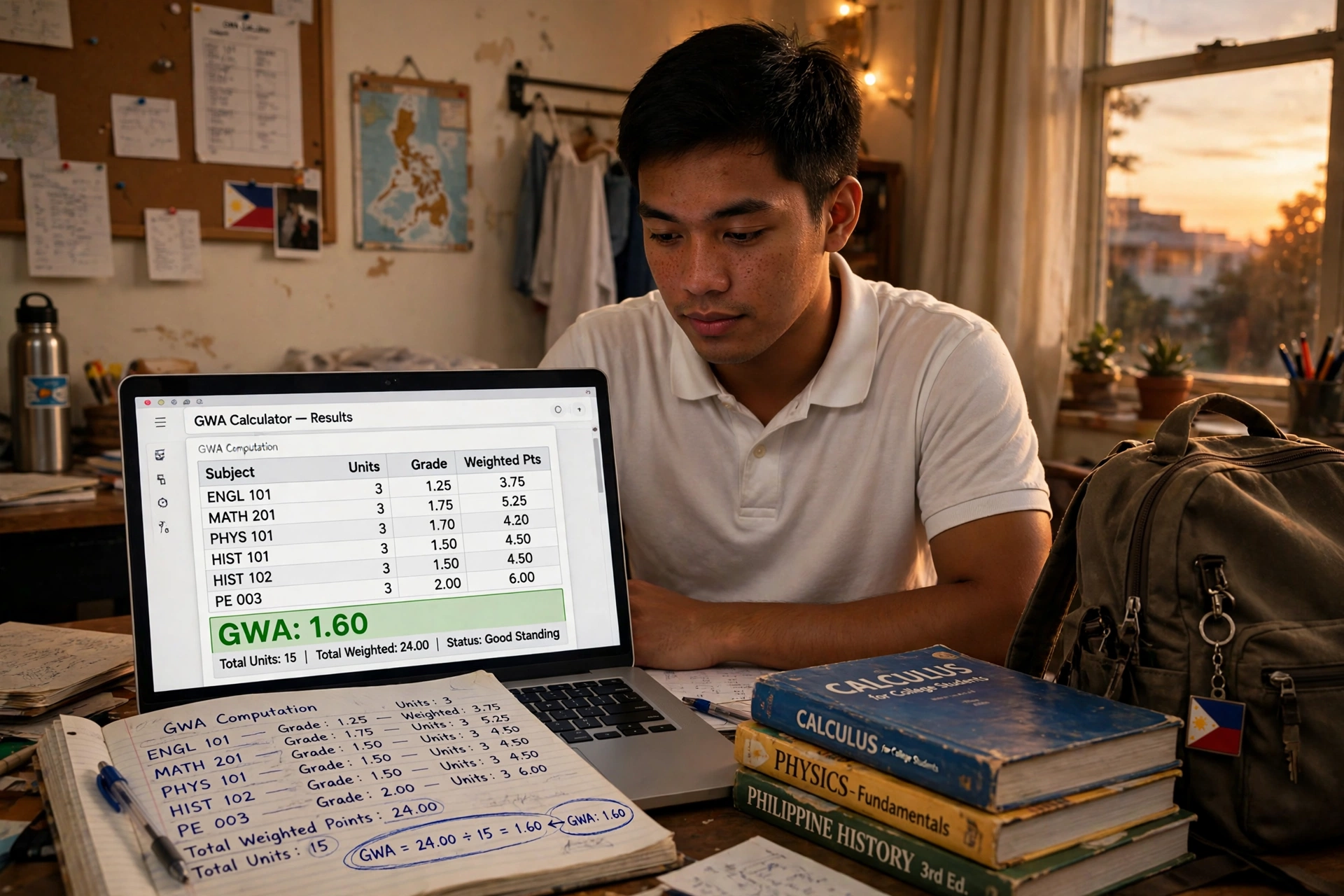
The formula has not changed since first year, and that is the point: the GWA is a weighted average, and the weights are the units. Every subject contributes its grade multiplied by its units to the total points, and the total points are divided by the total units.
GWA = (Grade × Units) + (Grade × Units) + … ÷ Total Units — with brackets around the whole sum before the division. One competitor page prints the formula without the brackets, and read literally it divides only the last subject. The worked examples below apply the brackets; the calculator on this site applies them too, and 48 test cases confirm it.
Three habits make the computation reliable. First, use the grades exactly as they appear on your grade slip or certificate of registration — a 1.75 is a 1.75, not “about 90%”. Percentages cannot be typed into this site’s calculator at all: typing 91 gives “invalid grade”, because the calculator only accepts grades from 1.00 to 5.00 or letters from A+ to F. Convert a percentage to a GWA first, using the GWA to percentage converter, and remember that the conversion is this site’s linear convention — your school’s own transmutation table may differ slightly, so check with your registrar before you rely on a converted figure near a cutoff.
Second, count every academic subject, including thesis and capstone. Junior year is the year this habit matters most, because capstone units are three units each and a capstone grade of 1.25 pulls a whole semester down (in the good direction) by more than a one-unit laboratory ever could. The worked example below shows the arithmetic: removing the capstone from the first semester moves the GWA from 1.60 to 1.66, because the capstone was the best grade in the load. That is the first thing to get right when you compute the gwa for junior students philippines — the subjects you leave out change the answer as much as the grades you type in.
Third, never average semester GWAs. A junior year of 1.60 and 1.71 does not average to 1.655 by the plain mean — it averages to 1.66 only because the two semesters happen to carry nearly equal units (22 and 21). The true junior-year GWA is the points of both semesters divided by the units of both semesters: 71.25 ÷ 43 = 1.66. When the semesters carry different unit loads, the plain average is wrong, and the competitor page gwacalculators.ph demonstrates it cleanly: three semesters at 1.80, 1.95 and 1.75 average to 1.83 by the plain mean but the true cumulative is 1.84 (115.65 ÷ 63). The difference is small; near a cutoff, small is the whole story.
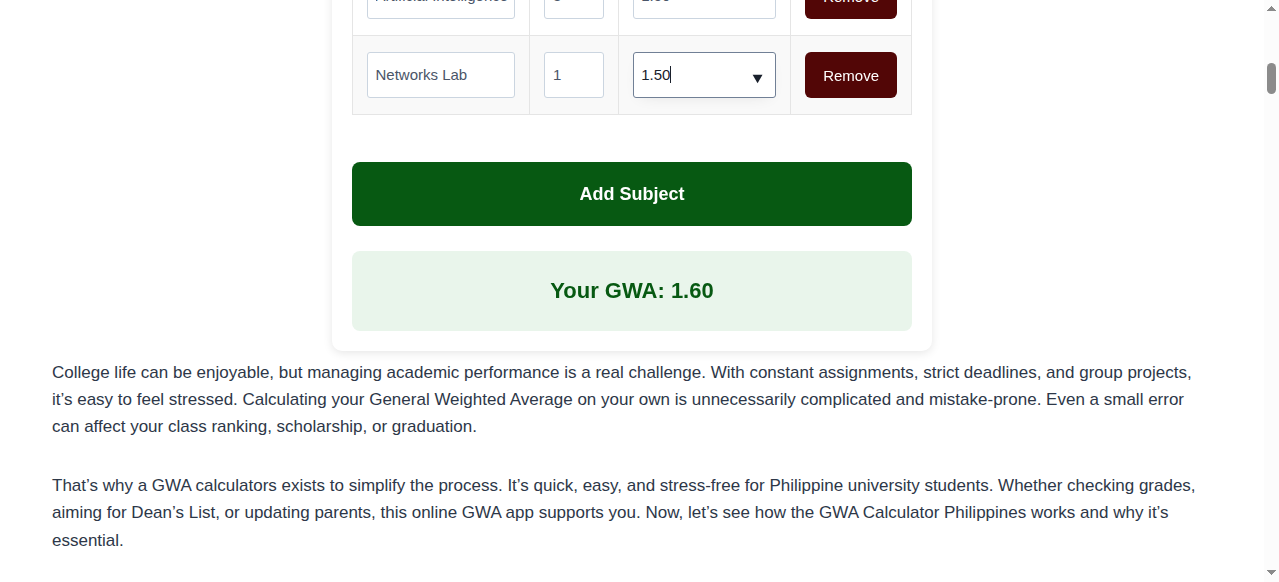
The fastest way to do all of this is the calculator on this site’s homepage: type each subject, its units and its grade, and the result updates live — there is no separate Calculate button to press, despite what the page copy says. The video below shows the whole junior first semester being typed in, live, ending on 1.60.
Worked Example 1: A Junior First Semester, GWA 1.60
Meet the load first, because the subjects are the point: third year in BS Computer Science is Software Engineering, Theory of Computation, Database Systems, Computer Networks, Capstone Project 1, Human-Computer Interaction, an Artificial Intelligence elective, and a one-unit Networks Laboratory. Eight subjects, 22 units, and the capstone is in the list — it counts, and it counts at three units.
| Subject | Units | Grade | Grade × Units |
|---|---|---|---|
| Software Engineering | 3 | 1.50 | 4.50 |
| Theory of Computation | 3 | 1.75 | 5.25 |
| Database Systems | 3 | 1.50 | 4.50 |
| Computer Networks | 3 | 2.00 | 6.00 |
| Capstone Project 1 | 3 | 1.25 | 3.75 |
| Human-Computer Interaction | 3 | 1.75 | 5.25 |
| Artificial Intelligence (elective) | 3 | 1.50 | 4.50 |
| Networks Laboratory | 1 | 1.50 | 1.50 |
| Total | 22 | 35.25 |
GWA = 35.25 ÷ 22 = 1.60227… → 1.60. That is test case T01: the hand computation and the site’s own calculator code, run unmodified in Node, agree exactly. On this site’s converter, 1.60 is 92.5% — comfortably above the 85% scholarship bar and inside the Dean’s List line of 1.75.
Two things in that table deserve a second look. The first is the capstone. At 1.25 it is the best grade in the load, and at three units it carries as much weight as any lecture subject. Take it out — the way a student would if they believed the competitor page that says thesis units are excluded — and the semester reads 31.50 ÷ 19 = 1.66 (T15a). Same student, same grades, a GWA 0.06 worse, because the best grade was deleted. The second is Computer Networks at 2.00, the worst grade in the load. It is also three units, so it pulls exactly as hard in the other direction: replace it with a 1.50 and the semester would read 33.75 ÷ 22 = 1.53. In third year, the three-unit subjects are the whole game; a one-unit laboratory, however well you do in it, cannot rescue a three-unit 2.00.

Worked Example 2: Second Semester, the Junior Year, and the Three-Year Cumulative
Second semester is Capstone Project 2, Compiler Design, Information Assurance and Security, Web Systems and Technologies, Mobile Computing, Technopreneurship, and a Data Science elective — seven subjects, 21 units, and the capstone again at three units.
| Subject | Units | Grade | Grade × Units |
|---|---|---|---|
| Capstone Project 2 | 3 | 1.50 | 4.50 |
| Compiler Design | 3 | 1.75 | 5.25 |
| Information Assurance & Security | 3 | 1.50 | 4.50 |
| Web Systems & Technologies | 3 | 2.25 | 6.75 |
| Mobile Computing | 3 | 1.75 | 5.25 |
| Technopreneurship | 3 | 2.00 | 6.00 |
| Data Science (elective) | 3 | 1.25 | 3.75 |
| Total | 21 | 36.00 |
GWA = 36.00 ÷ 21 = 1.71429… → 1.71 (T02). Web Systems at 2.25 is the worst grade in the load; drop it and the semester reads 29.25 ÷ 18 = 1.625 → 1.63 (T30) — a 0.08 swing from a single three-unit subject. Both semesters qualify for the Dean’s List at a 1.75 school, and both sit above the 85% scholarship bar (1.71 converts to 91.1%).
Now the two numbers that matter more than either semester on its own. The junior year is the two semesters combined: (35.25 + 36.00) ÷ (22 + 21) = 71.25 ÷ 43 = 1.65698… → 1.66 (T03), which is 91.75% on the converter. And the three-year cumulative — the freshman year from our freshman guide (80.50 points over 46 units) plus the sophomore year from our sophomore guide (67.00 over 40) plus this junior year (71.25 over 43) — is 218.75 ÷ 129 = 1.69574… → 1.70 (T04/T24c), or 91.25%.
That 1.70 is the junior checkpoint in one number, and it is worth sitting with. It is inside the UP Cum Laude line of 1.75, so at a UP-style school this student is on track for honours. It is outside the PUP Cum Laude ceiling of 1.60, so at PUP the same student is not — and the gap is 0.10 of GWA with only forty units left to close it. It is also outside the STI Cum Laude ceiling of 1.50 by a wider margin. The same transcript is an honours student at one school and not at another, and the difference is not the student’s effort. It is the school’s table. That is why the honours section of this guide prints each school’s numbers separately instead of one “standard” table — because the standard table does not exist, and why any junior working out the gwa for junior students philippines should start from their own school’s handbook, not from a generic table.
DOST JLSS: The Scholarship You Applied For Last Year Starts Paying in Third Year
The Junior Level Science Scholarship is the one scholarship that belongs to juniors and to nobody else — and the application is already behind you. JLSS is for regular second-year students in DOST-SEI priority science and technology courses, with a GWA of at least 83% and no failing or conditional grade from the first semester of first year through the first semester of second year, including midyear terms. If you met that bar, the benefits start in third year and run to graduation: a living allowance of ₱8,000 a month, tuition support of up to ₱40,000 a year, ₱10,000 for learning materials, a ₱10,000 thesis grant, up to ₱50,000 for research dissemination, and ₱1,000 for graduation. Apply through the official portal at jlss.science-scholarships.ph.
Two corrections matter here, because both cost real money. The first is arithmetic, and it is a competitor’s error: one JLSS guide writes that “at ₱8,000 per month, scholars receive roughly ₱96,000 per school year in living allowance alone”. DOST pays the living allowance for ten months per academic year, not twelve. The true figure is 8,000 × 10 = ₱80,000 a year — ₱16,000 less than the page claims. A junior budgeting a year on ₱96,000 would come up short by two months’ allowance.
The second is about dates. The AY 2026–2027 JLSS cycle ran April 17 to May 15, 2026, with the examination on June 28, 2026. That cycle is closed. One JLSS guide still answers its own FAQ — “Is the DOST JLSS 2026 application still open? Yes” — in November, six months after the window closed. If you are reading this in third year and you did not apply in second year, there is no senior-year version of JLSS to apply for instead. The door was second year only.
What does change in third year is the retention rule, and here the news is better than the numbers suggest — and also the place where a fresh competitor page gets it wrong. The DOST-SEI Scholar’s Handbook sets the retention bar by year level: first year, an annual weighted average of 2.75 in the UP System or 2.5 or 85% in other schools, with no failing grade in any academic subject; second year, the same bar measured semestrally. But for third, fourth and fifth years, the handbook states only this: passing grades in all academic subjects, provided you take the regular load and complete the course within its prescribed period. No GWA number is stated for juniors. A scholarship site that writes “third and fourth year scholars must earn passing grades in all subjects with a 2.50 GWA” is adding a number the handbook does not contain — we could not verify it, and the article states the handbook rule as written. The same site also writes “2.50 or better (80%)” three times: on the linear scale 2.50 is 81.25%, and 80% is 2.60. The pairing is invented, and it is the third different pairing for 2.50 found in two days of research — the handbook’s own “2.5 or 85%” is the first, and a foundation guide’s “2.5 or 80%” is the second. The lesson is the same every time: when a page gives you a GWA and a percentage side by side, check the conversion yourself, because the two numbers often come from different scales. The calculator tests for the boundaries are T13a–T13d: exactly 2.50 is kept, 2.51 fails it; exactly 2.75 is kept in the UP System, 2.76 fails it.
One more JLSS point for juniors: the thesis grant. The ₱10,000 thesis allowance is junior-year money in the most literal sense — it is tied to the thesis or capstone you are doing now. It is also the reason the thesis-units section below matters: the same units the grant pays for are the units that count in your GWA.
CHED and Foundation Scholarships: 85% Is the Number to Beat
If JLSS is the scholarship you already won or lost, the CHED Merit Scholarship and the foundation programmes are the ones still open to a junior — and their bars cluster tightly around one number. The CHED full Merit Scholarship requires a general weighted average of at least 85%; the half scholarship sits at 80%. On this site’s converter, 85% is a GWA of 2.20 (T23) and 80% is 2.60. A junior at the worked example’s 1.70 — 91.25% — clears both bars with room to spare; a junior at 2.30 (83.75%) clears the half scholarship but not the full one.
The foundation programmes surveyed for third-year students show the same pattern: of fourteen programmes listed in the most complete junior scholarship guide, seven set their bar at 85% — BPI Pagpugay, Ayala U-GO for incoming third-year women, Megaworld (85% with no grade below 80%), Cebuana Lhuillier, and the three Gokongwei GBF STEM programmes. The lower tiers are 80% (Security Bank RMKK, URC SURE with top 40% of the batch) and 83% (Security Bank internal). One programme, Inquirer/Aboitiz, states its bar in GWA terms instead: a 1.75 semestral average with no grade below 2.0. The pattern is an observed one, not a rule — each foundation sets its own bar and its own income ceiling — but a junior who holds 85% is inside the door at most of them, and a junior below 80% is outside nearly all of them.
Three conversion errors in this space are worth naming, because each one could mislead a junior about whether they qualify. First, the foundation guide lists the Mercury Drug Foundation Pharmacy Scholarship as “at least a 2.5 or 80% GWA”. On the linear scale 2.50 is 81.25% and 80% is 2.60 — the two numbers are not the same bar. Second, a scholarship site writes that CHED full scholars must maintain “at least 85% (2.00 or better)”. On the linear scale 85% is 2.20 and 2.00 is 87.5% — the pairing overstates what a 2.00 means and understates what 85% requires. Third, a third-year scholarship guide writes that applicants need “a GWA of at least 85% or QPI of 2.0 (or equivalent)”. On the Ateneo scale, QPI 2.0 (a C) is 75–78%; 85% is approximately QPI 3.0 (a B, 83–86%). The two are a full grade point apart: a student with QPI 2.0 reading that page would wrongly believe they meet an 85% bar, and a student at 85% might wrongly think they need only a QPI of 2.0. None of these pages is lying on purpose. They are copying a GWA figure from one scale and a percentage from another and printing them as equivalents. The fix is always the same: convert on one scale, and say which scale you used.

Retention in Third Year: UA&P, Arellano, and Why UP Has No GWA Line
Retention is the rule that decides whether you may enrol next semester, and in third year it is sharper than it was in second. Three published rules show how different the shapes are — and the University of the Philippines shows why a GWA threshold is not the only shape a retention rule can take.
At the University of Asia and the Pacific, the rule is a separation rule, and it is written in percentages of units, not in a GWA line. A junior is separated from the University if they incur grades below 3.0 in 30% or more of the total academic units they enrolled in during third year, including required subjects taken for the first time during the summer of the previous academic year. Only academic subjects count — PE, IPD, NSTP and APEC foreign-language units are excluded — and a failed subject that is retaken counts both times: the failing mark is not replaced. The same university’s bar was 2.75 for freshmen and 2.50 for sophomores; for juniors there is no single GWA to stay above, only a proportion of failed units to stay below. The rule is old — the published page was last edited in 2010 — so verify it with your college before relying on it; but it is the published rule, and it is the shape a third-year retention rule often takes.
At Arellano University, the third-to-fourth-year bar is twofold: students must pass the college-administered Revalida and obtain a GWA of 2.5, including PE and NSTP/ROTC, with a Revalida grade of at least 75%. The Revalida score counts for 20% of the final grade in Course Audit I. Note the inclusion, because it is the opposite of UP: Arellano counts PE and NSTP in the retention GWA, and the same load reads differently under the two rules. Failing the Arellano bar does not block enrolment outright — the student may still enrol but may be required to take remedial classes. The calculator tests for the boundary are T14a and T14b: exactly 2.50 is kept, 2.51 fails.
At the University of the Philippines there is no GWA line at all, and a popular legal blog’s claim to the contrary is one of the errors corrected in this guide. The Revised UP Code, Article 389, decides scholastic standing by the percentage of units failed — a grade below 3.00 — not by a GWA threshold: Warning at 25–49% of units failed, Probation at 50–75%, Dismissal at 76% or more, and Permanent Disqualification at 100%. INC grades are not included in the computation. That means a UP junior with a 2.60 GWA and no failed subjects is in good standing, while a UP junior with a 2.40 GWA built on failed subjects can be on probation. The respicio.ph article that prints “WARNING: GWA < 3.00 but ≥ 2.75 / PROBATION: GWA < 2.75 / DISMISSAL: GWA < 2.00” invents thresholds the UP Code does not contain. If your school is UP, your standing is a count of failed units, and the number to watch is not your GWA but the proportion of your load you failed.
One programme-level rule deserves its own paragraph, because it is stricter than any university rule in this guide. At National University, an accountancy student entering third year must have passed all second-year professional courses, take a qualifying examination with a 70% passing rate, and achieve an Equivalent Qualifying Grade of 1.5 — computed as 50% of the GWA of second-year professional courses plus 50% of the examination score. The incoming-sophomore EQG is 1.0. The junior bar is deliberately stricter than the sophomore bar: the programme is telling its students, in numbers, that third year is where the cohort is thinned. If your programme has a qualifying examination or an EQG-style rule, it will be in your student handbook under retention or progression — read that section before third year starts, not after the examination is scheduled.
OJT: The Gate Is Back Subjects and Units, Not Your GWA
Ask a junior what they need to qualify for on-the-job training and most will say a GWA. At the schools whose OJT policies we could read, the answer is: no. The gate is back subjects, year standing, and units — and the GWA does not appear in the policy at all.
The clearest example is a civil engineering OJT policy published for third-year students: OJT is a requirement for the completion of the degree in civil engineering of third-year standing, the student should be a regular civil engineering student with no back subjects, and the minimum is 240 hours, enrolled in the OJT subject during the summer term. No GWA number appears anywhere in the document. At CKS College, the practicum gate is units: at least 90 academic units and at least 24 units of professional subjects completed before enrolment in Practicum — a threshold reached at about the end of third year. At Xavier University, the pre-OJT work in third year is a plan of study, and OJT itself begins when the student has only 50 units left — 240 hours for 2 units under the old curriculum, or 9 units and 486 hours under the new one.
That is good news for a junior whose GWA is not where they want it, and it reframes the third-year task. The thing that blocks OJT is a back subject — a 5.00 sitting on your transcript from second year — not a 2.30 average. Clearing back subjects in third year is therefore not just grade repair; it is the literal prerequisite for the summer practicum. And the units gate means underloading has a cost beyond the semester: drop below the regular load in third year and you may arrive at the OJT term short of the 90 academic units, or with more than 50 units left, and wait a term. Check your programme’s OJT policy in third year first semester, not in the summer you planned to take it — the policies are published, and the numbers in them are units and hours, not GWAs.
Thesis and Capstone: The Units Count — Do Not Delete Them
One competitor page, a calculator site, writes this sentence: “In most Philippine universities, subjects like PE, NSTP, HK, SP/Thesis units, and Military Science are excluded from official GWA calculation.” It is wrong as a general claim, and it is wrong in exactly the place where it hurts juniors most. Thesis and capstone units are graded academic units. At most schools they count in the GWA like any other subject — and at three units each, they count heavily. PE and NSTP inclusion is school-specific: Arellano includes them in the retention GWA, UP excludes them, and the PUP handbook says only academic courses count toward the honours GWA. But no school in the research for this guide excludes thesis units from the GWA as a rule. A junior who deletes their capstone rows from the calculator, following that page, computes a GWA their registrar will not recognise — and in this guide’s worked example, deleting the capstone makes the semester look worse, not better, because the capstone was the best grade in the load.
The capstone also has a failure mode that first-year subjects do not. Fail Capstone Project 1 and the first semester reads 46.50 ÷ 22 = 2.11 (T05) instead of 1.60 — a 0.51 swing from a single subject, because a 5.00 at three units contributes 15 points where a 1.25 contributed 3.75. Retake it at 1.50 and the calculator’s model — both grades counted, because the calculator has no replacement mode — gives 51.00 ÷ 25 = 2.04 (T06). If your school replaces the grade instead, the same retake gives (46.50 − 15.00 + 4.50) ÷ 22 = 36.00 ÷ 22 = 1.6363… → 1.64, hand-computed. Same retake, same new grade, and the two policies are 0.40 of GWA apart. Which one applies is a registrar question, not a calculator question — and it is worth asking before you retake, because the answer changes whether the retake is worth a semester of your time. At STI and at UP Mindanao, the published rule is that a failed-and-retaken course counts every time it was taken, so the 2.04 figure is the honest one there; at schools with grade replacement, the 1.64 figure is.
An INC in a capstone is its own problem. The calculator cannot represent it at all: typing INC gives “invalid grade” (T07a), and the only workaround is to delete the row — which gives the second semester without Capstone 2 as 31.50 ÷ 18 = 1.75 (T07b), a figure that looks tidy and means nothing, because the capstone is still owed. At UP, an INC must be removed within one academic year. A capstone INC left sitting in third year becomes a graduation problem in fourth year, when the capstone sequence has no slack left in it. Clear it in the semester you incur it.
What a Good Junior GWA Is — Dean’s List, UP Scholars, PUP and STI
At most Philippine colleges, the Dean’s List line is a semestral GWA of 1.75 or better, and both semesters in this guide qualify: 1.60 and 1.71 are both inside it (T11 tests exactly 1.75, T11b tests 1.76 missing it). At UA&P the line is stricter — a Dean’s List of 1.00 to 1.50 — so the same 1.60 that makes the list at most schools does not make it there. Check your own school’s line; “1.75” is the common rule, not a universal one.
At UP, the scholar lines are 1.45 or better for University Scholar and better than 1.45 up to 1.75 for College Scholar, both with at least 15 units and no grade below 3.00 (T12a tests exactly 1.45, T12b tests 1.50 as College Scholar only). The Latin honours lines are Summa 1.20, Magna 1.45 and Cum Laude 1.75 under Article 410 of the UP Code. Our worked junior, at a three-year cumulative of 1.70, is inside the UP Cum Laude line with 0.05 to spare — and that margin is the subject of the next section.
At PUP the lines are different, and two competitor pages get them wrong by copying UP’s numbers. The PUP grading system handbook, page 44, sets Summa Cum Laude at 1.0000–1.1500, Magna Cum Laude at 1.1501–1.3500, and Cum Laude at 1.3501–1.6000, with only academic courses included, no final grade lower than 2.50, no 5.00, and no INC, withdrawn or dropped subject. The calculator tests are T24 and T24b: exactly 1.60 qualifies, 1.61 does not. The academic-suite guide gives PUP the UP numbers (1.20 / 1.45 / 1.75), and gwacalculatorph.com does the same; the academic-suite site then contradicts itself on its own Latin Honors Calculator page, which lists PUP as 1.25 / 1.50 / 1.75 — a third set of numbers. A PUP junior at 1.61 reading any of those pages would believe they are safely Cum Laude. They are not.
At STI the lines are stricter still: Summa 1.00–1.10, Magna 1.11–1.30, Cum Laude 1.31–1.50, with no grade lower than 2.25, at least 75% of units taken at STI, and no major offense — and a failed-and-retaken course counts every time it was taken. The calculator tests are T33 and T33b: exactly 1.50 qualifies for Cum Laude, 1.51 does not. And a gradebook vendor, OpenEduCat, attributes a different set of lines to “standard CHED CMO requirements”: Summa 1.0–1.20 with no grade below 2.0, Magna 1.21–1.45 with no grade below 2.5, Cum Laude 1.46–1.75 with no grade below 3.0. CHED sets no national Latin honours cutoffs at all — the respicio.ph commentary states it plainly, “CHED does not impose a uniform national GWA cutoff for summa cum laude, magna cum laude, or cum laude across all institutions” — and the “no grade below” ladder is invented. For contrast, PUP requires no grade lower than 2.50 for all three honours tiers, not a ladder. There is no CHED table to look up. There is only your school’s handbook.
One more correction in this space, from the same law-firm commentary: its generic bands put Magna Cum Laude at 1.21–1.50 and Cum Laude at 1.51–1.75. UP’s Magna line is 1.45, not 1.50, and Cum Laude starts at 1.46, not 1.51. A student at 1.47 reading those generic bands would wrongly conclude they are Magna. They are Cum Laude — still honours, but a different tier, and the tier matters for the civil service eligibility that comes with it: under PD 907, graduates with Latin honours — Cum Laude, Magna or Summa, all three — are granted automatic Second Level (Professional) eligibility, appropriate for first and second level positions. A competitor page that splits the eligibility by tier, giving professional eligibility only to Summa graduates, is wrong on both halves.
The Honors Trajectory: What Senior Year Has to Do
Third year is the last checkpoint at which the honours maths can still be changed by planning rather than by hoping. After third year, roughly forty units remain — about a quarter of a 169-unit degree — and the target-grade formula tells you exactly what those forty units have to average. The formula, printed with the brackets a competitor page leaves out, is:
Required average = (Target GWA × Total units − Current points) ÷ Remaining units. Read without the brackets, the same formula gives nonsense — one popular guide prints it that way and its own worked example quietly uses the brackets. Print it with them.
Apply it to the worked junior, who sits at 218.75 points over 129 units (1.70) with 40 units left. For PUP Cum Laude at 1.60: (1.60 × 169 − 218.75) ÷ 40 = (270.40 − 218.75) ÷ 40 = 51.65 ÷ 40 = 1.29. That is the average the whole senior year has to hit — every subject, both semesters — and test case T25 verifies the landing: a senior load averaging 1.29 over 40 units brings the cumulative to 270.40 ÷ 169 = 1.60 exactly. It is achievable, but it is not a casual target: it means no grade worse than about 1.50 in any three-unit subject all year. For UP Cum Laude at 1.75, the same junior can average up to (1.75 × 169 − 218.75) ÷ 40 = 77 ÷ 40 = 1.93 and still finish at 1.75 — a much softer target, which is why the school’s table matters more than the effort. And for Magna Cum Laude at 1.45: (1.45 × 169 − 218.75) ÷ 40 = 26.30 ÷ 40 = 0.66 — below 1.00, which no grade can be. It is impossible, and test case T31 proves it from the other side: even a perfect 1.00 across all forty senior units leaves the cumulative at 258.75 ÷ 169 = 1.53, still above the Magna line. A junior at 1.70 who is aiming at Magna is aiming at a number the arithmetic has already closed. The honest move is to aim at the Cum Laude line that is still open, and to know which school’s line that is.
For a junior further from the line, the formula is harsher still. A student at 2.25 after 60 units who wants Cum Laude at 1.75 with 60 units left needs (1.75 × 120 − 135) ÷ 60 = 75 ÷ 60 = 1.25 across the remaining two years — the example from yesterday’s guide, and the honest answer is that it requires near-perfect grades for four consecutive semesters. That is not a reason to give up. It is a reason to plan the four semesters as a single campaign — which subjects carry three units, which electives can be chosen for grade, and whether a retake is worth the slot — rather than discovering in fourth year that the line was out of reach all along. Our cumulative GWA guide works the same formula across all four years, and our how to improve your GWA guide covers the semester-level tactics: banking grades in high-unit subjects first, because a 1.50 in a three-unit subject moves the average three times as far as a 1.50 in a one-unit laboratory.
Shifting and Transferring in Third Year
Shifting programmes in third year is, at most schools, either closed or expensive. The common pattern is that shifting is a first- or second-year option: by third year the professional subjects have started, the new programme’s prerequisites are a year behind you, and the residency rule bites — the degree-granting school commonly requires no less than 50% to 75% of the total units to be taken with it, so a late shift can add a year. Transferees face the same residency arithmetic from the other side: units taken elsewhere may or may not be credited, and credited units often do not carry their grades into the new school’s GWA, which means a transferee’s honours standing is computed on a smaller, newer base. There is no national rule here; every school writes its own shifting and residency rules, and they are in the student handbook under “shifting”, “transfer” and “residency”.
What the calculator can do for a shifting decision is the target-grade maths, and the worked examples above are the template: put your current points and units into the formula, put the new programme’s honours or retention line in as the target, and see what the remaining units have to average. If the required average is below 1.00, the target is closed and the decision is made for you. If it is between 1.00 and 1.50, the target is open but demands near-perfect grades — and a shifting student should ask whether the new programme’s first-year professional subjects, taken a year late, are the place to attempt them. If the required average is above 1.75, the shift costs little in honours terms, and the decision can be made on the programme itself rather than the maths.
A Failed Subject in Third Year — and What a Retake Actually Does
A failed subject in third year costs more than the same failure in first year, for a reason that has nothing to do with the grade itself: the denominator is bigger now, so the recovery is slower, and the failed subject is more likely to be a prerequisite for a fourth-year subject. The capstone example above shows the scale — a single 5.00 at three units moves a 22-unit semester from 1.60 to 2.11 — but the same arithmetic applies to any three-unit professional subject. The retake question is always the same two-part question: does your school replace the grade or count both, and does the failed subject block a prerequisite chain? The first part is worth 0.40 of GWA in the capstone example (2.04 both-counted against 1.64 replaced). The second part can cost a semester: fail a prerequisite in the first semester of third year and the fourth-year subject that needs it may not be available until the following year.
The practical rules are short. Retake a failed subject at the first offering, because the prerequisite chain is the real cost. Ask the registrar, in writing if you can, whether the retake replaces the grade or counts alongside it — do not assume, because STI and UP Mindanao count both and other schools replace. And remember that a 4.00 conditional grade is counted by this site’s calculator at face value (T16): the calculator does not know a 4.00 is conditional, and a conditional that is not removed becomes a 5.00 at most schools. A conditional in third year is a deadline, not a grade.
What Juniors Actually Average: Real Data, Read the Right Way Round
Almost everything written about GWA in the Philippines is advice. Almost nothing is data. The one published study found in this research that reports real GWAs by year level is Musngi et al. (2024), a peer-reviewed study of 375 students at NU Fairview — 125 per year level — published in Psychology and Education: A Multidisciplinary Journal (full text at ejournals.ph). Its numbers: mean GWA 3.17 in first year (SD 0.42), 3.28 in second year (SD 0.57), and 2.87 in third year (SD 0.64). The difference across year levels is statistically significant (ANOVA F = 18.34, p = 0.00). Grit scores barely differ by year (3.15, 3.14, 3.24), and the grit–GWA correlation is weak (r = 0.12, p = 0.02).
Those means are the only real distribution in this guide, and they are worth reading correctly — because the paper itself reads them backwards, twice. Its discussion says second-year students “perform better academically on average”, but the second-year mean of 3.28 is the worst of the three years: on the 1.00–5.00 scale, lower is better. It then says the “decrease in average GWA among third-year students raises concerns about their academic performance” — but the decrease to 2.87 is an improvement: third-year students have the best mean GWA in the study. The paper’s own data says juniors are doing best; its discussion says they are doing worst. The error is instructive beyond this paper, because it is the easiest mistake in the whole GWA literature: every instinct from percentage grading says higher is better, and on the GWA scale the instinct is inverted. When you read any GWA claim — a study, a guide, a forum post — check first which direction the author thinks “better” goes. If they praise a rising GWA, stop reading.
What the data actually says is encouraging and unsurprising in equal measure: students get better at the system as they spend more years in it. A junior averaging 2.87 in that sample is not a weak student; they are the typical student, and the worked junior in this guide at 1.70 is well ahead of that typical figure. The gap between 2.87 and the scholarship bars is also the honest context for the rest of this guide: the modal foundation bar of 85% (2.20) and the JLSS bar of 83% (2.36) sit well above the typical junior’s average, which is why they are competitive. A junior at 2.50 is ordinary. A junior at 2.20 is competitive. A junior at 1.70 is, by the only published numbers available, exceptional.
Rounding: When 1.725 Prints as 1.73 and 1.625 Prints as 1.63
A GWA that looks like an exact tie at the second decimal can print either way, and the reason is binary floating point, not decimal intuition. This guide’s tests add two new cases to the four documented yesterday. A load of 13.80 points over 8 units is exactly 1.725 in decimal — and the calculator prints 1.73 (T10b), because the double closest to 1.725 sits a hair above it. A load of 29.25 over 18 is exactly 1.625 — and it prints 1.63 (T30), because 1.625 is exact in binary and a half rounds up. The junior-year example from a competitor page, 57.75 over 42, is exactly 1.375 and prints 1.38 (T22b). Yesterday’s cases still hold: 1.675 prints as 1.68, 1.575 prints as 1.57, and 1.525 prints as 1.52 — the same apparent tie, three different results, decided by which side of the decimal the nearest double falls on.
The practical consequence is narrow but real. If your GWA sits within 0.01 of a cutoff — 1.75 for the Dean’s List, 1.60 for PUP Cum Laude, 2.50 for retention — the two-decimal display is not the whole story, and a registrar computing from unrounded figures may see a different second decimal than your calculator shows. Keep four decimal places in your own spreadsheet until the last step, as the gwacalculators.ph guide advises, and if you are within a hundredth of a line, ask your registrar which figure they use. The calculator on this site shows two decimals because that is what the page prints; your transcript may carry more.
What the Calculator Cannot Do (and the Workarounds That Work)
This site’s calculator is a faithful implementation of one formula, and its limits are the limits of that formula. It cannot accept percentages: typing 91 gives “invalid grade” (T08a), and typing 88 and 90 together gives the same (T08b) — convert first, on one scale, and type the GWA. It cannot represent an INC: typing INC gives “invalid grade” (T07a), and the workaround is to delete the row, which computes the average of everything else — a useful preview, but not your GWA until the INC is cleared. It has no toggle to exclude PE or NSTP, so at a school that excludes them you must delete those rows by hand; juniors usually have no PE left to delete, which makes this less of an issue in third year than in first. It has no grade-replacement mode, so a retake is always modelled as both grades counted — if your school replaces, compute the replacement figure by hand, as the capstone section does. It counts a conditional 4.00 at face value (T16), it shows 0.00 when every row has zero units (T17), and it rejects any grade outside 1.00–5.00 (T18, T19). And it recalculates live on every keystroke: there is no Calculate button to press, and the number you see is always current. Knowing these five limits — percentages, INC, no exclusion toggle, no replacement mode, two-decimal display — is the difference between using the calculator and being misled by it.
Competitor Errors Corrected in This Guide
Nineteen new errors were documented in today’s research, on top of the twenty-two from yesterday’s sophomore guide — forty-one in total across the generic GWA pages. The table below lists the ones this guide corrects, with the correction in one line each. The full evidence, with quotations, is in the research notes for this article.
| Page | What it says | Correction |
|---|---|---|
| Musngi et al. (2024), NU Fairview | Second-years (3.28) “perform better”; third-years (2.87) “raise concerns” | Scale read backwards — lower is better; juniors have the best mean in the study |
| OpenEduCat | Latin honours tiers “per standard CHED CMO requirements”, with a “no grade below” ladder | CHED sets no national honours cutoffs; the ladder is invented |
| OpenEduCat | Philippine universities use an “inverted 4-point scale” | The scale is 1.00–5.00 — five points, not four |
| gwacalc.online (×3) | DOST retention “2.50 or better (80%)” | 2.50 = 81.25%; 80% = 2.60 |
| gwacalc.online | CHED full scholars need “85% (2.00 or better)” | 85% = 2.20; 2.00 = 87.5% |
| gwacalc.online | DOST retention needs no failing grades “in science and mathematics subjects” | Handbook: no failing grade in any academic subject |
| gwacalc.online | 3rd–4th year scholars need “a 2.50 GWA” | Handbook states no GWA number for juniors — passing grades + regular load |
| gwacalculatorcollege.online | Thesis/SP units are excluded from the GWA | Thesis units are graded academic units and count |
| gwacalculatorcollege.online | 5.00 = “Below 70%” | Failing is below 75%; the page’s own 3.00 row is 75% |
| philscholar.com | “GWA of at least 85% or QPI of 2.0” | QPI 2.0 = 75–78%; 85% ≈ QPI 3.0 — a full grade point apart |
| scholarship.com.ph | Mercury Drug: “2.5 or 80% GWA” | 2.50 = 81.25%; 80% = 2.60 |
| careersfilipino.com | JLSS living allowance “roughly ₱96,000 per school year” | ₱8,000 × 10 months = ₱80,000 |
| careersfilipino.com | JLSS 2026 application “still open” (November) | Window closed May 15, 2026 |
| financialassistance.ph | Income test as a general JLSS requirement | Income test applies only to the RA 7687 category, not JLSS-Merit |
| respicio.ph (Latin honours) | Magna 1.21–1.50; Cum Laude 1.51–1.75 | UP Magna is 1.45; Cum Laude starts at 1.46 |
| respicio.ph (Latin honours) | DepEd honours are the top 1%, 2% and 5% of the class | DO 36, s. 2016 used absolute bands (98–100 / 95–97 / 90–94); DO 015, s. 2026 replaced them with a single Academic Excellence Award (90+, no grade below 80) |
| gwacalculator.online | SHS general average = sum of (grade × units) ÷ total units | SHS subjects carry no units; the general average is a simple mean |
| gwacalculators.ph | “What Counts” table with a blank School column on all four rows | The reader is never told which school each rule belongs to (STI, Arellano, UP, UP Mindanao) |
One correction runs the other way, and fairness requires printing it: yesterday’s guide left phgwacalculator.com’s claim about DepEd Order No. 015, s. 2026 unverified. It is now verified — the order repeals DO 36, s. 2016, and from school year 2026–2027 the top academic recognition is a single Academic Excellence Award for a general average of 90 or higher with no final grade below 80. The claim was right; the flag is lifted. For the senior-high side of the same rules, see our DepEd grading system guide.
Frequently Asked Questions
What is a good GWA for a junior in the Philippines?
At most schools, a semestral GWA of 1.75 or better makes the Dean’s List, and a cumulative GWA of 1.75 or better is the UP Cum Laude line. The worked junior in this guide sits at 1.60 and 1.71 for the two semesters and 1.70 cumulative — inside both lines at a UP-style school, but outside the PUP Cum Laude ceiling of 1.60. “Good” is always relative to your school’s table, and the only published distribution available puts the typical junior at 2.87.
Does my thesis or capstone count in my GWA?
Yes. Thesis and capstone units are graded academic units and count in the GWA at most schools. One calculator site claims they are excluded; that is wrong. In this guide’s worked example, deleting the three-unit Capstone Project 1 moves the first semester from 1.60 to 1.66, because the capstone was the best grade in the load.
What GWA do I need for DOST JLSS in third year?
You do not apply for JLSS in third year — you applied in second year, with a GWA of at least 83% (2.36 on this site’s converter). In third year, the DOST-SEI handbook asks only for passing grades in all academic subjects and a regular load; it states no GWA number for juniors. The benefits — ₱8,000 a month for ten months, tuition support, and a ₱10,000 thesis grant — are paid from third year.
Can I still graduate with Latin honours if my junior GWA is 1.70?
At a UP-style school, yes for Cum Laude: you are inside the 1.75 line and can average up to 1.93 in senior year and still finish at 1.75. At PUP, only if your senior year averages 1.29, because the PUP Cum Laude ceiling is 1.60. Magna Cum Laude at 1.45 is out of reach from 1.70 — even a perfect 1.00 senior year leaves you at 1.53. Run the target-grade formula with your own numbers before you decide which line to aim at.
What GWA do I need for OJT?
Usually none. At the schools whose OJT policies were read for this guide, eligibility is third-year standing, no back subjects, and a units threshold — 90 academic units plus 24 professional units at CKS College, 50 units left at Xavier University, 240 hours in the summer term for civil engineering. Clear your back subjects in third year; that is the gate.
How do I compute my junior GWA?
Multiply each subject’s grade by its units, add all the products, and divide by the total units — with brackets around the whole sum before dividing. That is the whole method behind the gwa for junior students philippines figures in this guide. Or type the subjects into the calculator on this site’s homepage: it updates live, accepts letter grades from A+ to F, and shows the result to two decimals. Do not average your semester GWAs; combine the points and the units instead.
Do PE and NSTP count in my junior GWA?
It depends on your school and on what the GWA is for. Arellano includes PE and NSTP/ROTC in the retention GWA; UP excludes them; PUP counts only academic courses toward the honours GWA. Most juniors have no PE units left in any case. Ask your registrar which rule applies to the figure you need — retention, scholarship or honours — because the same load reads differently under each rule.
Why does my GWA print as 1.73 when my hand computation says 1.725?
Because the calculator shows two decimals and the underlying arithmetic is binary floating point: the double closest to 1.725 sits a hair above it, so it rounds up. The same effect makes 1.625 print as 1.63 and 1.575 print as 1.57. Near a cutoff, keep four decimal places in your own records and confirm the figure with your registrar.
