

GWA for Sophomore Students Philippines 2026
If you survived first year, you already know the hardest part of the gwa for sophomore students philippines is not the arithmetic. It is that second year is the first year when your GWA starts deciding things you cannot undo later. First year was an adjustment: new scale, new rules, a percentage average left behind in senior high school. Second year is when the numbers on your transcript turn into scholarship applications, retention decisions, shifting requirements and a cumulative average that is already halfway to your Latin honours. A sophomore who walks into second year without knowing the three numbers that govern it — 83%, 2.50 and 1.75 — is flying blind through the year that matters most for money and for staying in the programme.
This guide is written for that sophomore. It works out two real second-year semesters line by line — a BS Computer Science load, first semester 1.61 and second semester 1.74, giving a sophomore year of 1.68 and a two-year cumulative of 1.72 — and every figure was run through this site’s own calculator code before it was written down: 45 test cases, 45 passed, including the exact boundary cases for every cutoff in the guide. It explains the DOST Junior Level Science Scholarship, which exists only for second-year students and which a top-ranking competitor page describes wrongly. It prints the retention rules of two real universities, and the University of the Philippines’ scholastic standing rules as the UP Code actually writes them — not as a popular legal blog invents them. And it names, quotes and corrects the competitor errors found while researching this guide, because a wrong cutoff believed in second year costs a scholarship in third.
What Second Year Changes — and Why the GWA for Sophomore Students Philippines Matters More Now
First year forgives. Most universities set the freshman retention bar low — the University of Asia and the Pacific, for example, asks freshmen for a weighted average of 2.75 — and a weak first semester can be diluted by three good ones. Second year does not forgive in the same way, for three reasons, and each one is a number.
First, your cumulative GWA is now built on real weight. After two years you have roughly 86 units on record. A single 20-unit semester is now less than a quarter of your total, which means a bad semester moves the cumulative figure slowly — and a good semester moves it slowly too. The recovery maths in this guide shows exactly how slowly: a 2.50 student who takes 15 units at a perfect 1.00 improves only to 2.20, not to anywhere near 1.75. One popular guide prints that recovery as 2.23. It is wrong, and the difference matters, because a student planning a comeback on the wrong number plans the wrong number of semesters.
Second, second year is the only year the DOST Junior Level Science Scholarship opens. It is designed for regular second-year students in science and technology courses, and it closes the door the moment you become a third-year student. Miss the 83% bar in your first three semesters and the door never opens again — there is no senior-year version of JLSS.
Third, retention stops being theoretical. Universities check whether you may continue at the end of second year, and the check is usually a GWA line: 2.50 at UA&P and at Arellano University, among others. A sophomore at 2.51 is on the wrong side of that line by one hundredth of a point. This guide tests that exact boundary, because “about 2.50” is not a plan.

The Three Numbers That Decide a Sophomore Year
Everything in this guide hangs on three numbers. Learn them before you read the worked examples, because every calculation below is judged against one of them.
| Number | What it is | Who sets it | What happens if you miss it |
|---|---|---|---|
| 83% | DOST JLSS minimum GWA — about 2.36 on the 1.00–5.00 scale | DOST-SEI | You cannot apply for the Junior Level Science Scholarship, ever — it is second-year only |
| 2.50 | Sophomore retention line | Your university (UA&P, Arellano and others publish it) | Remedial classes, probation, or separation from the programme, depending on the school |
| 1.75 | Dean’s List and Cum Laude line at most 1.00–5.00 schools | Your university (UP: 1.45 / 1.75 scholar lines; PUP: Cum Laude ends at 1.60) | No Dean’s List that semester; off the Latin honours pace at graduation |
Notice what is not on the list: there is no single national GWA for sophomores. CHED sets minimum standards for higher education but does not dictate each university’s grading policy — a point the legal commentary site Respicio.ph itself makes, in the same article where it then invents UP thresholds that do not exist (corrected below). Every cutoff in this guide is traced to the institution that sets it, and every one carries the same advice: your registrar’s handbook beats any website, including this one.
How to Compute the GWA for Sophomore Students Philippines
The formula never changes, from first year to fourth: multiply each subject’s final grade by its units, add all those products, divide by the total units.
GWA = Σ (Grade × Units) ÷ Σ (Units)
What changes in second year is what goes into it. Your subjects are heavier now — 5-unit and 6-unit major subjects replace the 3-unit general education load of first year — so one weak grade in a major subject moves your GWA more than three good grades in GE subjects. A 6-unit subject counts twice as much as a 3-unit one, and the calculator on this site weights it exactly that way. If you average your grades without units, you get a different number, and it is the wrong one: in the Accountancy example on gwaph.com, the plain average of six grades is 1.75 — right on the Cum Laude line — while the real GWA is 1.82, because the weakest grade sits in the heaviest subject. That 0.07 gap is the difference between believing you are on pace for honours and actually being on pace.
Before you compute anything, convert your grades to the right scale. The calculator on gwcalculator.com accepts the 1.00–5.00 college scale and letter grades (A+ = 1.00, A = 1.25, A− = 1.50, B+ = 1.75, B = 2.00, B− = 2.25, C+ = 2.50, C = 2.75, C− = 3.00, D = 3.50, F = 5.00). It does not accept percentages: type 89 and the whole display reads “invalid grade”, because 89 is outside the 1.00–5.00 range. Second-year students rarely make this mistake — first-year students do it constantly — but it still bites when a subject is graded in percentages and you forget to convert. The conversion this site uses is linear:
percentage = 100 − (GWA − 1.00) × 12.5 | GWA = 1.00 + (100 − percentage) ÷ 12.5
So 83% = 2.36, 85% = 2.20, 90% = 1.80, 92.4% = 1.61. That is the site’s own convention, and you can check any of these figures on the GWA to percentage converter — but remember that schools with their own transmutation tables may map slightly differently, which is why the JLSS section below warns you to check which scale your school reports. If your school still grades in percentages, the DepEd grading system guide explains the senior high school side of the same maths.
Worked Example 1: A Sophomore First Semester, GWA 1.61
Here is a real second-year, first-semester load for a BS Computer Science student — eight subjects, 20 units — worked out loud, exactly as the calculator on this site computes it. Every number below was tested against the site’s own calculator code before it was written down (test T01 in the test log: 45 cases, 45 passed).
| Subject | Grade | Units | Grade × Units |
|---|---|---|---|
| Data Structures | 1.75 | 3 | 5.25 |
| Discrete Mathematics | 2.00 | 3 | 6.00 |
| Object-Oriented Programming (Lecture) | 1.50 | 2 | 3.00 |
| Object-Oriented Programming (Lab) | 1.25 | 1 | 1.25 |
| Technical Writing | 1.50 | 3 | 4.50 |
| Readings in Philippine History (Rizal) | 1.75 | 3 | 5.25 |
| The Contemporary World | 1.50 | 3 | 4.50 |
| Physical Education 3 | 1.25 | 2 | 2.50 |
| Total | 20 | 32.25 |
GWA = 32.25 ÷ 20 = 1.6125 → 1.61. As a percentage on this site’s converter, 1.61 is 92.4%. That clears every bar in the guide at once: the Dean’s List line (1.75), the UP College Scholar line (1.75), and the JLSS 83% line (2.36) with room to spare. Watch the video below — it is a real screen recording of this exact load being typed into the live calculator on gwcalculator.com, ending on “Your GWA: 1.61”.
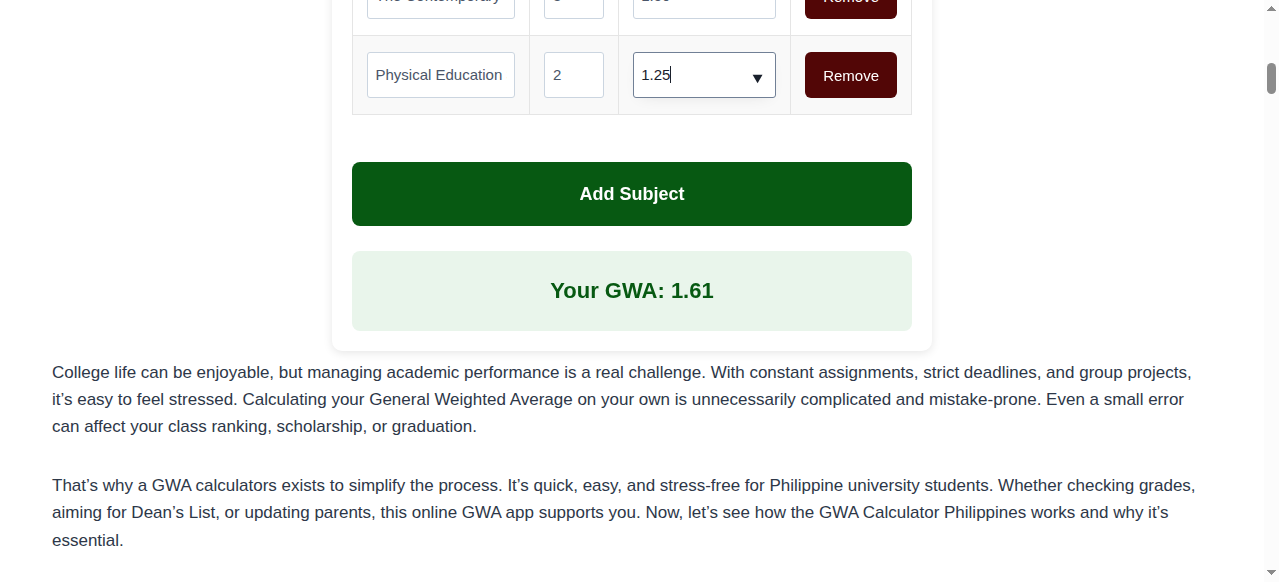

Two details in this table deserve attention, because both are sophomore traps. First, the laboratory is a separate 1-unit row from its 2-unit lecture. If you combine them into one 3-unit row at the lecture grade, you get a different GWA — and your registrar computes them separately, so enter them separately. Second, PE 3 is in the table at 1.25 and 2 units. Whether it belongs there depends on your school, and the difference is not trivial: drop PE from this load and the GWA becomes 29.75 ÷ 18 = 1.65, not 1.61 (test T15a). At UP, PE and NSTP are excluded from the GWA; at Arellano they are included; at PUP only academic courses count toward the honours GWA. The same load reads 1.61 or 1.65 depending on which rule you follow — so follow your school’s rule, not a calculator’s default. The full PE and NSTP section is below.
Worked Example 2: Second Semester, the Sophomore Year, and the Two-Year Cumulative
Second semester of second year is when the major subjects get heavier. Here is the same student’s second semester — seven subjects, 20 units:
| Subject | Grade | Units | Grade × Units |
|---|---|---|---|
| Algorithms | 1.50 | 3 | 4.50 |
| Database Systems | 1.75 | 3 | 5.25 |
| Operating Systems | 2.25 | 3 | 6.75 |
| Computer Networks | 2.00 | 3 | 6.00 |
| Statistics | 1.75 | 3 | 5.25 |
| Ethics | 1.50 | 3 | 4.50 |
| Physical Education 4 | 1.25 | 2 | 2.50 |
| Total | 20 | 34.75 |
GWA = 34.75 ÷ 20 = 1.7375 → 1.74. As a percentage, 1.74 is 90.8%. Still inside the Dean’s List line, still above the JLSS line — but notice the direction: the semester got worse by 0.13, driven mostly by one 2.25 in a 3-unit major subject. That is the unit-weighting lesson in miniature: Operating Systems at 2.25 contributed 6.75 points, more than any other row, and it alone pulled the semester from 1.61 territory to 1.74.
Now the number that actually matters — the cumulative figures. Do not average the two semester GWAs. The correct method is to add all the points and all the units together, which is what the cumulative GWA guide explains in full. Here it is for this student:
| Period | Points | Units | GWA | As % |
|---|---|---|---|---|
| Sophomore 1st sem | 32.25 | 20 | 1.61 | 92.4% |
| Sophomore 2nd sem | 34.75 | 20 | 1.74 | 90.8% |
| Sophomore year | 67.00 | 40 | 1.68 | 91.5% |
| Two-year cumulative (freshman year 80.50 / 46 units + sophomore year 67.00 / 40) | 147.50 | 86 | 1.72 | 91.0% |
The freshman year figures (80.50 points over 46 units, GWA 1.75) come from the freshman guide on this site, tested the same way. Two things to notice. First, the sophomore year GWA is 1.68 — and the exact value is 67.00 ÷ 40 = 1.675, which the calculator displays as 1.68. That is not a mistake; it is binary floating-point rounding, and it can go either way (the rounding section below shows a 1.575 printing as 1.57). Second, the two-year cumulative is 1.72 — better than the freshman year’s 1.75, because the sophomore year at 1.68 pulled it down. That is the good news of second year: you are now halfway through the degree, and a strong sophomore year still moves the cumulative figure by a visible amount. By fourth year it will not.
One more trap, tested as T21: do not average semester GWAs to get the cumulative figure. If this student took a 6-unit summer at 1.00 after WE1, the plain average of the two semester GWAs (1.61 and 1.00) would say 1.31. The true cumulative is (32.25 + 6.00) ÷ 26 = 1.47. The plain average is wrong by 0.16 — enough to flip a Dean’s List decision. The semesters had different unit counts, so they cannot be averaged equally. Every competitor page that warns about this is right, and the warning is worth repeating, because it is the single most common cumulative-GWA mistake in Philippine universities.
DOST JLSS: The Scholarship That Exists Only for Sophomores
The Junior Level Science Scholarship (JLSS) is the most important reason the gwa for sophomore students philippines is a different question from the GWA for any other year. It is run by the Department of Science and Technology – Science Education Institute (DOST-SEI), and it is designed for students who are currently in their second year of college and will enter third year in the next academic year. If you are a third-year student, you cannot apply. If you are a first-year student, you cannot apply. The window is one year wide, and it is this year.

The academic bar is a General Weighted Average of at least 83% or its equivalent, with no failing or conditional grades — from the first semester of first year through the first semester of second year, including midyear terms. The other conditions are: natural-born Filipino citizen, regular second-year student, enrolled in a DOST-SEI priority science and technology course, good moral character and good health. The 2025 cycle had 958 qualifiers out of 14,609 applicants, about a 6.5% passing rate — the exam is competitive, but the GWA bar is the gate: fail it and there is no exam to take.
On this site’s converter, 83% is GWA 2.36 (1.00 + 17 ÷ 12.5). That number is the whole point of this section, because a popular competitor page gets it wrong. The GPA-vs-GWA guide on thegwacalculator.netlify.app tells the story of “Maria, a college sophomore” who “applies for a Department of Science and Technology (DOST) scholarship, which requires a GWA of 1.75 or better” — and concludes she “qualifies easily”. There is no DOST scholarship with a 1.75 bar. JLSS requires 83%, which is about 2.36 on the 1.00–5.00 scale; the DOST Merit scholarship requires 90% or higher. The 1.75 figure is the Dean’s List line, imported into a scholarship it has nothing to do with. The practical damage runs the other way too: a sophomore sitting at 2.00 — comfortably above the 83% bar at about 87.5% — who reads that page concludes they cannot apply for DOST, when in fact they can. If you are at 2.36 or better with no failing or conditional grades, you meet the academic bar. Check the rest of the conditions on the official portal, jlss.science-scholarships.ph, and treat any other site’s version of the bar as a rumour.
How close is the line? Razor close. A 25-unit load totalling 59.00 points gives exactly 2.36 — 83.0%, a pass (test T13a). Change one 3-unit grade from 2.25 to 2.50 and the same load totals 59.75 points: 2.39, which converts to 82.6% — a fail (test T13b). One grade, in one subject, is 0.03 of GWA and the whole scholarship. That is why the worked examples in this guide are computed to the hundredth, and why a sophomore aiming at JLSS should compute their GWA the week grades come out, not the week applications close.
What does JLSS pay? For the 2026 cycle: tuition and other school fees up to ₱40,000 per academic year, a learning materials or connectivity allowance of ₱10,000 per year, a monthly living allowance of ₱8,000, a transportation allowance for students studying outside their home province, group accident and health insurance, a thesis allowance of ₱10,000, a research dissemination grant up to ₱50,000, and a graduation allowance of ₱1,000. Over the remaining two years of the degree that is more than ₱200,000 in total benefits. The application is fully online through the DOST-SEI portal, with official Forms C to I and a qualifying examination. For the academic year 2026–2027 cycle, applications ran April 17 to May 15, 2026, with the exam on June 28, 2026 — that cycle is closed. The 83% bar is the standing rule; the dates for the next cycle are published on the portal, and this guide will not guess them.
Two more JLSS details that trip applicants up. First, “regular” status matters as much as the grade: irregular students — those who dropped subjects or fell behind the curriculum flowchart — do not qualify, even with an 83% average. Second, one JLSS information page (updatesfilipino.com) states the requirement as 85% in its FAQ while its own requirements section says 83%. The 83% figure is the official one, confirmed by the DOST-SEI Scholar’s Handbook and every other source checked; 85% is that page contradicting itself.
The DOST “2.5 or 85%” Trap
Once you are a DOST scholar, keeping the scholarship has its own bar, and it contains a trap. The DOST-SEI Scholar’s Handbook says a second-year scholar must keep a semestral weighted average of 2.75 or better if enrolled in the UP System; 2.5 or eighty-five percent (85%) or better in other schools, with no failing grade in any academic subject. Read that as two different scales, not one number: on this site’s converter, 2.50 is 81.25% and 85% is 2.20. The two halves of DOST’s “2.5 or 85%” do not map onto each other. The handbook’s “or” covers the fact that schools report on different scales — a school that reports in percentages uses 85%, a school that reports on the 1.00–5.00 scale uses 2.50. A scholar at 2.50 who assumes that satisfies an 85% reading is wrong by nearly four percentage points (test T23: a load at exactly 2.20 is the 85% line). Before you assume you are safe, find out which scale your school reports to DOST.
Retention: The 2.50 Line, and Why UP Does Not Use One
Retention is the rule that decides whether you may enrol next semester. Two Philippine universities publish a sophomore retention line of 2.50, and they apply it differently — which is exactly why the number alone is not the rule.
University of Asia and the Pacific (UA&P). Its published business rules state: “Sophomores should attain a WA of 2.50 or better for all subjects taken during the 2nd year, including required subjects taken for the first time during the summer of the previous academic year.” Only academic subjects count — PE, IPD, NSTP and APEC foreign language courses are excluded. Two details matter. First, a failed subject re-taken does not replace the failing mark: both marks count in the weighted average. Second, the same page sets the freshman bar at 2.75 and the bar for seniors going to fifth year at 2.00. The page was last edited in 2010, so treat it as the published rule and confirm the current version with your college — but the structure (a per-year WA line, academic subjects only, no grade replacement) is how retention works at schools that use it. Tested: a 20-unit load at exactly 50.00 points is 2.50 and is kept (T14a); a 40-unit year at 100.50 points is 2.5125, displayed as 2.51, and misses the line (T14b).
Arellano University. Its retention policy states that students going from second to third year “must show a GWA of 2.5, including PE and NSTP/ROTC” — the opposite inclusion rule from UA&P. But failing the bar does not end enrolment: “Students who fail to achieve the required GWA may, nevertheless, enroll in the following semester or term according to their normal schedules of classes, but may be required to take special remedial classes in their identified academic areas of weaknesses.” At Arellano the 2.50 line is a trigger for remediation, not a dismissal. The same load therefore reads differently under the two rules: our WE1 is 1.61 with PE included and 1.65 with PE excluded. Both numbers are correct; only one of them is your university’s number.
University of the Philippines — no GWA line at all. This is where a popular legal commentary site goes badly wrong, and it matters because UP students read it. Respicio.ph’s article on re-enrolment states UP’s standing rules as GWA thresholds: “WARNING: GWA < 3.00 but ≥ 2.75”, “PROBATION: GWA < 2.75”, “DISMISSAL: GWA < 2.00”. None of those thresholds exists in the UP Code. The official Rules on Scholastic Standing (Revised UP Code, Art. 389) decide standing by the percentage of units failed — a grade below 3.00 — not by GWA at all:
| Standing | Official UP rule (Art. 389) |
|---|---|
| Good standing | Grade of 3.00 or better in at least 75% of registered academic units |
| Warning | Below 3.00 in 25–49% of units |
| Probation | Below 3.00 in 50–75% of units; load limited by the Dean |
| Dismissal | Below 3.00 in at least 76% of units; or probation followed by failing 50%+ again |
| Permanent disqualification | Below 3.00 in 100% of units |
A UP sophomore with a 2.60 GWA and no failed subjects is in good standing. A UP sophomore with a 2.40 GWA built on failed subjects can be on probation. The GWA number alone cannot tell you which one you are — only the percentage of failed units can. INC grades are not included in the computation. Individual UP colleges may add their own rules on top (the UP Department of Geography, for example, requires its majors to keep a total GWA of 2.50 and a Geography-subject GWA of 2.25, checked every semester, with one semester to recover), and Mapúa’s programme retention policy evaluates students every term, with a third failure in a critical course putting a student on Final Probation and a fourth dismissing them from the programme. The pattern is the same everywhere: retention is programme-level and rule-specific, and the only reliable source is your own handbook.
What a Good Sophomore GWA Is — Dean’s List, UP Scholars, and the PUP Correction
“Good” depends on what the number has to do. Here are the lines that actually exist, each tested at its boundary:
| Standing | Line | Tested |
|---|---|---|
| Dean’s List (most 1.00–5.00 schools) | 1.75 or better, no failing or incomplete grades | 1.75 qualifies (T11); 1.76 misses (T11b) |
| UP University Scholar | 1.45 or better, ≥15 units, no grade below 3.00 | 1.45 qualifies (T12a) |
| UP College Scholar | Better than 1.45 up to 1.75, same conditions | 1.50 qualifies as College Scholar only (T12b) |
| PUP Cum Laude (at graduation) | 1.3501–1.6000, academic courses only, no grade worse than 2.50 | 1.60 qualifies (T24); 1.61 misses (T24b) |
| UP Latin honours (at graduation) | Summa 1.20, Magna 1.45, Cum Laude 1.75 | Cumulative figures — see the Dean’s List guide |
The UP scholar lines deserve a second look, because a top-ranking competitor page gets them wrong in a way that costs real students. The site gwacalculatorph.com states: “University Scholar (US) — A student who earns a semester GWA of 1.75 or better … is recognized as a University Scholar.” That is wrong. Under the Revised UP Code (Arts. 381–383, published by the UP Diliman Office of the University Registrar), 1.75 is the College Scholar line; the University Scholar line is 1.45. A sophomore at 1.50 who believes that page thinks they are a University Scholar; they are a College Scholar. A sophomore at 1.60 who believes it thinks they missed University Scholar by a mile; in fact they were never near either line, and the number that matters for them is the College Scholar line they are already inside. The full UP scholar rules, with the 15-unit and no-grade-below-3.00 conditions, are in the freshman guide, verified against the UP Code itself.
The PUP correction is just as sharp, and it comes from PUP’s own handbook. Two competitor sites — academic-suite.online’s guide and gwacalculatorph.com’s PUP page — give PUP the exact same Latin honours cutoffs as UP: Summa 1.20, Magna 1.45, Cum Laude 1.75. The PUP Student Handbook says otherwise: Summa Cum Laude 1.0000–1.1500, Magna Cum Laude 1.1501–1.3500, Cum Laude 1.3501–1.6000, with only academic courses counted and no final grade lower than 2.50. A PUP sophomore at 1.61 who trusts the competitor table believes they are on pace for Cum Laude; under PUP’s real rule they have already missed it by 0.01. Worse, academic-suite.online contradicts itself: its own Latin Honours Calculator page lists PUP as 1.25 / 1.50 / 1.75 — a third set of numbers on the same site. If you study at PUP, the handbook is the only table that counts, and the PUP grading system page on this site explains the full scale. UST, for reference, is stricter than both: Summa 1.10, Magna 1.35, Cum Laude 1.60 — confirm it in your own handbook before planning around it.
One more warning about “good” that three competitor pages get wrong. Freetooler.com’s GWA guide says “1.00–1.50 typically corresponds to summa cum laude territory” and “1.50–1.75 covers magna”, with thresholds “commonly 1.75, 1.50, and 1.25”. That misstates two of the three honours: Summa is 1.00–1.20 and Magna is 1.21–1.45 at UP-style schools. A 1.50 is Cum Laude range, not Magna, and 1.25 sits inside Magna, not on the Summa line. The same page then contradicts itself on the Dean’s List, saying a GWA “between 1.50 and 1.75 qualifies” and in the next breath that a 1.75 “lands right on the Dean’s List edge at schools that use a strict cutoff of 1.50 or lower” — at a 1.50-cutoff school, a 1.75 does not qualify at all. These are not pedantic points. A sophomore who believes 1.50 is Magna pace will discover at graduation that it was Cum Laude pace, two years too late to fix it.
A Failed Subject in Second Year — and What a Retake Actually Does
Second year is when major subjects start failing students. Take WE1 and fail Discrete Mathematics — change its 2.00 to a 5.00. The points jump from 32.25 to 41.25 and the semester GWA goes from 1.61 to 2.06 (test T05). One subject, 0.45 of GWA. It also knocks the student out of Dean’s List contention for that semester, out of JLSS eligibility (a failing grade anywhere in the first three semesters disqualifies you), and — at schools like PUP, where no grade worse than 2.50 is allowed for honours — out of Latin honours contention permanently, even after a retake.
Whether the retake fixes the GWA depends entirely on your school’s retake rule, and the difference is enormous. There are three rules in Philippine universities, and your handbook picks one:
| Retake rule | What happens to the 5.00 | WE1 after retaking Discrete Math at 1.75 |
|---|---|---|
| Grade replacement | The new grade replaces the old one | 31.50 ÷ 20 = 1.575 → displays 1.57 |
| Both grades counted | Original 5.00 stays, retake added as a new row | 46.50 ÷ 23 = 2.02 (test T06) |
| Grade averaging | (5.00 + 1.75) ÷ 2 = 3.375 replaces the row | (32.25 − 6.00 + 10.125) ÷ 20 = 1.82 |
Same retake, same grade, three results: 1.57, 1.82, 2.02. The policy matters more than the grade. The calculator on this site models the both-counted rule, because it simply averages whatever rows you enter — to model replacement, delete the failed row and type the new grade in its place. And note the display quirk in the replacement row: 31.50 ÷ 20 is exactly 1.575, but the calculator displays 1.57, not 1.58. That is binary rounding again (see the rounding section), and it is worth knowing before you argue with your registrar about a hundredth of a point.
Two related warnings. An INC grade is not a free pass: the calculator cannot represent it at all — typing INC gives “invalid grade” — and at most schools an unresolved INC lapses to 5.00 after a year (at UP, within one academic year), entering your GWA retroactively at full unit weight. Resolve INCs before they resolve themselves. And a 4.00 conditional grade counts at face value 4.00 in the meantime (test T16: a load with a 4.00 comes out at 2.42); if it is not completed, most schools convert it to 5.00.
Shifting Programmes: The Target-Grade Maths, With the Brackets
Second year is also when students decide to shift — out of a programme that is not working, into one that fits. Shifting usually requires a GWA floor (UP’s shifting primer puts most programmes at 2.00 or better, some at 1.75; other universities set their own), and the question every would-be shifter asks is: what average do I need in my remaining subjects to reach my target? The formula is simple, but one popular guide prints it wrong. Onlinegwacalculator.com writes: “Required Average Grade = (Target GWA × Total Future Units) − (Current Cumulative GWA Points Earned) ÷ Remaining Units”. Read literally, with division before subtraction, that gives (1.75 × 120) − (135 ÷ 60) = 207.75 — nonsense. The brackets belong around the subtraction:
Required Average = [(Target GWA × Total Units at Graduation) − (Current GWA × Units Completed)] ÷ Remaining Units
Worked example, from that same guide, checked: a second-year student has completed 60 units at a cumulative GWA of 2.25 and wants to graduate at 1.75 (the Cum Laude line at most schools), with 60 units remaining. Total units at graduation: 120. Points needed: 1.75 × 120 = 210. Points already earned: 2.25 × 60 = 135. Points still needed: 75. Required average in the remaining 60 units: 75 ÷ 60 = 1.25. That is an extremely high standard — between Excellent and Very Good, sustained across every remaining semester — and the honest answer for most students in that position is to re-run the calculation with a more achievable target first, say 2.00, and check whether the required average is one they have already been hitting. The same target-grade maths is what the how to improve your GWA guide uses for recovery planning. And the recovery maths is equally blunt: a single perfect semester does not rescue a weak record. Sixty units at 2.50 is 150 points; add 15 units at 1.00 and you have 165 points over 75 units — 2.20, an improvement of 0.30. The guide that prints this recovery as 2.23 is wrong by 0.03 (test T22g), and a student planning on 2.23 plans on a number that does not exist. Recovery takes multiple semesters. There is no shortcut in the denominator.
PE, NSTP and PATHFIT: Included or Not?
No question produces more wrong GWA figures than this one, because the answer genuinely differs by school — and two competitor pages state it as if it were universal. The facts, school by school:
| School / rule | PE and NSTP in the GWA? | Source |
|---|---|---|
| UP System | Excluded (non-academic units) | UP Code; all competitors agree |
| Arellano University | Included, expressly (“including PE and NSTP/ROTC”) | Arellano retention policy |
| PUP (honours GWA) | Excluded — “only academic courses shall be included” | PUP Student Handbook |
| UA&P (retention WA) | Excluded — “only academic subjects are included” | UA&P business rules |
The competitor error here is phgwacalculator.com’s flat statement: “At UST and PUP, they’re included.” For PUP’s honours GWA that is wrong — the handbook excludes them. Whether PUP includes PE/NSTP in a semester GWA for other purposes is a separate question for PUP’s registrar; the honours figure, which is the one students plan around, excludes them. The practical rule is simple: find your school’s rule in its handbook, then set the calculator to match. This site’s calculator has no PE/NSTP toggle — you delete the rows yourself. Our WE1 shows the stakes: 1.61 with PE, 1.65 without it; WE2 is 1.74 with PE and 1.79 without it (test T30). A student who includes PE when their school excludes it is reporting a better GWA than the registrar will — and discovering the gap at scholarship application time.
NSTP deserves its own note because second year is usually the last NSTP semester. NSTP is commonly graded pass/fail, which means it has no numeric grade to enter at all — delete the row. If your school gives NSTP a numeric grade, enter it only if your school counts it. And remember that passing NSTP is still a graduation requirement at most schools even where it does not count toward the GWA: UP requires all 8 units of PE and 6 units of NSTP passed for graduation, regardless of the GWA.
Rounding: When 1.675 Prints as 1.68 and 1.575 Prints as 1.57
The calculator shows two decimals. Your registrar may keep three or four. Near a cutoff, that difference decides things — and the two-decimal display does not always round the way you expect, because computers store decimals in binary. Four exact ties were tested against the live calculator code in this guide’s test run:
| Exact value | Displayed | Where it appears |
|---|---|---|
| 1.625 | 1.63 | Exact in binary; half rounds up (T10b) |
| 1.675 (sophomore year) | 1.68 | Binary value is a hair above 1.675 (T03) |
| 1.575 (replacement retake) | 1.57 | Binary value is a hair below 1.575 |
| 1.525 / 1.425 | 1.52 / 1.43 | Competitor examples re-run (T22c, T22e) |
The lesson is not that the calculator is wrong — it is doing exactly what two-decimal display does. The lesson is that a GWA sitting exactly on a .xx5 tie can print either way, and a cutoff applied to the printed figure can go either way with it. Gwaph.com warns about this correctly: a 1.7504 GWA prints as 1.75 but does not meet a strict 1.75 rule. The same logic applies at 2.50 and at 1.45. If your GWA is within 0.01 of a line that matters — JLSS, retention, a scholar bracket — ask your registrar for the unrounded figure and the school’s rounding rule before you assume you are in or out. No competitor page other than gwaph.com mentions this at all.
What the Calculator Cannot Do (and the Workarounds That Work)
Three sophomore needs fall outside what the calculator on this site handles, and all three were tested rather than assumed:
Percentages. Type 89, 92 or 88 and the display reads “invalid grade” (tests T08a, T08b), because the calculator only accepts the 1.00–5.00 scale. Convert each percentage first with the converter formula above, then enter the converted grade. A grade of 89% converts to about 1.88; 92% to about 1.64.
INC grades. Typing INC gives “invalid grade” (test T07a). There is no INC, DRP or W in the calculator’s code. Delete the row entirely — that is what most registrars do until the grade is resolved — and remember the deadline: an INC left past your school’s limit lapses to 5.00 at full unit weight.
Out-of-range grades. Anything below 1.00 or above 5.00 is rejected (tests T18, T19: 5.50 and 0.50 both give “invalid grade”). Letter grades work, including mixed case (test T09: B+, A, b, C−, A+ gives 1.86), and decimals are rounded to two places on entry (1.333 becomes 1.33, test T10a). A 4.00 conditional is accepted and counted at face value (test T16).
The calculator also recalculates live as you type — there is no Calculate button to press, whatever the page copy says — and a load of all-zero units displays 0.00 (test T17), which is a display value, not a GWA. None of this is a criticism of the tool: it is a fast, free, no-signup calculator that does the weighted average correctly, as 45 out of 45 tests confirm. It is a reminder to know which rows belong in it before you trust its answer.
Competitor Errors Corrected in This Guide
Eleven pages were read in full for this guide — five generic GWA calculator pages, the DOST JLSS guide, the improve-your-GWA guide, the Latin honours guide, and the retention policies of Arellano and UA&P — plus the PUP Student Handbook, the UP Code, the DOST-SEI Scholar’s Handbook and the Civil Service Commission’s own pages. Twenty-two errors were found. The ones that change decisions are listed here; the full analysis, with quotes and sources, is in the research notes for this article.
| Site | What it says | What is true |
|---|---|---|
| thegwacalculator.netlify.app | DOST scholarship “requires a GWA of 1.75 or better” | JLSS requires 83% (≈2.36); Merit requires 90%+ |
| thegwacalculator.netlify.app | 15.25 ÷ 10 = 1.55 | 1.525, displayed as 1.52 |
| onlinegwacalculator.com | Target-grade formula printed without brackets | Literal reading gives 207.75; brackets required |
| onlinegwacalculator.com | Recovery: 60 units at 2.50 + 15 at 1.00 → 2.23 | 165 ÷ 75 = 2.20 |
| onlinegwacalculator.com | PD 907: honours give sub-professional eligibility; only Summa gets professional | CSC: all Latin honours get Second Level (Professional) eligibility |
| respicio.ph | UP Warning <3.00 but ≥2.75; Probation <2.75; Dismissal <2.00 | UP Code Art. 389: standing by % of units failed (25–49 / 50–75 / ≥76%) |
| academic-suite.online | PUP honours = UP honours (1.20 / 1.45 / 1.75) | PUP handbook: 1.15 / 1.35 / 1.60 |
| academic-suite.online | Same site’s calculator page lists PUP as 1.25 / 1.50 / 1.75 | Two different PUP tables on one site; both wrong |
| gwacalculatorph.com | PUP honours 1.20 / 1.45 / 1.75 | PUP handbook: 1.15 / 1.35 / 1.60 |
| gwacalculatorph.com | “University Scholar — 1.75 or better” | UP Code: University Scholar 1.45; 1.75 is College Scholar |
| phgwacalculator.com | “At UST and PUP, PE and NSTP are included” | PUP handbook: only academic courses in the honours GWA |
| phgwacalculator.com | JLSS 83% mixed with “STEM apply regardless of GWA” | That rule belongs to the freshman DOST undergraduate scholarship, not JLSS |
| freetooler.com | “1.00–1.50 summa territory; 1.50–1.75 covers magna” | Summa 1.00–1.20; Magna 1.21–1.45; 1.50 is Cum Laude range |
| freetooler.com | 1.75 “on the Dean’s List edge at schools with a 1.50 cutoff” | At a 1.50 cutoff, 1.75 does not qualify |
| updatesfilipino.com | JLSS requirement stated as 85% in its FAQ | Official bar is 83%; the page contradicts its own requirements section |
| gwacalculatorpro.com | Formula printed without brackets around the sum | Same presentation slip as onlinegwacalculator; brackets required |
| chedscholar.org | GWA 3.00 → GPA 1.00 | WES-style tables say 3.00 → 2.00; no single official conversion exists |
Two things are worth saying about this list. First, most of these pages get their arithmetic right — chedscholar’s second-year example, gwaph’s Accountancy example and freetooler’s Maria example all re-ran correctly through this site’s calculator. The errors cluster in the cutoffs, the conversions and the copied tables, which is exactly where a wrong number costs the most. Second, the GWA-to-GPA conversion deserves its own warning: 1.75 maps to 3.50 on one page, 3.25 on another (GPA = 5 − GWA), 3.00 on a third, and 3.30–3.70 on a fourth. There is no official conversion. If you are applying abroad, use the receiving school’s own table or a credential evaluator’s — never a calculator site’s.
Frequently Asked Questions
What is a good GWA for a sophomore in the Philippines?
It depends on the bar you need. 1.75 or better puts you on the Dean’s List at most schools and on the Cum Laude pace; 2.36 or better (83%) keeps the DOST JLSS door open; 2.50 or better keeps you clear of retention trouble at schools that publish a 2.50 line. A 1.61 first semester and 1.74 second semester — the worked examples in this guide — clear all three at once.
What GWA do I need for the DOST JLSS scholarship?
At least 83% or its equivalent — about 2.36 on the 1.00–5.00 scale — with no failing or conditional grades from the first semester of first year through the first semester of second year. You must also be a regular second-year student in a DOST-SEI priority science and technology course. The 2026 cycle (applications April 17 – May 15, 2026; exam June 28, 2026) is closed; the next cycle’s dates are published on the official portal, jlss.science-scholarships.ph.
What happens if my sophomore GWA is 2.51?
At UA&P, 2.51 misses the 2.50 sophomore retention line — the line is exact, and a load at 2.5125 displays as 2.51 (test T14b). At Arellano, missing 2.5 triggers remedial classes, not dismissal. At UP there is no GWA retention line at all — standing depends on the percentage of units failed. Check your own handbook: 2.51 is a different outcome at every school.
Does PE count toward my sophomore GWA?
It depends on the school. At UP, PE and NSTP are excluded. At Arellano they are included. At PUP only academic courses count toward the honours GWA. At UA&P only academic subjects count toward the retention average. On this load the difference is 0.04 of GWA (1.61 with PE, 1.65 without), so find your school’s rule before you compute.
Can I still get Cum Laude if I failed a subject in second year?
At PUP, no — the handbook bars any grade worse than 2.50 for honours. At UP, a 5.00 on the record is a problem for honours even after a retake; check your college’s rule. The GWA itself can recover: retaking a failed 3-unit subject at 1.75 brings the worked first semester from 2.06 to 1.57 under a replacement rule, or to 2.02 where both grades count. The honours consequence is separate from the GWA consequence, and the honours one is usually permanent.
How do I compute my cumulative GWA after second year?
Add every subject from every semester you have finished — all the grade × units products together, all the units together — and divide once. Do not average your semester GWAs. For the student in this guide: 147.50 points over 86 units is 1.72 after two years. The cumulative GWA guide walks through the same method with a spreadsheet option.
Is 1.75 a good GWA for a sophomore?
Yes — 1.75 is the Dean’s List line at most schools and the Cum Laude line at UP-style schools, and it is comfortably above the JLSS 83% bar. But it is not the same everywhere: at PUP, Cum Laude ends at 1.60, so a 1.75 cumulative would miss honours there; at UA&P the Dean’s List runs 1.00–1.50, so 1.75 would not make it either. “Good” is always relative to your school’s table.
Does my GWA reset when I shift programmes?
No. Your cumulative GWA carries all your subjects, and most shifting rules look at it directly — UP’s shifting primer generally requires 2.00 or better, with some programmes at 1.75. Some schools exclude pre-shift subjects from the new programme’s retention average (Mapúa gives shifters a fresh Academic Good Standing in the new programme), but the transcript keeps everything. Ask your registrar how your school treats shifted subjects before you decide.
Why does the calculator show 1.68 when my hand calculation says 1.675?
Because the calculator shows two decimals and computers store decimals in binary: 1.675 is stored a hair above 1.675, so it rounds up to 1.68, while 1.575 is stored a hair below and rounds down to 1.57. Near any cutoff, ask your registrar for the unrounded figure and the school’s rounding rule.
Second year is the year your GWA stops being a report card number and starts being a key: to a scholarship that only opens once, to a retention line that does not round in your favour, and to a cumulative average that is already half your degree. If you came here searching for gwa for sophomore students philippines, you now have the three numbers that govern the year — 83%, 2.50 and 1.75 — two worked semesters with every figure tested, the retention rules as the universities print them, and the corrections to the pages that get those numbers wrong. Compute your own GWA from your own class card, with your own school’s rules, and check it against your registrar’s figure while a discrepancy is still easy to fix. The calculator on this site will do the arithmetic in seconds, for free, with no signup. The judgement about what the number means is yours, and now you have the numbers to make it with.
