

GWA for Psychology Students Philippines: 2026 Guide
If you are studying — or planning to study — BS Psychology in the Philippines, one number follows you from your first enrolment form to the day you sign your name with “RPm” after it: your GWA. This guide to gwa for psychology students philippines starts with the honest answer most guides skip: there is no single GWA number for psychology students. The bar changes at every stage of the journey — getting into the programme, staying in it, graduating with honours, passing the psychometrician board exam, and going on to become a licensed psychologist. Each stage has its own number, its own scale, and in one case no number at all. What follows is the whole journey in one place, built on the actual rules as published by universities, the PRC and the law itself — including the number-one Google result for this exact topic teaching a GWA that cannot exist, and the real distribution of psychology students’ GWAs from a study of 344 AB Psychology students.
That matters because psychology is one of the few degrees where your grades are checked five separate times by five separate institutions. A state university checks your Grade 11 GWA before it lets you in. Your college checks your semester GWA before it lets you stay. Your registrar checks your cumulative GWA before it prints “cum laude” on your diploma. The PRC checks your degree — not your GWA — before it lets you sit for the psychometrician board exam. And the DOST checks your GWA before it pays for your third and fourth years. If you aim at the wrong number at the wrong gate, you waste effort in the wrong place. This guide tells you which number matters where, shows you worked examples run through this site’s own calculator, and corrects the errors other guides are still repeating.
GWA for Psychology Students Philippines: The Short Answer
When people search for gwa for psychology students philippines, they are really asking which of five different bars they belong under. Here are the five gates, in one table, before the detail:
| Gate | The number | What it decides |
|---|---|---|
| 1. Admission | Grade 11 GWA 86% or better (Benguet State University); 87% or better (Bulacan State University, board programmes); ≥80% in Math, Science and English (Batangas State University) | Whether you get into BS Psychology at all |
| 2. Retention | Psych 101 at 2.0 or better (Ateneo de Zamboanga, repeatable once only); major subjects 1.5 or better; two attempts maximum — fail twice and you are disqualified | Whether you stay in the programme — and whether your practicum is delayed |
| 3. Honours | Dean’s List at 1.75 or better (1.50 at UA&P); Latin honours Summa ≤1.20 · Magna ≤1.45 · Cum Laude ≤1.75 (cumulative, whole degree) | Whether you graduate with honours |
| 4. Board exam (BLEPP) | 75% weighted average, no subject below 60% (RA 10029, Sec. 18) — and no college-GWA requirement to sit for it | Whether you become a registered psychometrician (RPm) |
| 5. Psychologist track + scholarship | Master’s degree + 200 hours supervised practicum + advanced-subjects exam; DOST-JLSS needs ≥83% to apply, 2.5 / 85% to keep | Whether you become a licensed psychologist (RPsy) — and whether the government pays for your degree |
Two of those rows surprise almost everyone. The board exam — the biggest test of a psychology student’s life — does not care about your college GWA at all; it only requires the degree. And a GWA of 2.00, which many students think of as merely “average”, is actually the most common grade real psychology students earn — the modal GWA in a study of 344 AB Psychology students at Tarlac State University. The gates where your GWA genuinely decides your fate are the first three and the scholarship: admission, retention, honours and DOST. The rest of this guide walks each gate in order, with the exact numbers, the sources they come from, and worked examples you can check yourself on the calculator below.
Gate 1: Getting Into BS Psychology — The Admission GWA
Before you have a college GWA, schools judge you on your senior high school GWA — and the bars are higher than most applicants expect, because psychology is a board programme. The headline example comes from Benguet State University, whose Department of Psychology publishes its rule plainly: applicants need a GWA of 86% or better, with English, Mathematics and Science each at 86% or better, and qualifiers face an interview. At Bulacan State University, one of the country’s biggest state universities, the bar is a notch higher: for board and licensure programmes, which include BS Psychology, BulSU requires a Grade 11 GWA of 87% or better, with a minimum of 87% in Science for psychology applicants and 85% in every Grade 11 subject. An entrance exam is also required. Those 86–87% figures are percentage-scale GWAs — on the 1.00–5.00 scale they sit roughly around 1.75, which is exactly the Dean’s List bar most colleges use later. In other words, the standard you will need to keep in college is roughly the standard you need to get in.
Other schools set the bar differently, and that is the first registrar caveat of this guide: no admission number in this article is universal. Batangas State University, for example, does not publish a single GWA bar for BS Psychology; instead it requires at least 80% in Mathematics, Science and English in Grades 10–11, plus screening and an interview. A student with a strong overall GWA but a 78% in Math could clear BulSU’s rule and fail BatStateU’s. Check the admission page of the school you are actually applying to — and check it in the year you apply, because these numbers move. (BulSU’s own programme page, for instance, was still showing a January 2025 application deadline when it was checked in November 2026 — university pages go stale, and a stale page can cost you a slot.)
Transferring or shifting into psychology has its own bar, and it is stricter than freshman admission in one important way: it looks at your college record, not your high school one. Palawan State University requires transferees into board programmes to have a GWA of 2.25 or better (its page says “2.25 or higher” — read as “or better”, because on the 1.00 scale a higher number is a worse grade; more on that trap below). UP Diliman’s BA in Applied Psychology requires foreign transferees to hold a GWA of 2.00 or better with at least 33 units earned. One failed subject in your first programme can close the psychology door at a school like this even if your overall average is fine — a pattern you will see again at the retention gate.
One more thing worth knowing before you enrol: BS Psychology is a substantial degree. Under CHED’s CMO No. 34, s. 2017, the programme runs to about 126 units — roughly 63 units of general education, 45 units of major subjects and 18 units of electives — with BS Psychology adding 20 further units of natural-science electives, plus a thesis and NSTP. That is a lot of graded units, which is good news in one way: a single bad semester cannot sink a cumulative GWA built over 126 units, and a single good one cannot rescue it either. Both directions are slow, and that is exactly why the worked examples below matter.

Gate 2: Staying In — Retention, Probation and the GWA That Gets You Disqualified
Getting in is the easy gate. Staying in is where psychology programmes are strict, because the degree is a professional licence track and schools are judged on their board-exam passing rates. Most psychology programmes run a retention policy built on two numbers: a semester GWA bar and a per-subject floor in the major subjects. Cross either one and the consequences start — and unlike a single low grade, the consequences compound.
The only full BS Psychology retention policy published online comes from Ateneo de Zamboanga University, and it is worth reading closely because it shows how unforgiving these rules can be. At AdZU, second-year psychology students must hold a GPA of 1.5 and pass Psych 101 with a grade of 2.0 or better. Third-year students must hold a weighted average of 1.5 with major subjects at 1.5 or better — and the 5-unit major subjects (Psych 203, 301 and 305) at 1.0 or better. Required subjects below 80 must be repeated, with a maximum of two attempts: fail the second attempt and you are disqualified from the programme. Psych 101 itself is repeatable once only — fail it twice and you are out. And a student with below-80 grades in required subjects is not qualified to graduate at all.
Scale trap — read this before you copy AdZU’s numbers. AdZU’s policy never states its grading scale, and its numbers only make sense on Ateneo’s 4.0-highest QPI scale, where 1.0 is the bare pass and 4.0 is the best grade — the opposite of the UP 1.00–5.00 scale, where 1.00 is the best grade. On AdZU’s scale, “GPA 1.5” is a modest bar and “Psych 101 = 2.0” is a middling grade; on the UP scale the same digits would look excellent. Never copy a retention number without asking which scale it is on. The AdZU document is also dated June 16, 2011 and still live — ask your registrar for the current version before you plan around it.
How close is a typical student to the retention bar? Closer than you might think — and here is the only real data anyone has. A thesis at Tarlac State University surveyed 344 AB Psychology students and validated their self-reported GWAs against the Dean’s Office records. Most of them sat at GWA 1.75 (90% average) or 2.00 (87.5%). Read that plainly: the modal psychology student is already sitting at or just under the common Dean’s List line, and only a modest slip away from the 2.00–2.25 zone where retention bars start to bite. The same study found that personality traits overall had no significant relationship with GWA — only Openness showed a weak link. Your grades are not your personality, but the registrar’s office measures your grades all the same.
To see what a retention-risk semester actually looks like in numbers, take the same six subjects as the strong semester below, but with the grades a tired, overloaded student might actually get:
| Subject | Units | Grade | Points |
|---|---|---|---|
| Introduction to Psychology (PSYCH 1) | 3 | 2.50 | 7.50 |
| Psychological Statistics | 3 | 2.25 | 6.75 |
| Theories of Personality | 3 | 2.50 | 7.50 |
| Developmental Psychology | 3 | 2.00 | 6.00 |
| Rizal’s Life and Works (GE) | 3 | 2.25 | 6.75 |
| Physical Education 2 (PE 2) | 2 | 2.00 | 4.00 |
| Total | 17 | 38.50 |
38.50 points ÷ 17 units = 2.26. That is a retention-risk GWA: above the common 2.00 bar, and close enough to the 2.25 transfer bar that a single failed subject next semester would push the cumulative average past it. Run through this site’s calculator, the same semester gives 2.26 — test case C25 in our verification file, one of 38 test cases run against the live calculator’s own code, all matching hand calculations exactly. Notice what is not in this table: any failing grade. Every subject here is a pass, and the semester is still a problem. Retention is usually lost gradually, one 2.50 at a time — not in a single dramatic failure.
That is also why the practicum gate matters. CHED’s psychology curriculum requires a practicum / on-the-job training component before graduation, and most schools require you to finish your academic subjects first — a failed major subject in third year can mean a whole semester of waiting before you can start your practicum hours. The failed subject costs you twice: once in the GWA, and once in the calendar.
Worked Examples: Real Psychology Semesters, Run Through the Calculator
Every number in this section was run through gwcalculator.com’s own calculator — not a spreadsheet, not a guess. We extracted the calculator’s live page code, ran it unmodified in Node, and checked 38 test cases against hand calculations; all 38 matched exactly (the full verification is in the test-results file linked from this article’s package). Here are the three semesters that matter most, plus the traps that catch psychology students specifically.
Example 1 — A strong semester: GWA 1.50
Six subjects, 17 units, the kind of semester that puts you on the Dean’s List:
| Subject | Units | Grade | Points |
|---|---|---|---|
| Introduction to Psychology (PSYCH 1) | 3 | 1.50 | 4.50 |
| Psychological Statistics | 3 | 1.50 | 4.50 |
| Theories of Personality | 3 | 1.75 | 5.25 |
| Developmental Psychology | 3 | 1.25 | 3.75 |
| Rizal’s Life and Works (GE) | 3 | 1.50 | 4.50 |
| Physical Education 2 (PE 2) | 2 | 1.50 | 3.00 |
| Total | 17 | 25.50 |
GWA = 25.50 ÷ 17 = 1.50. On the percentage scale that is about 93.8% (“Excellent” on this site’s GWA-to-percentage converter). The same six subjects entered as letter grades — A-, A-, B+, A, A-, A- — give exactly the same 1.50, because the calculator maps A- to 1.50, B+ to 1.75 and A to 1.25. Type them in yourself on the free GWA calculator and watch the result land on 1.50; the video below shows exactly that, with four of these subjects typed live.
In the video, four psychology subjects — Intro to Psychology 1.50, Psychological Statistics 1.75, Theories of Personality 2.00 and Developmental Psychology 1.25 — compute to a GWA of 1.63: (4.50 + 5.25 + 6.00 + 3.75) ÷ 12 = 19.50 ÷ 12 = 1.625, rounded to 1.63. That rounding matters: the calculator displays two decimal places, and a raw 1.625 rounds up to 1.63, not down to 1.62. Half a hundredth of a grade point has decided Dean’s List places before.
Example 2 — A heavy 23-unit load: GWA 1.77
Upper-year psychology loads are heavier, and the 5-unit subjects start to dominate. Eight subjects, 23 units:
| Subject | Units | Grade | Points |
|---|---|---|---|
| Abnormal Psychology | 3 | 1.75 | 5.25 |
| Experimental Psychology | 3 | 2.00 | 6.00 |
| Psychological Assessment | 3 | 1.50 | 4.50 |
| Social Psychology | 3 | 2.25 | 6.75 |
| Industrial Psychology | 3 | 1.75 | 5.25 |
| Research in Psychology 1 | 3 | 2.00 | 6.00 |
| Physical Education 3 (PE 3) | 2 | 1.25 | 2.50 |
| NSTP 2 (CWTS/ROTC) | 3 | 1.50 | 4.50 |
| Total | 23 | 40.75 |
GWA = 40.75 ÷ 23 = 1.77. Note the NSTP row: if your school counts NSTP as 3 units, it enters the average — including a 3-unit 1.50 row lowers the GWA from 1.81 to 1.77, because 1.50 is better than the average of the other subjects. Many schools exclude NSTP entirely, and some give it zero units — a zero-unit row is skipped by the calculator altogether (test case C15). Check your handbook before you type NSTP in: entering it when your school excludes it gives you a number your registrar will not recognise.
And here is the psychology-specific warning: several major subjects in this degree carry 5 units — Psychological Statistics, Experimental Psychology, Field Methods and Psychological Assessment at some schools. One 5-unit grade moves your GWA more than a whole 3-unit subject. A 2.50 in a 5-unit Experimental Psychology course costs you 12.50 points — the same as a 2.50 in a 3-unit subject plus a 2.50 in a 2-unit subject. When you choose where to spend your study hours, spend them on the 5-unit subjects first.
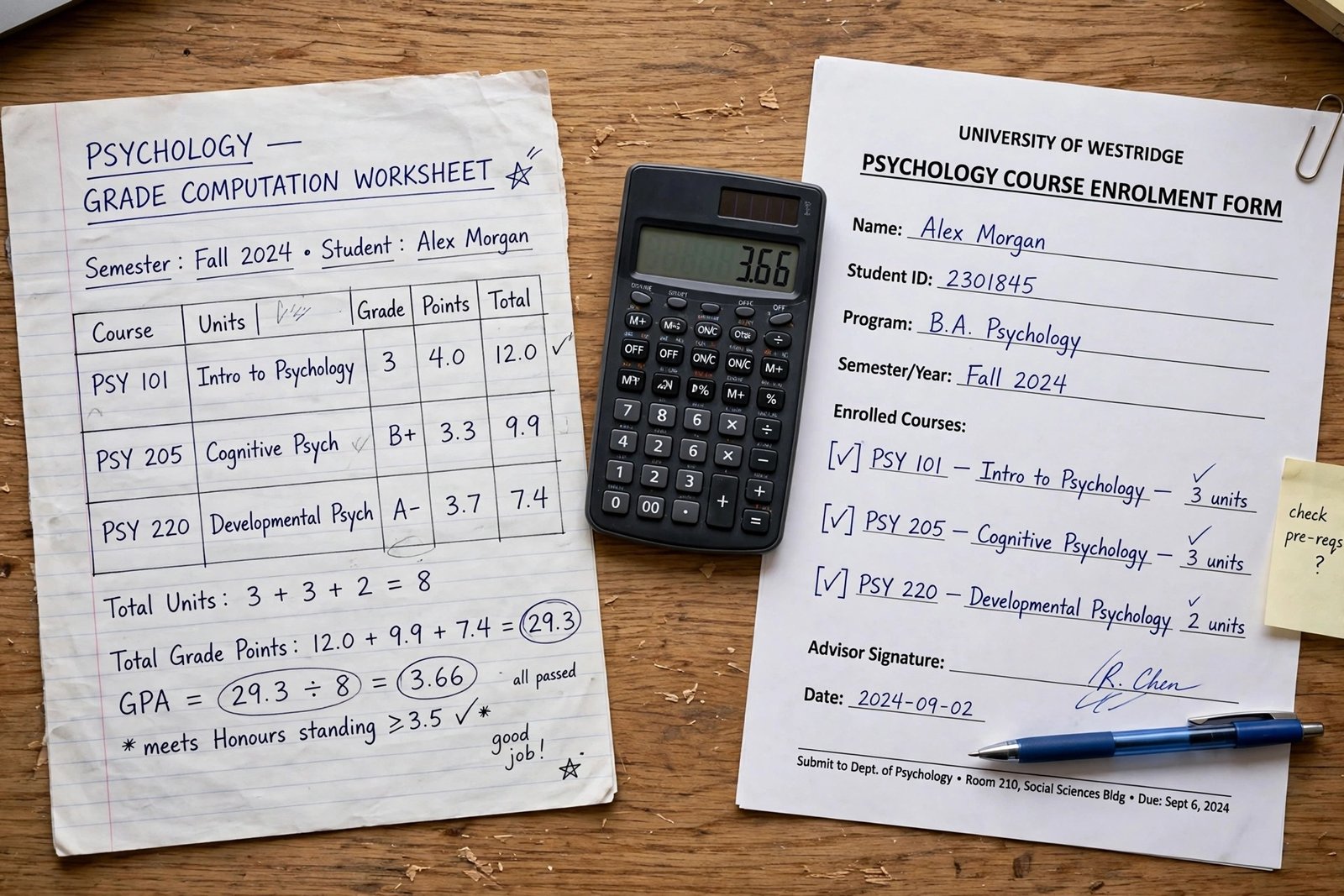
Example 3 — The recovery: one failed major subject
Take the strong 1.50 semester and add one failed 3-unit subject — Psychological Statistics at 5.00. The semester becomes (25.50 + 15.00) ÷ 20 = 2.02. One failure drags a Dean’s-List semester to the retention bar. Now retake that subject next term and score 1.75. What happens depends entirely on your school’s rule:
- Both grades counted (the common rule): (25.50 + 15.00 + 5.25) ÷ 23 = 1.99. The failure never leaves your average; the retake only dilutes it.
- Replacement (some schools, on petition): the 5.00 row is removed and the 1.75 takes its place: (25.50 + 5.25) ÷ 20 = 1.54.
The difference between 1.99 and 1.54 is the difference between an ordinary transcript and a Dean’s-List one — and the calculator cannot know which rule your school uses, because it counts every row you enter. Ask your registrar before you retake: if your school counts both, the fastest recovery is not one brilliant retake, it is a full strong semester that dilutes the failure with 17 more good units. The numbers prove it: a student at 1.85 cumulative over 96 units who posts the strong 1.50 semester ends at 1.80; the same student with a 2.10 cumulative ends at 2.01 — still above the 2.00 bar — while a student at 1.95 ends at 1.88. And the hard truth in test case C9: a student at 2.20 cumulative over 96 units who scores a perfect 1.00 in a final 17-unit semester still ends at 2.02. By the last semester, it is mathematically too late. Recovery has to start early.
Three traps that catch psychology students
1. The simple-average trap. Averaging your grades without weighting by units is wrong, and the error is biggest exactly where psychology students feel safest. Three units of Psychological Statistics at 2.50 plus two units of PE at 1.00: the simple average is 1.75, but the real GWA is (7.50 + 2.00) ÷ 5 = 1.90. Averaging two semesters is the same mistake at a larger scale: a 17-unit semester at 2.00 and a 3-unit summer term at 1.00 average to 1.50 by the naive method, but the real cumulative GWA is (34.00 + 3.00) ÷ 20 = 1.85. Always weight by units — or let the calculator do it.
2. The percentage-conversion trap. A GWA of 2.30 is roughly 82% on the standard Philippine equivalency table — a solid passing grade. One popular calculator site claims, by a straight-line formula, that 2.30 equals 67.5%. A psychology student told they are at 67.5% would think they are failing. Do not use a linear formula; use the table your school publishes, and if your school publishes none, use the standard one:
| Percentage | GWA (1.00 scale) | Description |
|---|---|---|
| 97–100 | 1.00 | Excellent |
| 94–96 | 1.25 | Excellent |
| 91–93 | 1.50 | Very good |
| 88–90 | 1.75 | Very good |
| 85–87 | 2.00 | Good |
| 82–84 | 2.25 | Good |
| 79–81 | 2.50 | Satisfactory |
| 76–78 | 2.75 | Satisfactory |
| 75 | 3.00 | Passing |
| Below 75 | 5.00 | Failed |
Two details in that table are worth memorising. First, 92% maps to 1.50, not 1.75 — the number-one Google result for this topic maps it to 1.75 and 80% to 2.75 (it is 2.50), which makes its whole worked example wrong: correctly computed, its example gives 1.88, not 2.05. Second, a GWA can never be below 1.00 — the same site’s second worked example ends in an impossible “Overall GWA = 0.865”, produced by dividing percentages by 100 and calling the result a GWA. If a calculator ever shows you a GWA below 1.00, the calculator is broken, not your grades. GWA stands for General Weighted Average, not “Grade Weighted Average” as that page claims.
3. The “or higher” trap. Official pages write “GWA of 2.25 or higher” and “GWA of 2.00 or higher” for transfer rules — Palawan State University and UP Diliman both do it. On the 1.00 scale, “higher” is worse: read literally, “2.25 or higher” would admit everyone up to 5.00, the failing grade. Both pages obviously mean “2.25 or better“. Always translate “or higher” into “or better” when the number is a GWA on the 1.00 scale, and write your own targets that way too.
Two calculator behaviours are worth knowing as well, because they surprise students who type in a real transcript. First, an INC or DRP row makes the whole computation fail — the calculator returns “invalid grade” rather than skipping the row, so you must remove incomplete or dropped subjects (or enter the completed grade) before it will compute at all. Second, the letter grade D maps to 3.50 in this site’s calculator, even though the homepage’s grade dropdown shows D = 3.00 — a discrepancy between the calculator’s own grade map and its dropdown that we have flagged before, and which your registrar’s table, not either of them, ultimately settles.

Gate 3: Dean’s List and Latin Honours — The Cumulative Bars
Dean’s List is a semester award; Latin honours are a degree award. Confusing the two is the most expensive mistake in this whole guide, because it makes students celebrate a semester that qualifies for nothing.
The typical Dean’s List bar on the 1.00 scale is a semester GWA of 1.75 or better, often with no grade below 2.00 (or 2.50, depending on the school) in any subject. Isabela State University publishes exactly that: President’s List at 1.50 or better, Dean’s List at 1.75 or better. The University of Asia and the Pacific is stricter — Dean’s List at 1.50 or better, with no failing mark ever and no incomplete in the semester. On the Ateneo 4.0-highest scale the bar looks different but means the same thing: real AB Psychology and BS Psychology students on Ateneo de Davao’s Dean’s List for the second semester of 2025–2026 held quality point indices of 3.42 to 3.69. Whatever the scale, the Dean’s List line sits at roughly the top quarter of the class — and the TSU study says the modal psychology student is already at 1.75–2.00, so the line is not a distant dream; it is one strong semester away for most students.
Latin honours work differently: they are judged on your cumulative GWA across the whole degree, not on any single semester. The widely quoted UP bands are Summa Cum Laude at 1.20 or better, Magna Cum Laude at 1.45 or better, and Cum Laude at 1.75 or better — and those numbers are cumulative. This is where a popular GWA calculator site contradicts itself: its worked example claims a single-semester GWA of 1.75 “qualifies for Cum Laude”, while its own FAQ says honours are cumulative over the whole degree. The FAQ is right and the example is wrong. A one-semester 1.75 qualifies for nothing by itself. The test data above proves why: a student at 1.55 cumulative over 96 units who posts the strong 1.50 semester ends at 1.54 — still short of a 1.50 cum laude bar at a school that uses one — while a student at 1.45 cumulative over the same 96 units ends at 1.46 and clears it. Honours are won or lost over four years, one semester at a time.
Some schools add conditions beyond the number. Isabela State University requires honours candidates to have no grade below 2.5 in any subject, to have taken at least 75% of their units at the university, to carry a normal load of at least 15 units per semester, and to finish within the prescribed period. A student with a 1.40 cumulative average but one 2.75 in a first-year GE subject can lose cum laude on that single grade. Check the fine print in your handbook — the number is only the first condition.
Gate 4: The Board Exam — The 75% Rule, the 60% Floor, and the GWA Myth
Here is the sentence most psychology students need to hear first: your college GWA does not matter for the psychometrician board exam. There is no college-GWA requirement to sit for the BLEPP — the Board Licensure Examination for Psychologists and Psychometricians. RA 10029, the Philippine Psychology Act of 2009, sets the qualifications in Section 13: a BS or AB Psychology degree from a CHED-recognised school, with sufficient credits in the four board subjects; good moral character; and no conviction for a crime involving moral turpitude. Grades are not on the list. Your transcript proves you hold the degree; the number on it is never screened. If you have been losing sleep over whether a 2.25 will keep you out of the exam room, stop: it will not.
What matters instead is a different average — the board exam’s own weighted general average. The exam has four subjects, weighted by the PRC’s table of specifications:
| BLEPP subject | Weight |
|---|---|
| Psychological Assessment | 40% |
| Theories of Personality | 20% |
| Abnormal Psychology | 20% |
| Industrial Psychology | 20% |
Under RA 10029, Section 18, you pass with a weighted general average of 75% or higher AND no subject below 60%. Two details in that sentence are routinely gotten wrong, and both of them decide real results.
First, the subject list itself. The most widely copied text of RA 10029 online — the Scribd copy that tops the search results — lists “Developmental Psychology” as a board subject. The law says Theories of Personality. A student revising from the Scribd copy would spend weeks studying the wrong subject. The same copy also says the law was enacted on January 8, 2013; RA 10029 was actually approved on March 16, 2010 (January 8, 2013 is the effectivity date of its implementing rules). A sloppy transcription is a sloppy transcription — verify against the full text of RA 10029 on LawPhil, not a document-sharing copy, and check the PRC website for the current exam schedule and requirements.
Second, the 60% boundary. The law says no grade “lower than sixty percent”. Exactly 60% in a subject passes the floor. Several law explainers — including a well-known 2010 explainer and a SlideShare deck — write “60% or less” fails, which is wrong by exactly one point, and one point is the whole ballgame at this level. The conditional-pass rule makes the boundary matter even more: if your weighted average is 75% or higher but one subject falls below 60%, your result is conditional, not failed — you retake only that subject within two years, and you must score at least 75% in it. Fail that retake and you retake all four subjects. But if your overall average is below 75% as well, there is no conditional status at all — you have failed outright, however good any single subject was.
Three worked board averages, recomputed from the weights above so you can see the rule working:
| Psych Assessment (40%) | Theories of Personality (20%) | Abnormal Psych (20%) | Industrial Psych (20%) | Weighted average | Result |
|---|---|---|---|---|---|
| 59 | 85 | 86 | 86 | 75.0% | Conditional — retake Psychological Assessment only, within 2 years, at ≥75% |
| 76 | 59 | 82 | 83 | 75.2% | Conditional — retake Theories of Personality only, within 2 years, at ≥75% |
| 72 | 73 | 74 | 70 | 72.2% | Failed outright — no subject below 60%, but the average is below 75%, so there is no conditional pass; retakes are unlimited |
Check the arithmetic on the first row: 59 × 0.40 + 85 × 0.20 + 86 × 0.20 + 86 × 0.20 = 23.6 + 17.0 + 17.2 + 17.2 = 75.0% exactly — the thinnest possible conditional pass, decided by the 40% weight of the one subject the candidate failed. That weight is also the strategic lesson: Psychological Assessment is worth double any other subject, so it deserves double the review time. The exam fee is ₱900, and outright failures may retake without limit.
One more thing the explainers get wrong: several present “registration without examination” under Sections 16–17 of RA 10029 as a live route to the licence. It is not. That route was open only to applicants who filed within three years after the Board’s creation — the Board was created in 2010 and its rules took effect in January 2013, so the window closed over a decade ago. There is no way onto the register now except the exam.
Gate 5: The Psychologist Track — and the Scholarship That Pays for It
Registered psychometrician (RPm) is the first licence, not the last. To become a registered psychologist (RPsy) under RA 10029, Section 12, you need a master’s degree in psychology, 200 hours of supervised practicum or internship, and a second licensure exam with four advanced subjects — Advanced Theories of Personality (20%), Advanced Abnormal Psychology (25%), Advanced Psychological Assessment (30%) and Counseling and Psychotherapy (25%) — under the same 75% overall, no subject below 60% rule. Your college GWA matters here only indirectly: it decides which graduate programmes admit you, and it is the habit of studying that carries you through the 200 practicum hours. The 200-hour figure is for psychologists only — psychometricians do not need it, whatever some guides imply.
And then there is the money. BS Psychology is a priority course under the DOST-SEI Junior Level Science Scholarship (JLSS), which means psychology students can apply for a government scholarship that most degree programmes cannot touch. The GWA rules, as published by DOST-SEI: apply in your incoming third year with a GWA of at least 83%, and keep the scholarship by maintaining 2.5 (85%) at a non-UP school or 2.75 at UP, with no failing grade. The Merit scholarship needs a high-school GWA of 90% or better. One scholarship guide contradicts itself on this — 83% in its requirements list, 85% in its own FAQ — because it confuses the two numbers: 83% is the bar to apply, 85% is the bar to keep. They are different gates, and mixing them up is exactly the mistake this guide exists to prevent. PE, NSTP and religion subjects are excluded from the DOST GWA computation, which is another reason to know whether your school counts NSTP before you type it into a calculator.
Between the two licences and the scholarship, the psychology path has more gates than most degrees — but it also has more funded ones. A student who holds 1.75 through third year has, in the same stroke, the Dean’s List, the DOST retention bar, and a cum laude trajectory. The gates reward the same number.
What Is a Good GWA for a Psychology Student?
With real data in hand, here is the honest answer to the question behind gwa for psychology students philippines. At Tarlac State University, where 344 AB Psychology students’ GWAs were checked against the Dean’s Office records, most students sat at 1.75 (90%) or 2.00 (87.5%). Against that distribution:
- 1.50 or better puts you in the top slice of the class — Dean’s List everywhere, cum laude trajectory, DOST-safe with room to spare.
- 1.75 is the Dean’s List line at most schools and the single most common grade among real psychology students. It is good, not average — and it is also the cum laude bar, so holding it for four years is the whole game.
- 2.00 is the modal grade: the most common single GWA a psychology student actually has. It keeps every door open — retention, transfer, DOST retention (2.5 is the bar, and 2.00 clears it comfortably) — but it does not win honours.
- 2.25–2.50 is below the class centre and close to the retention and transfer bars. It is not a crisis, but it is the zone where one failed subject starts to cost real options.
- 3.00 is the passing line. It is a degree, and a degree gets you into the BLEPP — but it closes the Dean’s List, the honours, the DOST scholarship and most graduate programmes.
For comparison, criminology students — the closest parallel degree — cluster lower, at 2.10–2.50. Psychology students cluster higher, at 1.75–2.00. The two degrees are graded on the same scale, but their classes sit in different places on it, so do not judge your psychology GWA against a friend’s criminology GWA. Judge it against the gates above.
Common Mistakes Psychology Students Make With Their GWA
Believing a GWA below 1.00 is possible. It is not. The 1.00–5.00 scale starts at 1.00. Any page, app or spreadsheet that shows you 0.865 has divided percentages by 100 and mislabelled the result. The number-one Google result for this very topic does exactly that.
Copying the wrong equivalency table. 92% is 1.50, not 1.75; 80% is 2.50, not 2.75. The same number-one result maps both wrong and then reports a “correct” GWA of 2.05 for an example that correctly computes to 1.88. If you copy its table, you will miscalculate your own GWA by nearly two grade points.
Using a linear percentage conversion. A straight line from “1.00 = 100%, 5.00 = 0%” says a 2.30 GWA is 67.5%. The real table says about 82%. Never convert with a formula; use the table, or this site’s GWA-to-percentage converter, which uses the standard equivalency bands.
Reading “or higher” literally. “GWA of 2.25 or higher” on a transfer page means 2.25 or better. On the 1.00 scale, higher is worse. The same sloppy phrasing appears in honours documents (“1.5 or above”) — always translate it.
Treating the board exam’s 75% like a college GWA. They are different numbers on different scales. Your college GWA is a 1.00–5.00 average over ~126 units; the BLEPP average is a percentage over four exam subjects, weighted 40/20/20/20. A 1.75 college GWA does not predict a 75% board score, and a 2.50 does not predict failure. Study for the exam on its own terms — and start with Psychological Assessment, the 40% subject.
Believing CHED sets the formula. One popular site calls its formula “the official formula recognized by CHED”. CHED prescribes no GWA formula. CHED’s CMO 34 (s. 2017) sets the psychology curriculum; your school’s handbook sets the grading arithmetic. When two sources disagree, the handbook wins.
Leaving INC or DRP rows in the calculator. The calculator refuses the whole computation when it meets a non-numeric grade. Remove or complete those rows first. And remember the D = 3.50 quirk: this site’s calculator maps the letter D to 3.50, while its dropdown shows 3.00 — confirm your school’s letter mapping before you trust either.
How to Improve Your GWA as a Psychology Student
The honest answer is that there is no trick, only arithmetic — and arithmetic has a clear order of operations, which is the practical side of gwa for psychology students philippines. First, protect the 5-unit subjects. Psychological Statistics, Experimental Psychology, Field Methods and Psychological Assessment carry the most units, so each grade point there is worth more than a grade point anywhere else. A 1.75 instead of a 2.50 in one 5-unit subject is worth more than the same improvement in two 3-unit subjects combined. Second, protect Psych 101. At schools like AdZU it is repeatable once only, and it is a prerequisite for everything after it. Third, fix the semester before the cumulative average. A student at 2.20 cumulative cannot recover with one perfect semester (the maths above proves it: even a 1.00 final semester leaves them at 2.02), but a student at 1.95 can reach 1.88 with one strong term. The earlier you start, the more semesters you have to dilute a bad one. Fourth, check the replacement rule before you retake. If your school counts both attempts, a retake is worth less than a strong new semester; if it replaces, the retake is the single highest-value thing you can do. Finally, compute before the semester ends. Run your partial grades through the GWA calculator while there is still time to move the number — a quiz, a paper, a final exam. After the grades are posted, the only tool left is next semester.
For the mechanics — how the formula works, how letter grades map, how to convert a GWA to a percentage for a job or scholarship application — see this site’s how to compute GWA guide, the Latin honours guide, and the board-exam GWA and job-application GWA guides. The grading rules behind the numbers in this article — the PUP system and the DepEd system — are explained in the PUP grading system and DepEd grading system guides.
Frequently Asked Questions
What GWA do I need to get into BS Psychology?
It depends on the school. Benguet State University requires a GWA of 86% or better with 86% or better in English, Math and Science. Bulacan State University requires a Grade 11 GWA of 87% or better for board programmes including psychology, with 87% in Science. Batangas State University requires at least 80% in Math, Science and English. There is no national admission GWA — check the school you are applying to.
What GWA do I need to stay in BS Psychology?
Retention rules are per-school. The only full policy published online, from Ateneo de Zamboanga University, requires a GPA of 1.5 (on its 4.0-highest scale), Psych 101 at 2.0 or better, major subjects at 1.5 or better, and allows a maximum of two attempts at any required subject — fail twice and you are disqualified. Your student handbook has the exact numbers for your school, on your school’s scale.
Does my GWA matter for the psychometrician board exam?
No. The PRC requires a BS or AB Psychology degree from a recognised school with sufficient credits in the four board subjects, not a particular GWA. The exam itself is passed with a 75% weighted general average and no subject below 60% under RA 10029 — and exactly 60% in a subject passes, because the law says “lower than 60%”.
What happens if I score below 60% in one board subject?
Your result is conditional, not failed — provided your overall average is at least 75%. You get one retake of that subject within two years, and you must score at least 75% in it. Fail the retake and you must retake all four subjects. If your overall average is below 75% as well, you have failed outright, and retakes are unlimited. The exam fee is ₱900.
What GWA do I need for Dean’s List in psychology?
Usually a semester GWA of 1.75 or better, often with no grade below 2.00 (or 2.50, depending on the school) in any subject. The University of Asia and the Pacific sets the bar at 1.50 or better. Latin honours use your cumulative GWA over the whole degree: Summa at 1.20 or better, Magna at 1.45 or better, Cum Laude at 1.75 or better on the 1.00 scale.
What is a good GWA for a psychology student?
Based on real data from 344 AB Psychology students at Tarlac State University, 1.75 or better puts you in the top slice of the class, 2.00 is the most common grade students actually have, and 2.10–2.50 is below the class centre and close to the retention bars. A 1.50 or better is a Dean’s-List, cum laude and DOST-safe position.
Can I get a DOST scholarship as a psychology student?
Yes — BS Psychology is a DOST-SEI priority course. The Junior Level Science Scholarship needs a GWA of at least 83% to apply in your incoming third year, and you keep it by maintaining 2.5 (85%) at a non-UP school or 2.75 at UP, with no failing grade. The Merit scholarship needs a high-school GWA of 90% or better.
How do I compute my psychology GWA?
Multiply each subject’s grade by its units, add all the points, and divide by your total units. A worked example: six psychology subjects totalling 25.50 points over 17 units gives a GWA of 1.50. Or use the free GWA calculator on this site — type in your subjects, units and grades and it computes the result instantly. Remember that 5-unit major subjects move your GWA more than 3-unit ones.
Conclusion
Your GWA as a psychology student — the real meaning of gwa for psychology students philippines — is not one number; it is five gates, and each one asks something different. Admission wants 86% at Benguet State or 87% at Bulacan State, or 80% in three subjects at Batangas State. Retention wants Psych 101 passed and your majors held, with two attempts at most before disqualification. Honours wants a cumulative 1.75, 1.45 or 1.20, earned over four years, not one good semester. The board exam wants 75% overall with no subject below 60% — and does not want your college GWA at all. And the psychologist track wants a master’s degree, 200 practicum hours and a second exam, while DOST will pay for your degree if you hold 83% to apply and 2.5 to keep. Know which gate you are standing at, check your registrar’s numbers for your school and its scale, and run your own grades through the calculator before the semester ends — while there is still time to move the number that matters.