

If you are reading this, your enrolment form probably does not look like anyone else’s. Your classmates are taking five subjects from the same year level; you are taking a second-year major you failed last semester, a third-year elective you got into early, a lab from another block, and PE you still owe. Welcome to the club. The question every student in that position eventually asks is how to work out the gwa for irregular students philippines style — not the tidy example from a prospectus, but the real number that comes out of a mixed-up load like yours. This guide answers it with every multiplication shown, every number tested on the calculator on this site, and every trap labelled before you step in it.
First, the one rule that makes everything else make sense: on the Philippine 1.00 to 5.00 scale, lower is better. A GWA of 1.50 beats a GWA of 2.50. So when a rule says “2.00 or better”, it means 2.00, 1.75, 1.50 — anything at or below 2.00. Pages that tell students to aim for “1.75 or higher” have the direction backwards, and students who follow them literally aim at the wrong end of the scale. Keep that direction in mind through every section below, because three of the traps in this guide are direction errors in disguise.
Who Counts as an Irregular Student?
An irregular student is simply a student whose subjects do not match the standard sequence for their year level. There is nothing shameful about it, and it is far more common than the prospectus suggests. You become irregular by failing a subject and retaking it later, by shifting courses and carrying credited subjects across, by transferring from another school, by dropping a subject mid-semester, by taking an advanced subject early because a slot opened, by underloading for work or health reasons, or by returning after a leave of absence and rejoining a different block. None of those paths changes the formula. All of them change which subjects go into the formula — and that list, not the arithmetic, is where irregular students get their GWA wrong.
Most GWA guides on the internet are written for regular students. They show one semester, five neat subjects, and a single division. That is why a dedicated guide to the gwa for irregular students philippines situation matters: an irregular student’s record has extra rows that may or may not count: a failed subject and its retake, an INC waiting for completion, a dropped subject, a PE or NSTP grade, and subjects credited from an old program. A calculator cannot decide those rows for you. It will happily average whatever you type. Your school’s rules decide which rows belong, and the rest of this guide shows you, with measured numbers, what each decision is worth.
GWA for Irregular Students Philippines: The Worked Example
Meet our example student, an irregular second-year student with a 12-unit load that no block in her program actually takes together: Filipino (3 units, 1.50), an advanced major subject (3 units, 1.75), an elective taken early (3 units, 2.00), a laboratory (1 unit, 1.25), and PE (2 units, 1.50). The gwa for irregular students philippines calculations use exactly the same formula as everyone else’s: multiply each grade by its units, add the results, and divide by the total units.
| Subject | Units | Grade | Grade x Units |
|---|---|---|---|
| Filipino | 3 | 1.50 | 4.50 |
| Advanced major subject | 3 | 1.75 | 5.25 |
| Elective (taken early) | 3 | 2.00 | 6.00 |
| Laboratory | 1 | 1.25 | 1.25 |
| PE | 2 | 1.50 | 3.00 |
| Total | 12 | 20.00 |
20.00 divided by 12 is 1.6667, which displays as 1.67. That figure was not estimated: it was run through the calculator on this site as test case I1, and the calculator returned 1.67. The same grades entered as letters (A-, B+, B, A, A-) also returned 1.67, because on this site’s letter map A- is 1.50, B+ is 1.75, B is 2.00 and A is 1.25. One warning about letters, though: this site’s map is its own. At many schools A means 1.00, not 1.25. If you are checking credited subjects from another program, always enter the numeric grades from your transcript, not letters.
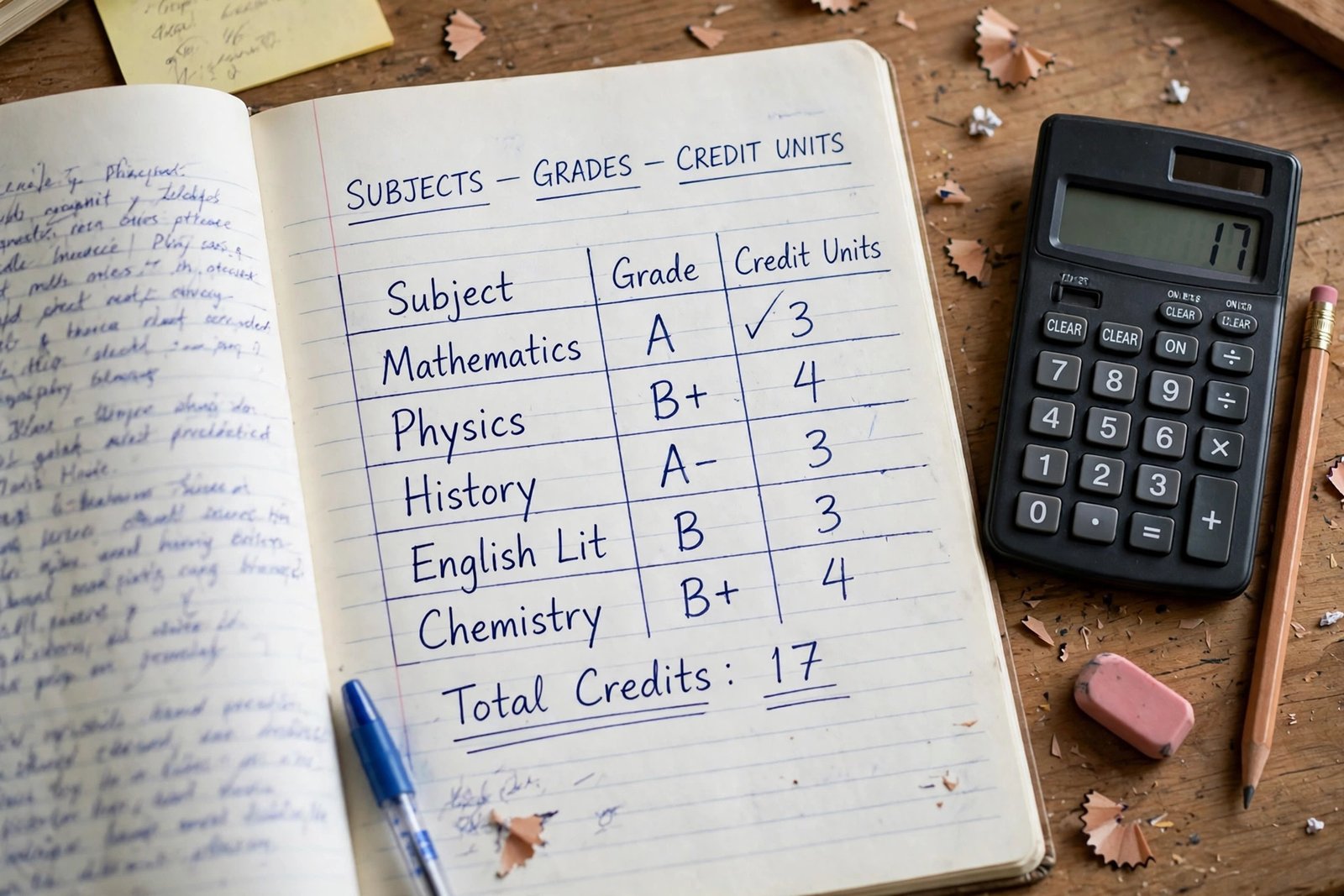
Notice what the weighting does in that table. The 1-unit lab at 1.25 contributes only 1.25 points, while the 3-unit elective at 2.00 contributes 6.00. That is why a simple average is the wrong tool for an irregular load. The simple average of those five grades is (1.50 + 1.75 + 2.00 + 1.25 + 1.50) / 5 = 1.60. The real, unit-weighted GWA is 1.67. A starker version of the same trap: one 3-unit subject at 1.00 plus one 1-unit subject at 3.00 gives a weighted GWA of 1.50, while the simple average says 2.00. Whenever your subjects carry different units — and irregular loads almost always do — divide by total units, never by the number of subjects.
The Four Questions to Ask Your Registrar Before You Compute Anything
Every trap in this guide is really one of four unanswered questions. Ask them in this order, in writing if you can, before enrolment or before you trust any number a calculator gives you:
- Which subjects are included in my GWA? Ask for the inclusion list: PE, NSTP, electives, credited subjects — in or out?
- What is the retake rule? When I retake a failed subject, does the old grade stay, get replaced, or do both count?
- What is the INC deadline? How long do I have to complete an incomplete grade, and what happens if I miss it?
- Which of my old subjects are credited? If I shifted or transferred, which subjects still count and which are dropped from the computation?
If the registrar’s office cannot answer, ask for the student handbook section on grading and scholastic standing. The answers live there even when the front desk does not know them offhand. Everything below is organised around those four questions, because each one is worth real GWA points.
The Retake Trap: 2.24 or 1.68 for the Same Transcript
Now add one failed subject to our example student: a 3-unit major at 5.00. The load becomes 15 units and 35.00 points, and the GWA becomes 35.00 / 15 = 2.33. That is test case I3, measured on the calculator. One failed subject has moved her from 1.67 to 2.33 — past most scholarship and honours cutoffs in a single blow. So she retakes the subject next semester and scores 1.75. What is her GWA now? It depends entirely on the retake rule, and the two possible answers are 0.56 apart.
If her school counts both grades, the calculator rows are the original load, plus the 5.00, plus the retake at 1.75: 40.25 points over 18 units, which is 2.24 (test case I4). If her school replaces the old grade, the rows are the original load plus only the retake: 25.25 points over 15 units, which is 1.68 (test case I5). Same student, same retake grade, two GWAs, and the difference decides scholarships, Dean’s List and academic standing. This is why the strongest sentence in the competitor guides is also the most important one: the repeat policy “is set by the institution, not by this calculator”. Never type a retake into a calculator until you know which of those two numbers your school will actually record. And note the enrolment rule at the University of the Philippines, which is worth knowing even if you study elsewhere: required courses in which a student has failed take precedence over other courses in the next enrolment. Retakes are not electives you can postpone at leisure; the failed required subject comes first.

INC Grades: Excluded, Then Counted, Then Dangerous
An INC (incomplete) is the mark that breaks naive calculator use. Type INC into the calculator on this site and the whole result becomes “invalid grade” (test case I6) — because INC is not a number, and the calculator refuses to guess. That refusal is actually helpful, because the registrar’s treatment of INC is a three-act story, and the calculator can only tell you act one.
Act one: while the INC stands, it is not included in the computation. The University of the Philippines rules on scholastic standing state this plainly: “for purposes of scholastic standing, a grade of Inc is not included in the computation”. So our example student, with an INC pending, should compute her GWA on the finished subjects only — 1.67 on the base load — and keep the INC row out of the calculator entirely. Act two: when the INC is completed, the replacement grade is included, in the semester when the removal is made. If she completes that 3-unit subject at 2.25, her load becomes 26.75 points over 15 units, which is 1.78 (test case I7). Act three is the one students miss: at some schools an INC that is not completed within the succeeding term lapses to 5.00 or F automatically. A Mapua Malayan Colleges support page states the rule exactly that way — complete within the succeeding term, or the INC becomes a failure. An INC is not a pause button. It is a deadline with a 5.00 attached. Diarise the completion date the day the INC is issued, and check whether an INC on your record also disqualifies you from Latin honours or the Dean’s List for that semester even after completion — at many schools it does, which is a separate question from the GWA itself. For the honours rules, see our guides to the Latin honours cutoffs and the Dean’s List.
Dropped Subjects: The Cheapest and the Most Expensive Row on Your Record
Whether a dropped subject costs you anything depends on one word: officially. Our example student officially drops a subject within the prescribed period. Entered the calculator’s way — as a row with 0 units — that row is skipped entirely, and her GWA stays 1.67 (test case I8). An official drop, properly filed, costs nothing in GWA terms. That matches the standard guidance that dropped classes shown in parentheses, or officially withdrawn, are excluded from the computation.
Now the other version. She stops attending a 1-unit lab without filing anything, and the school records an unofficial withdrawal as 5.00. Her load becomes 25.00 points over 13 units, which is 1.92 (test case I9). One unfiled lab has cost her 0.25 of GWA — more than the difference between several scholarship tiers. The lesson is administrative, not mathematical: if you are going to drop, file the form before the deadline, keep the acknowledgment, and check that the subject appears as DRP or withdrawn on your grade report rather than as a 5.00. A five-minute form is worth more GWA points than a week of studying.
PE, NSTP and the Inclusion List: 1.53 or 1.70 for the Same Load
Here is the quietest trap in the whole topic. Take the same base load (1.67) and change only which non-academic subjects count. Add an NSTP subject at 1.00 for 3 units, and the GWA becomes 23.00 / 15 = 1.53 (test case I10a). Remove PE from the load instead — because your school excludes PE from GWA — and the GWA becomes 17.00 / 10 = 1.70 (test case I10b). Same grades, same student, a 0.17 swing decided by a list she never saw. This is why “what is my GWA?” is an incomplete question. The complete question is “what is my GWA on my school’s inclusion list?”
The competitor guides agree on the direction but leave the student hanging: one lists NSTP as “often excluded” without saying what to do about it, another notes that PE is typically excluded at UP but counted at many private colleges, and a third says only to “check your student handbook”. All true, all insufficient. Here is the actionable version: get the list, then build two calculator runs — one with the list applied, one without — and keep the listed one as your official figure. If you are comparing yourself to a cutoff (scholarship, honours, retention), always use the listed figure. If you are comparing yourself to a friend at another school, remember you are probably not comparing the same list. The PUP grading system and the DepEd grading system pages show how different two official lists can look, and neither is a substitute for your own school’s list.
Cumulative GWA Across Irregular Semesters: 1.88, Not 1.92
Irregular students almost always have semesters of different sizes — a 12-unit semester here, a 9-unit semester there — and that makes the most common cumulative-GWA mistake almost unavoidable. Take our example student’s two semesters: the 12-unit semester at 1.67 (20.00 points) and a light 9-unit irregular semester at 2.17 (19.50 points: 3 units at 2.50, 3 at 2.25, 3 at 1.75). The tempting calculation is (1.67 + 2.17) / 2 = 1.92. It is wrong. The correct calculation pools the points and the units: (20.00 + 19.50) / (12 + 9) = 39.50 / 21 = 1.88 (test case I12). The simple average overvalues the small semester, because it gives a 9-unit semester the same weight as a 12-unit one. For the full treatment, including more semesters and a second worked example, see our guide to cumulative GWA across semesters.
The same pooling rule governs the recovery question every irregular student asks after a bad semester: how good must my next semester be? After the failed load, our student sits at 2.33 on 15 units (35.00 points). To get back under a 2.00 cutoff over a combined 30 units, her next 15-unit semester must average (2.00 x 30 – 35.00) / 15 = 1.6667, i.e. 1.67 or better. The calculator confirms both sides of that line: a 15-unit semester at 1.50 pulls the cumulative to 1.92 and passes (test case I15a), while the same semester at 1.75 leaves it at 2.04 and fails (test case I15b). “Good grades” are not enough; the recovery average has a number, and now you know how to compute yours: (target x total units – current points) / next semester’s units. If that number is below 1.00, the target is out of reach in one semester, and you should plan for two — or pick a nearer target — rather than burn out chasing an impossible average.
Shifting Courses: When Old Subjects Follow You
Shifting is the irregular student’s second origin story, and it has its own trap. When you shift programs, some subjects are credited and some are not — and the credited ones usually keep counting. Add one credited old-program subject (4 units at 2.75) to our example load and the GWA becomes 31.00 / 16 = 1.94 (test case I14), up from 1.67. That is a real cost of shifting that no prospectus mentions: a weak subject from a program you have left can keep dragging your new program’s GWA for semesters.
This is also where the GWA-versus-CWA distinction matters. GWA, loosely, covers your grades overall; CWA (curriculum weighted average) covers only the subjects in a specific curriculum, as the per-school grading tables for the Philippines confirm. A shifter’s CWA for the new program may exclude old-program subjects that the general GWA still includes, or vice versa — it depends on the school’s curriculum rules. Before you shift, ask for both numbers from the registrar: your GWA as it will stand after crediting, and your CWA in the new curriculum. Students who shift on the strength of a single “my GWA is fine” conversation, without that credited-subject list, are the ones who discover the 1.94 in their second semester in the new program. Our failed-subject guide covers the failed-subject side of the same story, and our good-GWA guide puts these numbers in context against honours and scholarship bands.

How to Use the Calculator as an Irregular Student, Step by Step
Here is the workflow that produces a number you can trust, in order:
- List every subject on your grade report, with its official units and numeric grade.
- Cross out the rows your school’s inclusion list excludes — official drops, parenthesised grades, PE or NSTP if your list says so, uncredited old-program subjects.
- Leave INC rows out entirely until they are completed, and diarise the completion deadline separately. Never type INC into the calculator.
- Apply the retake rule before typing retakes: if both grades count, type both rows; if only the new grade counts, type only the new row.
- Enter numeric grades, not letters, whenever any subject came from another program, another school, or a different grading table.
- Check the result against a hand calculation for at least one semester: multiply, add, divide. If the calculator and your hand calculation disagree, a row is mistyped — find it before you trust either number.
- For a cumulative figure, pool all semesters’ points and units and divide once. Never average semester GWAs.
Try it now on the free GWA calculator: enter the example load above (3 units at 1.50, 3 at 1.75, 3 at 2.00, 1 at 1.25, 2 at 1.50) and confirm you get 1.67. Then enter your own listed subjects the same way. If you need the result as a percentage for a scholarship form, use the GWA to percentage converter — but remember there is no single national conversion table, so a converter’s percentage is an estimate unless it uses your school’s own table. The video below walks through the same example on the calculator, including the retake rows, so you can see exactly which rows to type and which to leave out.
Three Competitor Errors Worth Knowing About
Because irregular students search for answers under stress, it is worth naming the errors circulating on the most-shared pages, so you recognise them when you meet them. First, the direction error: several popular pages tell students to aim for “1.75 or higher” for scholarships and honours. On the inverted scale that is backwards — the cutoff is 1.75 or better, meaning 1.75 or lower. Second, the arithmetic error: one well-ranked “what is GWA” page works an example to a total of 17.75 points over 9 units and then announces the answer as 1.94. 17.75 divided by 9 is 1.97, not 1.94, and the page even writes 17.5 in the division step instead of its own total. If a page cannot divide its own example, do not trust its cutoffs. Third, the conversion error: one calculator page converts GWA to US GPA by subtracting from 5.00 (so 1.75 becomes 3.25). That is a rough approximation, not an official rule, and no admissions office publishes it. For shifting, transfer or study-abroad paperwork, use your registrar’s conversion table and nothing else.
Irregular-Student Checklist Before Enrolment
- Get the inclusion list (PE, NSTP, electives, credited subjects) in writing.
- Get the retake rule (both count, or replacement only) in writing.
- Get the INC completion deadline and the lapse consequence in writing.
- Get the credited-subject list if you shifted or transferred, and ask for both your GWA and your CWA after crediting.
- File drops officially, before the deadline, and keep the acknowledgment.
- Put failed required subjects first in your next enrolment — at UP that is the rule, and everywhere else it is the fastest way back to regular standing.
- Compute recovery targets with the formula above before choosing your load, not after the semester ends.
Frequently Asked Questions
Am I an irregular student if I only failed one subject? Yes, in the practical sense that matters here: your load no longer matches the standard sequence, because the retake will sit in a semester where it does not belong. The label itself carries no penalty; the retake rule and the inclusion list are what affect your GWA.
Does an INC lower my GWA? Not while it stands — it is excluded from the computation. It lowers your GWA only if it is completed with a low grade, or if it lapses to 5.00 because you missed the completion deadline. The danger of an INC is the deadline, not the mark itself.
Should I include my retaken subject twice in the calculator? Only if your school counts both grades. If your school replaces the old grade, include only the retake. On our example load the difference is 2.24 versus 1.68, so this single decision matters more than any other row in your computation. Ask the registrar first.
Do dropped subjects affect my GWA? Officially dropped subjects, filed within the prescribed period, do not — they are excluded. Unofficially dropped subjects usually do, because the school records them as 5.00. Always file the form.
Are PE and NSTP included in my GWA? It depends on your school. At UP, PE is typically excluded; at many private colleges every unit counts; NSTP is often excluded but not always. There is no national rule, which is why the inclusion list is question one on the checklist above.
How do I compute my cumulative GWA if my semesters have different unit totals? Pool all the points and all the units across semesters and divide once. Never average the semester GWAs. On our example, pooling gives 1.88 while averaging gives 1.92 — and the pooled figure is the correct one.
Can I still graduate on time as an irregular student? Usually yes, if you plan the retakes and credited subjects early. The risk is not the label but the load: failed required subjects take precedence in the next enrolment, summer terms and overloads have their own caps, and some subjects are prerequisites for others. Map the sequence with your program adviser before you assume a graduation date.
Conclusion
Being irregular is not a grade problem; it is a paperwork problem with grade consequences. The formula never changes — grade times units, added up, divided by total units — but the rows you feed it change everything: a retake counted twice costs 0.56, an unofficial drop costs 0.25, an inclusion list swings the result by 0.17, and averaging semesters instead of pooling them invents 0.04 out of thin air. Get the four answers from your registrar, type only the rows that belong, leave INC out until it is completed, and check every result by hand at least once. Do that, and the gwa for irregular students philippines number you carry into enrolment, scholarship applications and shifting decisions will be a number you can defend — because you will know exactly which rows produced it, and why. Run your own listed load through the free GWA calculator now, and if your recovery target looks out of reach in one semester, plan for two: a realistic plan beats an impossible semester every time.