
Understanding the Philippines DepEd Grading System for K to 12 Students: A Complete Guide
The Philippines Department of Education (DepEd) grading system for K to 12 students forms the backbone of the nation’s basic education curriculum. Introduced in 2013 as part of the K-12 program, this system standardizes assessment across kindergarten through grade 12, ensuring students, parents, and teachers speak the same language when evaluating academic progress. If you’re a parent navigating report cards, a teacher refining lesson plans, or a student aiming for top marks, grasping the DepEd K-12 grading scale is essential. This guide dives deep into how grades are calculated, what they mean, and tips for success in the Philippine basic education grading framework.
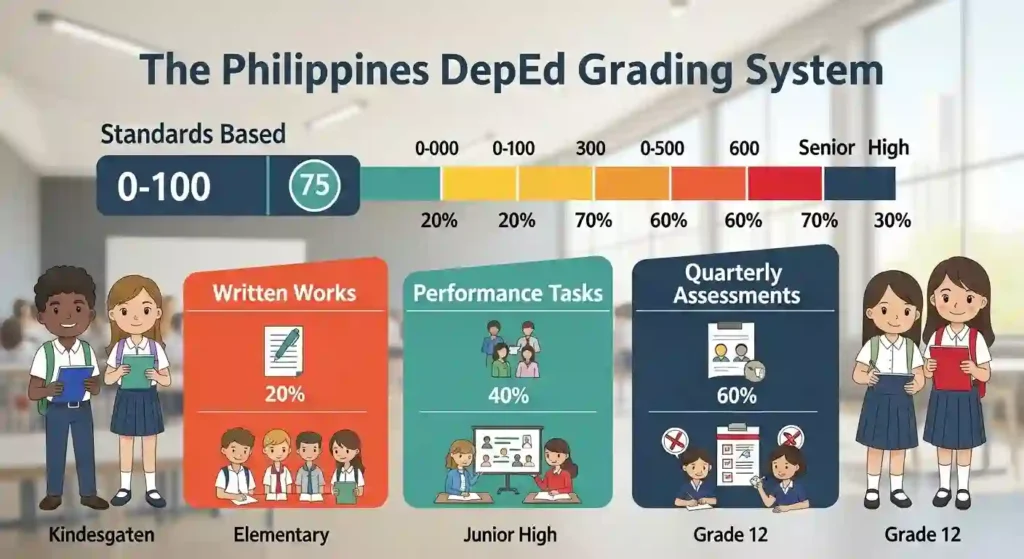
Evolution of the DepEd Grading System in the Philippines
Before the K-12 reform, the Philippine education system relied on a 1.0 to 5.0 grading scale with lower numbers indicating better performance. The shift to K-12 expanded basic education to 13 years, including kindergarten, six years of elementary, four years of junior high, and two years of senior high school. DepEd overhauled the grading policy to emphasize holistic student development, blending numerical grades with descriptive indicators.
Today, the DepEd grading system for elementary and secondary levels uses a 0-100 percentage scale for most subjects, promoting transparency and alignment with international standards. For younger learners in kindergarten to grade 3, it incorporates qualitative descriptors alongside numbers to foster growth without overwhelming pressure. This evolution reflects DepEd’s commitment to outcomes-based education, where grades measure not just rote learning but competencies in core subjects like math, science, English, and Filipino.
Breaking Down the DepEd Grading System Scale for K-12
At the heart of the system lies the DepEd grading scale, designed to be straightforward yet comprehensive. Here’s how it works across different levels:
This structure in the Philippines K-12 assessment system encourages consistent evaluation, helping students track improvement semester by semester.
How DepEd Calculates Final Grades for Students
Wondering how those report card numbers come together? DepEd’s grading computation is formula-driven for precision. For each quarter in the K-12 curriculum, teachers average scores from three components:
The quarterly grade is:
Quarterly Grade=(WW×0.4)+(PT×0.5)+(QA×0.1)
Final grades average the four quarters, with transmutation applied if needed to fit the 0-100 scale. In senior high, core subjects like General Mathematics or Earth Science follow this, while electives might adjust weights for practical skills. Special cases, like students with learning difficulties, allow for modified grading under Republic Act 10618.
Parents often search for “DepEd grade computation for K-12” to verify these calculations it’s a game-changer for understanding promotion criteria.
Key Differences: Elementary vs. Secondary DepEd Grading
The DepEd grading system adapts to age groups for age appropriate evaluation.
Elementary (Grades 1-6):
Emphasis on foundational skills with lighter homework loads. Grades 1-3 prioritize descriptors over strict numbers, transitioning fully by grade 4. Homeroom guidance integrates behavioral marks into the overall profile.
Junior High (Grades 7-10):
More rigorous, with subjects like Araling Panlipunan and MAPEH (Music, Arts, PE, Health) using the full scale. Students need at least 75 in most subjects to advance, or face intervention programs.
Senior High (Grades 11-12):
Tailored to tracks like Accountancy, Business, Arts (ABA), or Technical-Vocational-Livelihood (TVL). Grades influence college admissions via the UPCAT or entrance exams, with a focus on strand-specific competencies.
These distinctions in the Philippine DepEd K-12 grading policy ensure progressive challenges, from basic literacy in kinder to advanced research in grade 12.
Common Challenges and Pro Tips for Better Grades
Navigating the DepEd K-12 grading system isn’t always smooth. Challenges include subjective performance tasks, uneven teacher grading, or post-pandemic learning gaps. High school students often struggle with the 75 passing threshold in STEM subjects.
Boost success with these strategies:
Real story: A grade 10 student in Manila improved from 78 to 92 in Science by focusing on performance tasks, proving consistency trumps cramming.
Long-tail searches like “how to improve DepEd grades in junior high school” highlight these pain points address them head-on for academic wins.
Implications for College Admissions and Beyond
DepEd K-12 final grades directly impact futures. Universities convert them to percentages for admission (e.g., 96 = 1.0 honors). Scholarships from CHED or DOST prioritize top performers (95+ averages). Understanding the grading scale equips students for the Philippine Science High School entrance or international benchmarks like PISA.
Wrapping Up: Empower Your K-12 Journey
The Philippines DepEd grading system for K to 12 students is a robust tool for measuring growth, from kindergarten play-based learning to senior high specialization. By mastering its scales, computations, and nuances, students can thrive in this standardized yet flexible framework.
Ready to ace the next quarter? Share this guide with fellow parents and educators, and drop a comment below: What’s your biggest grading challenge? Subscribe for more DepEd tips, K-12 updates, and study hacks!
Call to Action: Download our free DepEd grade calculator template today enter scores and get instant quarterly averages. Click here to get yours and stay ahead in the K-12 race!